Horseradish is a spicy vegetable used in cooking and folk medicine. Growing it is simple; it's important not to let the plant run wild. Horseradish can fill an entire garden plot, suppressing many other garden crops, and is undemanding of soil and light conditions. Remote, empty corners of the garden are chosen for planting.
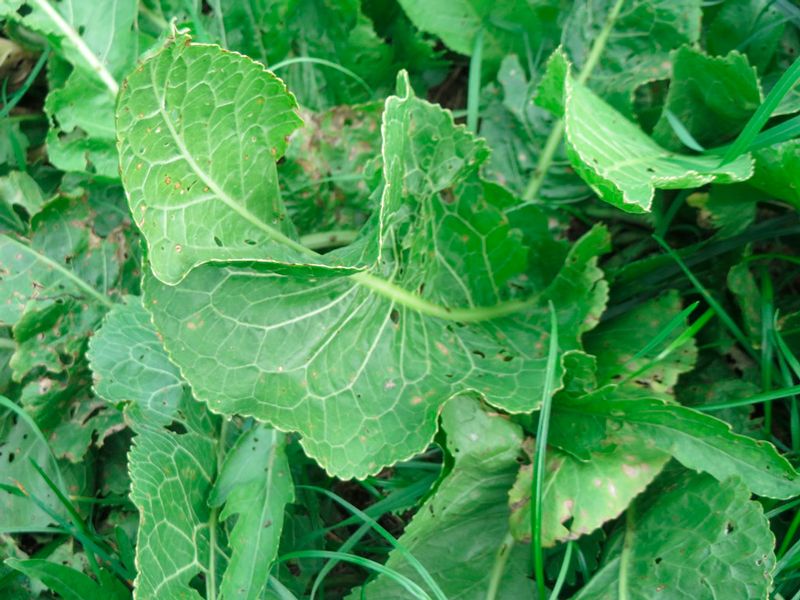
To harvest the leaves and roots of this herb, a bountiful harvest rich in nutrients requires following several growing guidelines. In a garden, the bush looks very decorative: its dense, dark foliage and wavy, upright, wide leaves perfectly camouflage an unsightly fence or compost heap.
Content
General information about horseradish
Horseradish is a perennial herb in the cruciferous family with a long, dense rhizome, up to 2 meters long, and a lush rosette of leaves. The leaves grow up to 0.7 meters tall, and the flower stalks reach up to 1.5 meters. It blooms in its second year, in May–June, producing pods up to 5 mm long containing 3–4 small, round seeds.
The plant reproduces:
- by seed method;
- apical buds;
- using cuttings.
The roots contain allyl isothiocyanate, which imparts bitterness and has antiseptic properties. The plant is valued for its high content of:
- vitamins C, PP and group B, carotene;
- microelements P, Ca, K, Fe, Cu, Mg, S;
- organic resins;
- essential oils;
- alkaloids.
The crop overwinters well in temperate climates, adapts well to hot climates, and is drought-resistant. Traditional early-breeding varieties:
- Suzdal late ripening, distinguished by its pungency and spiciness;
- Valkovsky is an early-ripening variety that forms a thick root, up to 3 cm in diameter per season;
- Latvian or common, late-ripening, blooms in mid- or late June, common in western and central Russia;
- Rostov mid-season, recognizable by its wide leaves with a high content of essential oils;
- Atlas is a mid-season variety with dry, cream-colored rhizome flesh, characterized by slight spreading during growth and good shelf life;
- Tolpukhovsky, the seed ripens in 200–250 days, recommended for mechanical cultivation, the root system is compact, the flesh of the rhizomes is white, medium-spicy.
Horseradish can remain in one place for many years, but as a garden crop, it is recommended to dig it up annually or two years after planting, before the rhizomes become too deep. Horseradish is very difficult to control as a weed.
Peculiarities of horseradish cultivation
The density, firmness, and flavor of the roots depend on growing conditions and harvesting time. As a foliar crop, rosettes are planted in pots; in winter, horseradish is grown indoors on a windowsill. A decoction of the leaves helps with sore throats and acute respiratory infections, and is used as a gargle. It is an excellent antiseptic for treating household cuts and burns.
Horseradish grows in any soil and doesn't require intense light. It thrives in confined spaces. It's often grown as an annual crop to prevent overgrowth.
Planting dates
This undemanding crop survives in any conditions and is frost-resistant. Horseradish can be planted throughout the spring and summer, or in the fall, depending on when the leaf or root harvest is needed. There are no planting restrictions in terms of cultivation:
- In spring, cuttings are planted or seeds are embedded in the soil when the soil warms up to a depth of 10 cm; the plant begins to grow at a temperature of +5 °C;
- for mechanical cultivation, the best time for planting in the Central zone of Russia is considered to be the second half of April; if there are severe return frosts, the roots may not take root;
- Horseradish is planted and transplanted in the summer, when there is no severe drought, the air humidity is not lower than 70%, on sunny days for the first 5-7 days the plantings require shading and intensive watering;
- In autumn, the last planting period is 2 weeks before the onset of regular morning frosts (mid-October or early November). If autumn is dry, it is necessary to thoroughly moisten the soil; cuttings are deepened into the soil 3–4 cm deeper than in spring.
Planting methods
Horseradish is grown in both open and protected soil. For summer rooting, cuttings are planted in hotbeds when the first thawed patches appear (early to mid-March). The plantings are deepened by 3–4 cm, mulched, and covered with snow to a depth of 15–20 cm. The hotbed is tightly closed and left for a month. The snow will melt, gradually moistening the soil.
When warm weather arrives, the roots are planted in isolation:
- Plant on a raised bed (at least 30 cm). This planting method is suitable for areas with high groundwater levels; the bed will act as drainage. The roots quickly gain mass and are easily dug up in the spring.
- The thin film of the rhizome is broken through into a "sleeve" made of thick or reinforced polyethylene. The crop is not grown in this "screen" for more than three years; the rhizomes grow to a depth of 2.5–3 meters, and the plant becomes wild, turning into a difficult-to-eradicate weed.
- In a large container, dig it in at a depth of 5 cm from the edge. There should be holes in the bottom to prevent water from stagnating.
In the fall, the containers are removed; harvesting the rhizomes is easy. New cuttings or surface buds are planted in the soil. With limited cultivation and fertile soil, a large harvest of horseradish with valuable pulp can be achieved. Cultivation techniques for growing horseradish in a closed space are no different from regular care.
Growing from seeds
New horseradish varieties with distinctive flavors and ripening times are constantly being developed. Roots are grown from purchased seeds in early spring, when the soil warms to 5°C, or in late fall, before winter, 12–14 days before the onset of permanent frost. The seeds are planted 2.5–3 cm deep. Rows are spaced 90 cm apart, and seeds are spaced 7–10 cm apart within the row. The seeds are frost-resistant. Seedlings emerge on the first warm days, 4–7 days after planting.
Planting by cuttings
Horseradish is preferred for propagation by cuttings. Seeds keep well in a cellar or refrigerator, but the main thing is to keep the substrate where the cuttings are buried moist. It shouldn't dry out too much. Sometimes root buds awaken during storage, in which case they should be brought into the light and allowed to germinate thoroughly. After germination, "blind" the plants by removing excess buds with a thick cloth; these buds appear in all the internodes of the root. Leave sprouts at the bottom and top for the leaf rosette and small rootlets.
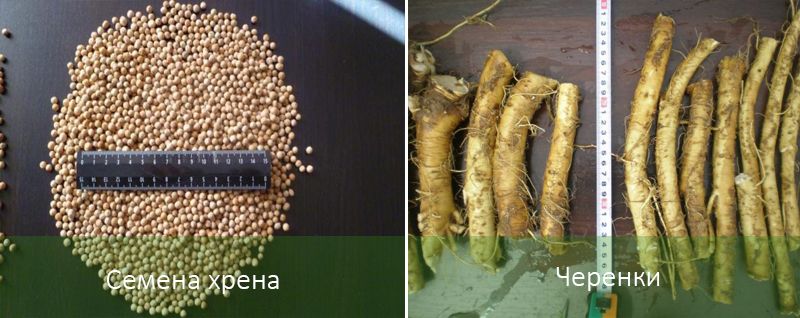
Horseradish transplants easily. Cuttings are spaced 40 cm apart, and a large rosette of leaves develops in the first year. The following year, the plant grows rapidly, and in the fall, the rhizomes are ready for digging and reach maturity.
The following are used as cuttings:
- thin lateral roots;
- uneven areas of the root that are difficult to process.
The recommended cutting length is 20 cm, but any rhizome fragments will take root. They are usually planted immediately after harvesting. Keeping cuttings indoors is necessary if you buy them during the cold season. When you have a spare pot at home, it's best to bury the horseradish; the young greens are used in soups and salads. In the spring, simply "blind" the buried cuttings and then replant.
Caring for horseradish
The crop's flavor and productivity depend on the soil's chemical composition. In urban areas, the plant is grown in abandoned areas, away from shrubs and fruit trees. It doesn't require any special care, but the soil should be enriched with organic matter and minerals before planting. When grown in poor, acidic soils, the root production is reduced by half, as the roots contain a lot of bitterness and coarse fibers. For delicate sauces and tomato relish (horseradish), soft, starchy rhizomes are preferred.
Wood ash and lime are added to acidic soils at a rate of 0.3–0.5 kg/m². Mineral fertilizers provide trace elements. Potassium nitrate, ammonium nitrate, and superphosphate are mixed 1:1, with up to 30 g of the mixture applied per m². Clay soils require up to a bucket of peat and sand. Poor soils are amended with well-rotted or fresh manure at a rate of up to 2 buckets per m². Organic matter is essential for the formation of aromatic compounds in horseradish leaves and rhizomes.
The plant thrives in marshy areas and finely rocky soil. It's not grown in roadside front gardens, as its leaves and roots can accumulate heavy metals and harmful organic compounds.
Watering and fertilizing
Although horseradish is a drought-resistant crop, the flavor of its roots deteriorates in dry years, with a reduced pungency and piquancy. During periods of severe drought, the plant is watered to encourage growth in the central part of the rhizome. Insufficient watering will reduce yields, causing numerous thin lateral roots to form, and coarse fibers to develop. Excessive watering causes the central rhizome to rot, giving it an unpleasant aftertaste reminiscent of musty hay.
Horseradish doesn't need regular watering; a good watering once a week is sufficient. The roots will absorb moisture from deep within. Osmosis is used: covering the soil with plastic wrap allows moisture from the lower soil layers to rise. This method is effective when the groundwater table is close.
Fertilizers improve the chemical composition of horseradish. Complex mixtures are worked into the soil annually in the spring at a rate of half the recommended amount on the package. They gradually dissolve during rainfall and after the morning dew. If desired, you can water the plant with fertilizers formulated for open- or closed-ground vegetables.
Weeding and loosening the soil
Horseradish doesn't require much weeding; its large leaves shade weeds and prevent them from developing. Weeding is necessary for young plants in heavy soils, where a crust forms, preventing air from reaching the roots. This accelerates the growth of the leaf rosette and improves yield. Loosening is done to the maximum possible depth. To promote mass and root growth, young shoots are hilled, but this is not necessary.
Harvesting and storage
For preserving, the leaves can be picked at any time; sunny days are chosen for drying. The leaves keep well in the vegetable drawer of the refrigerator. The roots are used in pickling and canning. The roots have a long shelf life if the skin is not peeled. They are placed in damp sand and removed as needed.
Top.tomathouse.com informs: what to do if horseradish has taken over your plot
A healthy vegetable often turns into a noxious weed. During harvesting, the root is crushed, and then all the pieces sprout.
Basic measures to prevent uncontrolled growth of horseradish:
- it cannot be placed near perennial crops, shrubs, trees, as it makes it difficult to remove the roots;
- soil with the remains of small roots and seeds cannot be used for sprinkling other crops; it is enriched and again used for growing horseradish or put into compost;
- Young, unwanted shoots are “salted”: they are cut off, covered with fine salt, and isolated from access to water so that the sodium chloride is absorbed into the rhizome;
- annual shoots die after treatment with Roundup, but the root will grow again, and repeated applications of the decomposing chemical will be required to thin it out;
- The flower stalks are broken off, preventing the formation of seeds.
There are no problems with isolated plantings of the crop in large containers, growing horseradish as a biennial crop.