Peas are a herbaceous vine. They not only beautify the garden when in bloom, but also provide a tasty, nutritious crop. It's recommended to grow sweet peas, a favorite among children and perfect for preparing a variety of culinary delights.
Content
- 1 Pea planting dates by region according to the lunar calendar in 2023
- 2 Preparation of planting material
- 3 The best place for peas in the garden
- 4 Preparing the soil for planting peas
- 5 Rules for planting peas in open ground
- 6 Caring for peas in open ground
- 7 Pest and disease control of peas
- 8 Harvesting and storing peas
Pea planting dates by region according to the lunar calendar in 2023
Favorable and unfavorable days for planting peas can be calculated according to the lunar calendar.
| Region | Favorable days | Unfavorable days |
| Southern region | March: 15 (from 15:05)-17 (until 17:24), 23 (from 21:41)-30. April: 7 (from 09:29)-9 (until 15:57), 11 (from 20:33 pm) - 13 (until 23:42 pm), 22 (from 13:11) - 24 (until 21:58). | March: 7, 21, 22. April: 5, 6, 7, 19, 20. |
| Central Russia, Moscow region | April: 22 (from 13:11)-24 (until 21:58). May: 1-4 (until 20:34), 7-8, 17 (from 15:26)-18 (until 18:52), 21-24 (until 17:34), 27-31. | April: 19, 20. May: 5, 6, 19, 20. |
| Siberia, Urals | May: 1-4 (until 8:34 pm), 7-8, 17 (from 3:26 pm)-18 (until 6:52 pm), 21-24 (until 5:34 pm), 27-31. June: 5 (until 10:31 am), 9 (from 1:14 pm)-11 (until 4:19 pm), 13 (from 9:30 pm)-15, 19 (from 7:37 am)-20, 23 (from 1:34 pm)-25, . | May: 5, 6, 19, 20. June: 3, 4, 17, 18. |
Preparation of planting material
Before planting peas, it is recommended to soak them in water for at least a day, until they begin to sprout.
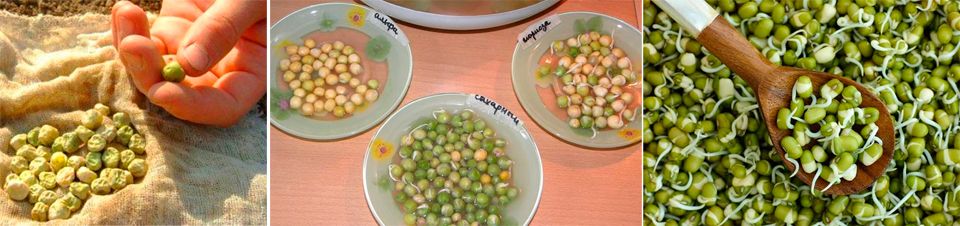
If you plan to use seed from a previous sowing, i.e., your own, you should first determine which seeds are diseased. This can be determined by immersing them in a salt solution (30 g per 1 liter of water). Keep the seeds there for no more than 10 minutes. As time passes, some peas will sink, leaving a few remaining on the surface. Those that don't sink are likely diseased and should be discarded. Rinse the remaining seeds thoroughly, then place them in water until they germinate.
The process is as follows. The water should be approximately 1 cm above the peas. They should be left in this state for at least 12 hours, after which they should swell. After this time, they should be removed and rinsed in clean water. Next, wrap them in cheesecloth and place them in plastic bags. This will create a greenhouse environment for them, allowing them to germinate. They should remain in this state at room temperature for about 2 days. To improve quality, remove them from the cheesecloth once or twice a day and rinse them under clean water. This is done to prevent slime and rot from forming on the peas.
If you need to postpone planting, perhaps due to bad weather or other factors, the seeds can be stored. It's best to do this in the refrigerator, but for no more than a few weeks. This will not stop the germination process.
To disinfect planting material before sowing, it is recommended to place them in a pink solution of manganese for no more than a quarter of an hour.
The best place for peas in the garden
When choosing a location for a pea bed, it's important to consider such factors as the area's lighting, neighboring plants, and vegetables. Soil type also plays a significant role; light soil is recommended.
The most important factor is the climate in the region where peas will be grown. Peas prefer humid climates with high rainfall.
The best neighbors for peas
Neighboring plants play a major role in peas' development. Carrots, pumpkins, cucumbers, and tomatoes are the most suitable neighbors.
It is also not forbidden to grow potatoes and beets nearby.
Preparing the soil for planting peas
Soil preparation is an important task. It should be started in the fall. Dig the proposed site to a depth of about a spadeful, mixing the soil with fertilizer, such as humus (6 kg), superphosphate (40 g), and potassium salt (20 g) per 1 m.².Before sowing, cover the area with wood ash. Regularly fertilizing the soil will also help improve the growth of all plants and vegetables in the area.
It is necessary to water the bed generously before planting peas.
Rules for planting peas in open ground
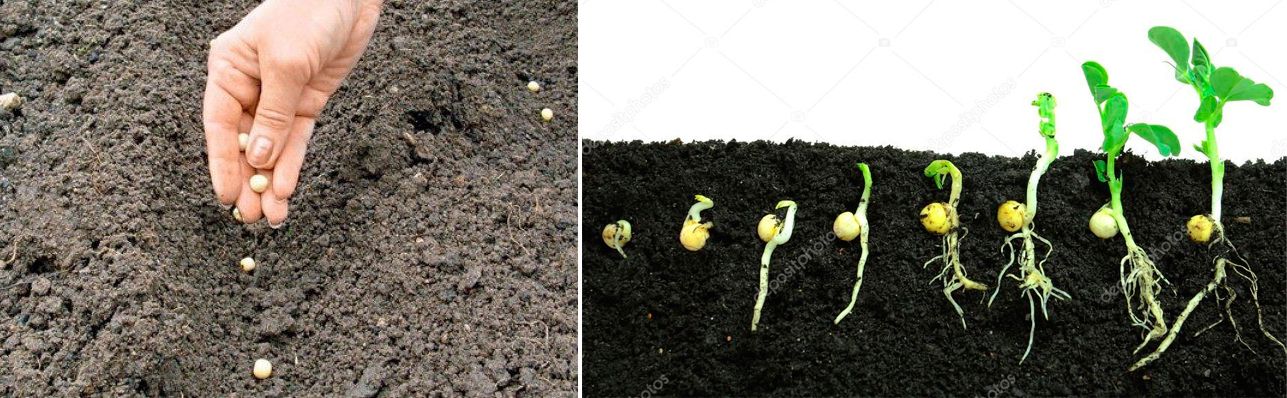
To ensure comfortable pea growth, maintain proper spacing between plants. Plant seeds 30-60 cm apart. The planting depth depends on the soil type. In light soil, it should not exceed 3 cm. In heavy clay soil, the depth should be 4-5 cm.
Before planting, you need to prepare the seeds. To do this, you need to soak them and germinate them. However, you can also plant dry seeds.
In the bed prepared in the fall, make furrows. Add a little humus; compost will also work. It's recommended to plant the peas in a staggered pattern at a set distance between each pea. Planting in a line is also possible, but be sure to maintain a distance between each pea. Then cover with soil and compact it lightly.
Next, you need to create greenhouse conditions for the bed; to do this, you need to cover it with something, for example, agril.
Caring for peas in open ground
Like all plants and vegetables, it requires care while growing. However, the list of necessary procedures is not extensive, and even a novice grower can easily handle them.
Peas tolerate cold well; it's not a problem for them. The same can't be said for heat, which has a negative effect on the sprouts, killing them.
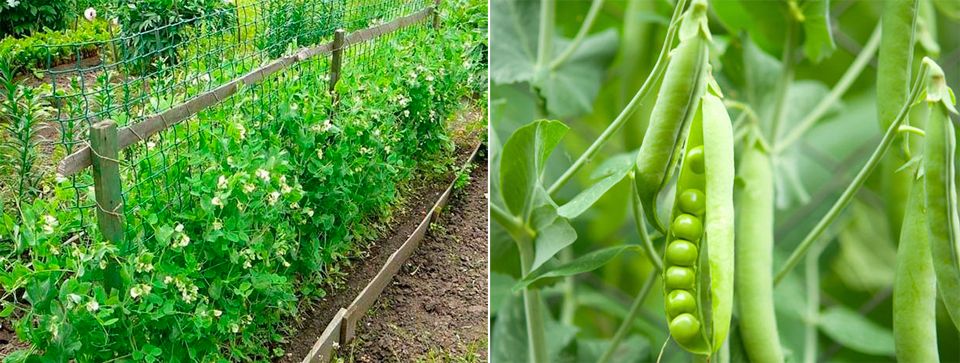
In hot weather, regular watering, soil loosening, and weeding are essential. Supporting the plant is also necessary. Let's look at each of these steps in more detail.
Watering and weeding
Peas love moisture, so it is necessary to provide regular and abundant watering to avoid problems.
If there is not enough water in the soil, peas will not germinate well.
Watering is divided into 2 parts: before and after flowering.
- Before flowering, watering is done no more than once a week; in hot weather, it is increased to 2 times a week.
- Once flowers appear, watering is doubled, meaning at least twice a week, and in dry weather, four times a week. The required amount of moisture is determined by a bucket of water per square meter.
The watering process also has its own peculiarities. It is highly recommended to avoid splashing water on the leaves; water should be poured directly between the beds.
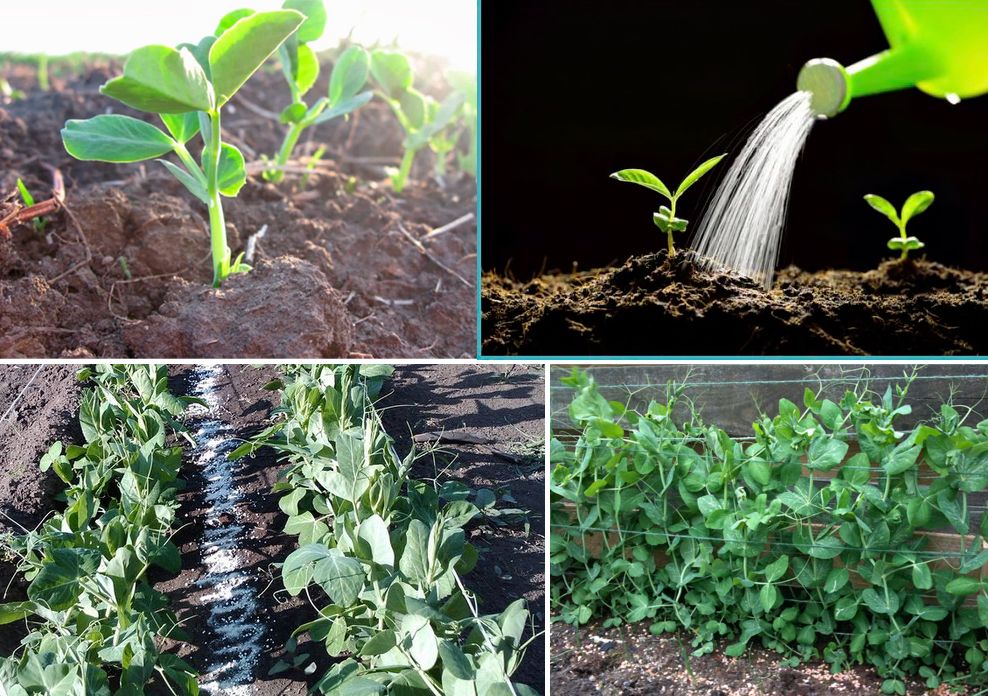
Immediately after watering, the beds are loosened and weeded to allow moisture to penetrate as deeply as possible. After the seeds begin to sprout, about 10 days later, the soil is loosened more thoroughly to oxygenate it.
Top dressing
To ensure peas grow to their full potential, they need to be provided with the most favorable growing conditions or fertilized. Given the prevailing climate in Russia, the latter option is more suitable for gardeners.
- In the fall, when you begin preparing the soil for planting, you need to apply the first fertilizer. Apply 0.5 buckets of rotted organic matter per 1 m².
- The next time will be during planting. This will be superphosphate, potassium salt, and nitrate. The required soil ratio was described above.
- The next fertilizer application to the soil occurs when the seedlings emerge. This is done with an infusion of nettle (green) and dandelion.
- The last time to apply fertilizer to the soil is during the flowering period. This should be done regularly along with watering. To do this, add a tablespoon of nitrophoska per bucket of water. The recommended watering rate during this period is 5 liters per square meter.
The use of fertilizers containing nitrogen is recommended only if
the soil in which the peas are planted is not very fertile, or the spring is quite cold.
Pest and disease control of peas
Peas are susceptible to various diseases and pests. Their biggest enemy is the pea moth, a moth whose active period occurs during flowering. They cause damage by laying eggs on the plant, which then hatch into caterpillars. These caterpillars cause the most damage, burrowing deeper into the pods and feeding on the seeds.
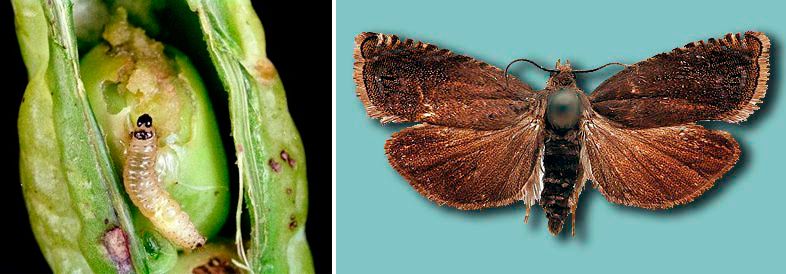
One such butterfly can lay up to 250 eggs, which is a catastrophic number for a single plant. Early sowing is recommended as a preventative measure. This allows flowering to occur before pests become active, thus saving the plant from death. Frequent soil loosening is also recommended to kill the insect pupae. Pollination with wood ash and tobacco is also possible.
The next major problem is the Bruchus beetle. Like the butterfly, it feeds on peas, gnawing through the pulp. Particular care should be taken to ensure that damaged seeds are not consumed by anyone, as the pest's excrement contains a large number of hazardous substances that can have an extremely negative impact on humans and animals.
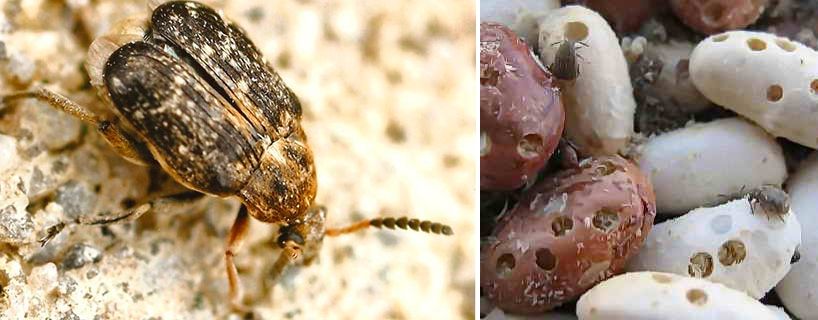
It's worth noting that the larvae can survive the winter in the grain. To prevent this, store the peas at sub-zero temperatures and then pass them through a 3% salt solution. Damaged seeds will be immediately visible; they will float to the surface.
Another pest is the root nodule weevil. It causes significant damage to crops, despite being only half a centimeter in size. It feeds primarily on the plant's tops, laying eggs. These eggs, in turn, feed on the plant's root system, its above-ground parts.
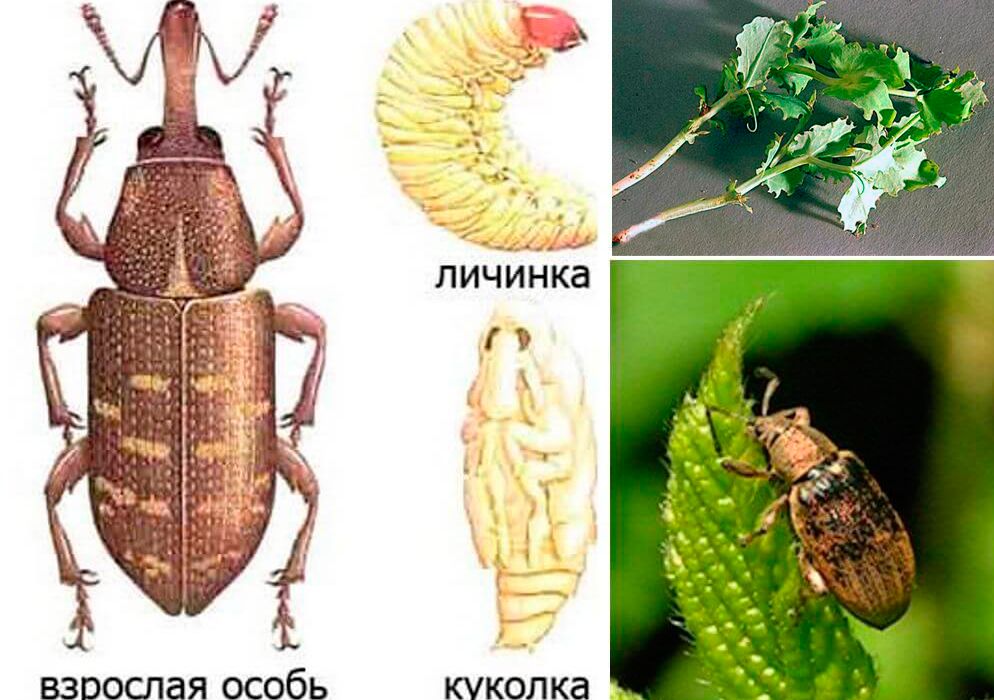
As a preventative measure, deep plowing in the fall is recommended to destroy pest larvae. Early sowing also allows the plant trunks to be strong enough by the time the beetles appear, making them inhospitable to the pest. Pollination with tobacco and wood ash is also a very effective solution.
Harvesting and storing peas
Harvest as they ripen, not all at once. It's worth noting that peas don't have long-term storage properties. It's recommended to immediately store them in one of several ways: dried, canned, or processed.