Marsh marigold (from the Old Russian "kaluzha," meaning "swamp") is a herbaceous plant that grows in damp areas. It is found in temperate climates, as well as in more northern regions, such as the Arctic and Scandinavia.
Description and characteristics of marsh marigold
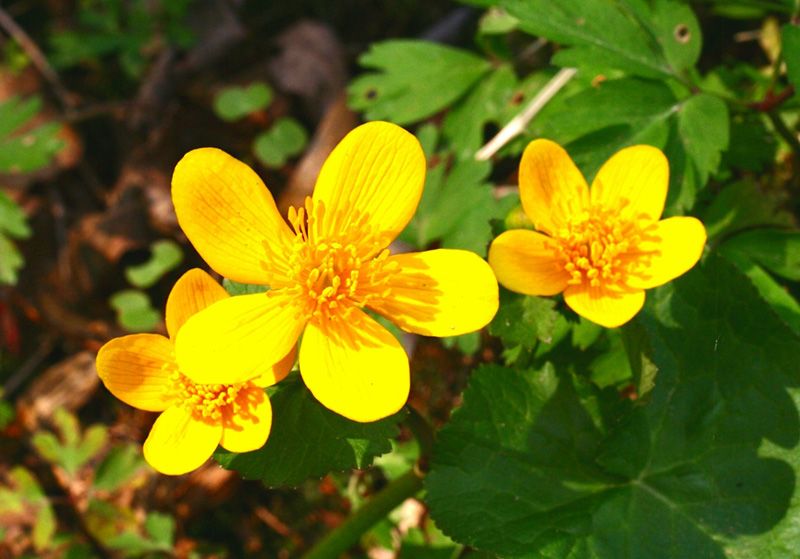
This herbaceous perennial belongs to the buttercup family. It is distinguished by its rich green leaves and grows from 40 cm to 3 m in height. It grows primarily in marshes, but can also be found in dry soils where rainfall is frequent. Due to its winter hardiness (it can withstand temperatures down to -35°C), it is often planted outdoors in Russia.
The root system is poorly developed. The leaf blades are uneven, changing depending on their location. Near the ground, they are larger, 15-20 cm in size, while in the center, they are smaller and have short petioles. The stems are fleshy, especially near the base. The upper leaves are sessile. They respond to prolonged exposure to sunlight by curling into tubes.
The plant blooms once a year after eight years of development. The inflorescences are open and can be singly arranged or several on a single stalk. They open in late April and last until late May. The fruit forms in the first months of summer. The color of the buds depends on the specific marsh marigold species and can be white, bright yellow, or amber.
Types and varieties of marsh marigold
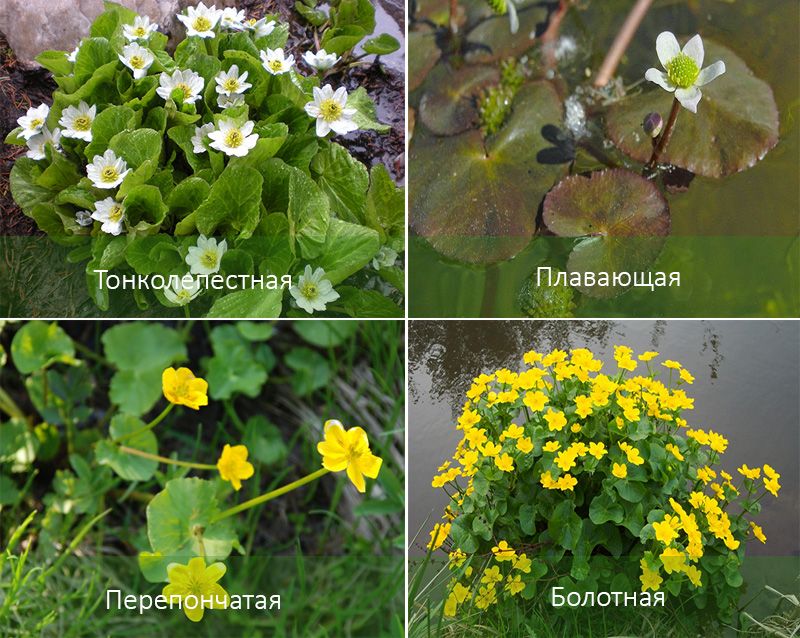
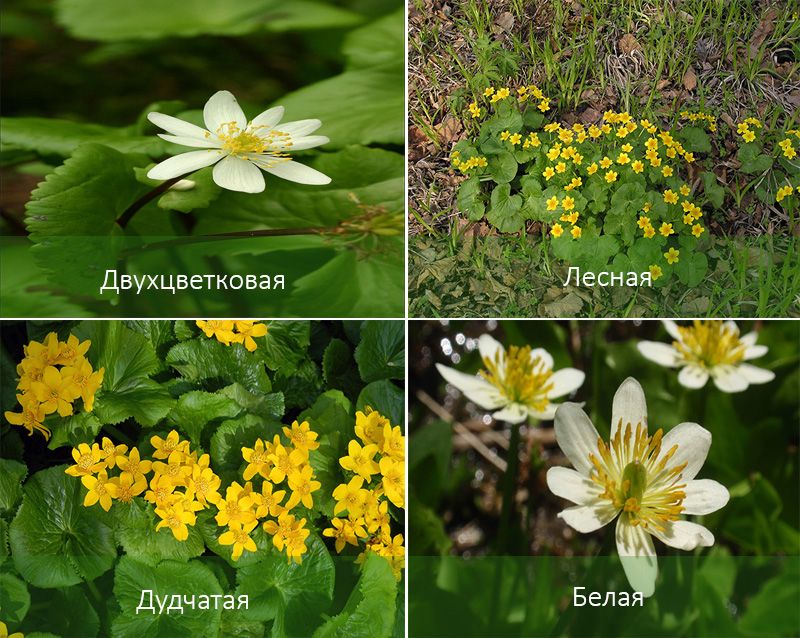
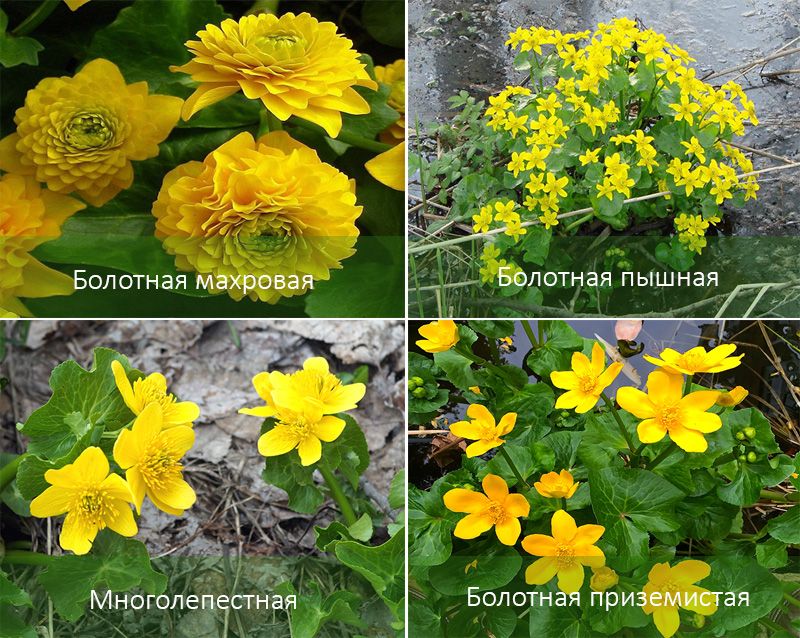
| View | Description | Leaves | Flowers |
| Fine-petalled | Stems up to 35 cm, straight. Petioles reach lengths from 5 to 25 cm. | Richly colored, about 10 cm long, with a serrated edge. | Two flowers per stem, with white petals and a bright yellow center. Size up to 2 cm. |
| Floating | An aquatic species preferred for use in ornamental ponds. | Round, reaching 4 cm in size. Stay on the surface of the water. | Quite large, up to 4 cm in diameter. White in color. |
| Membranous | The main difference is its abundant flowering. It also stands out for its branched stem. | They reach 15 cm. They are kidney-shaped, on petioles up to 30 cm. The color is dark green. | Small, yellow, up to 20 pieces on one bush. |
| Swamp | Height up to 60 cm, root system developed. The stem thickens as it grows. | Heart-shaped, with jagged edges, fleshy, and borne on long petioles, they darken noticeably after flowering. | Corn-colored, up to 5 cm in size. |
| Two-flowered | One of the smallest varieties, maximum size 10 cm. | 7 cm, smooth, heart-shaped. | Due to the long peduncle, they are positioned well above the bush itself. White, up to 2 cm. |
| Forest | Can reach 1.5 m. Grows primarily in sun or partial shade. | Kidney-shaped/round, 14-15 cm. | On one shoot there are 5-15 light-colored buds, 3 cm in size. |
| fist-shaped | Before inflorescences form, the height is 30 cm, after – up to 120. Prefers shaded areas. Stems are hollow. | Leathery, they grow sharply after flowering, up to 15 cm. | 5-7 cm, located in groups of 5-6 pieces. |
| White | A perennial with a root system of about 10 cm. Grows no more than 20 cm. | Glossy, with a serrated edge and rounded outlines. | Single, white, with 5-6 separate oblong petals. |
| Marsh terry | It grows only in moist soil in partial shade or almost no sun. The bush forms a spherical crown. | Heart-shaped, dark green. | With many petals, double, lemon-colored. |
| Swampy lush | The stem has almost no branches, reaches 1.5 m, and is mostly bare. | At the base, the flowers are large, heart-shaped, and closely adhere to the stem. Above, they are small, up to 8 cm, with a serrated edge. After the flowers die, they increase in size to 30 cm. | They last the longest, from May to early October. The color is yellow. |
| Multi-petaled | The bush is spherical in shape, 20-30 cm in diameter. | Dark, with jagged edges, medium size. | Golden, 8 cm. |
| Marsh squat | A plant with a creeping stem. | Rarely found on the stem, they are of a rich shade and have heart-shaped outlines. | Single, corn-colored, from 5 cm. |
Growing marsh marigold in open ground
The plant is winter-hardy and can withstand severe frosts. Therefore, it can be grown outdoors without digging during cold periods. Covering the plant for the winter is also not necessary.
Marsh marigolds can be placed in lily pads filled with soil and left in the pond during the warmer months. In this case, they should be replanted in the ground before the first frost to prevent ice formation from damaging the root system.
Landing
It's best to plant seedlings outdoors between March and April. If the soil hasn't warmed up by this time and is difficult to dig, you can postpone the process until mid-May. Since marsh marigold tolerates cold well, there's no need to monitor the air and soil temperature during planting. However, keep in mind that weak and very young plants can still die in unfavorable conditions. Therefore, if the plant is less than six months old, it's best to leave it outdoors only after sudden nighttime cold snaps have completely subsided.
No additional fertilization is required when planting. Simply lightly bury the rhizome and ensure the appropriate distance (10-30 cm, depending on the size of the mature plant's root system) between the seedlings. At first, it's recommended to water the plant more frequently to encourage new roots to develop.
Caring for marsh marigold in the garden
Since the flower is unpretentious, regular watering may be all that's needed for care. However, to ensure more vibrant blooms, it's recommended to periodically take the following measures:
- Add fertilizer to the soil. Once a month is sufficient. A complex mineral fertilizer is suitable.
- Divide the root system and replant the bush. Over four years, the plant grows rapidly and loses its attractive appearance. To preserve the attractive foliage, it's necessary to divide the bush into several sections and either distribute them evenly across the area or plant them in the ground at least 30 cm apart.
- Loosen the soil, remove weeds.
Reproduction of marsh marigold
Propagation can be done vegetatively or by seed. The second method is more difficult and is rarely used.
Marsh marigold seeds quickly lose viability, so it's recommended to collect and plant them in June, immediately after emergence. The first shoots will appear in late August or early September.
It's easier to propagate by dividing the rhizome. There's no need to cut it; simply remove any clumps of soil and gently spread the roots. After planting, the seedlings should be watered generously and shaded for a few days.
Diseases and pests of marsh marigold
This plant is particularly hardy. It is resistant to diseases, root rot, and pests. Insects are repelled by its toxic sap. The only problem that may arise when growing it is drying out due to insufficient watering.
Marsh marigold in landscape design
Landscape designers regularly use this flower when decorating public and private spaces. The marsh marigold's value lies in its early bloom and the rich color of its foliage. Because of these traits, it is often planted in prominent locations, creating vibrant blooms in the spring and aesthetically pleasing, dark-green, glossy thickets in the summer.
The best location for the plant is the banks of various bodies of water:
- artificial or natural pond;
- fountain;
- small river;
- multi-level (cascade) installation.
The plant should be planted with its flowering characteristics in mind. Since the budding period is April-May, there should be no other crops nearby that could distract from its bright petals or dense foliage.
It's best to position the marsh marigold so that later-blooming plants bloom around it starting in June. This will prevent the flowerbed from remaining empty for a period of time.
The flower can be planted not only near water but also along paths and around stone installations. This makes an excellent setting for taller plants. The key is to ensure regular watering to ensure the leaves retain their brightness and shine. Soil quality and lighting conditions are also important.
Some marsh marigolds can grow without additional shelter, while other varieties must be planted next to buildings, trees or garden furniture so that they are in the shade for part of the day.
Top.tomathouse.com recommends: the beneficial properties of marsh marigold and its contraindications
This plant is sought after in medicine due to its beneficial micronutrient content. It is believed to promote wound healing, kill microbes, and inhibit tumor growth. The following benefits of marsh marigold are also used in pharmaceuticals:
- pain relief;
- relief of inflammation;
- reducing fever, treating fever symptoms;
- vasoconstriction;
- relief of spasm and, as a result, anticonvulsant effect.
Experts extract healing juice from the stems and leaves and then use it to make various pharmaceutical and cosmetic products.
However, self-medication with the plant is prohibited. The sap contains a certain amount of toxin, which can cause gastrointestinal upset, burns to the mucous membranes, and other adverse effects. Unprofessional handling, especially in folk medicine, can lead to serious poisoning.