Campsis is a vine native to North America and China. This plant, a member of the Bignoniaceae family, is widely used by gardeners as an ornamental flower due to its low maintenance and unique inflorescences. Another name for campsis is bignonia.
Description of Kampsis
The smooth, branching stem can grow up to 15 meters. Young shoots are light green, but with age, the vine becomes woody at the base, acquiring a more pronounced burgundy hue. Small internodes are located along the entire length of the plant. From these internodes originate the Trumpet Cactus's aerial root system and its large petioles, each bearing 8-10 glossy leaves covered in plant wax.
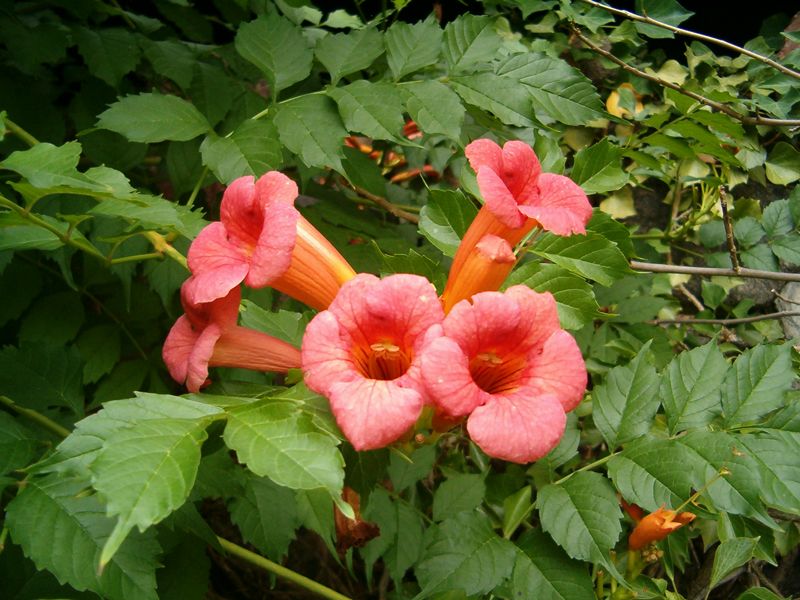
The underside of the elliptical leaf has numerous veins, along which there is a characteristic pubescence. The tubular flowers, usually orange-red, pink, or yellow, average 5-8 in number, are unscented.
The fruit is a hard, elongated pod, up to 8-10 cm long, containing numerous brown seeds. The roots are well developed, growing both deep into and around the trumpet pod, occupying a large area.
Types and varieties of trumpet creeper
There are several species and varieties of bignonia that are grown on the site.
| View | Description |
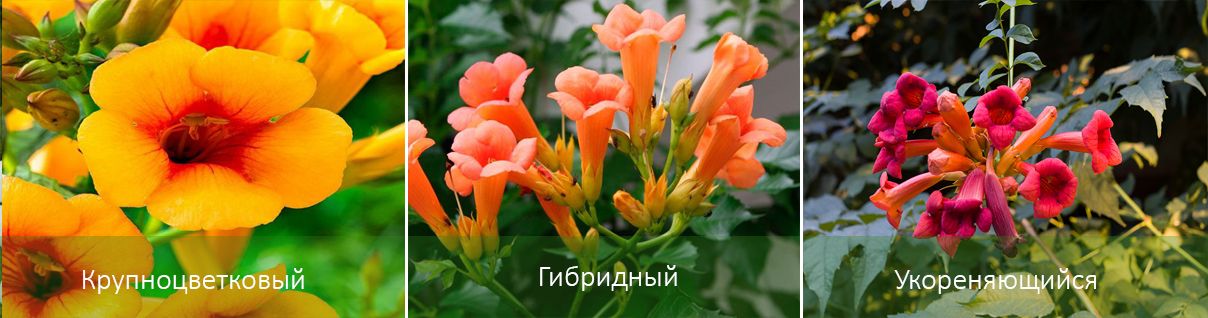
| Large-flowered (Chinese) | A large deciduous or shrubby vine without aerial roots, it branches profusely and twines around a support. It thrives in warmth but does not tolerate cold temperatures well. The leaves are elongated, pointed at the tip, dark green, and pubescent, 6-8 cm long. The flowers are large, up to 9 cm, and a rich orange-red hue with a golden sheen. |
| Hybrid | A long, up to 8 m, vine with numerous flexible, smooth branches. It is frost-resistant and highly decorative. The leaves are ovate, rough, with serrated, sinuous edges, a rich green hue, and about 7-10 per petiole. Large, tubular flowers with variegated petals, pink-yellow with a purple shimmer. |
| Rooting | A branching vine, woody at the base, with numerous aerial roots and vines. Frost-hardy, it can survive temperatures as low as -20°C. The leaves are rough, leathery, glossy, and have pointed edges, gray-green. The flowers are medium-sized, up to 7 cm long, pink-purple or scarlet with a golden sheen. This species is widespread in the southern regions of Russia. |
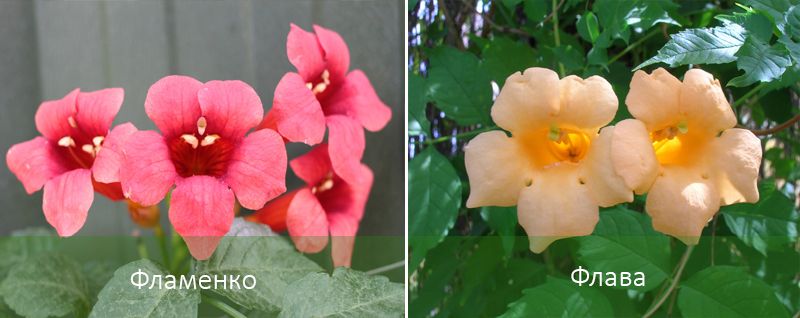
| Flamenco | A perennial vine growing 2-5 m tall, highly branched, and takes up a large area. The oval-pointed leaves have numerous veins, 7-10 on a petiole, with serrated edges and opposite lobes. The petals are variegated, purple-red, and rich orange. A frost-hardy variety. |
| Flava | A large deciduous vine growing up to 7 m tall. It has well-developed aerial roots that provide a strong grip on support. The leaves are bright green, 7-15 cm long, with slightly wavy edges. The funnel-shaped flowers reach 5 cm in diameter and are yellow-orange or red-gold with a crimson tint. It is winter-hardy and can withstand temperatures down to -20°C. |
When to plant Trumpet trumpet in the middle zone
Bignonia is resistant to cold and sudden frosts that don't last long. Some varieties can withstand temperatures down to -20°C, but don't rush into planting them outdoors. It thrives best in temperate climates, particularly in the Moscow region. Early to mid-May is ideal, when the soil has warmed up sufficiently and the risk of unexpected frosts is minimal.
Avoid planting the vine during particularly hot weather, as it may fail to establish and die from dehydration. Choose a day with moderately warm weather, no precipitation, and no strong winds.
Planting Trumpet Cactus in open ground
Since Trumpet vines live for several decades, they can be planted in the fall or spring. Planting in mid- to late September is much more beneficial because it enjoys virtually all the conditions of its natural environment: high air and soil humidity, warm weather, and natural precipitation. To ensure successful planting and rapid establishment, the following steps are necessary:
- The hole for bignonia needs to be dug 1-2 weeks before planting.
- Deepen no more than 40 cm, taking into account the age and size of the seedling.
- The diameter of the hole should be 40-60 cm.
- Weed the area around the flower beds and thoroughly loosen the soil.
- Add mineral (nitrogen, phosphorus or potassium) fertilizers and peat, compost.
- If the soil is heavy and loamy, it is necessary to prepare a drainage layer of foam plastic, broken brick, nut and egg shells, which should be placed on the bottom.
- It is best to choose leafless cuttings for planting.
- Place the campsis in the center of the hole and add soil so that the root collar protrudes from the soil by 8-10 cm.
- When filling, the seedling must be gently shaken to fill the cavities.
- The roots of the plant should be placed on the substrate, it will produce more shoots.
- Gently compact the soil without damaging the root system, water thoroughly.
- Bignonia needs support, so it is necessary to provide the flowerbed with a pole or moss post.
Caring for Trumpet Plant
Campsis is easy to care for and does not require any special gardening skills, so you should adhere to certain conditions so that the flower grows lushly and pleases the eye with its inflorescences.
| Parameter | Conditions |
| Location/lighting | It's not recommended to place flowerbeds near windows in living spaces, as the nectar of bignonia flowers attracts various insects, including bees, wasps, and hornets. It's also important to consider the characteristics of its root system: it can destroy rock structures or fences, so trumpet trumpet is planted at a slight elevation. It prefers full sun but can also grow in partial shade under a canopy. A south or southeast exposure is best for growing it. |
| Temperature | It thrives in heat and frost, and can withstand temperatures down to -20°C to -25°C. However, prolonged cold spells can kill it without special protection. It flowers and branches best in hot climates at temperatures between +20°C and +28°C. In areas with particularly cold winters or frequent temperature fluctuations, it does not thrive, stops blooming, and soon dies. |
| Watering | Regular watering is recommended, especially on hot days. If there has been no rain for a long time, increase the frequency and mist the leaves and petioles, avoiding contact with the flowers. Bignonia can survive short periods of drought, but do not leave the plant without water, otherwise it will dry out and die. It is also important to ensure that water does not stagnate and is fully absorbed into the soil. If there is no drainage, you can create channels to drain excess water, preventing rot and infection with harmful bacteria. |
| Top dressing | It practically doesn't need any fertilizer. If you mixed the soil with organic matter (compost, humus, pine needles) and added peat, sand, ash, sawdust, or charcoal chips during planting, you don't need to worry about fertilizing. During the growing season and the beginning of flowering, use mineral complexes or universal fertilizers for garden plants. |
| Soil | It's easy to grow, but thrives in enriched mineral substrates. Also, if the bignonia turns yellow or wilts, improve the soil's nutritional value by adding peat, sand, ash, sawdust, pine needles, humus, or compost. Gently loosen the soil occasionally to allow more oxygen to reach the underground root system, and weed the area. |
| Trimming | Regular and thorough. In the spring, carefully remove dried and dead shoots, treating the cuts with cinnamon. Young, fuller, and denser shoots will appear in their place. It's also necessary to remove faded buds and wilted petioles. Prune off any diseased parts of the plant immediately. In late fall, before wintering, ensure the Trumpet Creeper remains within its designated area by trimming any excess branches. |
| Wintering | It's best to begin preparations in late September, before the onset of severe frost. Cover the soil and exposed roots with a layer of dry leaves, humus, pine needles, sawdust, and spruce branches. Wrap the stem and vines tightly in plastic film or lutrasil. You can also cover the top with a mat without damaging the shoots. If you can bend the vine branches to the ground, you can remove the support and cover the bignonia with fallen leaves and spruce branches. |
Reproduction of Trumpet Cactus
Bignonia is commonly propagated in two ways: generatively and vegetatively. Both methods are widely used by gardeners, depending on conditions and time of year. Cuttings are best taken in June:
- First, examine the adult trumpet vine and select cuttings with 2-4 healthy leaves from the central part of the plant.
- Treat the lower part of the shoot with a root-forming solution.
- Choose a shaded area with loose, enriched soil. Add some peat and sand to the soil.
- To help the cuttings take root faster and begin to grow actively, you can use Maximarin.
- Cover the area around the young trumpet vine with freshly cut grass or tree bark.
If the cutting is woody, it should be cut in early spring, March-April, and appropriate planting procedures should be carried out.
Another way is by layering:
- Use a disinfected knife to cut off shoots that are very close to the ground or lying on it.
- Thoroughly moisten the soil and dig a planting hole depending on the size of the shoot; approximately a third of the shoot should be underground.
- Place the shoot in peat soil, providing it with drainage.
- The root system will begin to form fairly quickly, and by next spring the trumpet vine can be transplanted to a chosen site in open ground.
Thanks to the well-developed long root system, another method is distinguished - propagation by roots:
- The aboveground roots should be carefully examined; shoots appear on them from time to time.
- Before the shoot begins to actively grow and develop, it should be cut off along with a portion of the root system. If the root system is too long, you can separate the excess branches.
- On the site, select a flowerbed with pre-prepared substrate and drainage.
- Dig a planting hole so that the roots are completely underground.
- Water thoroughly and treat the soil with mineral fertilizers, this will help the seedling adapt and grow faster.
Bignonia seeds can be purchased at the store or collected by hand from ripe fruits. They are grown for seedlings in early spring.
- Select several individual containers with loose, nutrient-rich soil.
- Do not plant the seeds too deep (about 0.5 cm) and water them thoroughly.
- Create greenhouse conditions: maintain a temperature of at least 23–25°C, place the pots in a well-lit, draft-free area, and water regularly. Plastic wrap is optional.
- The first shoots will appear in about a month. Continue caring for the sprouts as usual.
- When the shoots become stronger and 5-6 healthy leaves grow on them, the trumpet vine can be transplanted into open ground.
Top.tomathouse.com explains why Trumpet trumpet isn't blooming.
Many gardeners face this problem. If bignonia was grown from seed, the plant will bloom for the first time only after 5-6 years, so vegetative propagation is much more productive.
When propagated by cuttings, the vine begins to bud in the third or fourth year. However, you can speed up the development process by regularly fertilizing and maintaining the nutritional value of the substrate.
Another reason for the lack of flowering may be various diseases or infections caused by improper care or contamination from other plants. Insect pests that drain the Bignonia's vital energy also negatively impact not only its flowering but also threaten the vine's full growth.
Furthermore, improper care, specifically too-low temperatures, prevents flowering. It's important to protect the Trumpet Cactus from spring and fall frosts by covering it with a protective covering. Frequent drafts delay the ripening of buds, and if left unchecked, the plant may become diseased. Don't expect Bignonia to bloom in cold climates where the air temperature doesn't exceed 20°C.
Pests and diseases of Trumpet trumpet
Bignonia is characterized by high resistance to various infections and pests. The plant may remain asymptomatic for a long time, but if it does become infected, appropriate measures must be taken.
| Manifestation | Cause | Method of elimination |
| The leaf blade softens, becoming translucent. The petioles and stems turn black. | Bacterial (wet) rot. Caused by stagnant water or contamination. | Treat with a solution of water and tar soap, trim away any rotten areas, and renew the soil. Reduce watering frequency by half and improve drainage. |
| Brown and grey spots with a reddish-brown centre, cavities and yellowness on the campsis. | Fungal infection. | Prepare solutions:
The use of chemical preparations is also permitted: Chistotsvet, Skor, Discor, Keeper. |
| Leaves develop a mosaic pattern, yellow spots, and a distinct roughness. Fruit does not appear, and flowering may cease. | Viral infection. | Remove affected shoots and treat with special copper-based fertilizers. If the plant is completely damaged, dig it up along with the root ball to prevent the infection from spreading. |
| Greenish insects, 0.5-1.5 cm in size, cling to buds, leaf blades, and young shoots. The shoots become deformed. | Aphid. | There are several ways to fight:
|