Erythronium (Latin for "canine tooth" or "dog's tooth" in Turkic) is a perennial bulbous plant of the Liliaceae family. It grows in the mountainous regions of North America, Europe, and Japan. In Russia, it is common in the Caucasus and southern Siberia. The plant was known as early as the first century BC.
There are 29 species, some of which are grown in gardens as ornamental plants. Three rare species are listed in the Red Data Book of Russia.
Description of kandyk
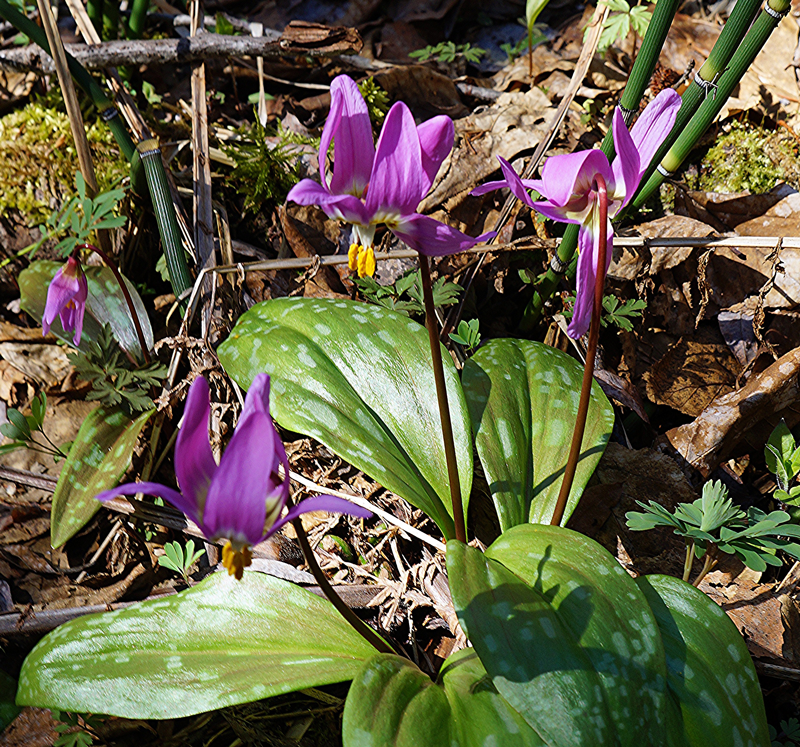
The plant is small in height, 10-30 cm, rarely reaching 60 cm under optimal conditions. The bulb is elongated, cylindrical, or ovoid. At the base of the peduncle are two long, elongated leaves arranged opposite each other, which adds even more elegance to the plant and highlights the beauty of the flowers.
The flower is typically solitary, large, with six long petals gathered into a bell-shaped, drooping shape. The edges of the petals gracefully curve upward. It resembles the common houseplant cyclamen or a small lily.
Flowering begins in April-May and lasts 2-3 weeks. Each flower opens very quickly, literally before your eyes, and blooms for 8 days. Afterward, a capsule-shaped fruit containing several seeds forms. However, the erythronium's above-ground lifespan is short; the green parts of the plant dry up and die by the second half of summer.
The plant is a honey plant and gives its name to a very rare early honey variety. Bees collect kandyk honey in the Altai Mountains and Siberia. It is dark in liquid form, but crystallizes very quickly, lightening to the color of baked milk. It has an unusual taste and medicinal properties.
Erythronium tubers are also used medicinally. They are used to treat epilepsy, impotence, and lung diseases.
In gardening, erythronium is grown in separate patches or in rock gardens in combination with other primroses. It is increasingly used for forcing, along with tulips and hyacinths. The flowers last a long time when cut, making them ideal for spring floral arrangements.
Types and varieties of erythronium
| View | Description | Leaves
Flowers |
Varieties |
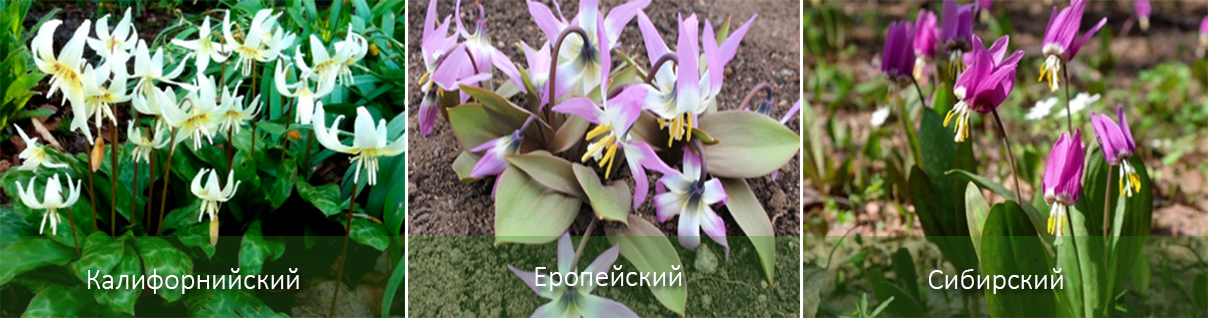
| European | It prefers to grow in shrubs and deciduous forests in the mountainous regions of Europe. It is found in the Alps and western Ukraine. The stem is light pink, 10-30 cm tall. | Wide, tapering towards the bottom, green in color with purple spots.
The petals are pointed, strongly curved upwards. Pink, purple, with a white center. |
|
| Siberian | Found in southern Siberia and Mongolia. The bulb is shaped like a predator's fang. Height ranges from 12 to 35 cm. It tolerates temperatures down to -50°C. | Elliptical in shape, with pointed ends. Green, marbled, with reddish-brown veins.
8 cm in diameter, whitish, pinkish, purple with a yellow core. |
|
| Tuolumne | Grows exclusively in the Sierra Nevada. Height 30-40 cm. | On a petiole, uniform green, up to 30 cm.
On the peduncle there are several golden-colored flowers with a greenish base. |
|
| Californian | Grows in forested areas of California. | Oblong, with a rounded end. Spotted, 10 cm long.
One or more per plant. White-cream with an orange aperture. |
|
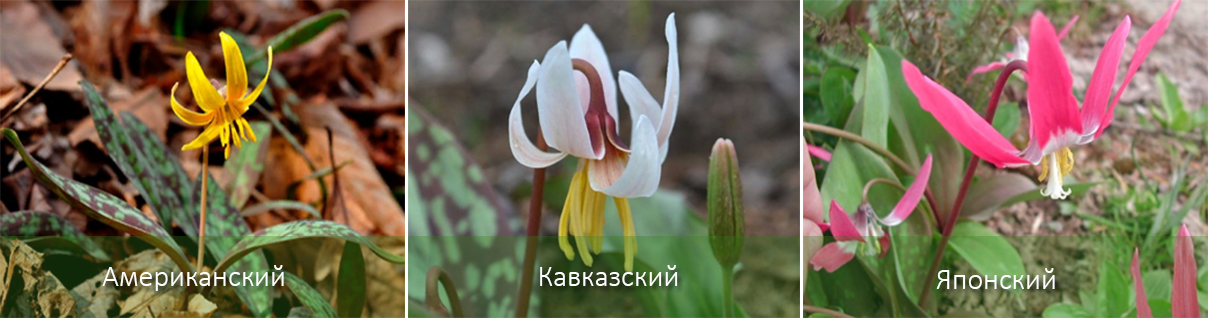
| Japanese | Distributed in the Kuril Islands, Sakhalin, Japan, and Korea. Does not tolerate heat well. | Narrow, up to 12 cm long.
One, drooping, pale purple. |
None. Rare, listed in the Red Book. |
| Caucasian | Native to the mountainous regions of Western Transcaucasia. The bulbs are cylindrical. The stem is 25 cm long. Frost-sensitive. | Ovoid-shaped, glaucous in color, spotted.
White, sometimes yellowish. The center is red-orange. |
|
| American | It grows wild in the mountains of the USA and Canada. | Oblong, with brown spots. Length 20 cm, width 5 cm.
Bright yellow. Peduncle 30 cm. |
|
Planting erythronium in open ground
Erythronium is an early-blooming plant. It is grown in shaded areas, on the north side of the garden, under the canopy of trees and shrubs that protect it from the sun.
Planting is carried out in the last days of summer. Typically, the planting material overwinters successfully, and the crops germinate in the spring.
The soil should be moist, peaty, loose, and slightly acidic. Equal volumes of humus, river sand, and leaf mold are suitable.
Two weeks before planting, the area needs to be fertilized. For this, apply a 1 m2:
- 200 g bone meal;
- 150 g superphosphate;
- 100 g crushed chalk;
- 30 g of saltpeter.
Erythronium propagates by seeds and seedlings. If the capsule ripens, the seed will fall to the ground if not harvested. Therefore, to ensure safe harvesting, it is recommended to cut off slightly immature capsules and dry them on mats in a dry, ventilated area.
The soil is treated in advance to prevent ants from carrying away the seeds.
For sowing, furrows are made 10 cm apart and 3 cm deep. Seeds are placed every 5 cm, covered, and watered generously.
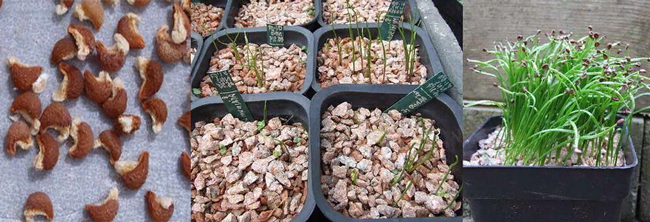
Seedlings should appear in the spring. Plants planted this way will bloom in 4-5 years. Erythronium is a primrose and is one of the most beautiful snowdrops.
In the first spring, the shoots should be at least 4 cm tall. Otherwise, additional feeding and increased watering are needed. By autumn, bulblets 4 cm in diameter form. In the second year, they increase in size to 7 cm. In the third season, the bulblet takes on a cylindrical shape, grows to 8 cm in diameter, and penetrates deeper into the soil – 7-10 cm.
You can also plant seeds in the spring. However, to speed up germination, you should first create an artificial winter. To do this, place them in a plastic bag with moist peat and refrigerate for 2-3 months.
Erythronium seedlings are planted in the soil at a depth of 10-15 cm (American varieties are planted deeper, at 16-20 cm), covered with a layer of mulch, and watered generously. With this propagation method, the plants bloom the following year.
You can grow seedlings indoors in boxes covered with plastic. Sow the seeds 2-3 cm apart. Once the seedlings emerge, remove the plastic.
Once the sprouts have grown stronger, they are taken outside for a short time to harden off. After the ground has thawed and warmed up, the seedlings are planted in their permanent location.
Caring for erythronium in the garden
The plants require virtually no maintenance. Watering is very infrequent. If the soil is mulched, weeding and loosening the soil are unnecessary.
During the first year, erythronium seedlings do not require additional fertilizer, as the soil has already been prepared and fertilized before planting. In subsequent years, apply standard mineral fertilizers for flowering garden bulbous plants.
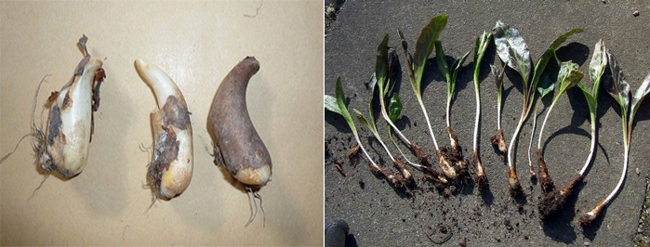
After 4-5 years of flowering, the erythronium bushes begin to grow underground and need to be replanted. This should be done after the plant has finished flowering and has had a rest, in July-August.
You can tell a bush is ready for transplanting by its yellowed and wilted leaves. Dig up the bushes, and carefully separate the offspring from the main bulb. Sprinkle the broken areas with crushed charcoal.
New bulbs should be planted immediately, as they dry out quickly and should not be exposed to air for more than 24 hours. If planting is planned for a later time, or the seeds need to be transported, the bulblets should be stored in a container with damp sand, peat, or moss. Young bulbs can survive in this condition for up to 20 days.
Erythronium in winter
The plant is winter-hardy. It overwinters well in open ground. Only if the winter is expected to be cold and snowless should the crops be covered with spruce branches or dry leaves.
This type of cover will retain moisture well in the spring, so it is removed only after the snow has completely melted.
Diseases and pests
Erythronium is virtually disease-resistant. It can be harmed by insects and rodents that live in the soil, such as mole crickets, moles, and shrews.
Controlling these pests is quite labor-intensive. To avoid the use of poisons and save money, you can use affordable and humane folk remedies.
Mole crickets' nests will be destroyed if the soil between the plants is loosened to a depth of 10-15 cm. If possible, a plastic bottle cut into a cylinder at both ends should be buried around each bush. This will prevent the insects from reaching the bulbs.
Moles and shrews can be repelled using homemade devices. Take 1-1.5 m long iron rods and drive them halfway into the ground in areas where rodents congregate.
Place an empty beer or Coke can on top of the free end. The wind will rattle the can, transmitting the vibrations through the iron rod and scaring away the animals.
Also, cloth ropes soaked in dust are placed directly into the burrows. This smell is very unpleasant for moles and shrews, forcing them to leave the area.
To prevent pests from destroying all the plants at once, it is better to plant them in several places in the garden that are far from each other.