Canna is an ornamental perennial plant belonging to the Cannaceae family. The first flowers were brought from India, China, and South and Central America. They were brought to Europe by Portuguese ships in the 16th century. The ancient Greek word can be translated as "reed," while the Latin means "pipe." An ancient Native American legend tells of a tribal chief who decided to burn a peace treaty in a bonfire, leading to a bloody massacre. Flowers with bloody petals sprouted from the site of the fire, reminiscent of flashes of flame or spilled blood.
Content
Description of the Canna Flower
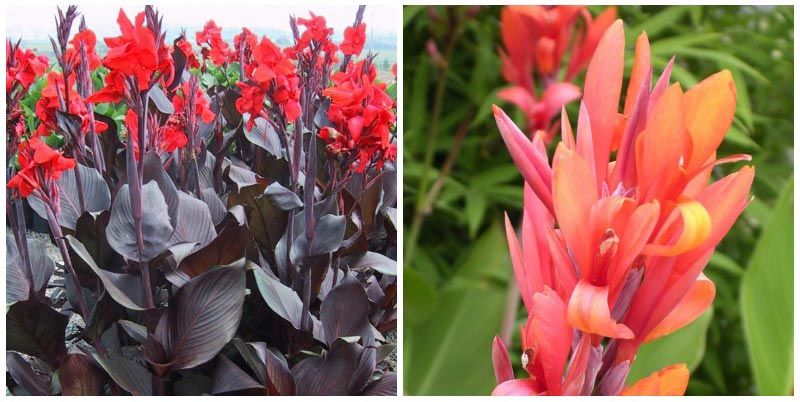
The branched rhizomes of this perennial plant spread widely. Thickened, hollow stems, 0.6 to 3 m long, terminate in a peduncle. Large, elliptical or elongated leaves range from 25 to 80 cm in length and 10 to 30 cm in width, pointed at the top, with a smooth surface. The inflorescences and foliage are decorative. The green mass comes in attractive colors, ranging from malachite, dark burgundy, red-brown, and lilac.
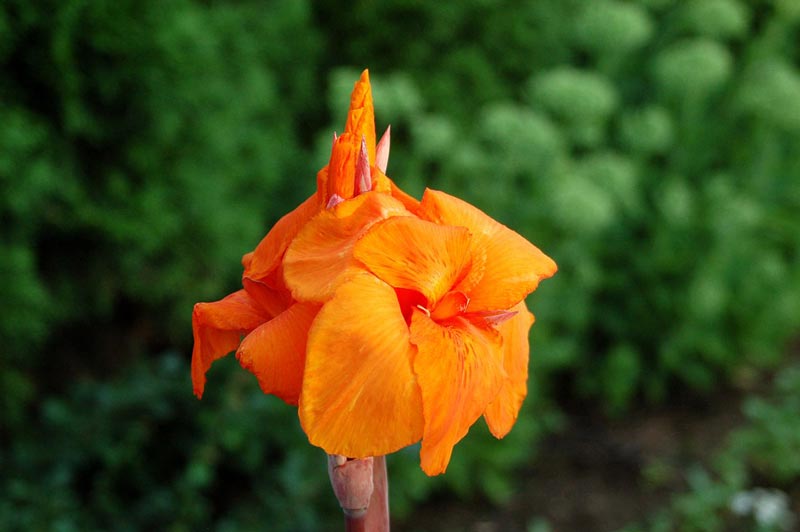
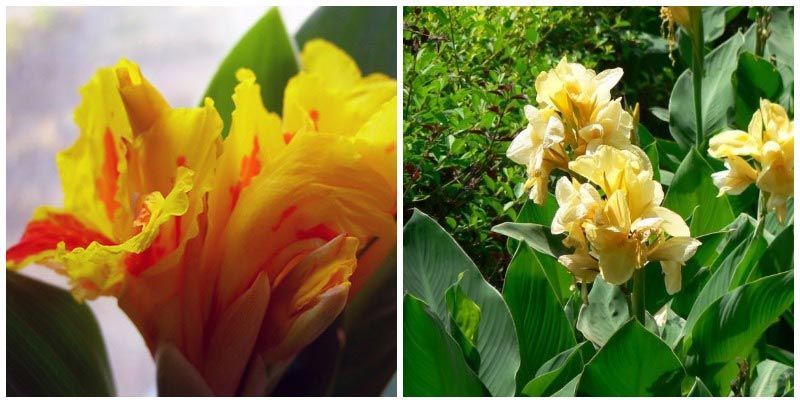
The plant's inflorescences, gathered in a panicle or raceme, are distinguished by a variety of colors. Crimson, golden, soft pink, amber, speckled, bordered, and asymmetrical, they resemble gladiolus or orchids. Upon fertilization, a three-celled capsule appears.
Types of Cannas
Almost all modern varieties descend from the Indian species of canna. Cultivated descendants are given the botanical designation Canna hortum.
| View | General description | Height, m | Varieties |
| Crozy | Introduced in 1861, the leaves are malachite or dark burgundy with white. The petals are reflexed. | 0.6-1.6 |
|
| Orchidaceae | Flowers up to 12.5-17.5 cm across, with folded edges. Leaves are dark green or lilac-green. | 1-2 |
|
| Deciduous (small-flowered) | The leaves are malachite, lilac, or greenish-green. The flowers are small, up to 6 cm in diameter. | 3 | Durban: Flowers are orange-yellow, leaves are green and striped. |
Growing Cannas in the Garden
The flowers are easy to grow and are successfully grown in gardens and public spaces. Propagation is by dividing the tubers and sowing seeds.
Sowing Canna Seeds
This method was typically used to cultivate plants for breeding purposes. Easy-to-germinate canna seeds for garden plots have only recently become available, but they have quickly gained popularity.
Seed germination begins in late January or early February. The hard seed coat prevents the flower from sprouting quickly.
To speed up the process, it's assisted in its destruction. One of the following methods is recommended:
- treated with boiling water;
- kept for 3-4 hours in a thermos with hot water;
- bury it in a snowdrift for 2-3 hours or put it on a freezer shelf for 1 hour;
- act mechanically.
After this treatment, the seeds are placed in an aqueous solution of growth stimulant for 24 hours. The prepared seeds are placed in bowls with planting soil at a depth of 0.7-1 cm. After watering, they are covered with plastic wrap and left to germinate, which lasts for a month. During this time, the soil temperature is maintained at 22ºC. After 3-4 leaves have emerged, the seedlings are transferred to separate containers. The flowers develop in these containers until they are transplanted outdoors. After 3-4 days, the transplanted seedlings are kept in a room with a temperature of 16...18ºC.
Growing from rhizome
Rhizome division is a reliable method for propagating cannas. It begins in the last ten days of March or early April. The roots, stored in a cellar over the winter, are cleaned, and the dried parts are separated. Each section is cut into divisions, based on the number of buds on the tuber. Closely spaced sections are not divided.
To prevent infection by fungal diseases, the resulting sections are treated with potassium permanganate (0.2 g per 1 liter of water) or wood ash.
The prepared cuttings are planted in soil composed of equal parts soil, peat crumbs, and rotted manure. The soil should not be buried too deeply. The first leaves should appear within 2-3 weeks. As they emerge, the pots are moved to well-lit areas where they will be kept at a temperature of 16 to 18ºC. Under these conditions, new shoots do not stretch and develop at a healthy pace. Light watering and keeping the temperature cool is all the care young seedlings require.
When to plant cannas
Cannas are transplanted outdoors after the last frost has passed. Damaged roots can take a long time to germinate, stunting their growth, delaying flowering or even preventing it altogether.
Selecting soil
Planting requires a sunny location protected from drafts and wind. Cannas thrive in humus-rich, warm soil. Prepare the garden site in advance. Dig a hole 0.5-0.6 m in diameter. Fill the bottom with 0.2 m of fresh manure. This will keep the rhizome warmer, encouraging vigorous growth and blooming. Add soil over the manure. Place the rhizome in the watered hole, with the growing point facing up, and cover with soil. Plant unsprouted rhizomes no more than 6-9 cm deep. Leave a distance of 0.5 m between plants, and 0.3 m between dwarf varieties. The same distance should be maintained between rows if there are many seedlings. Mulching the planted flowers helps protect against lack of moisture and weed growth. After planting, sprouts appear within 2 weeks, and flowering takes 1.5-2 months. Germination is delayed at temperatures below 15ºC.
Next, the flowers require timely watering, loosening of the upper layers of soil and fertilizing.
How to fertilize cannas
Throughout the growing season, cannas are fertilized to ensure timely development. Add 2 grams of potassium permanganate per bucket of water (or place granules under each plant) when watering. This stimulates flowering. Before flowering, apply a solution of chicken manure and water at a ratio of 1:10. Repeat the same watering after two weeks. Cannas appreciate complex mineral fertilizers, scattered under each plant. Mix them into the soil while loosening the soil.
When watering, be careful about the amount of water. Excess water can lead to the risk of fungal disease outbreaks.
At the end of the season, the root collars are covered with soil to prevent damage during cold weather. During the first frost, the roots are pruned back to 15-20 cm. Digging is done at the end of September, leaving a large lump of soil.
Storing Cannas in Winter
At the end of August, cannas are transplanted into containers that can be easily brought indoors if there's a risk of frost. The final lifting takes place in late September or early October, as the flowers are not frost-hardy. To improve canna wintering, it's important to maintain an air temperature of 7 to 15ºC. Cannas have no noticeable dormancy period.
The plant delights gardeners with its beauty year-round. However, for the flowers to bloom, they require proper conditions. Store cannas in a cool, low-light location for two months, reducing watering. After digging, store them in perlite, sphagnum moss, or peat placed in plastic boxes at a temperature of 6 to 8ºC. Care should be taken to avoid touching the tubers. Check the rhizomes twice a month for condition, wetting the covering materials with water if necessary. Remove any damaged areas, and treat the cut areas with iodine.
Canna at home
Cannas can be grown on their own or transplanted in the fall from the flowerbed into a pot at least 50 cm in diameter. To prevent infestation, the soil is treated with insecticides beforehand. In winter, the plant becomes a bright, eye-catching focal point. For optimal health, it requires a sunny location and regular watering. Gently wipe the plant's leaves several times. After flowering, it needs a rest period. Trim the stem to a height of 10-15 cm and store in a shady spot with a temperature of 10ºC.
Problems with growing cannas
The flower plant is susceptible to diseases and various types of pests.
| Disease/pest | Symptoms | Elimination measures |
| Viral diseases | Yellow streaks develop along the veins and on the leaf. Later, pale spots appear, plant growth is stunted, and flowering is delayed. | There is no cure. The plants must be dug up and destroyed. |
| Fungal diseases: rust and gray mold | Orange spots all over the plant. Brown spots on the flower. |
Regulate soil and ambient air humidity. Increase circulation. Adjust the temperature. Spray the leaves: ¼ teaspoon of chlorothalonil per 1 liter of water. Repeat the procedure after 10 days. |
| Phytoplasma disease | The leaves turn yellow, wrinkle, and grow deformed. | Destroy the diseased plant. |
| Leaf rollers | The appearance of holes in leaves eaten by insects | Set traps or collect by hand. |
| Spider mite | Yellow thickenings on the leaves. |
Treat with horticultural oil, insecticidal soap or solution. Periodically tear off old lower leaves. Reduce watering and application of nitrogen fertilizers. |
| Thrips | Clear or yellow spots. |
Top.tomathouse.com recommends: Canna in the landscape
Cannas look great both in group plantings and individually, making them a favorite among landscape designers. They pair well with low-growing plants such as marigolds, coleus, and cineraria. They pair well with kochia, perilla, and petunias.
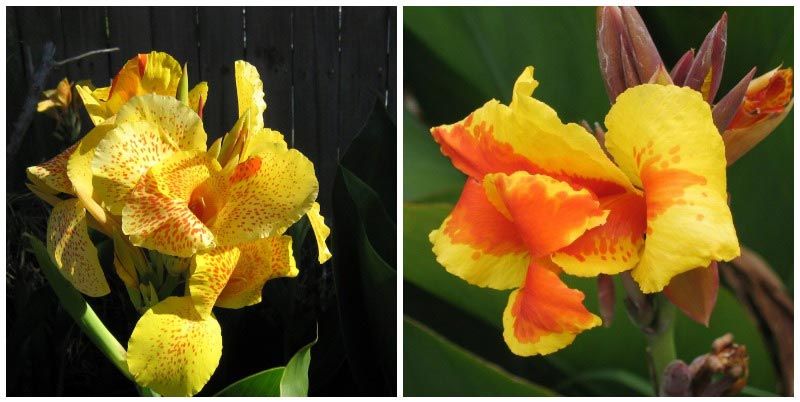
When planting with other flowers, give it a central position, surrounding it with medium-sized and low-growing flowers. When planted in groups, arrange them into wide, long beds.
Summer balconies, loggias and terraces are decorated with flowers, planted in a pot or large tub.