Catharanthus is an evergreen herbaceous subshrub belonging to the Apocynaceae family. Its medicinal properties and beauty are renowned throughout the world.
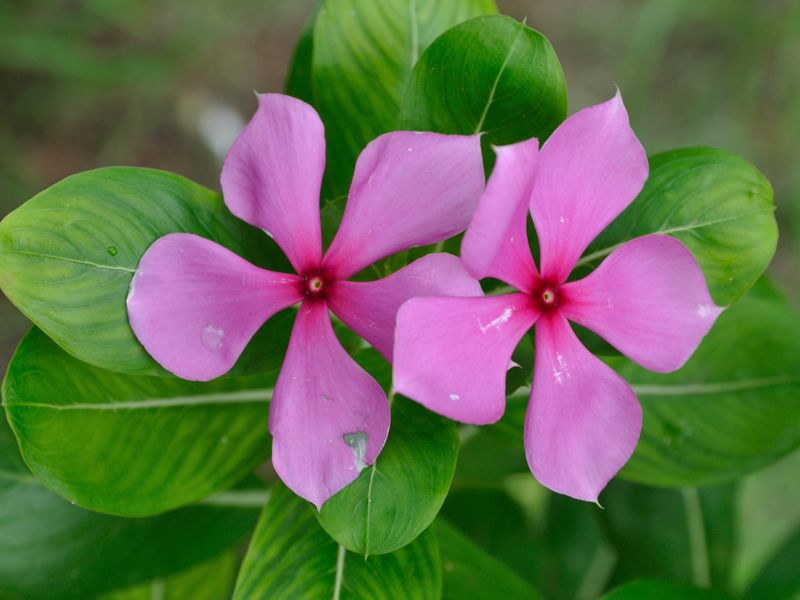
This wild flower is found in tropical countries such as Cuba, Africa, Indochina, Indonesia, and Java. The plant's native land is Madagascar. It is suitable for both indoor and garden cultivation.
Description of Catharanthus
As a houseplant, the catharanthus is a perennial or annual flower, reaching a height of approximately 30-60 cm. Stems with smooth green bark branch toward the top. The dark green leaves, not tapering toward the edges, have a white midrib and are approximately 8 cm long. The catharanthus has a taproot, extending up to 30 cm underground and emitting a characteristic unpleasant odor.
The plant's flowers are almost unscented, very similar to phlox, and grow at the tips of the shoots. The petals are white or pink, with some varieties featuring a pronounced contrast, such as a burgundy center and white edges. There are only five perfectly shaped petals. The plant blooms all summer and even into early fall.
Types and varieties of catharanthus for the home
| View | Description | Flowers |
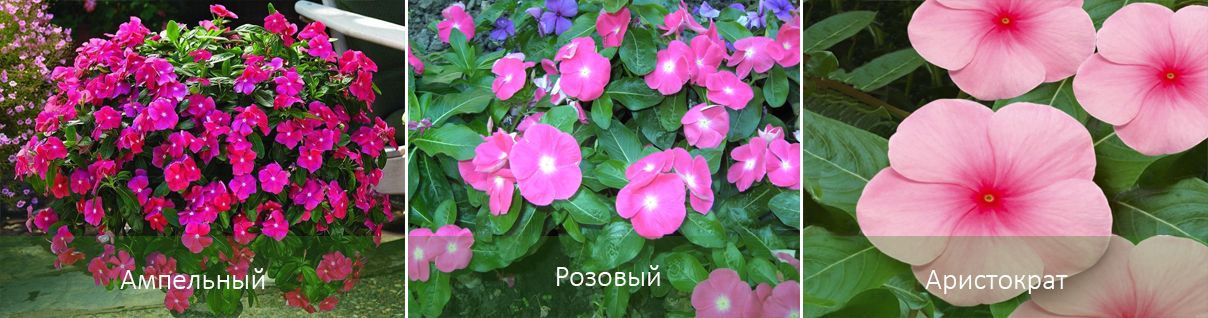
| Ampelous | The bush reaches no more than 15 cm in height. The length of the hanging shoots is 100-150 cm. | Large, bright pinkish or purple petals grow along the entire length of the shoots. The coloring evenly transitions from the light edges of the petals to the dark center. |
| Pink | It grows up to 60 cm and is perennial. Its glossy, green leaves, coated with plant wax, are quite large and reach 10 cm in length. Some external characteristics are similar to those of the cinquefoil, and scientists previously mistakenly believed that they were the same variety. | Single, five-petaled flowers. The color palette is varied: from light pink or white to burgundy, and the purple corolla pharynx harmoniously completes the overall picture. Size: 3-5 cm. |
| Aristocrat | It grows up to 50 cm in length and is suitable for both indoor and outdoor cultivation. | They reach up to 5 cm in size. They have a contrasting eye, and the colors range from snow-white to burgundy. |
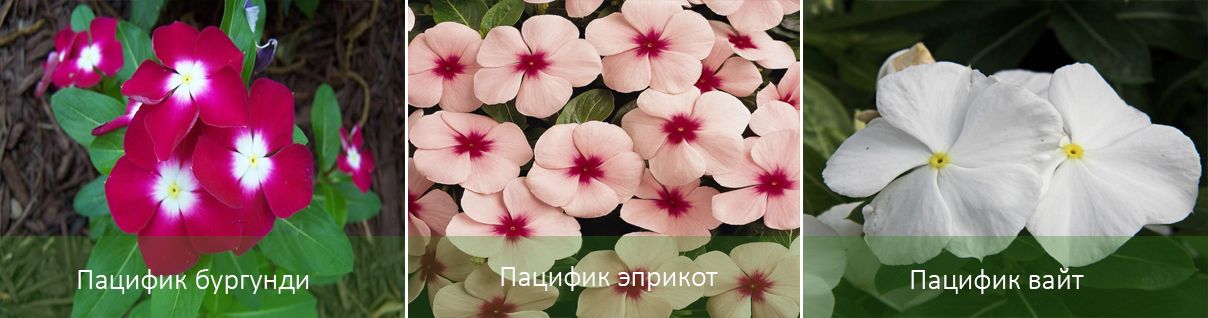
| Pacific Burgundy | Small in size, with a well-developed root system, it reaches no more than 30 cm in height. | The petals are soft pink with a white center, there are five of them in total. |
| Pacific Apricot | Not tall, 30 cm, while the hat's diameter is about 20 cm. | Apricot-colored with a rich red center. |
| Pacific White | Solid white petals. There are also flowers with a red center. | |
| First kiss | Small in size - 35-40 cm. Has a beautiful cap. | The shades are very diverse. There are about 13 in this variety, including violet-blue, white-pink, and others. |
Caring for Catharanthus at Home
| Parameter | Necessary conditions |
| Location/lighting | It loves light, so pots are placed on east- or west-facing windows. Direct sunlight quickly kills it, and insufficient light causes the stems to become withered, and the flowers practically disappear. |
| Temperature | +22…+26 °C, the flower feels great and produces the largest number of buds. |
| Humidity/Watering | Regular and thorough watering should never allow the soil to dry out, otherwise harmful insects will appear on the plant. The bush should also be misted daily, especially at the roots, to maintain water balance. |
| Soil | The soil should be prepared in advance. Catharanthus thrives in peat soils. A special substrate consisting of turf and perlite is usually added to the pot to help the plant take root. |
| Top dressing | Mineral fertilizers, phosphorus, and carbon solutions. You can begin applying them two weeks after planting. |
Planting and caring for catharanthus in open ground
| Parameter | Necessary conditions |
| Location/lighting | Most often, flower beds with shrubs are placed on the sunny side of the plot, either east or west. However, the plant does not like direct sunlight, which is important to keep in mind when planting. |
| Temperature | Seedlings should be planted at temperatures above +20 °C, otherwise the plant will die; it does not tolerate heat well and requires constant moisture. |
| Humidity/Watering | Make sure the soil never dries out and always remains moist. However, too much moisture can negatively affect the catharanthus. Therefore, during prolonged heavy rains, a special awning should be erected over the shrub. |
| Soil | Weeding and weeding are necessary beforehand. Ash or expanded clay can be added to make the shrub feel more comfortable. Catharanthus especially prefers peat soil, so several peat tablets are often placed in the hole. |
| Top dressing | Every two weeks, no more often, with special mixtures for ornamental plants. Reduce the dosage stated in the instructions by half and inject the resulting solution under the roots. It's best not to use fertilizers in winter. |
Transplanting Catharanthus
Catharanthus needs to be repotted annually, as it grows quickly. To promote bushy growth, trim back any stems that have grown long over the winter each spring.
Pruning Catharanthus and shaping the bush
Flowers will appear on the pruned shoot within a few weeks. It's not recommended to keep the shrub for more than three years. Over time, it loses its former lushness, the flowers become sparse, and the stems become shriveled.
It's much more effective to rejuvenate catharanthus by cuttings. The tips of the shoots are often pinched to give the plant a more organic appearance. The shrub grows vertically and delights with its lush inflorescences.
Reproduction of Catharanthus
Seeds can be sown indoors at any time of the year.
- You should prepare a container with a depth of more than 10 cm, since the catharanthus has a long root, and make drainage holes in the bottom to allow excess water to escape.
- Before soaking the seeds in prepared soil, soak them in an Epin solution for two hours.
- The first shoots should appear within a week and a half, then the pot should be placed in a well-lit place.
- During its early development, the catharanthus is quite vulnerable, so it's essential to maintain a temperature of at least 22–23°C. It takes the plant a full month to establish a strong root system, making its growth virtually invisible.
- Catharanthus should be repotted into individual containers only after four healthy leaves have emerged. This should be done in February or March to allow the plant time to mature.
After hardening off the seedlings on the balcony, they can be planted outdoors when the outside temperature reaches above 20°C. These conditions facilitate the shoots' adaptation and promise stunning flowers in the future. Before planting, the garden soil should be thoroughly tilled and mixed with expanded clay.
Cuttings are perhaps the simplest and most practical method. To propagate catharanthus this way, you need:
- In the spring, prepare apical shoots approximately 12 cm long.
- The main thing is to remove the leaves from the bottom and place the cutting in moistened, peat-based soil. To ensure a constant temperature, cover the container with protective film or a greenhouse lid.
- For the next three weeks, you need to ventilate and spray the cuttings with water; after about this time, the plant will take root.
- The operation can also be performed in open ground. To do this, you need to cover the cuttings with a special container (a jar or plastic) and sprinkle them with soil to a depth of about 3 cm - that is, create greenhouse conditions.
- It's best to grow periwinkle in a greenhouse, but most amateur gardeners lack the necessary equipment. Cuttings can be planted (or the protective barriers removed when growing outdoors) when the shoots produce their first leaves.
The two methods above are typical for both the garden and the home. The following is typically used when transplanting a periwinkle from one pot to another.
Dividing the bush occurs in several stages:
- The plant is removed from the pot and excess soil is shaken off. After deciding how many parts to divide the rhizome into (this depends on its size, usually 3-4 parts), it is cut with a pre-disinfected knife.
- To prevent the periwinkle from dying, an antiseptic or activated carbon is applied to the cut sites.
- At the end of the process, the resulting plants are placed in individual containers.
This method has become widespread because it produces mature catharanthus that adapts quickly. Once the new root system has fully developed (about three weeks), the plant can be transplanted into open ground.
Potential problems when caring for catharanthus, diseases and pests
| Manifestation | Reasons | Elimination measures |
| Dark spots on the leaves. Disease: rust. | Over-hydration. | Spray with fungicides. Replant the bush in new soil. |
| Yellowing on leaves. | Excessively dry air and lack of proper humidification. | Increase the frequency of spraying or place a saucer of water next to the plant. |
| Rapid wilting of foliage | Exposure to direct sunlight. Ultraviolet light negatively affects the catharanthus, causing the plant to lose strength and eventually die. | Avoid exposure to direct sunlight. |
| A fine web appears on the plant. The stem weakens and wilts. Pest: spider mite. | A dry and hot environment is ideal for this pest to thrive. Spider mites spread infections, causing the plant to die before your eyes. | Treat with insecticides (Akarin, Bitoxibacillin, and others), and spray regularly. Preventatively, treat the bush with a soapy solution. |
| Cessation of flowering and wilting of foliage. | The pot for the catharanthus is too small; its roots have nowhere else to grow. | Transplant the plant into a deeper container. |
Top.tomathouse.com warns: Catharanthus is a useful and dangerous plant
The aboveground shoots of the rose catharanthus are used as medicinal raw materials, and the leaves are used to produce pharmaceuticals. The plants are harvested in late summer (August-September), as this is when the shrub blooms, and all the beneficial substances accumulate in the stems and leaves. They are cut and dried at a temperature of approximately 50°C (in special dryers). The catharanthus can retain its medicinal properties for three years, after which it becomes useless.
The shrub is traditionally used as an antibacterial, antitumor, and hypotensive agent. A tincture made from it helps with diabetes, fibroids, endometriosis, infertility, and even hemorrhoids. Rose catharanthus oil and serums made from it are also used to combat fungal infections, ulcers, and other skin conditions. In some countries, this plant is even used to treat scurvy.
The shrub is poisonous and, if used incorrectly, can cause harm rather than benefit.