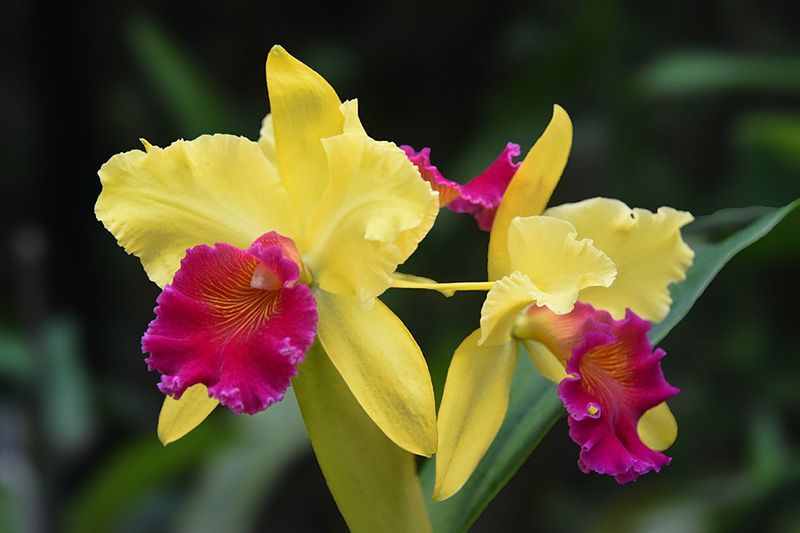
Cattleya belongs to the Orchidaceae family. It is an evergreen plant with an aerial root system. It grows naturally in tropical forests of the Americas and the Caribbean islands. Many species are grown in apartments and greenhouses.
Content
Description
In the wild, plants grow freely or cling to trees and rocks. Flowers can be found at sea level or on cliffs. Cattleya has pseudobulbs with two or three internodes, each supporting one or two leaves. New shoots form at the base of the previous year's shoots, causing the plant to grow wider.
Common characteristics of all Cattleya species
The inflorescence is terminal, with a single bud or racemose, emerging from the leaf axil and covered by leaf blades growing at the base. The stem is sympodial, underdeveloped, and succulent. Young plants have several growth points. Over time, only the main shoot remains; the others die off.
One or two narrow, oblong leaves form within the pseudobulb. The leaves are dense, fleshy, or leathery, and do not bend as they grow. Cattleya can be:
- single-leafed with fleshy, spindle-shaped bulbs with one leaflet;
- two-leafed with elongated, cylindrical bulbs with two or more leaves.
All the false bulbs are connected by a root system. The plant has a creeping aerial root system, suitable for growing in the mountains or on trees. It can be located above ground or buried deep in the soil.
Flowering lasts up to four weeks, depending on the orchid variety. Some varieties bloom even in spring and winter.
A bud with three petals and the same number of sepals. It has a so-called "lip." This is the middle petal, shaped like a funnel or tube, with a brighter shade than the others, and a fringed edge.
The corolla's circumference ranges from a few mm to 30 cm (depending on the Cattleya variety). Coloration can range from pinkish, lilac, crimson, and pure white. Typically, the orchid has at least four pseudobulbs, from which buds open one after another. Cattleya flowers have a pleasant fragrance. Cut buds last a long time, even without water.
Main types
Cattleya has about 180 varieties. The most common ones are:
| Name | Description |
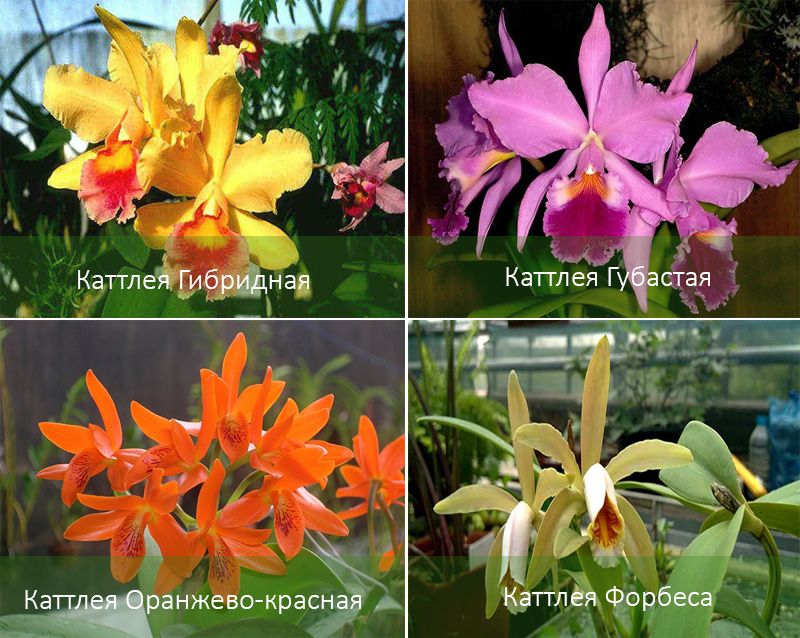
| Hybrid | The name refers to a large number of hybrid forms obtained by crossing different species and their varieties:
|
| Thick-lipped | The spindle-shaped false bulbs are single-leafed, covered with gray-green scales. The leathery leaves are oblong, obtuse, and notched at the tip. The pinkish or lilac flowers are 12-14 cm long. The petals are narrow, ovate, with wavy edges, three times wider than the sepals. This is the founder plant of the genus. |
| Orange-red | The spindle-shaped stems are thin at the base, gradually thickening toward the top, and are covered in a membranous sheath. The two ovate or elliptical leaves are stiff and fleshy. The inflorescence, located on a shortened peduncle, bears two to ten fiery orange buds. Breeders use this species to develop cultivars with yellow or orange flowers. |
| Forbes | The slender, cylindrical or spindle-shaped stems are bifoliate and grow up to 30 cm. The leaf blades are oblong and blunt. A straight, shortened peduncle holds two to six buds. The buds are pale olive-yellow or light chestnut, with slightly darker veins. |
Growing conditions for cattleya
To ensure that cattleya grows and blooms vigorously, the following conditions must be created in the apartment:
| Parameter | Recommendations |
| Location | Any windowsill except north-facing ones. In summer, the plant can be moved to a balcony or veranda. |
| Lighting | Bright light, with a minimum of 12 hours of daylight. There's no need to protect the plant from the sun in the morning or evening. Special phytolamps are used for illumination; regular ones turn the leaves purple. Avoid sudden changes in light levels. There are varieties that tolerate shade well (for example, the hybrids known as Patinara). |
| Temperature | During the growing season, the temperature should be between 22 and 30°C. A temperature difference of approximately 7°C is essential. To achieve this, open windows and vents, but avoid drafts. During the winter dormancy period, the temperature should be reduced to 12 to 15°C. Temperatures below 5°C or above 40°C will kill the plant. |
| Air humidity | The recommended level is 60-80%. In hot weather, place a container of cold water next to the plant. Mist the air around the orchid during warmer months. Avoid getting water on the false bulbs, flowers, and flower stalks. |
Features of planting and replanting cattleya
In their natural habitat, orchids grow on trees, so for planting, bark (preferably coniferous) and sphagnum moss are used as a substrate. The former is soaked for several days to improve moisture retention. All ingredients are crushed, and polystyrene foam and perlite are added to the mixture. Ready-made orchid soil is also available at a specialty store.
Cattleyas don't tolerate planting or repotting well, so disturbing them should only be done in extreme cases. When the pot becomes too crowded, the root system will begin to rot, or the plant will need resuscitation.
If repotting is necessary, it's best to do it in the spring, when shoots are forming on the bulbs. At this time, the shoots are small and the risk of damage is minimal.
Planting in various containers
Miniature varieties of hybrid cattleyas, no more than 10 cm in size, thrive in glass gardens called terrariums. Planting is as follows:
- A florarium is prepared: an aquarium, a jar, a vase (any glass container) is used.
- A layer of stones is laid out on the bottom.
- Crushed bark is poured in (2 cm pieces).
- A thin layer of damp sphagnum moss is applied.
- An orchid is placed on top and secured with thin sticks.
- The composition is complemented by other exotic plants suitable for a florarium (fittonia and others).
- Decorated with decorative elements.
If planting in a pot, pay attention to ventilation when choosing a pot. The plant loves air; without enough, it will die. Ceramic and plastic pots are suitable for cattleyas.
The advantage of the first material is that it's natural. Ceramic protects the root system from sudden temperature changes. However, such a pot has a short lifespan: after three to four years, it will begin to deteriorate due to waterlogging and root growth. Plastic pots are inexpensive and come in a wide range of colors and shapes. Moreover, such a pot will last much longer than a ceramic one.
Planting is done as follows:
- A drainage layer of 2 cm of gravel or expanded clay is laid on the bottom.
- A layer of bark and large-sized sphagnum moss is poured.
- A flower is placed on top, and a layer of substrate with smaller pieces of the constituent components is laid out.
- The pot is placed on a tray with water.
Flowering conditions
Cattleya orchids bloom when they reach adulthood. The size of the pseudobulb on a mature specimen varies depending on the variety, ranging from 8 to 20 cm. If the pseudobulbs have living roots and at least one bulb with a sheath, the orchid will bloom.
Prerequisites:
- Flowering will not occur on a north-facing windowsill. Cattleya requires full sun. It is recommended to expose the plant to ultraviolet rays in the morning and evening. Avoid this during periods of intense sunlight, as it can cause foliage burn.
- The plant needs regular watering. In summer, the soil should be moistened two to three times a week and placed under a warm shower once a month. Without this, the plant will not grow well, and as a result, it will not bloom. However, overwatering can kill the cattleya. Therefore, ensure the soil has time to dry out between waterings.
- During active growth, the plant requires fertilizing. Every month, add orchid fertilizer containing a minimal concentration of phosphorus and potassium to the water. Once the buds have formed, stop fertilizing.
- The daily difference between day and night temperatures is not less than +5 ºС.
Rest period
If flowering occurred in the fall, the plant will hibernate until spring. During this time, the orchid needs proper care.
During the dormant period, the orchid is moved to a cool room. Provide adequate lighting, and watering is reduced to twice a month. Misting is also not recommended; for humidification, placing a container of wet expanded clay or moss nearby is sufficient.
Reproduction methods
Cattleya is propagated by division and cuttings. Seed propagation is extremely rare, as seedlings are difficult to grow and take a long time to flower.
A mature orchid bush is divided and replanted into different pots. This is done as follows:
- The plant is watered generously and left for three to four hours. When the soil is completely wet, the orchid is carefully removed.
- The rhizome is thoroughly washed with warm water, and any remaining soil is removed from the shoots.
- The bush is divided into sections using sterile instruments. Each section contains at least three bulbs and living roots. The cut areas are treated with crushed charcoal.
- New bushes are planted in separate pots.
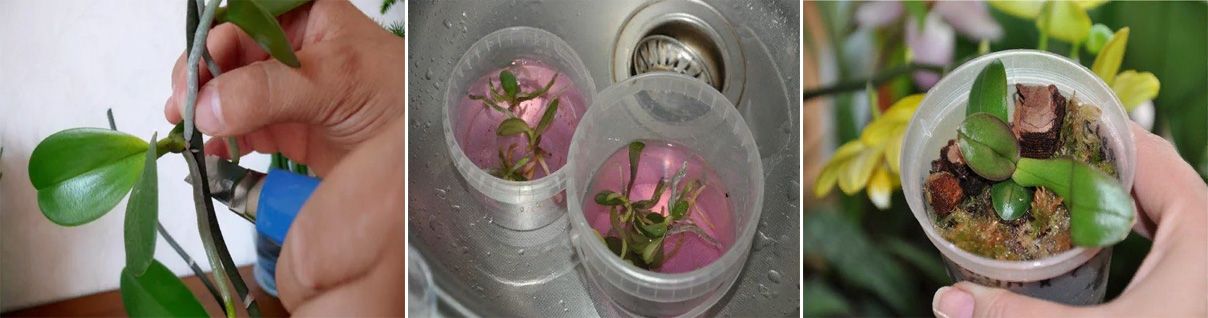
Cattleya plants tend to form offspring. When these are absent, it's recommended to use cytokinin paste to stimulate growth. Propagation occurs as follows:
- A daughter shoot is carefully cut from the mother plant. The offspring should be fairly developed, with living roots and several leaves.
- The sprout is soaked in Kornevin for several hours.
- The cuttings are planted in a pot with bark and moss.
- The recommended temperature is maintained in the room (+22…+30 ºС), diffused light is created, and the soil is moistened.
Mistakes in Cattleya Care and How to Fix Them
If care is improper, the plant will become ill and may even die. Therefore, it's important to know the underlying cause of the orchid's condition so that any problems can be addressed promptly.
| Symptoms | Error |
| The flower stalk dries up without producing buds. | Lack of light, moisture or fertilizer. |
| The leaves and bulbs turn yellow. | A burn has been caused. |
| The leaves change color to dark green, the leaves become softer and droop. | Lack of lighting. |
| The tips and edges of the leaves dry out and turn brown. | The room temperature is too high. |
| The flower stalks have stopped developing, and only new shoots are being formed. | The flower is too young (it has three or fewer pseudobulbs) or the orchid is not being watered correctly. |
| The bulbs at the base turn black and appear to be wet. | Excess moisture. The situation is aggravated by low temperatures and drafts. |
Diseases and pests
Cattleya is susceptible to the following diseases:
| Diseases/pests | Symptoms | Reasons | Elimination |
| Mosaic | The leaf blades and flowers lose shape, and variegation appears. | A fungus that begins to synthesize in overly wet soil. | Liquidation along with the pot. |
| Chlorosis | Yellowish streaks on the leaves. | Iron deficiency. | Repotting in new soil, spraying the leaves with fertilizer. Water only with soft water, as hard soil causes salts to form in the soil, which interferes with iron absorption. |
| Root rot | Leaves and shoots turn black. Mold appears at the base. | Overwatering. | Destruction or resuscitation. |
| Spider mite | White plaques and a fine web are visible on the leaves. The green color fades, first turning grayish, then brown. | Insufficient air humidity. | Treatment with Fitoverm, Actofit or Vermitek. |
| Shield aphid | Brown plaques appear on the blades and pseudobulbs, and the leaves become dull. | Dry air. | Removing plaques manually, treating with soap solution. |
Resuscitation
Mistakes in home care, various diseases, and insect infestations lead to rhizome death. The plant requires resuscitation. This is done as follows:
- The flower is soaked in water for two hours daily.
- Once the roots appear, manipulations stop.
- When the first three shoots grow to 6 cm, the plant is planted in a narrow pot.
Resuscitation may take several weeks or even a year. It is recommended to perform the procedure during warmer months or in a greenhouse at temperatures between 20 and 25°C.