Clivia is an evergreen perennial native to the rainforests of South Africa. Discovered by scientist John Lindley, it was named in honor of Charlotte Clive, Duchess of Northumberland. The genus Clivia, in the Amaryllidaceae family, comprises five main species, including two ornamental ones.
Content
- 1 General description of clivia
- 2 Types of Clivia
- 3 Clivia care at home - a table by season
- 4 Soil requirements
- 5 Watering and fertilizing
- 6 Flowering and dormant periods
- 7 Landing and transplanting
- 8 Reproduction
- 9 Clivia pests and diseases - how to treat them
- 10 Mistakes in caring for clivia
- 11 Top.tomathouse.com informs: Clivia is a flower for Sagittarius
General description of clivia
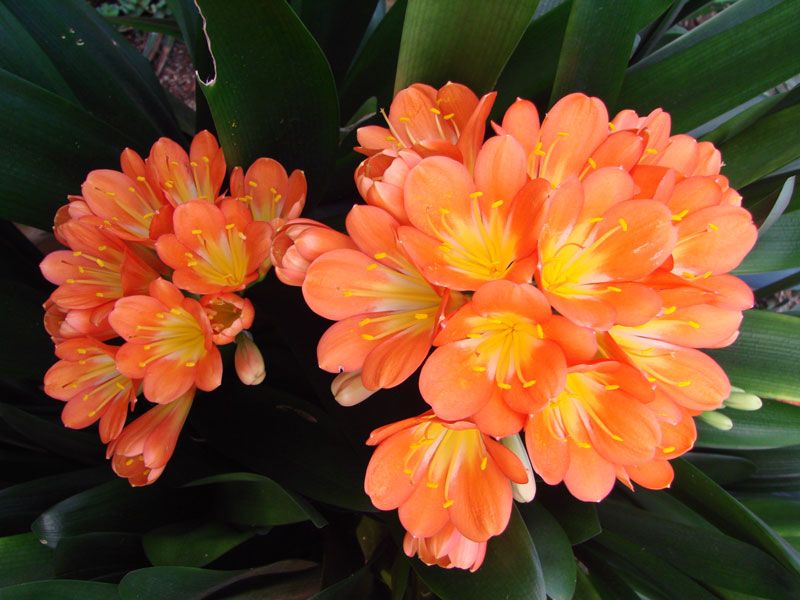
The herbaceous leaves have a thickened base and are gathered into a rosette. Flowers are red, yellow, or orange, arranged in large clusters. They bloom twice a year: the first in February or early March, the second in late May or early June. The roots are thick and strong, capable of storing moisture and nutrients.
The plant is considered easy to grow and can be placed on any window in the home. Of the variety, the most cultivated are Clivia miniata and Clivia nobilis. The former is used medicinally by the Zulu people as an antidote for snake bites and a remedy for fever. However, experts warn that the roots of the flower are toxic due to the presence of alkaloids, so they should be used with caution.
Types of Clivia
There are five species of clivia found in the wild, and several more have been bred from them through selective breeding:
- Clivia miniata (cinnabar) is the most common variety; one peduncle can bear 15 to 20 orange-red inflorescences; flowering peaks in February–March.
- White – fleshy, strap-shaped leaves, white bell-shaped flowers gathered in inflorescences of 20. Blooms in early spring.
- Yellow - several yellow umbrella-shaped flowers are located on an elongated peduncle, the leaf blades are belt-shaped, the peduncle opens in mid-spring.
All three species reach a height of 70 cm. In addition to these crops, there are also the following varieties
| Type, description | Inflorescences | Leaves | Flowering time |
|
Noble - bred in the Old World back in 1828. Plant length is 30 cm. |
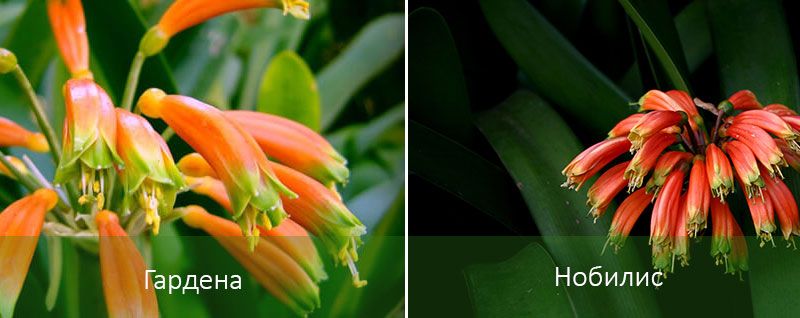
On a half-meter peduncle there are up to 60 orange inflorescences of a tubular-drooping shape. | Sword-shaped, dark green in color. | The second half of February. |
| Nobilis is a native plant of the Cape Province of South Africa. | The flower stalk is thick and elastic, with several umbel-shaped flowers of pale red color ripening at the end. | Long, rich green in color with a tapered end. | The second half of winter. |
| Gardena (gardenii) - discovered in 1856 by Robert Garden. Plant height up to 50 cm. |
Red-orange bell-shaped buds. | Sword-shaped, length varies from 40 to 90 cm. | Late autumn – early winter |
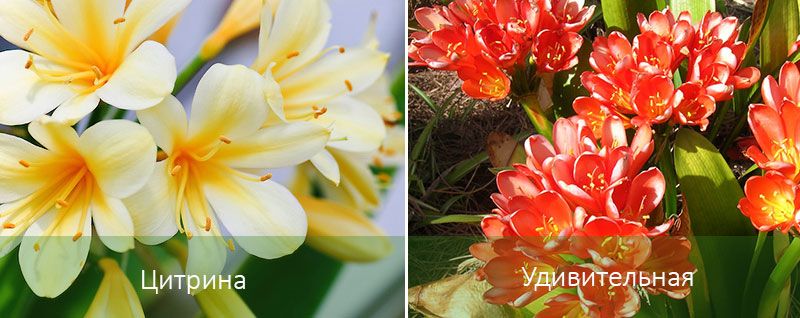
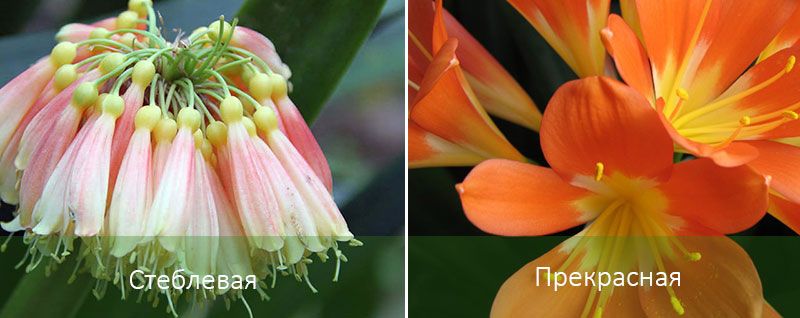
| Beautiful. | 50-60 orange tubular inflorescences. | The length of the crop is 30 cm. | Mid-January – early February. |
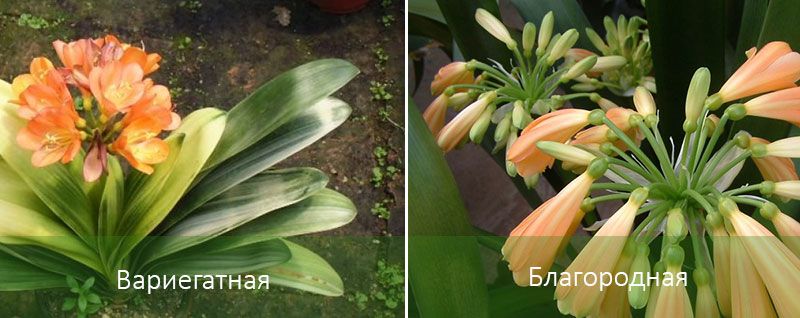
| Citrina (citrina) was bred in the early 19th century. The plant grows to 60 cm in height. | Delicate cream. | Bright green, belt-shaped. | From February to March. |
| Stem - year of opening 1943. | Red-orange, bell-shaped. | Forms a stem from the lower drying leaf blades, from which aerial roots emerge. | Spring and summer, less often autumn. |
| Amazing - discovered in 2002. | Drooping bell-shaped inflorescences of coral-orange color. | The base is burgundy and there is a white stripe down the middle. | Winter. |
| Variegated. | Blossoming bells of ochre color. | Smooth belt-shaped ones are colored with a white stripe in the middle. | May - June. |
| Powerful.
The height reaches 2 m. |
The bell-shaped flowers are collected in an umbrella-shaped brush. | Long, sword-shaped. | January. |
Clivia care at home - a table by season
In order to grow a healthy and beautiful plant, you should consider the following.
| Season | Summer | Rest period | Emergence of the flower stem |
| Temperature conditions. | +20…+25 °C. | +12…+15 °С | .+20…+25 °C. |
| Lighting. | Natural, outdoors in partial shade. | Place on a northern-facing windowsill, shade. | Move to western or eastern windows for maximum lighting, but avoid direct sunlight. |
| Watering. | Not strong, as the moisture evaporates. | From once a week to once a month. | Not strong, as the moisture evaporates. |
| Top dressing. | Once every 14 days. | They don't. | Once every two weeks. |
| Humidity. | It doesn’t matter, the leaves are washed as the surface becomes dusty. | ||
Soil requirements
Clivia requires proper drainage. A 2:2:1 mixture of leaf mold, turf, and sand is best. Another combination, 1:2:1, can also be used: humus, turf, and peat, with a little sand added.
Watering and fertilizing
During warmer months, clivia requires regular watering. During the dormant period, watering is either minimal or extremely infrequent. During flowering, copious irrigation with room-temperature water is recommended.
The plant requires organic and mineral supplements at a rate of 2 g per 2 liters of water and only during flowering. Fertilizing is recommended once every two weeks. Nitrogen fertilizers are also given sparingly, as they slow flowering and, conversely, promote leaf growth.
Flowering and dormant periods
To prevent clivia from becoming overly bloomed, it's recommended to provide it with adequate rest. Plants should rest for 2-3 months before budding begins. Therefore, if they bloom in the spring, they should remain dormant during the winter. If they bloom in the winter, they should recuperate in the fall. During this time, the plant is moved to a cooler room, where the temperature is maintained between 10 and 12°C.
Simultaneously with the transplant, reduce watering, and if leaves fall, apply a small amount of water. During this time, do not feed the plant.
The resting period ends when the plant produces a flower stalk, which can be approximately 10-15 cm long. The pot is moved to a warm room and watered generously. During budding and flowering, it is not recommended to move the plant to another room or outdoors, as the temperature change can cause the clivia to drop its buds without opening.
After flowering, watering continues, gradually preparing the plant for the dormant period.
Young clivias delight the eye with their inflorescences every year, while adults do so twice a year.
Landing and transplanting
Despite their fussy growing conditions, clivias don't tolerate transplanting well. Therefore, they are only disturbed when the roots emerge from the soil. Young plants are repotted no more than once a year, while mature plants are repotted every two to three years.
For plants that are 10 years old or older, the soil is improved by removing the top layer of soil in the pot to a depth of 5 cm and replacing it with new soil.
Transplanting from a smaller pot to a larger one begins after flowering. If a wound appears, sprinkle it with crushed activated charcoal powder to prevent root rot. Each subsequent container should be 3 cm larger than the previous one. If the container is too large, the plant will focus on root growth rather than flower stalk formation.
Place drainage stones at the bottom, then add the prepared potting mix. If you're buying it from a store, choose orchid soil, which is ideal for clivias.
Before placing the potting soil in a pot, it must be disinfected. This can be done in several ways:
- place in microwave for a few minutes;
- treat with hot water or a weak pink solution of potassium permanganate (potassium permanganate);
- Place in the oven at maximum temperature for a quarter of an hour.
These measures are designed to destroy fungal spores and pest larvae. The use of fungicides and other chemicals is not recommended, as they also kill beneficial microorganisms.
About 30 g of fertilizer, which includes phosphate flour, is added to the prepared soil.
Transplantation sequence:
- Water the clivia a few hours before repotting. Carefully remove the damp root ball. Any rotted or broken roots are trimmed, and the wounds are treated with activated charcoal powder.
- Drainage is poured into the bottom of the flowerpot.
- Then add a 3 cm layer of soil and transfer the plant. Spread the roots and cover with the remaining soil up to the root collar.
Reproduction
Clivia is propagated in several ways:
- Baby bulbs form near the adult plant; they are carefully dug up and planted in other pots.
- You can propagate by cuttings. To do this, wait until the shoot has four independent leaves and separate it from the mother plant after it has flowered. First, place it in a room with a temperature of 16–18°C and water it moderately. After two weeks, the young shoots will root and be cared for in the same way as larger flowers.
- Clivia seeds can be grown at home from plants older than 7 years. They are planted in small trays immediately after being collected from the mother plant, as they quickly lose their viability (ability to germinate). Cover the containers with plastic or a mini-greenhouse. Seedlings will appear in about 30 days, and planting in permanent containers occurs after the first true leaves appear.
Clivia pests and diseases - how to treat them
If the soil was disinfected before repotting, the risk of disease is minimal. The most common pests affecting clivia are mealybugs, rot, and scale aphids.
| Pest | How to treat |
| Mealybug - leaves cotton-like spots. | Remove the pest with damp cotton swabs; in case of severe infestation, use insecticides. |
| Shield aphid - brownish-red spots appear on leaf blades. | To kill insects, add a few drops of industrial alcohol or kerosene to a soap solution. Apply this to the affected areas, then spray with Inta-Vir, Akarin, Aktara, or a green soap solution. |
| The rot causes the leaf to turn yellow and the flower to die. | Treatment involves removing rotting roots, treating wounds with activated charcoal, and replanting in a new pot. |
Mistakes in caring for clivia
In addition to pests, clivia can wither due to improper care at home.
| Manifestation | Cause | Elimination measures |
| The leaves are turning yellow. | Natural aging of the leaf blade. | Not required. |
| Over- or under-watering. | Remove rotted roots and treat wounds. Reduce or increase watering depending on the cause. | |
| Low fertilizer content. | Fertilize every 2 weeks during the flowering period. | |
| Redistribution of forces at the time of flowering. | Remove the flower stalk after flowering. | |
| Reaction to drafts. | Move to a place protected from drafts. | |
| Frequent movement around the apartment. | Move only for rest or flowering. | |
| Consequences of transplantation. | Wait for rooting, maintain the correct temperature and follow the watering regime. | |
| Brown spots. | Sunburn. | Move to partial shade. |
| The leaves become faded and pale. | Irregular feeding. | Follow the recommendations for the amount of feeding. |
| There are no pests, but the leaves are rotting. | Damage to the root system. | Stop watering and wait until the soil dries. |
| Brownish tint at the tips of leaf blades. | Excess moisture. | Water moderately, do not allow water to accumulate in the trays. |
Top.tomathouse.com informs: Clivia is a flower for Sagittarius
Since the flowering period for most species of this crop falls in November and December, when according to the astrological calendar the sun is in the sign of Sagittarius, astrologers consider clivia to be its patron flower.
At the same time, the plant is surrounded by omens and superstitions. Most of these stem from its poisonous nature. Therefore, neither the flowers nor the fruits of the plant should be eaten.
Families with small children, who are attracted to the brightly colored flowers, should be especially careful. Signs of poisoning from the sap include vomiting, abdominal pain, chills, and drowsiness.
People who want to improve their well-being are advised to perform a simple ritual: during flowering, place a yellow coin in a flowerpot.
There's also a superstition: if a clivia was blooming and suddenly stops blooming, changes await the home's owners, including possible financial losses. If a healthy flower suddenly dies, superstitious people also consider this a warning sign.
Avoid placing any type of flower in the bedroom; the living room is the best room. The sword-shaped leaves symbolize victory over enemies, so esotericists recommend placing the flower in offices for success and protection from competitors.