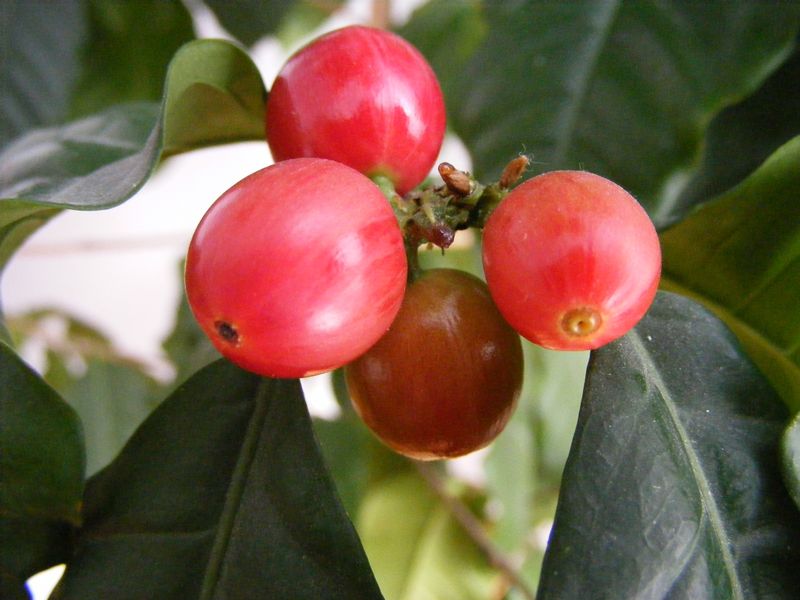
Coffee is a tree native to Ethiopia, belonging to the Rubiaceae genus. It was long rejected as a houseplant due to concerns about its difficulty in cultivation. However, with proper care, this unusual, exotic plant can not only flower but also produce fruit suitable for making a truly authentic coffee drink.
Content
Coffee tree varieties
Of the wide variety of coffee trees, only three varieties are suitable for indoor conditions.
| Variety | Description |
| Arabian | A compact tree with elliptical or elongated olive-green leaves. Their surface is smooth, and the underside is pale. It has small inflorescences (no more than 2 cm), the flowers blooming alternately, followed by the formation of burgundy-colored, berry-like fruits. The seeds ripen in eight months. It grows up to 5 meters. |
| Dwarf Nana | Reaching no more than 1 meter in height, it boasts an abundance of flowers and, with proper care, an excellent yield of seeds. By pruning and pinching, the tree can be given a unique shape. |
| Liberian | The most popular variety for growing indoors. The leaves are large, growing up to 40 cm. The flowers, gathered in a light-colored inflorescence, are also quite large. The fruits are scarlet or orange. |

Growing conditions at home
If you want to get a healthy plant, it is recommended to take into account a number of important nuances.
Location, lighting
The coffee tree loves light, so it's best placed on south, southeast, and southwest-facing windows. However, it can tolerate shade; placing it on a north-facing window will slow growth and result in incomplete flowering. Shade is recommended after fruit set.
Interestingly, sometimes growth retardation can also be caused by excessive lighting, especially in young plants.
Temperature
The best temperatures in spring and summer are 21 to 23°C. In autumn and winter, the ideal temperature is 14 to 15°C. Avoid temperatures below 12°C, as the tree may die.
Humidity
The plant requires high humidity. Even frequent misting may not be sufficient.
Priming
The plant requires acidic soil: humus, turf, leaf mold, and sand, taken in equal proportions, with the addition of two parts peat. This substrate is used when planting young plants and for replanting mature ones.
Drainage is essential. It's best to add fine sphagnum moss to maintain soil moisture and acidity.
Watering
In spring and summer, coffee trees need to be watered generously; in winter, moisture is less important. Soft rainwater is best.
Since coffee beans absorb moisture from the air, they need to be misted daily. Wiping them with a damp sponge is also recommended. Occasionally, the tree can be sprayed with warm water from a shower or by pouring water into a tray.
Fertilizer
Coffee trees are fertilized in spring and summer during the growing season; there's no need for this in winter. Potassium- or nitrogen-rich liquid fertilizers are suitable. A solution of chicken manure (500 ml per 1 liter of water) can also be used. Another option is a bone meal solution (200 g per 10 kg of soil). Fertilize at the roots, keeping the soil moist.
From early spring until the first frost, coffee is fed with complex fertilizers for roses and azaleas; this should be done every day.
Pruning and tree shaping
After the initial planting, the coffee tree grows to a height of 20-25 cm within a year. During the growing season, axillary buds—the seeds of future branches—form. Crown growth actively occurs in the second year. Pruning the plant is not recommended during this time. Branches grow perpendicular to the trunk, resulting in a wide, lush crown.
Transfer
The tree is repotted in the spring every first three years. Initially, the plant's pot should be no more than 12 centimeters in diameter. Subsequently, the pot is increased by 5 cm each time. At three years of age, repotting every three years is sufficient, but the top 3-5 cm of soil should be replaced annually. Failure to follow these guidelines will prevent the plant from blooming.
Planting a plant
The specifics of tree planting directly depend on the chosen method of its propagation.
Reproduction
There are two methods of obtaining a complete plant:
- seed;
- cutting.
Seed propagation
Use regular, unroasted coffee seeds. Germination steps:
- Scarify the grains (break the shell). This process can be done chemically (by quickly dipping the seed in cheesecloth into sulfuric or hydrochloric acid) or mechanically (by making a cut or filing).
- Soak the prepared grain in a growth stimulator (Zircon, Epin or Kornevin).
- Prepare the soil in advance (preferably six months before planting). It should consist of one part steamed turf soil, two parts peat and two parts sand, and you can add some ash.
- Pour drainage and prepared substrate into the pot, take a seed and, with the flat part down, deepen it into the soil by about 1 cm.
- Water, cover with transparent material (glass, film).
- Place in bright light, but not in direct sunlight. Maintain a room temperature of +20…+25°C.
- Periodically remove the cover and spray the planting.
If you follow the instructions, the seeds should sprout within a month. When leaves appear, repot. Use a pot no larger than 7 cm in diameter but deep enough. Be sure to protect the seedling from direct sunlight. After a month, repot again, using a larger container.
Cuttings
This method has a number of advantages:
- 100% result if the rules are followed;
- the properties of the mother tree are completely transferred to the new one;
- the time it takes to grow a full-fledged plant is reduced, meaning you can get your first harvest faster;
- the tree grows in width.
Stages of cuttings:
- Prepare the substrate using a mixture of perlite and peat. It should be loosened, oxygenated, and moist.
- Water the prepared soil with a weak solution of potassium permanganate for disinfection.
- Prepare a cutting by selecting a one-year-old branch from the middle of an adult tree and using a sharp knife cut it three centimeters below the leaf.
- Make scratches with a needle along the bottom of a freshly cut branch to improve root formation.
- Place the cutting in a root growth stimulating solution for three hours. For example: one tablespoon of honey per 200 ml of water or ¼ of a Heteroaxin tablet per 1.5 liters of water.
- Place it vertically so that only the lower part is submerged. Then plant the cutting in soil, deepening it about three centimeters so that the part under the bottom leaf is completely covered. Cover the top with plastic (bag or film) with holes to allow oxygen and moisture to enter when spraying.
- Place the container in a shaded area. The optimal temperature for rooting the cuttings is 25°C.
Diseases and possible difficulties when growing
During growth, coffee is attacked by insects (spider mites, scale insects), and diseases develop, in particular fungi.
For any of the above problems, wipe the foliage on both sides with a sponge soaked in soapy water. Only then can you use specialized anti-parasite treatments, such as Actellic or Karbofos.
Take 10 drops of any of these products and dilute them in 10 liters of water. If the coffee plant is heavily infested, repeat spraying is essential. The interval between treatments should be at least a week.
Rubbing alcohol is effective against aphids; wipe both sides of the foliage with it. Copper sulfate is used against fungus.
It is also worth remembering a number of rules:
- when planted in soil that is not acidic enough, the tree's foliage may turn pale;
- if the room temperature is below +10 degrees, the tree dies;
- If the air in the room is dry, the leaves curl up.
When to expect the harvest?
When growing a tree from seeds, the first fruits will appear no sooner than four years later. A tree grown from a cutting produces fruit in the first year of flowering.
By following all the above coffee care guidelines, you can not only enjoy a delicious beverage but also decorate your home. The beans can be used to create all sorts of decorative elements.
Coffee is believed to help combat migraines and fatigue. It is used to dilate blood vessels and increase blood pressure. It is occasionally used for poisoning.
It's worth noting that, according to Feng Shui rules, this tree has a number of unique properties. It is believed that placing it in a home improves well-being and family relationships. This plant is considered a type of money tree.
Placing this tree in the bedroom guarantees a long and happy marriage. This plant attracts positive energy into the home, which is already a good reason to grow a coffee tree.