Kohleria is a herbaceous perennial plant in the Gesneriaceae family. It is native to the tropics of Ecuador, Colombia, Mexico, and Venezuela. More than 60 species are found in the wild. It is distinguished by its unusual color palette and long flowering period. It is named after the 19th-century botanist Michael Kohler. Another name is Colombian beauty.
Description of the color
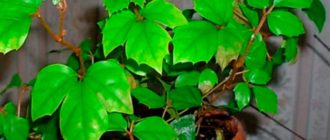
Kohleria grows in the shade of trees in humid tropical forests as a shrub or subshrub, 60-80 cm tall. The leaves are arranged opposite each other on the stems. They are oval, elongated, with serrated edges and pubescent, up to 18 cm long and 8 cm wide. Leaf colors vary: dark green, emerald with red veins. Olive and light veins are also found. Hybrid varieties have silvery and bronze coloring.
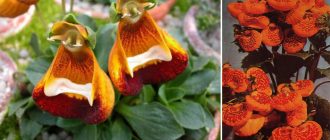
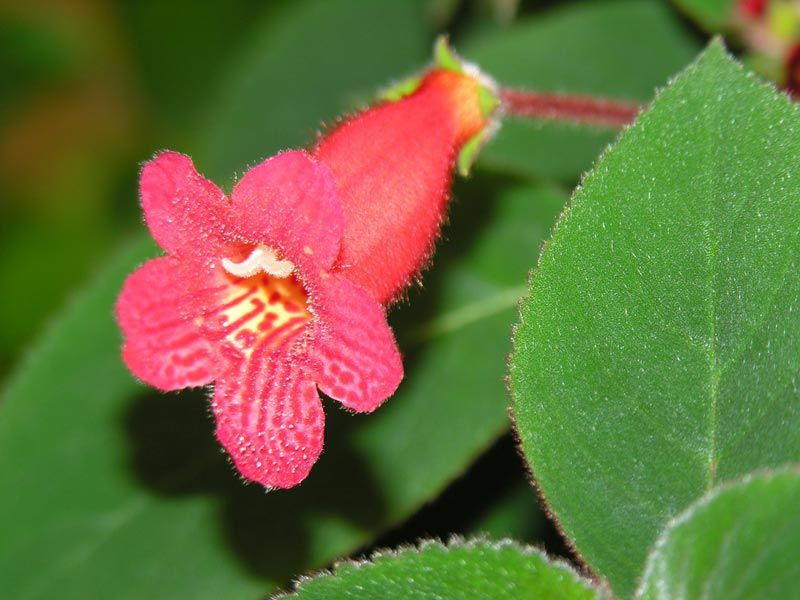
The unusual flowers (1-3 per inflorescence) are asymmetrical, bell-shaped, up to 5 cm long, with a corolla that narrows near the throat and swells at the other end. The throat is open, decorated with specks, dots, or streaks, and has five lobes. The flowers can be one color, while the throat is a different, speckled color. It blooms in July and continues until the end of November.
The root system consists of rhizomes or tubers covered with scales. They resemble pine cones in appearance.
Varieties of colors
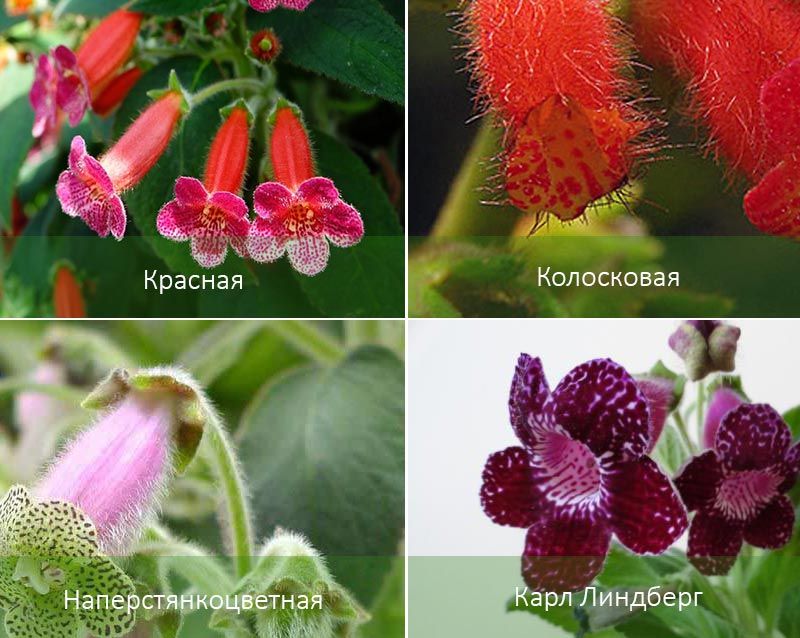
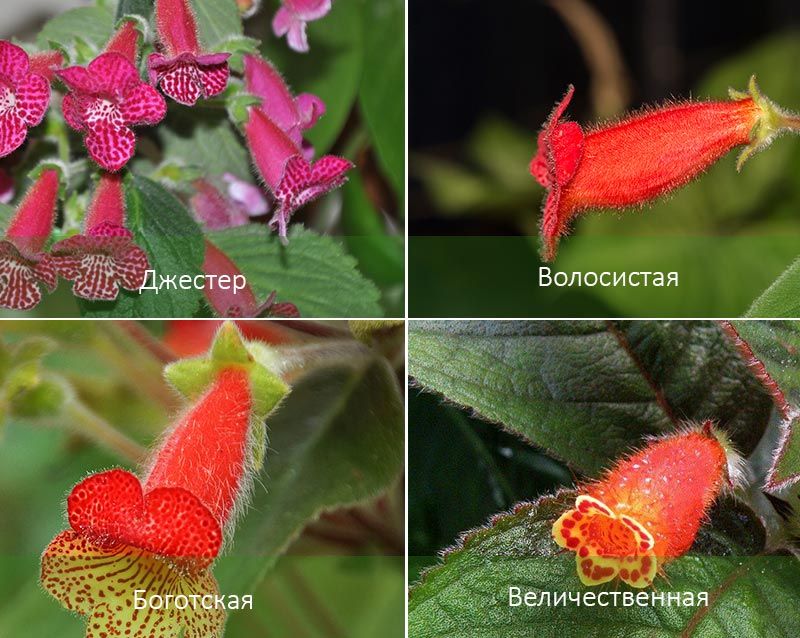
The types and varieties of decorative flowers differ in shape and leaf color:
| View | Leaves | Flowers and the period of their formation |
| Bogotá | Long up to 10 cm, dark emerald. | The tube is red-yellow, scarlet, with bright orange and red stripes inside. They bloom in summer and continue until autumn. |
| Red (grandmother's) | Dark green, covered with hairs. | Large, red with beige speckles. |
| Majestic | With light edging on top. | Large, sunny with bright scarlet dots, dark red stripes inside the throat. |
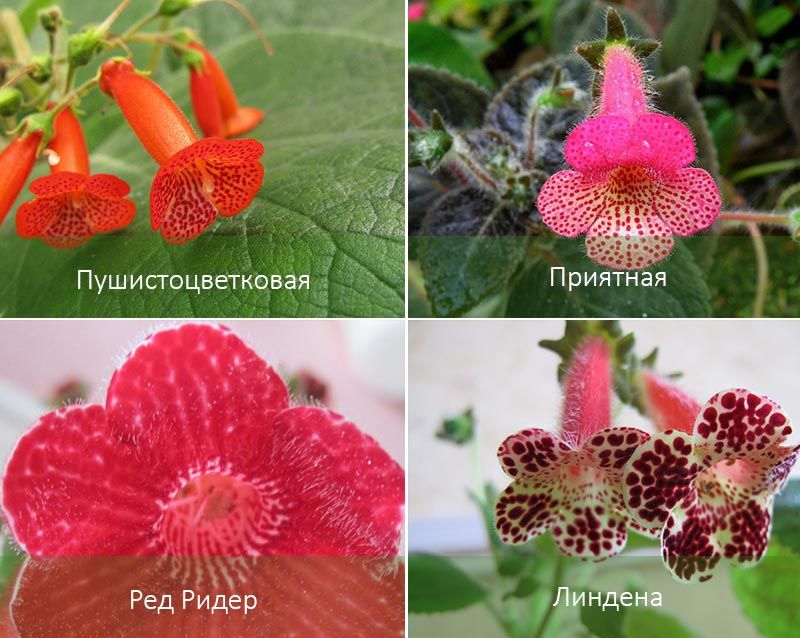
| Fluffy-flowered | Oval, soft, dark. | Orange or scarlet. White, bright red spots, blooms year-round. |
| Spikelet | Gray, elongated, with a pointed end, with silver fluff. | Orange tube, yellow inside with scarlet dots. |
| Linden (Gloxinella) | Narrow, elongated, up to 30 cm, pale pink below, green above, silvery veins, herringbone-shaped. | Purple on top, orange-hued petals with brown spots. Blooms in mid-autumn. |
| Foxglove | Long, light green, with a red border. | Bright pink with lilac stripes. Inside, light green with purple dots. Blooms in early fall. |
| Nice | Wide, up to 10 cm, variegated with brown veins and silvery strokes. | Reddish-pink on the outside, light with crimson speckles on the inside. Blooms year-round. |
| Trumpet-flowered | Oval, pointed at the top, red on the underside. | Richly sunny, not expanded at the end. |
| Woolen | Large with light brown veining. | Beige with brown and white inside, beige inclusions. |
| Dwarf (low-growing) | Fluffy, with light stripes. | Bright, orange. |
| Hairy | Bronze tint. | Scarlet, lilac specks, burgundy. |
| Varshevich | Dark green, pointed at the top. | Lilac, pink tube and yellow-green petals with brown, purple dots. |
| Uneven | Green, bright. | Red on the outside, purple speckled on the inside. |
| Flashdance | Bright green. | Large, coral, yellow with pink petals and fuchsia edging. |
| Jester | Green with a bronze tint, serrated at the edges. | Light with pink spots. |
| Carl Lindbergh | Pointed, serrated edges. | Dark lavender, covered with white dots. |
| Queen Victoria | The colors of rich grass. | Pink, the tube inside is light with red specks. |
| Red Reader | Thick, dark green. | Dark red with a white throat. |
| Roundley | Dark. | Orange, white inside. |
| Persian carpet | Green, with a red border. | Velvety, red-raspberry with an orange throat. |
Caring for a coleria at home
Kohleria is unpretentious, blooms profusely, and even a novice gardener can create comfortable conditions.
| Factor | Spring / Summer | Autumn / Winter |
| Location/lighting | Western and eastern windowsills. Diffused, sunny, draft-free light. | If necessary, add additional light with a phytolamp. |
| Temperature | +20…+25°C, without fluctuations. If it's higher, the roots won't be able to provide the new shoots with the nutrients they need for growth and development. | +15…+17°C, when the flower sheds its leaves. If there is no pronounced dormant period, care for it as usual. |
| Humidity | 30% – 60%. Place the flower pot on a tray with wet gravel or expanded clay. Use a humidifier. Do not spray. | |
| Watering | Moderate watering is carried out with warm, softened, settled water once every 5 days, around the edge of the pot. Make sure the soil does not dry out. During bud formation, water more frequently if necessary, being careful not to touch the stems or leaves. | During dormancy – once a month. If the plant is not dormant – 3-4 times. |
| Top dressing | From April to September, once every 14 days with liquid fertilizer for flowering plants. | Not required. |
Kohleria is only brought outdoors in the summer. It is grown as a trailing plant, but can be trained into a bush if desired. Overgrown and trailing stems are pinched. The top of the plant is trimmed back by one-third (20-30 cm) with a disinfected tool before buds begin to form, and the tips are trimmed off.
This is necessary for the awakening of buds and the formation of new buds on lateral shoots.
In autumn, the withered parts are removed and moved to a cool room for winter hibernation.
Transplantation and soil
The plant is repotted once a year, preferably in late March or early April, using the transshipment method. Carefully transfer the bush to another, wider, shallower pot. Do not shake off the soil.
The soil should be nutritious, loose, and slightly acidic, mixing turf and leaf mold, adding peat and sand (1:2:1:1). Another option is sand and humus, equal parts turf and leaf mold, and adding small pieces of charcoal. Beginner gardeners can purchase ready-made violet soil.
Choose a plastic pot, but ceramic is better. It's more stable and retains moisture longer. Choose a container with drainage holes, and place 2 cm of brick, pebbles, or expanded clay underneath.
Reproduction
Florists use the following methods of propagation: cuttings, leaves, division of rhizomes, seeds.
Propagating from cuttings at home is simple: cut off the top of the shoot and place it in a mixture of equal parts sand and leaf mold. Treat it with a growth stimulant (Kornerost), and heat the container from below. Moisten the soil, add Fitosporin to the water to prevent rot, and cover with glass or a cut-off plastic bottle with the cork part removed. Ventilate regularly. After rooting, repot the plant separately after two weeks. Rooting can also be done in a container with water.
The plant's leaves are treated in the same way. A plucked leaf is placed in 1-2 cm of water, with a stimulant added.
Propagate by seeds from mid-winter until the end. It's best to purchase them from a specialist store. Place the seeds in prepared soil made of peat and sand, water, cover, and do not cover with soil. Set the temperature at 20 to 24°C. Ventilate the soil daily once seedlings emerge, which should take 2-3 weeks. Once four normal leaves appear, transplant.
New shoots and roots form from the rhizomes. The mature plant is removed from the soil and divided into several parts (usually three). Each part should have two healthy shoots. The cut areas are sprinkled with charcoal and allowed to dry. Each part is planted in a cup with prepared soil. The plant is buried 2-3 cm deep, covered, and watered regularly with warm water.
Difficulties in growing Kohleria
If all the rules for growing kohleria are not followed, it may become less attractive.
| Manifestation | Cause | Elimination measures |
| The leaves turn yellow and curl. Brown spots appear. | Too dry air. Sunburn. | Humidify the room and shade it from direct sunlight. |
| Does not bloom. | Lack of light and nutrition. The air in the room is cold or too warm. | They increase or decrease the temperature and feed them. |
| The leaves become spotted. | Water got in while watering or spraying. | Water is poured into the tray. |
| The flower wilts or the shoots stretch out. | Not enough light. | They provide additional illumination with phytolamps. |
| The roots are rotting. | Abundant watering. | They are replanted, removing the diseased parts. |
| The plant is covered with a grey coating. | Fungal disease. | Damaged shoots are cut off and treated with a fungicide. |
| Brown spots. | The water is too cold for irrigation. | Warm up the water a little. |
| The leaves become deformed and dry out. | Aphid. | They are collected by hand and treated with a soap solution. |
| The leaves are covered with small, light spots, curl up and fall off. | Spider mite. | Remove damaged leaves, water the soil with Aktara, and humidify the air more frequently. |
| Silvery streaks, black dots. Pollen is falling off. | Thrips. | Processed with Spark. |
| Sticky drops, brown insects. | Scale insect. | They are removed and then sprayed with an insecticide (Inta-Vir, Confidor). |
| White coating on shoots. | Powdery mildew. | The above-ground part is cut off, the rhizome is treated with a fungicide (Fundazol, Topaz). |
| Drops buds. | Excess calcium in the soil. | They are changing the soil. |