A tall shrub in the Lamiaceae family bears the beautiful name of Coleus Blumei. The plant is popular, often found on windowsills and in gardens, and is widely used in landscape design.
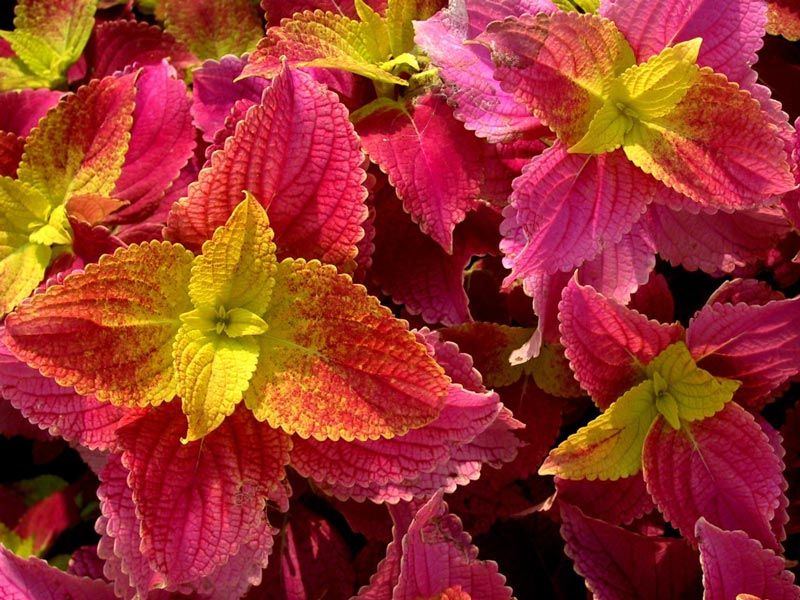
Blume is grown not for its flowers, but for the variety of leaf colors. The extraordinary beauty of the combinations of yellow and red, green and deep purple, and light green and creamy white is captivating. It feels velvety to the touch. Among the hybrids, the most sought-after is the Rainbow blend.
Description of Coleus Blume
The shrub's native land is the tropical forests of Southeast Asia, Africa, and Australia. Today, there are approximately 150 known wild species, and even more hybrids. New, vibrant varieties appear every year.
The plant's stem has a square cross-section but remains quite fragile; over time, woodiness begins at the base. Branching begins at the base. The leaves are arranged in pairs, crisscrossing each other. They also serve as the bush's ornamentation, velvety to the touch. Depending on the variety, it comes in a variety of colors. The resemblance between coleus and stinging nettle is noticeable even to the untrained eye, but the magical colors transform this common weed into the queen of the garden.

Blume blooms in a complex spike, the inflorescence located at the crown and side shoots. The flowers themselves are so unsightly compared to the foliage that they are simply carefully removed to avoid weakening the plant, and are only left in cases where seed production is desired.
They mostly grow mixtures; the regular botanical variety is too large (3 meters). Hybrid coleus is much more interesting and vibrant. It grows up to a meter tall, and its trunk does not become woody, preventing leaf shedding.
Varieties of Coleus Blume
Among the artificially bred varieties, the following are the most famous and in demand.
Rainbow Series Hybrids:
|
Variety |
Leaf color |
| Wizard | There are different shades and mixtures. |
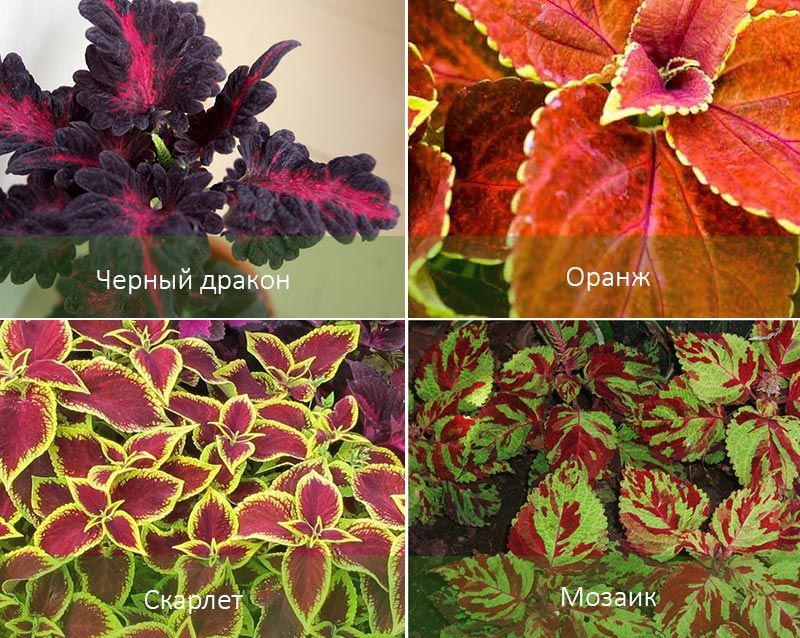
| Orange | Lemon border with orange center. |
| Evening dawn | A green outline frames a rich red leaf. |
| Black Dragon | The brownish-purple leaf is dissected with scarlet veins. |
| Fun | Different shades and combinations. |
Wizard series hybrids:
|
Variety |
Leaf color |
| Scarlett | Light green border with a burgundy center. |
| Mosaics | Burgundy spots on a green leaf. |
| Jade | Yellow center with green border. |
| Coral | The coral color center is framed by a brown-green outline. |
| Magical jade | Salad edge with white core. |
| Velveteen | The dark red leaf is bordered by a light stripe, a carved outline. |
| Golden | Saturated yellow shades. |
| Scarlet | Red with lemon border. |
| Sunset | Orange leaf with light edging. |
Planting and caring for Coleus Blumei
Regardless of the variety, the plant prefers warm, well-lit areas. The brighter the light, the more beautiful and vibrant the color. It can be planted in shaded areas, but don't expect the shades to be as rich. The color won't fade, but it will appear pale.
During hot periods, watering should be generous; spraying the leaves is not recommended. Reduce watering in winter and fall.
When planting, you can use a general-purpose potting mix, but you can also make your own. Mix equal parts garden soil, peat, sand, and humus.
Propagation of Coleus blumei
The plant is easy to propagate. To obtain young plants, cuttings are used. To speed rooting, the cut is made in the middle of an internode. Take a lateral shoot from the parent plant and place it in water. Once roots appear, transplant the seedling into the ground.
Some gardeners plant the cuttings directly into the ground; no problems have been noted with this method of propagation.
Propagation by seed requires no preparation, and there's no need to prepare seedlings. Coleus produces good seedlings in soil warmed by the spring sun.
Diseases and pests
Coleus is not susceptible to disease; its strong immune system protects it from most ailments. During the summer, plants in flowerbeds need to be watered daily, as they quickly lose their decorative qualities if allowed to dry out.
Due to the need for frequent watering, the plant is prone to powdery mildew. This fungal disease is treated with general-spectrum fungicides. It is recommended to remove affected leaves and flowers before treatment.
Whiteflies love the plant. To get rid of them, apply a combination of insecticides at intervals of 3-4 days. It is recommended to change the product each time to prevent the insects from becoming accustomed to the poison.
Top.tomathouse.com informs: the use of Coleus blumei and its psychotropic properties
Indigenous peoples of southern Mexico claim that the leaves of the bush have a mild, relaxing, and hallucinogenic effect. Modern science has not proven this, and the plant's psychoactivity remains understudied.
There are known cases of people experiencing some changes in consciousness after chewing the leaves and brewing tea. However, there is currently no reliable information.