Coleus is a shrub in the Lamiaceae (Labiatae) family, commonly known as "poor man's croton." These plants share similar leaves, but croton is more expensive and fussy. Its wild species resemble nettles, hence its other common name, "stinging nettle." Coleus is found in tropical Asia and Africa. It is resilient, easy to maintain, and beautiful, boasting vibrant, diverse foliage.
Breeders have developed numerous varieties with decorative leaf coloring. Thanks to these characteristics, the plant is widely used in landscape design, paired with solid-colored flowers. Coleus not only decorates flowerbeds but also looks attractive in pots, especially trailing varieties in hanging baskets and planters. In its native habitat, it grows as a perennial; in temperate regions, it is grown outdoors as an annual.
Growing and care requirements
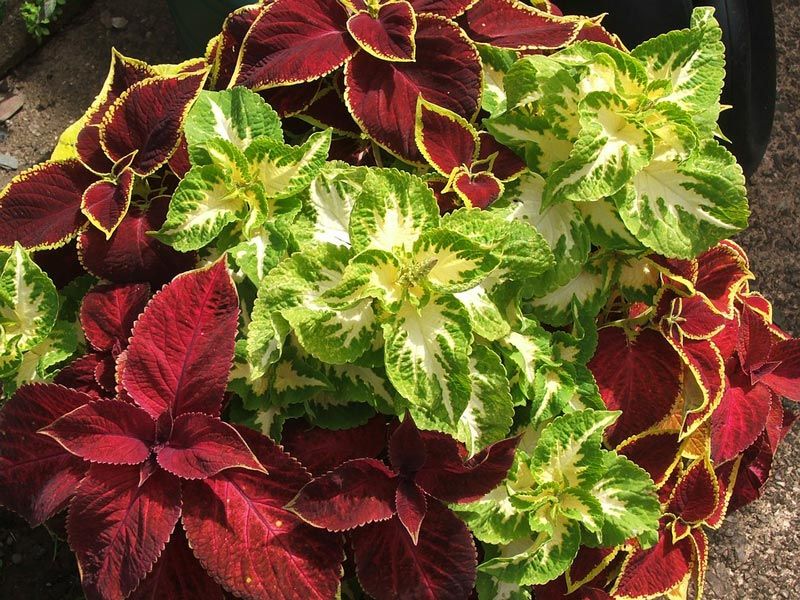
Coleus shoots are square, straight, and strong, becoming woody at the base after six months. The leaves are heart-shaped, oval, and oblong, with downy hairs and serrated edges. They are arranged oppositely and can reach up to 15 cm in length in some varieties. They come in shades of red, beige, purple, emerald, yellow, wine, and green.
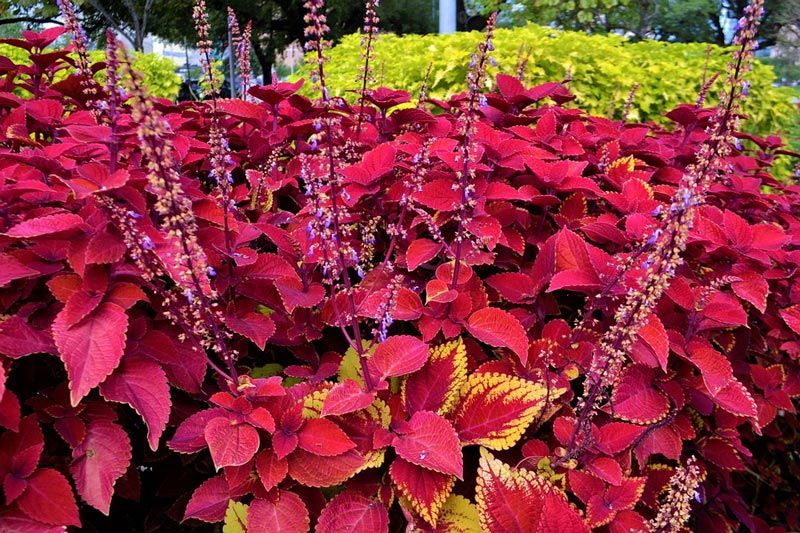
The spike-shaped flowers are blue, small and inconspicuous, but exude a pleasant fragrance. Growing from 20 to 60 cm in height, even an inexperienced gardener can grow it. It looks beautiful both indoors and outdoors on a south-, west-, or east-facing windowsill. In summer, the houseplant can be moved outdoors, to a balcony, or loggia.
Main features of cultivation:
|
Factor |
Condition |
| Landing | Sow seeds in March. Plant seedlings in open ground in May-June. |
| Lighting | Bright until midday, then light shade. Rotate the pot occasionally indoors to ensure even growth. |
| Temperature | In summer +18…+25 °С, in winter +10… +12° С. |
| Soil | Neutral, fertilized. For an indoor flowerpot: leaf mold, turf, soil, humus, peat, sand (4:4:2:1:1). |
| Watering | Water liberally as it dries. Use soft, settled water. |
| Humidity | The plant prefers high humidity of 40-60%; the leaves and air are sprayed or a tray with wet expanded clay is placed nearby. |
| Top dressing | Once a week in summer, less frequently in winter, once a month. Apply organic and mineral fertilizers alternately. |
| Transfer | Once every 3-4 years in spring, after pruning the shoots. |
| Bloom | The buds form at the top of the shoot and look like violet or lilac panicles. After flowering, the stem is pruned. |
| Pruning and pinching | Pinch throughout the growing season, then prune at the beginning of active growth in spring. Leave 2-3 buds on the shoot. |
Planting coleus in open ground
When purchasing ready-made seedlings, pay attention to the color of the leaf blades and the firmness of the stems, or take seeds and grow the seedlings yourself. The sowing month depends on the region—March, April, or May.
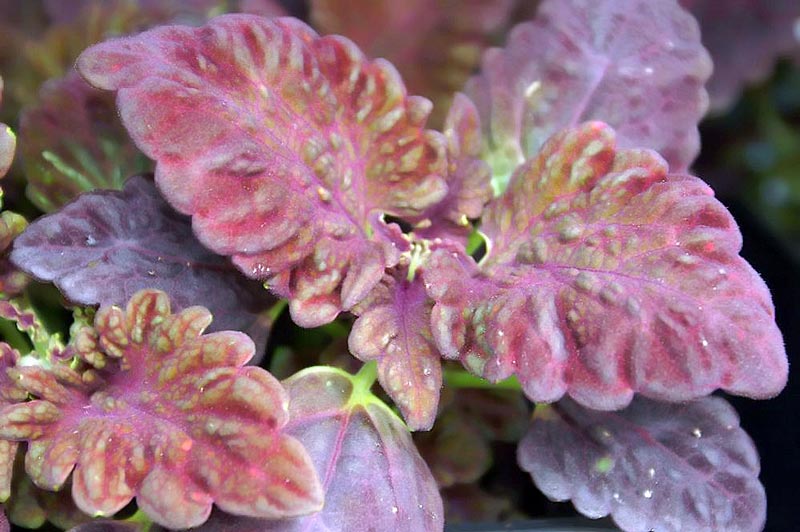
English and Dutch seeds are popular now, especially for varieties with variegated foliage. Home-collected seeds don't offer all the decorative qualities. Prepared containers are filled with leaf mold, turf soil, peat, and sand (1:1:1:1), or purchased from a flower shop. The seeds are not planted deep, but a thin layer of sand is placed on top and misted. Cover and set the temperature at 20–24°C.
The seeds germinate after 14 days. Indirect light is preferred. The first transplant is needed after 4 weeks, when two true leaves appear. The second transplant is done after five weeks, into separate containers of approximately 400 ml. Then, transplant the seedlings to their permanent location in a pot or flowerbed once the last frost has passed.
Choose a sunny area, protected from the wind, so that at midday it is slightly shaded and the leaf blades do not burn and fall off.
In open ground, coleus prefers light, permeable soil rich in nitrogen and nutrients. If grown in heavy soil, the plant will be susceptible to root rot; add sand and peat. Varieties with red and light-colored leaves prefer direct sunlight, while those with green leaves do not. Therefore, they are best placed in dappled shade.
Add a handful of peat or compost to the dug holes. Planting can be done in warm soil using the transshipment method. Timing depends on the climate: May or early June, when temperatures reach +10 to +15°C. The seedlings are buried in the holes with a lump of soil and watered thoroughly. Space the seedlings 25-30 cm apart.
To prevent fungal diseases, it is recommended to water the holes with a solution of fungicides (Fitosporin-M, Trichodermin).
Caring for Coleus in the Garden
Coleus care involves generous watering (especially in hot and dry weather) with settled tap water or rainwater in the evening or morning. The soil should not be allowed to dry out. When watering, be careful not to let moisture get on the shoots and leaves. Periodically loosen the soil and weed.
https://www.youtube.com/watch?v=d44zCvI-26k
After two weeks, apply flower fertilizer, halving the dosage indicated in the instructions. During the active growth phase, apply nitrophoska every seven days, then a wood ash solution. Subsequently, use mineral and organic fertilizers. This enhances the foliage and delays flowering.
Formed inflorescences are removed to prevent the bush from wasting nutrients on their development. Pinch the flowers when they reach 10-12 cm and trim them 2-3 times per season. At 4-5 cm, remove the top buds and side shoots, which will allow the flower to take on a rounded shape. Bushes that are too tall or heavy are supported with stakes.
Coleus (indoor and outdoor) does not tolerate sudden drops in temperature well; in cold summers its growth slows down.
Propagation of coleus by cuttings
To propagate by cuttings, trim healthy shoots to 10-15 cm, excluding inflorescences and buds. Remove the lower leaf blades. Place the cuttings in clean water (preferably dark glass), changing the water periodically. Sometimes, root formation can be stimulated with Heteroauxin or Kornevin. Keep the container with the cuttings out of direct sunlight at a temperature of 18 to 20°C. Once roots appear, plant them in the ground.
With the second option, the cuttings are buried in wet vermiculite. Sometimes they are placed in a bag and covered with a plastic bottle. After a week and a half, 1-2 cm roots will form, and the shoots are planted in small cups. Sometimes they are covered with plastic wrap. Once the coleus has grown, it is placed in open ground or in a pot with drainage. The first fertilizer is applied after 2-3 weeks.
Diseases and pests of coleus
Young flowers with insufficient light, even without pinching, have bare lower shoots. Leaves lose color in bright light and fall off if there's insufficient moisture. Insufficient light causes the bushes to stretch.
Spider mites are a pest that attacks the plant. Yellow spots appear on the leaves, merging into a large patch. Treatment with a garlic solution or Apollo or Akarin helps.
Aphids—green insects—suck out the sap from the leaves, causing them to turn yellow, shrink, and then develop black spots. Garlic and onion infusions, as well as chemicals like Akarin and Fitoverm, are used to control them.
If you're attacked by whiteflies, you can see the insects flying when you touch them. The plant will have a sticky coating. Initially, spray with a solution of laundry soap and water, an infusion of citrus peels, or, in severe cases, Aktara, Tanrek, or Actellic.
Mealybugs – when these insects appear, the coleus will be coated with a white waxy coating. Tobacco tincture, calendula alcohol solution, or Confidor or Mospilan can help.
Top.tomathouse.com informs: Coleus in winter
Perennial varieties are transplanted from the flowerbed into pots and placed near south- or southwest-facing windows or on a balcony or loggia. Old plants are dug up, pruned, and propagated. Coleus is kept as a houseplant, fertilized once a month. Watering is reduced in the fall.
During the winter, temperatures between +8 and +15°C are sufficient. If it's too cloudy, supplemental lighting is provided with phytolamps. In March, rejuvenation pruning is performed, shortening shoots and removing old leaves. When warmer weather returns and temperatures reach +10°C, replant the plants in the garden.