Hydrangea is a flowering plant of the Hydrangeaceae family.
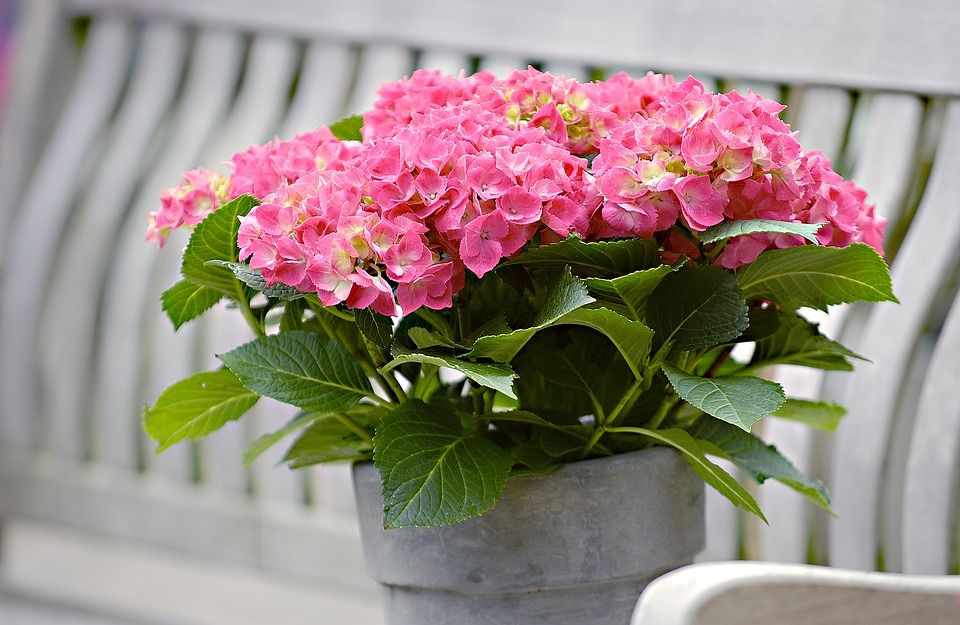
It is grown as a garden and house plant, although in the latter case it is only large-leaved.
Description of hydrangea
Hydrangea can grow up to 4 m outdoors, and up to 1.5 m indoors. Its leaves are simple and ovate, colored bright green.
Flowers are collected in 10-15 cm corymbs. Pinkish, ethereal flowers, 3 cm in size, are located along the edges. Some species have inflorescences up to 20 cm in length. Their color can be pink, white, or even blue.
Varieties of indoor hydrangea
Large-leaf hydrangea has many varieties. The most common are categorized by color:
| Colors | Variety | Description |
Inflorescences Features of flowering |
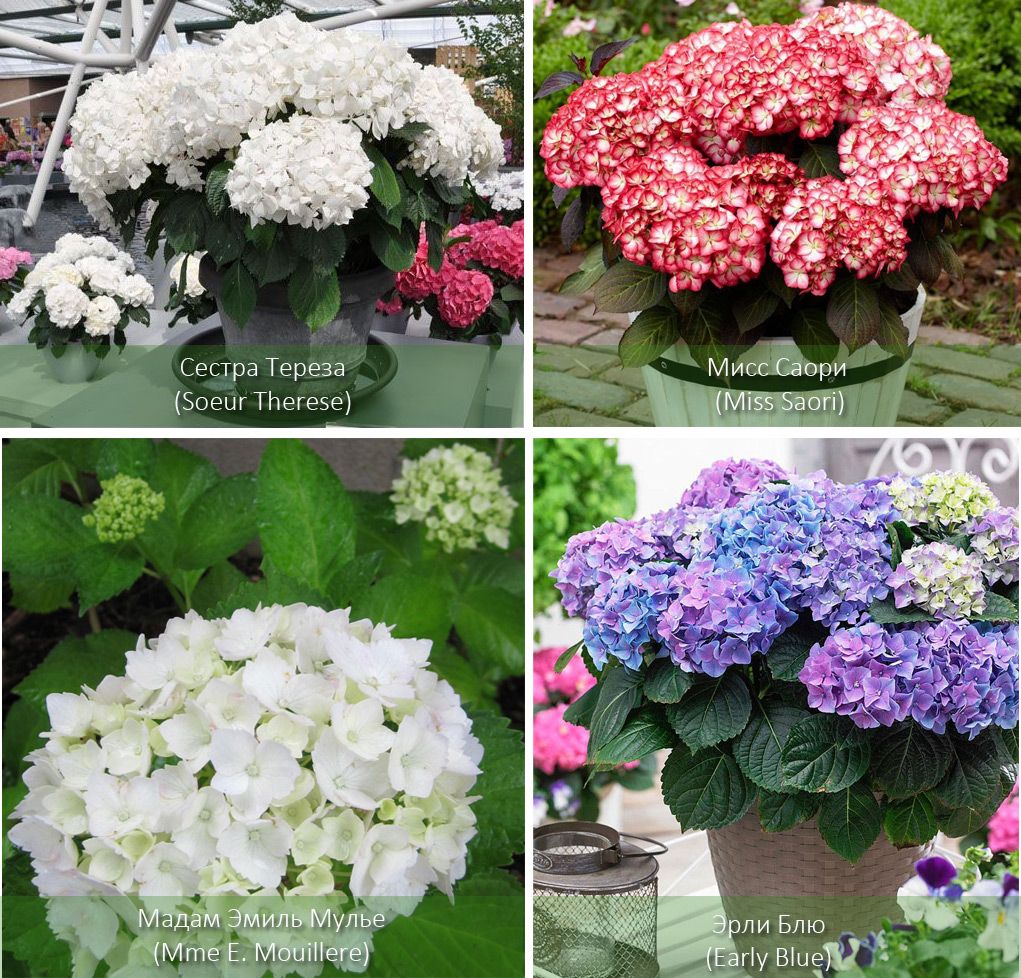
| Light shades | Sister Teresa (Soeur Therese) |
The bush is quite dense and has large leaves. |
Painted white with a slightly pinkish-lilac sheen, about 30 cm. Abundant, continuing until September. As the flowers fade, they change color to a greenish-pink. |
| Madame Emile Mulier (Mme E. Mouillere) |
Compared to various other varieties, the leaf blades are narrower. |
20 cm, and the color is white. At first they are white, but then turn slightly pinkish and bluish. The blooms are abundant and continue until October. |
|
| Blue | Early Blue (Early Blue) |
The bush is small, but its root system is quite strong. |
Reaches 30 cm. Their color is blue, as well as blue and purple shades. Slightly greenish at first. Abundant and lasting until October. |
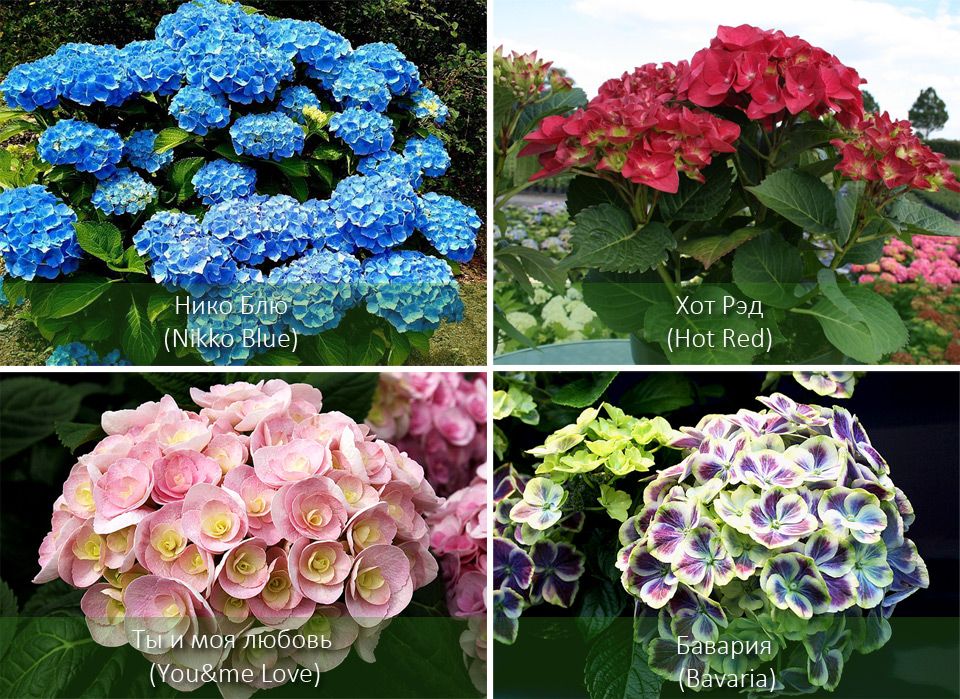
| Niko Blue (Nikko Blue) |
To ensure vibrant flowers, maintain soil pH at 5.5–7.0. The bush will grow quite quickly. |
About 30 cm. The color of the flowers is bright blue. Very abundant until September or October. |
|
| Pink | Ramars Mars | The size of the bush is not very large. | They are painted in a pinkish-crimson hue, with white edges. Despite the small size of the bush, they reach 30 cm. Continues until September. |
| Miss Saori | The leaf blades are dark green with a slight purple tint. |
18 cm. Snow-white, edged with a pinkish edging. Soil conditions do not affect the color. This variety blooms until September. |
|
| You and my love (You&me Love) | Reaches 100 cm in height. The leaves are resistant to powdery mildew. It can withstand temperatures of 29°C. |
If the soil is alkaline, the color will be pink, and if it is acidic and contains a lot of aluminum, the color will be blue. It starts in May and ends in September. |
|
| Reds | Admiration | The crown of the bush is quite dense. |
20 cm, bright red. Abundant, right up until the first frost. |
| Multicolored | Bavaria | Compact, has a small size. |
20 cm are lime-colored, with a bluish-purple tint in the middle. Rich until mid-autumn. |
| Hot Red (Hot Red) |
A bush with small inflorescences, very lush. |
15 cm. Scarlet, but if the soil acidity increases significantly, they acquire a purple color. Continues until October. |
|
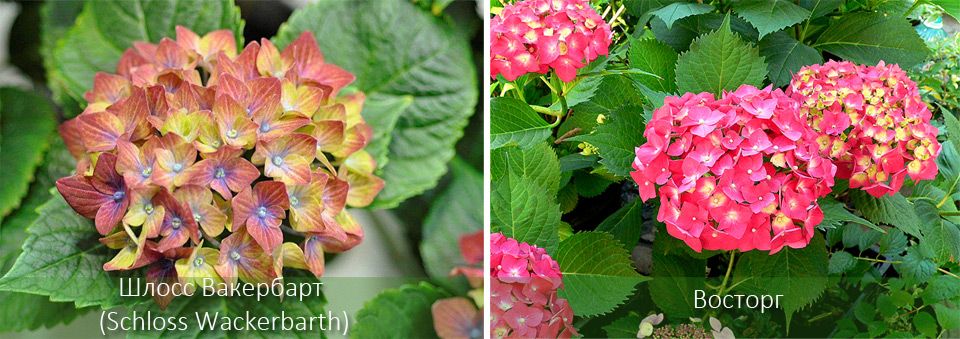
| Schloss Wackerbarth | Flowers of this variety have light stamens. | They can reach 30 cm in size. Their coloring begins as green, then turns pink, developing a blue center and green border. They last until October, sometimes until early November. |
Planting indoor hydrangea
Indoor hydrangea usually lives for about four years.
Additionally, it should be repotted annually, as it grows and requires more space. The pot shouldn't be too deep. A wide one is key, as this plant's roots grow outward. Each new container should be approximately 1.5 times larger than the previous one.
A large and beautiful hydrangea can be obtained by growing it in suitable soil, taken in the ratio (0.5:1:1:2):
- sand;
- peat;
- leaf soil;
- turf.
Compost should not be added because it has a negative impact on the flower's root system.
Indoor hydrangeas experience stress from transplanting, which negatively impacts their future development. To help them survive this process as best as possible, use the transshipment method. Place a sufficient amount of drainage material in the bottom of the pot where the plant will be placed. After this, arrange the plant in the pot and then fill the remaining space with fresh soil. The root collar of the hydrangea should be level with the soil surface.
Afterwards, you need to moisten the soil and add a little peat mulch on top. This helps retain sufficient moisture in the soil.
Hydrangea care at home: table
Indoor hydrangeas don't like bright light; their flowers fade and develop spots in the sun. Therefore, it's best to place them on a west- or east-facing window. In summer, they can be placed on a balcony, terrace, or in the garden.
| Factor | Spring/summer | Autumn | Winter |
| Lighting | Scattered. | Not necessarily. | |
| Temperature | +17…+22 °C. | +9…+12 °C. | +5…+8 °C. |
| Watering, water acidity | Once or twice a month, add acidified water, adding 5 drops of lemon juice or a pinch of its acid per 1 liter of liquid. | Acidify the water once or twice a month. | Only after the soil has dried out, acidification is not necessary. |
| Humidity | 50-60%. In the morning it is necessary to spray with soft water. | Not less than 50%. | Low. |
| Top dressing | A couple of times a month with regular fertilizer for hydrangeas. | Do not use. | |
Unusual properties
Interestingly, this flower is unique in its ability to change color based on varying soil acidity. Many are experimenting with this technique.
For example, when there's a lot of limestone, the petals turn pink, while when there's aluminum, they turn blue. Highly acidic soil allows for a more vibrant color, and vice versa.
Propagation of hydrangea
There are two ways to propagate hydrangea: by seeds and cuttings.
For seeds, sow them in the fall. Then, follow these steps:
- Prepare the soil. To do this, mix leaf mold and peat soil with sand (4:2:1).
- Place the seed in the substrate, sprinkle soil on top and moisten.
- Cover the pot with plastic wrap. Remove it occasionally to allow the soil to air out.
- The temperature should be within the range of +14 °C…+20 °C.
- When sprouts appear, you can remove the film.
- When two or three true leaves grow, it is necessary to transplant to another place.
Cuttings are taken in winter. This requires:
- Make several cuttings and treat their cuts with Kornevin.
- Plant in moist peat-sandy soil, at a depth of about 3 cm.
- Cover it with something (like film). This should create a mini-greenhouse.
- Make sure that the temperature is approximately +20 °C and the humidity is around 80%.
- From time to time, the plant should be ventilated and sprayed.
- When roots appear (this takes about a month), the seedlings need to be transplanted into other pots.
Some people use another method - layering.
To propagate it this way, you need a large, spacious pot. The process itself is as follows:
- They choose the largest branch.
- It is slightly cut and bent towards the ground, while being sprinkled with earth on top.
- The soil is kept moist.
This will allow the shoot to develop roots. After this, it is separated and placed in a separate pot.
Protection from diseases and pests
|
Symptoms Manifestations on leaves |
Reasons | Methods of elimination |
| The flowers and shoots have withered. | The root system received too much moisture and because of this, root-gnawing pests appeared in the soil. | Repot the plant immediately. First, check the root system for rot and remove any that is present. Then treat with a fungicide. Dry the roots and avoid watering for a while after repotting. |
| They turned yellow and began to fall. | There's too much lime in the soil and not enough iron. This can also be caused by too much light. | Protect from bright light. It's important to measure the soil's pH. If it exceeds 8, the soil needs to be changed immediately. Remember to water with clean, soft water. |
| Dried out at the edges. | Needs moisture. | Water in a timely manner and spray with boiled water in the morning. |
| The appearance of stains and plaque. | Fungal disease. Powdery mildew. | Treat with fungicides three times a week. Monitor temperature, watering, humidity, and lighting. Fertilize. |
| Doesn't bloom. | The winter dormancy period has been missed. Temperatures are elevated. | Place in a cool, shaded place. |
| The pot is too wide. | Move to a container suitable for the roots. | |
| The trunk turned black at the bottom. | The flower suffers from blackleg. This disease is caused by excessive moisture and low temperatures. | Check the plant for intact roots. If they are present, there's a chance of saving it. Take several healthy cuttings. Then, replace the soil. Treat the plant with Fitosporin and an immunostimulant. You can also treat it with Trichopolum several times a week. |
| The shoots dry out and break. | The roots are overdried. | The soil should be watered several times and dried shoots should be trimmed. Regular watering and spraying are also important. |
| Growths, fluff and cobwebs appeared. | Pests: The growths are scale insects, the fluff is mealybugs, and the webbing is spider mites. | Treat the flower with a pest control agent (they must be removed first). |
| There are a lot of holes, the buds wither and then fall off. | Weevils and aphids. | Spray with any pest control product. |
| Traces of microworms are visible. | Nematodes have contaminated the soil. | Treat the soil and leaves with Nematophagin. It's best to replace the soil. |
| There are multi-colored circles. They also change shape. | Viral disease. | Remove damaged parts of the plant. For two months, treat the plant several times a week with a mixture of: one teaspoon of Fitolavin + eight drops of Epin + one dose of Extra Flor No. 1 + one knife-tip of boric acid per liter of water. |