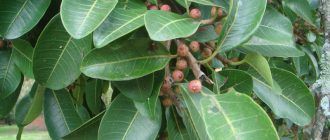
Mint is a deciduous subtropical plant native to Africa, Asia, and Australia. Its medicinal properties have been known since ancient times and are widely used today. It is used in cooking, cosmetology, perfumery, and medicine. The most famous varieties are lemon mint, meadow mint, scented mint, water mint, field mint, peppermint, and menta piperita. Indoor mint, also known as plectranthus, is grown indoors. It grows quickly, is undemanding, and is easy to propagate.
Content
Description of indoor mint
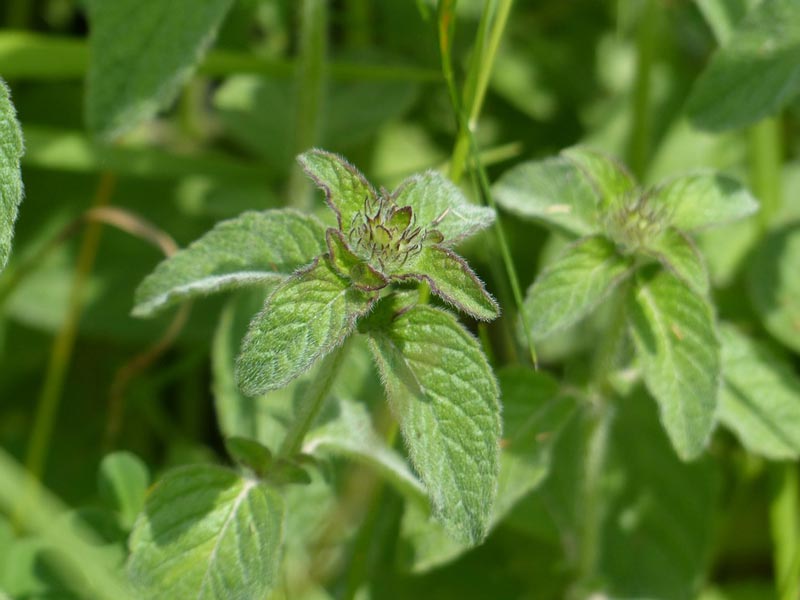
Mint (Plectranthus aromaticus), or spurwort, is a perennial evergreen herbaceous plant in the Lamiaceae (labiate) family with oblong, oval, and pointed leaves. The flowers are small, pale, gathered in umbels or racemes on the upper shoots, appearing in summer. The root system is fibrous, and the stem is ribbed, smooth, or pubescent. The plant is a trailing plant, but some species are classified as shrubs with shoots up to 40 cm tall and abundant foliage.
If you run your hand over the leaves, a pleasant aroma will immediately spread.
Varieties of indoor mint
There are up to 300 varieties of plectranthus, which differ in appearance and the aroma of their leaves:
| Variety | Peculiarities |
| Coleus-like | A shrub growing up to a meter tall with straight, square stems and large, 6 cm leaves with white and cream edges covered in similar spots. It has a strong aroma. |
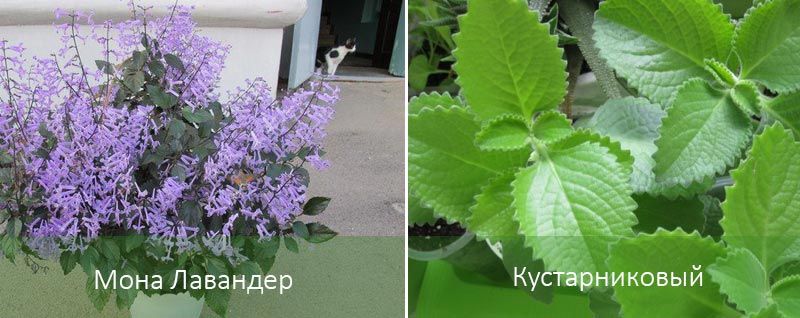
| Shrub (moth tree) | Large, reaching a meter in height, with heart-shaped, single-color leaves that release essential oils when touched. The flowers are blue. |
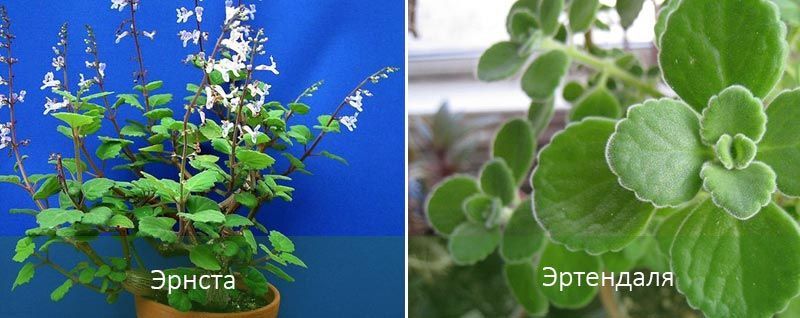
| Ertendal | A subshrub growing up to 40 cm, it is the most common variety. It has round, serrated, velvety leaves up to 5 cm in diameter, dark green above and purple below with light veins. White flowers form clusters and bloom in summer. They have a camphor-like aroma. |
| Mona Lavender | It is distinguished by its long flowering period, from February to November. The glossy leaves have serrated edges and are purple underneath. It grows to a height of up to half a meter. |
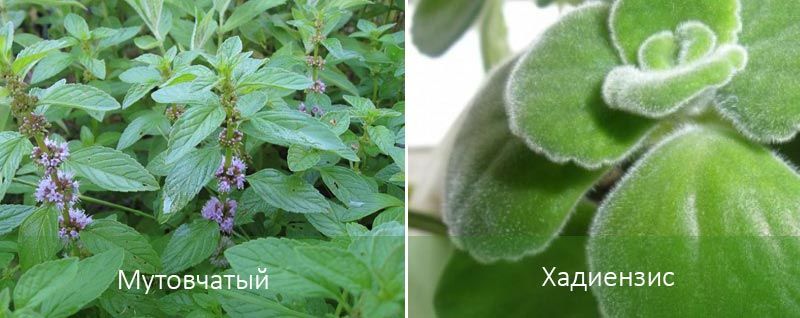
| Hadiensis (felted) | A shrub up to 75 cm tall, with pubescent, light-green leaves up to 10 cm long with a minty scent. Used in India as a spice. |
| Ernst | Small, heart-shaped leaves are purple underneath and green and velvety above. Grows up to 0.5 m. |
| Fragrant | A perennial plant up to 2 m tall, with finely haired, tetrahedral stems, green-purple. The leaves are oval and pointed. Flowers are purple, white, and violet. |
| Forster | The pubescent leaves are oval-shaped with serrated edges. Height up to a meter. |
| Whorled | The leaf blades are smooth, green, and covered with white hairs, with red veins underneath. The stems are crimson. It grows up to 40 cm. |
Several ways to plant mint
The perennial can be obtained in several ways: by seeds, cuttings, or by dividing the bush.
Seeds
Seeds can be purchased at a flower shop or collected at home. They are placed in a container with moist soil to a depth of 0.5 cm and covered with plastic wrap or glass. They will germinate in 14 days. Carefully transplant them into a pot, place them in a cool room, and then return them to their usual growing location after 40 days. The harvest will begin within two months. Young shoots have slightly different flavors.
Cuttings
The easiest and fastest method of propagation. Cut a 6-8 cm section of a lateral stem at a 45-degree angle with a sharp knife. Trim the bottom two leaves. Place the cutting in a glass of water or sand. When 1.5 cm of roots appear, transplant it into soil.
By dividing the bush
When the bush reaches three years of age, dig it up and divide it into sections. Each section should have shoots, roots, and buds. Plant it at a depth of 10 cm and add humus.
Growing conditions for indoor mint
Provide the plant with bright but diffused light; potted mint should be placed on east- or west-facing windowsills. Temperatures should range from 16 to 25°C in summer and 14 to 16°C in winter. Humidity should be maintained at 60-70%. Excessive sunlight can cause the plant to wilt. In winter, provide artificial lighting; if daylight hours are insufficient, the plant will stretch, so lower the temperature to 15 to 18°C. In summer, place the pot on a draft-free balcony or loggia.
Care
At home, caring for the plant does not require much effort; any gardener can handle it.
The container can be anything: a flowerpot or a box, but the key is to choose one that's wide enough to accommodate the extensive root system. Rotate the plant to ensure uniform growth.
During flowering, water generously, and less frequently in winter. The water should be soft, settled, and at room temperature. In summer, shower and mist the plants, and in winter, if the air is dry, dust the leaves.
Do not allow the soil to dry out.
Fertilize monthly in spring and summer, alternating organic and mineral fertilizers for ornamental foliage plants. Leaves are pinched back, leaving 20 mm from the shoot, to encourage new growth. In spring, weak, bare shoots are trimmed back, and the tips are pinched.
Transfer
After purchase, the young plant is transplanted into a new, larger container. This is done by transshipment, without disturbing the root ball. Repotting is then necessary once a year in the spring, and then every two years when the plant is five years old. The soil is prepared from two parts turf, one part humus, one part leaf mold, and 0.5 parts sand and peat. First, disinfect the soil with boiling water or a potassium permanganate solution. A 3-cm drainage layer of expanded clay or crushed stone is placed at the bottom.
Diseases and pests
Mint rarely gets sick, but sometimes problems arise.
| Problem/Manifestations | Reasons | Elimination |
| The leaves wither and burn out. | Exposure to direct sunlight. | Shade or move to another location. |
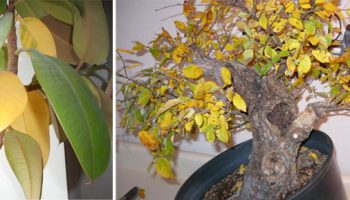
| Yellowing and shedding of leaves. | Low temperature +12…+16 °C, excessive moisture. | Increase the room temperature or reduce watering. |
| The roots are rotting. | Stagnant water, soil acidification, cold air. | |
| Drooping leaves in summer. | Dry air. | Spray more often, install humidifiers. |
| The leaves are falling off, the plant does not bloom. | Too hot, lack of light. | Increase lighting, lower temperature. |
| Gray-violet spots. | Peronosporosis (downy mildew). | Remove affected parts. Treat with fungicides (Actofit). |
| White coating. | Powdery mildew. | Spray with serum with 1/3 water or colloidal sulfur. |
| Curling leaves, green insects on them. | Aphid. | Treat with tobacco infusion, or in advanced cases with Fitoverm or Iskra. |
| White or silvery web. | Mite. | Actellic is used for processing. |
Beneficial properties of indoor mint
Indoor mint is not poisonous, and its beneficial properties are extensive – it is a diaphoretic, laxative, and analgesic, and the plant also:
- Improves digestion.
- Calms the nervous system.
- Eases breathing (chew leaves for nasal congestion).
- Helps in the treatment of gynecological diseases.
- Relieves itching from insect bites (crush the leaf and apply)
- Treats colds (drink mint tea for throat infections).
- Juice together with pomegranate relieves nausea.
Mint fights moths and other harmful insects. It's used as a spice and brewed into tea. Its essential oil has a calming effect.
Mint is harvested after flowering. Large leaves are collected, and the stems are trimmed by 1/3 during the day on a sunny day. Then, the leaves are washed, wiped, and laid out on a cloth to dry in the oven or outdoors. Store hermetically sealed.
Contraindications for use by pregnant and lactating women, and children under 12 years of age.
Mint is placed in the bedroom; it drives away anxiety and relieves fatigue. According to superstitions, it attracts money to the home.