Coreopsis belongs to the Asteraceae family. It's native to temperate American states. Planting doesn't require any special skills, and caring for the bush is easy. This makes it a popular choice for gardens and summer cottages.
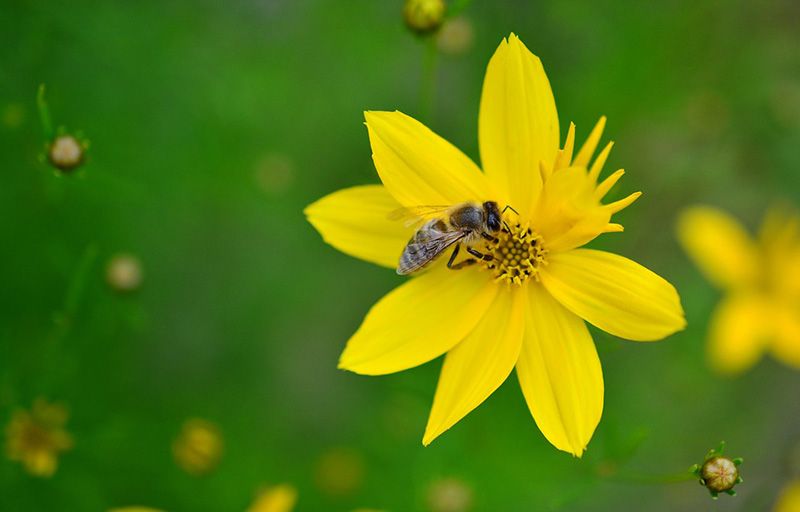
Botanical description of Coreopsis
Coreopsis is a perennial or annual rhizomatous plant. Stems are slender, highly branched, and reach 0.4–0.9 m.
The green leaves are maple-shaped or dissected down to the main vein, lanceolate or tapering. They grow on the lower half of the stems and are arranged crosswise.
Yellow, brownish-red, pinkish, and crimson flowers with a dark spot in the center begin to form in June. They can be single or double. They have eight linear, tapering petals with serrated tips. Flowering ends only with the first frost.
Flat seed pods appear in place of the flowers. They contain up to 500 seeds. The Greek word "coreopsis" translates as "bug-like." This refers specifically to the fruits, which resemble these insects.
Types of Coreopsis
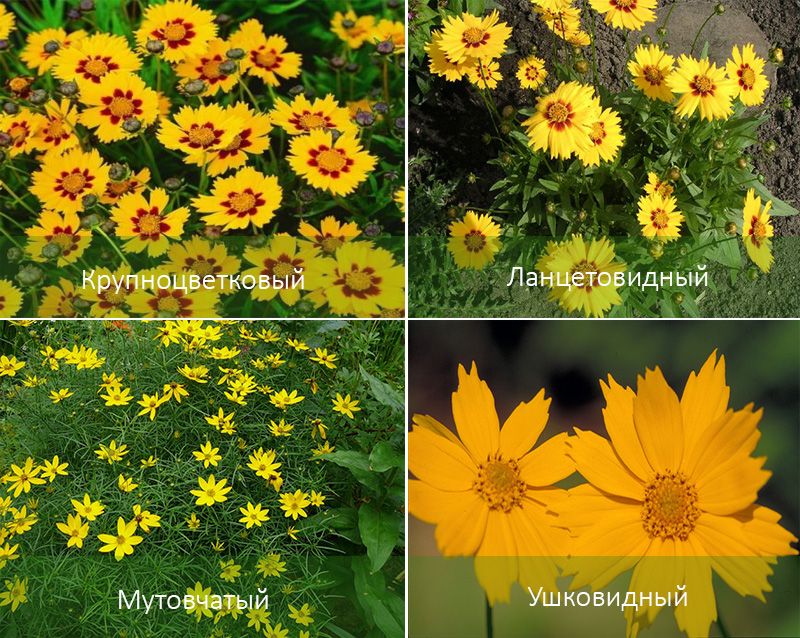
The genus includes approximately one hundred species, but not all are suitable for growing in our climate. The following coreopsis are grown in Russia:
| Type and description | Varieties | Leaves | Flowers/flowering period |
| Large-flowered The shoots are erect and branching. Requires repotting every three years. |
|
Basal leaves are simple. Those located on the stem are pinnately dissected. | Yellow-golden, with a darker center. On strong peduncles.
From mid-summer until the onset of cold weather. |
| Lanceolate
Branching shoots form a bush up to 60 cm. |
|
Simple, lanceolate, petiolate. | Yellow, on drooping inflorescences. July-September. |
| Whorled
Up to 1 m. Can grow without replanting for about 6 years. |
|
Pale green, needle-shaped, sessile. | Needle-shaped, ligulate, sunny-hued flowers. Gathered in star-shaped inflorescences.
From July to October. |
| Auriculate
Up to 40 cm. |
|
Simple, medium-sized. Covering half the stem. | Golden, small, similar to daisies.
From the 2nd month of summer to mid-autumn. |
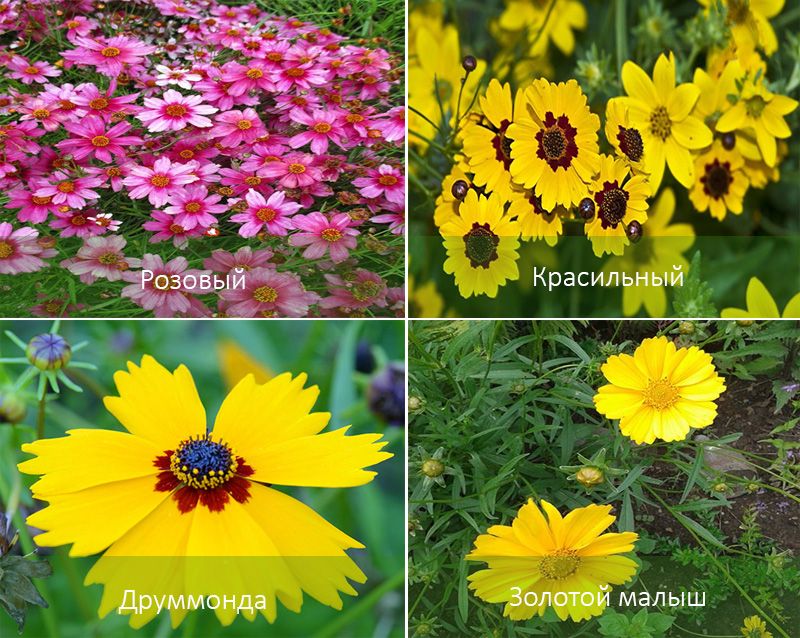
| Pink
Dense bush. |
|
Tapered, linear. | Pinkish, with a canary-colored center.
June-September. |
| Dyeing
An annual bush with a thin, branched stem. |
No varieties | Narrowed, elongated. They grow to the middle of the stem. | With corrugated petals, amber with a dark red center.
July-October. |
| Drummond
40-60 cm. |
Large, bright lemon with a reddish-brown core.
July. |
||
| Golden baby
Up to 40 cm. |
Petiolate, lanceolate or nearly linear, they begin to thin out as they rise toward the top of the trunk. | Yellow, double, orange in the center. From midsummer to autumn. |
Planting coreopsis in open ground
The bush should be planted in a sunny spot. It may die in the shade. For abundant flowering, use loose, light, moderately fertile soil.
This perennial is best sown by seed. To ensure blooming in the first year, the seedlings are placed in small containers in winter and kept in a warm place until spring. Once the snow melts, the seedlings are planted outdoors. No special care is required for the shoots. Providing the young plants with bright light and regular moisture is sufficient.
If you decide to sow the seeds directly outdoors, do so in spring or fall. The planting material tolerates low temperatures well. The first seedlings are thinned out, and weeds are kept out of the way.
Caring for Coreopsis in the Garden
Coreopsis shoots grow quickly, so the bush is divided every 3-4 years and replanted. Shallow holes are dug in the ground, spaced 0.5 meters apart.
Mature plants are drought-tolerant and don't require frequent watering. Water only when necessary, when the soil cracks from drying out. Varieties with pink and reddish flowers require more generous watering.
The soil around the bush is regularly loosened. Fertilizer is applied only to poor soil once a year in July. Use mineral mixtures; organic matter is undesirable for coreopsis.
Species with long, thin stems should be tied up. Otherwise, they will break in strong gusts of wind. Wilted inflorescences should be cut off immediately. This will allow buds to begin forming later in the year.
During cold weather, stems are cut back to the base, with the exception of the large-flowered coreopsis, which can freeze. It should be dug up, repotted, and brought indoors. The plant is winter-hardy and tolerates frosts well. However, in the north, it is advisable to cover the bush with spruce branches or leaves. During a thaw, the root system can rot due to melting snow. Therefore, small ditches should be made around the bush to allow excess water to drain.
Propagation of Coreopsis
The flower is propagated by dividing the rhizome, cuttings, or seeds. The first method is preferable as it is simpler and more productive. It is carried out in early spring, as soon as the snow melts:
- Loosen the soil around the bush.
- Remove the plant carefully so as not to damage the root system.
- Divide the rhizome with a sharp knife so that 2-3 buds remain on each shoot.
- Replant the cuttings. Care for them in the same way as for an adult plant.
Propagation by cuttings is carried out in June-July:
- Cut healthy shoots with several leaves 10 cm below the internode.
- Remove the greens from the bottom.
- Place the cuttings in containers (no more than 3 in 1 pot).
- Keep in partial shade, water when the top layer of soil dries out.
Seed propagation step by step:
- In March, evenly distribute the seed material over the surface of the nutrient substrate.
- Press it into the ground with a small board.
- Cover with polyethylene or glass to create greenhouse conditions.
- Remove the cover daily for ventilation and watering. When the first shoots emerge (in about 10 days), remove the film or glass completely.
- After a couple of true leaves appear, transplant into separate pots.
- When the crops grow to 10-12 cm, transplant again.
- Plant outdoors in May. Harden off the young plants first (take them outside for a few hours daily).
Diseases and pests of coreopsis
Coreopsis is susceptible to the following diseases and insect damage:
| Description of the problem | Cause | Methods of control |
|
Spotting. |
|
|
Fusarium. |
|
|
Rust. |
|
|
Viral infection. |
|
|
Aphid. |
|
|
Damage by beetles and caterpillars. |
|
Provided with optimal growing conditions and proper care, coreopsis will be immune to the aforementioned problems. To prevent insects from settling on the plant, it should be regularly inspected for their larvae.