Crassula is a succulent plant in the Crassulaceae family, which includes 300-500 species, according to various sources. This plant is native to Africa, particularly Madagascar. It can also be found on the Arabian Peninsula. Many varieties thrive in indoor conditions.
Description of Crassula
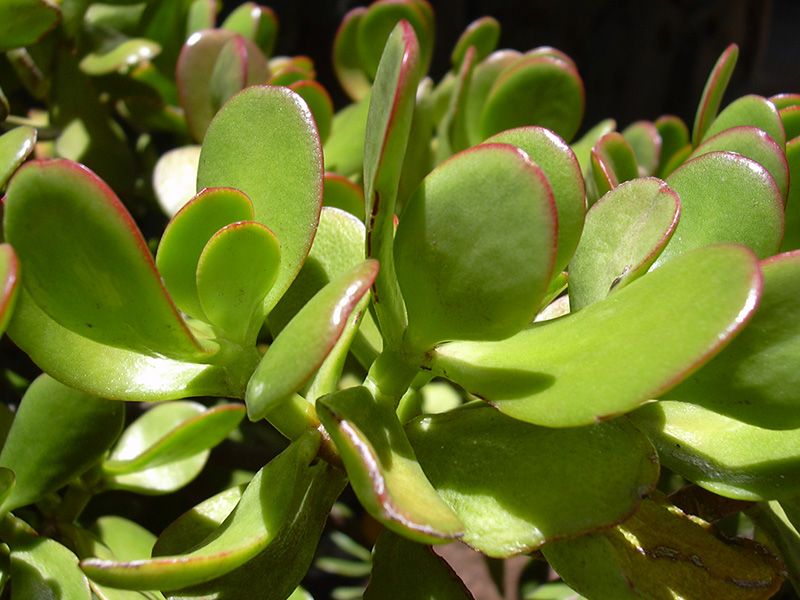
Some species are aquatic or herbaceous. Others are woody shrubs. They share a common characteristic: the stem bears fleshy leaves arranged crosswise. The blades are entire or simple, sometimes ciliated. The inflorescences are terminal or lateral, racemose or umbel-paniculate. The flowers are yellowish, scarlet, snow-white, pale blue, or pink. It rarely blooms indoors.
Crassula species
The following varieties are popular:
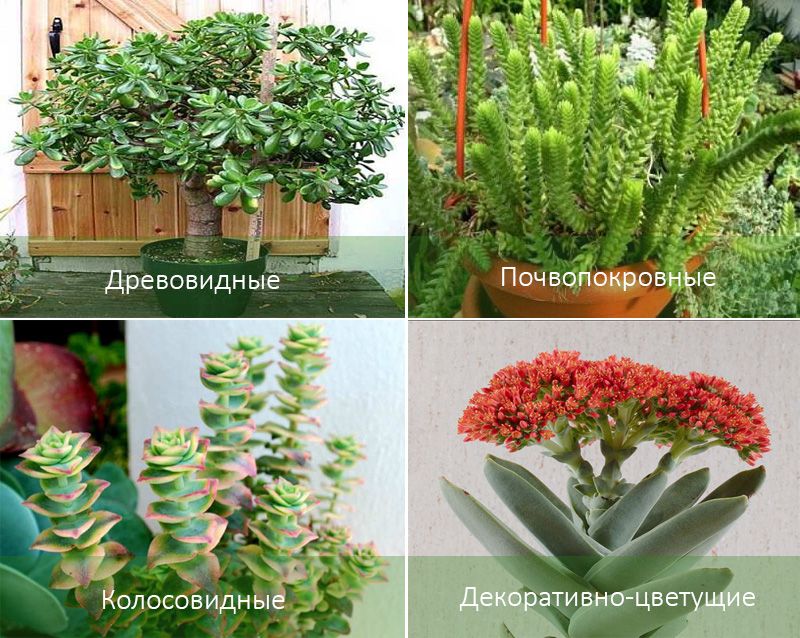
| Group | View | Stems/leaves/flowers |
| Arborescent | Ovata |
Height 60-100 cm. Woody, with many branches. Small, soft pink, star-shaped. |
| Purslane | A variation of the previous variety. The only difference: light-colored, aerial roots on the stem that darken over time. | |
| Silvery | Similar to Ovata. Distinguished by its light inclusions and silvery sheen. | |
| Minor |
Fleshy, green, becoming woody over time. Small, dark green with a red border, oval in shape. Small, snow-white. |
|
| Oblikva | Distinctions from Ovata: the leaves are larger. The tip is pointed and raised, and the edges are curved downwards. | |
| Tricolor and Solana (Obliqua hybrids) |
Woody, densely covered with branches. As with the original species, but Tricolor has snow-white lines on the plates, located unevenly, and Solana has yellow ones. Small, whitish. |
|
| Milky Way |
Up to 0.6 m. Large, with whitish inclusions around the perimeter. Snow-white, collected in dense panicles. |
|
| Gollum and the Hobbit (mix of Ovata and Milky Way) |
Up to 1 m, abundantly branching. The Hobbit's are turned outward, fused from the bottom to the middle. Gollum's are rolled into a tube, widened at the ends to form a funnel. Small, light. |
|
| Sunset |
Woody. Green, with yellow or white lines and a red border. They retain their color in good light, which can only be achieved in a greenhouse. In an apartment, they take on a pure green hue. White, pinkish, bluish, reddish. |
|
| Tree-like |
Up to 1.5 m. Rounded, bluish-gray with a thin red border, often covered with dark dots. Small, snow-white. |
|
| Groundcover | Lycopodioidea |
Up to 25 cm. Around the central stem grow numerous creeping, fleshy shoots with slightly raised ends. Thin, with a sharp end, folded in 4 rows. Inconspicuous, small, in the shape of white stars. |
| False lycopod | Difference from the previous species: curved stems, less pressed leaf blades of variegated, silvery, yellow color. | |
| tetrahedral |
They have brown aerial roots. Fleshy, awl-shaped. Whitish, unremarkable. |
|
| Point |
Deciduous, highly branched. Grown as a trailing plant (in a hanging pot). Green, with red spots on the outside and purple-scarlet on the inside. Transparent cilia line the edges. Small, star-shaped. |
|
| Offspring |
Herbaceous, abundantly branching, up to 1 m. With a pointed end and serrations around the perimeter. The edges can be variegated. White or beige. |
|
| Rosette (rounded) |
Herbaceous, highly branched. Fleshy, light green, with a pointed, reddish tip, they are gathered in rosettes resembling flowers. Inconspicuous, whitish. |
|
| Spike-shaped | Perforate |
Sparsely branched, rigid, up to 20 cm. Diamond-shaped, paired, and arranged crosswise, the rhizomes are fused and clasp the stem. Light green with a gray-blue bloom and a red border. Small, snow-white. |
| Variegated |
Stems and flowers are the same as the previous species. Bright yellow in the center or along the edges. Turning green as they grow. White, at the top of the shoots. |
|
| Grouped |
Herbaceous, thin, highly branched. Round, small, flat, and smooth. Gray-green, with cilia along the edges. Snow-white-pink, small, collected in apical inflorescences. |
|
| Rock art |
Creeping or erect. Herbaceous, becoming woody over time. Dense, smooth, ovoid or diamond-shaped. Paired or arranged crosswise. The plates are bluish-green with a dotted or solid rusty line along the edges. Pink or yellow, collected in umbrella-shaped inflorescences. |
|
| Cooper |
Up to 15 cm. Brownish-green, with brown spots, arranged in a spiral. The tip is pointed, with a large hair in the center. There are sparse cilia along the edges. Whitish or pinkish, small. |
|
| Buddha Temple |
Erect, almost unbranched. Paired, succulent, triangular. The ends curve upward. As they grow, they form quadrangular columns of regular shape. Almost white, with a pinkish tint, sterile. |
|
| Monstrosa | They grow abnormally: asymmetrically, with fractures. Small, scaly, yellow-green. Unremarkable. |
|
| Deceptor |
Up to 10 cm. Almost hidden under the foliage. Short, tetrahedral, thick. Greenish-gray, with silvery spots. Small, collected in inflorescences. |
|
| Ornamental flowering | Sickle-shaped | Erect, slightly branched, up to 1 m. Juicy, fleshy, greyish-green, sickle-shaped. Red-orange, collected in large umbrella-shaped inflorescences. |
| Schmidt |
Greenish-pink. Lanceolate, narrow, with a pointed tip. The outer side is green with a silvery coating, the inner side is red. Carmine hue. |
|
| Justi-Corderoi | Similar to the previous variety. Distinguished by its flattened, rounded-down plates and ciliated edges. | |
| Perfoliate |
Erect, slightly branched. Juicy and fleshy, triangular or lanceolate. The outside is covered with red speckles and has teeth around the perimeter. Snow-white, scarlet. |
Caring for Crassula at Home
The plant is easy to care for, and even beginners can grow it. Because crassula is easy to care for indoors, it's often used to decorate apartments and offices.
| Factor | Spring-summer | Autumn-Winter |
| Location/lighting | Window sills on the east and west sides. | |
| Place on a terrace or loggia, protect from direct sunlight. Keep away from heating devices. | Provide additional lighting using phytolamps and daylight devices (at least 10-12 hours). | |
| Temperature | +20…+25 ℃. | +14 ℃. |
| Humidity | Place under the shower, covering the ground with plastic. | No need. |
| Watering | Moderate, after the top 3-4 cm of soil has dried out. | Rarely, only when the plant dries out. |
| The water has settled and is at room temperature. | ||
| Top dressing | You need to purchase a special fertilizer for cacti and succulents. | |
| Contributed once every 4 weeks. | Once every 3 months. | |
Transplantation, soil, pruning
If you begin to shape a mature specimen, the cuts will leave stumps, which will significantly spoil the plant's appearance. Therefore, pruning should be done when the bush is still young, about 15 cm tall:
- Pinch off the 2 smallest leaves at the top.
- In this place, 4 will grow instead.
- As the crassula grows, you need to regularly pinch off the leaves in those places where you want to make the crown thicker.
The planting substrate should consist of the following components in a ratio of 1:1:3:1:1:
- leaf soil;
- humus;
- turf;
- gravel;
- sand.
You can also purchase ready-made soil mixture for succulents and cacti.
Repotting is performed when the root system has grown vigorously and completely envelops the root ball. This happens approximately every 2-3 years. The best time is spring.
The pot should be slightly larger than the previous one. It should be wide but not deep, otherwise the roots will grow downwards and the aboveground part will begin to grow rapidly upwards, resulting in a thin and weak stem. Repot as follows:
- Lay out a drainage layer of expanded clay.
- Move the bush with the root ball by transshipment.
- Fill the free space with fresh substrate.
- If the roots grow too long, trim them.
To keep the plant miniature, it doesn't need to be repotted. Simply change the top layer of soil annually.
Methods of reproduction
You can use:
- seeds;
- cuttings;
- leaves.
Vegetative propagation is the simplest and yields the best results. Step-by-step instructions:
- Spread the seeds evenly over the soil surface (leaf soil and sand 1:2) in a wide container, sprinkle with sand.
- Cover with glass to create greenhouse conditions.
- Remove the cover daily for ventilation, remove condensation from the walls, and moisten the soil with a spray bottle.
- After sprouting, transplant the seedlings 1 cm apart. Keep in a warm, well-lit area.
- When the first strong leaves grow, transplant the shoots into separate containers with turf-sand soil (1:2).
- Keep at a temperature of +15…+18 ℃ until fully rooted.
- Transplant to a permanent location.
Step-by-step propagation by cuttings:
- Cut off the strengthened shoot and treat the damaged area with charcoal.
- Place the planting material in a growth accelerator (for example, Kornevin) for 1-2 days.
- Plant in loose, fertile soil.
- After the roots appear, transfer them to separate containers (5-8 cm in circumference).
- Care for it in the same way as for an adult bush.
Leaf propagation:
- Cut the planting material and dry it in the air for 2-3 days.
- Deepen vertically into the substrate.
- Spray the soil regularly until rooting occurs.
- After growth begins, transplant into separate pots.
Mistakes in caring for crassula, diseases and pests
If the plant does not have the necessary conditions, it will become sick and pests will start eating it.
| Manifestation | Reasons | Elimination measures |
| The leaves turn pale and fall off. |
|
|
| The stem is too elongated. | Excess water at low air temperatures or insufficient light. | If this happened in the summer:
When the problem is in winter:
|
| Reddish streaks on greenery. | Bacterial infection. |
|
| Slow development. |
|
|
| Stem rot. | Overwatering. |
|
| Yellowing on leaves. | Insufficient lighting. | Provide diffused light for 10-12 hours. |
| Softening of plates. | Strong moisture of the substrate. | Dry out the root ball. If this doesn't work, replant the bush:
|
| Dark spots. |
|
|
| White dots. | Excess moisture. |
|
| Reddening of greenery. |
|
|
| Silvery coating, unless specified by the variety. | Crassula has survived the stress and has begun to recover. | There is no need to do anything, the bush will return to normal on its own. |
| Wrinkling of leaves. | Heavy watering after the substrate dries out. | This causes significant damage. In most cases, the plant dies. |
| Dry brown plaques. | Lack of water. | Water as the top layer of soil dries out. |
| Drying. |
|
|
| Yellow, light brown spots and bumps. | Scale insect. |
|
| A thin web on the greenery, visible grey or red dots in constant movement, yellow and brown spots. | Spider mite. |
|
| White balls, similar to cotton wool, on the roots and in the axils of the leaves. | Mealybug. |
|
| Insects are visible on the roots. | Root mealybug. |
|
| Mold. |
|
Transplant into new soil, clearing the roots of old soil. |
| The appearance of white spots on the upper side of the leaves, gradually increasing in size and spreading to the entire above-ground part. | Powdery mildew occurs due to:
|
|
| Gray or black spots appear. They gradually merge, and a sooty film covers the blades. The foliage falls off, and the crassula stops growing. | Black. Provoking factors:
|
|
| Brown spots that develop a fluffy coating over time. | Gray mold caused by:
|
|
| Yellow spots with a dark brown dot in the middle and a grey border, extending to the entire above-ground part. The bush stops growing. The stems rot and crack. |
Anthracnose, which appears as a result of excess moisture in the soil and air. | Treatment with Previkur, Skor, Fundazol. |
| Rotting of the root system and trunk. | Root and stem rot:
|
If the stem rots, the flower cannot be saved. |
Signs about Crassula and its beneficial properties
Crassula is also known as the "money tree." It is believed to bring financial well-being. However, this quality only applies to a well-maintained, healthy plant. A sick one, on the contrary, leads to financial loss.
Crassula purifies the air of harmful elements and enriches it with oxygen. The plant is widely used in folk medicine, as it helps with a variety of ailments:
| Disease | Recipe |
| Pyelonephritis. | Chop 2 tablespoons of herbs and pour 1 liter of boiling water over them. Take 1 tablespoon before meals. |
| Gastric and duodenal ulcers. | Chew 1 leaf every day. |
| Neuralgia, varicose veins, muscle pain. | Pour 2 tbsp. into 200 ml of vodka. Let it sit overnight. Rub into the sore spots. |
| Cuts, hematomas, arthritis, gout, osteochondrosis. | Pass through a meat grinder. Make compresses from the pulp. |
| Calluses. | Apply the pulp to the affected area. |
| Haemorrhoids. | Mix the plant juice with olive oil or petroleum jelly (1:1). Soak a cotton pad in the mixture and apply to the hemorrhoid. |
| Angina. | Gargle with juice diluted with water (1 to 2). |
Any alternative treatment method must be agreed upon with a doctor in advance.