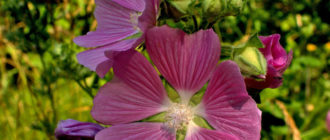
Croskomia, or Japanese gladiolus (montbretia), is a perennial plant in the bulbous family. The name, translated from Greek, means "crocus scent." This strikingly beautiful flower has tall (1-1.5 m), densely arranged stems with extensive branching. Its scent can be confused with saffron. The appearance of the stem and buds resembles that of gladiolus, which is related to it, as are irises and crocuses.
Small, funnel-shaped flowers (4 cm) can be seen for quite a long time: from mid-summer to mid-autumn. Every gardener craves a unique plant, but montbretia isn't often used for this purpose. It doesn't require much care or maintenance. When growing crocosmia outdoors, certain agricultural practices are essential to ensure this beautiful flower is present in your garden. It can be used to create beautiful, unique, and designer arrangements.
Content
Description and characteristics of crocosmia
Crocosmia is a flowering plant native to South Africa. There are many varieties, but the most popular is the Lucifer variety, distinguished by its bright red bloom and tall stems. Among gardening enthusiasts, the plant goes by various names, but the most commonly used are montbretia, tritonia, and Japanese gladiolus. Dried flowers emit a light and pleasant saffron aroma.
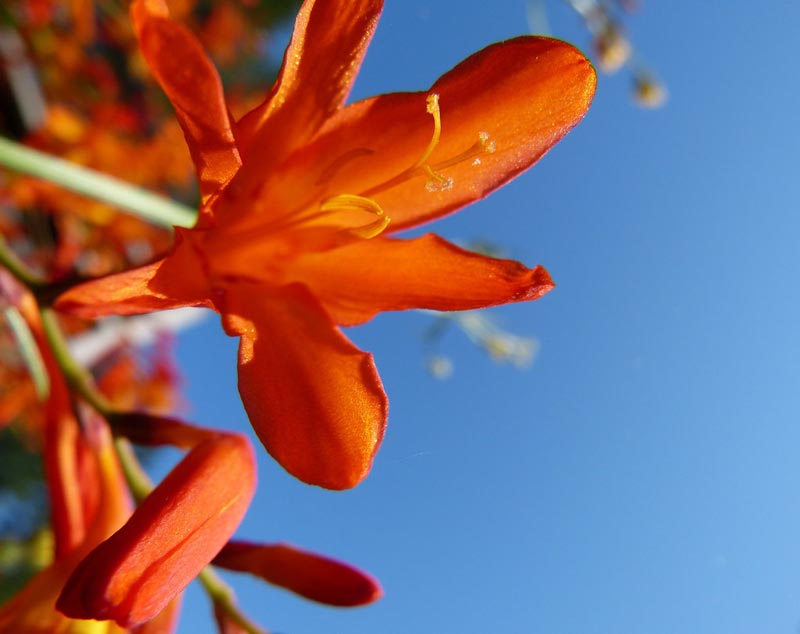
This tropical perennial plant of the Iridaceae family is propagated by bulbs. Its graceful, long, sword-shaped leaves grow up to 60 cm in length. The structure is corrugated with longitudinal stripes. The flowers are arranged in spreading clumps. A slender, tall peduncle grows up to 1 meter. At the top of the shoot is an inflorescence with up to 40 buds, which open gradually from the bottom to the top.
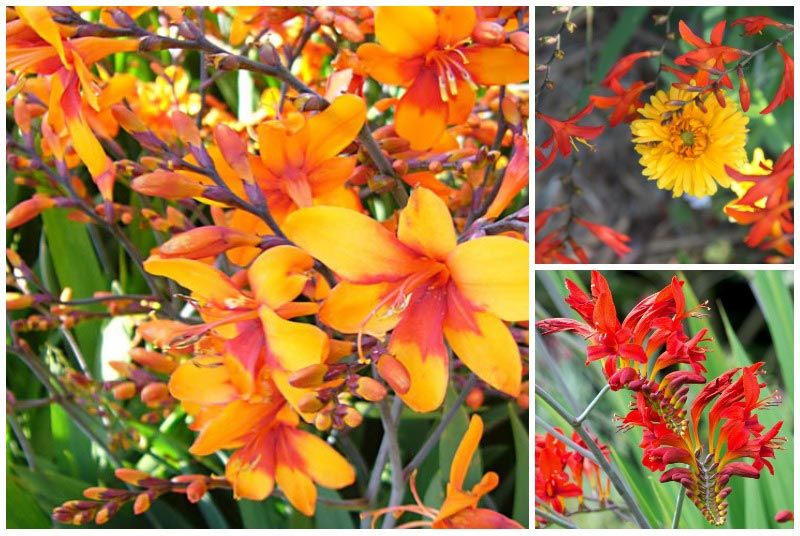
The variety of cultivars showcases petal colors ranging from light yellow to brick red. Each flower, when fully open, reaches 5 cm in diameter.
Crocosmia is often confused with freesia due to the similarity of its stems, or with lilies due to the shape of its flower.
The first buds begin to open by midsummer and continue to delight the gardener until frost. The fruit is a round capsule filled with fairly large, deep brown seeds.
Types of Crocosmia
Montbretia is found in the wild in over 55 varieties, but only a small fraction are cultivated. Let's look at the most common ones.
Masonorum
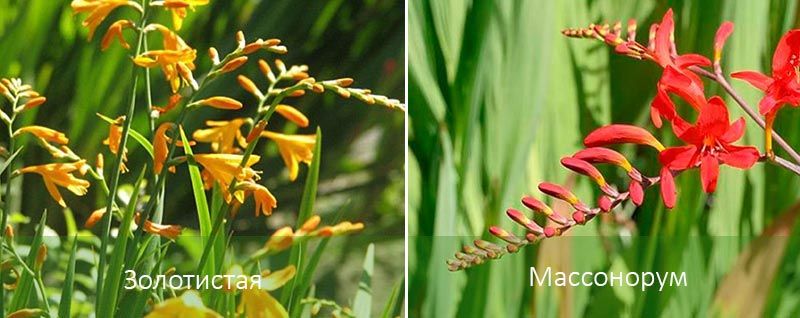
It is highly cold-resistant and ideal for growing in northern regions. It is a low-growing shrub, 0.6-0.8 cm tall, with sword-shaped, ribbed leaves. The flower stalk grows upward and, where the inflorescence begins, turns horizontally, parallel to the ground.
Golden
The original species was brought from the South African tropics. It blooms in September. Depending on the variety, the flowers can be orange, yellow, or red.
Potts
It grows in the marshy soils of the African continent. In the garden, choose shaded areas with poorly draining soil. The plant's leaves are thin and smooth, and the flowers are small.
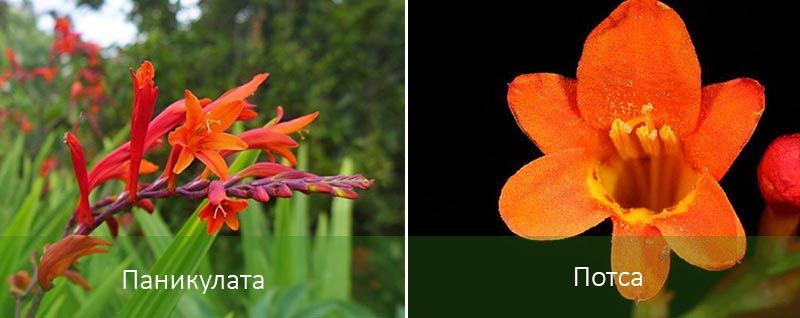
Paniculata
The one-and-a-half-meter-tall bush is adorned at the base with a tuft of corrugated, light-green leaves. Compact, bright-orange inflorescences appear in the second half of June. This is the earliest-growing species of the family.
Ordinary
One of the first garden hybrids, created in the late 19th century, the plant reaches a meter in height. The light-hued foliage consists of erect, narrow, and graceful leaves. The inflorescence includes small, funnel-shaped buds. The first clusters appear in midsummer.
Popular varieties and uses in garden design
Crocosmia is popular among hobbyists and landscape designers. Its airy, vibrantly colored blooms adorn flowerbeds in virtually every garden, so breeders are constantly working hard. To date, over 400 varieties have been developed.
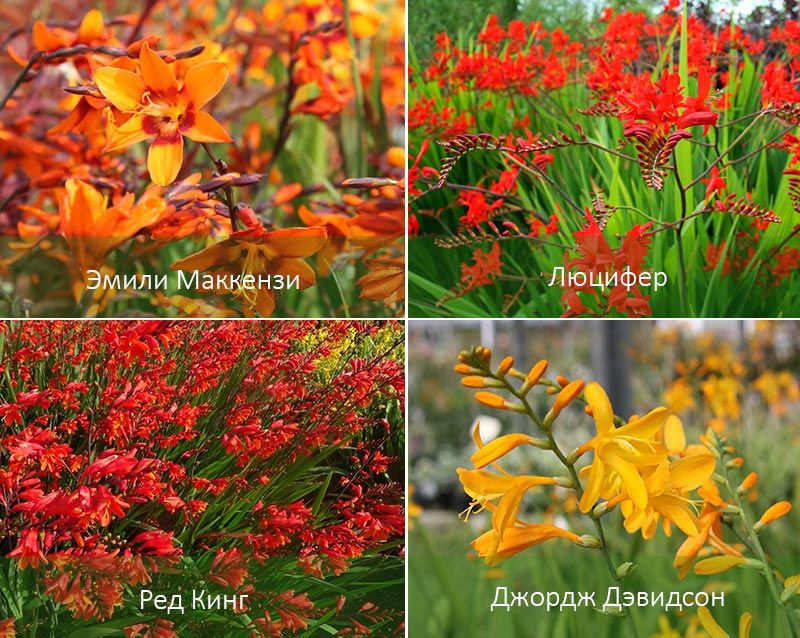
Let's look at the best of them:
|
Variety |
Height, cm | Description |
Application |
| Emily Mackenzie | 60 | Low-growing bush. Flowers are brick-orange with a bright spot in the center. |
Used in group arrangements in mixed flowerbeds. Combines well with crops that bloom in late summer. |
| Lucifer | 150 | Frost-resistant variety. Large blood-red flowers are deservedly recognized as some of the most beautiful. |
They are cut and used in bouquets and in exterior design as background plants. |
| George Davidson | 70 | The juicy amber-yellow flowers look great against the dark green background. | Ideal for tabletop arrangements. |
| Red King | 90 | The buds are red-orange in color with a bright center. | Grown as a houseplant. |
| Spitfire | 60 | Orange inflorescence on a delicate stem. | In gardens and on windowsills. |
| Tangerine Queen | 120 | Grown in flowerbeds. |
Given its long flowering period and vibrant flower color, this plant is widely used in outdoor design. Typically, the bush is planted in the background, where the lower green part serves as a backdrop, while the inflorescences on graceful stems add airiness and completeness to the arrangement.
Top.tomathouse.com recommends: combining crocosmia with other plants
Tall perennials make ideal neighbors. Among them, rudbeckia, cypress, catnip, veronica, and rogersia are particularly noteworthy.
A combination of perennial shrubs is assembled based on flowering time and designed to delight the eye with lush, vibrant colors. Modern hybrid varieties offer a diversity that allows for the creation of flowerbeds solely from crocosmia.
This flower is indispensable for landscape design. It has proven successful in wall-mounted cascades, decorating cracks and dilapidated parts of buildings. The shrub is widely used to decorate artificial ponds.
Growing methods
Like all plants in this family, croscomia can be grown in two ways: from seeds or from bulbs. The first method is quite time-consuming, as it takes about three years from planting to the appearance of the first flowers. The second method is about a year shorter because you don't have to wait for the bulb to form.
Growing crocosmia from seeds
This method is simple and accessible to almost anyone. The main requirement is to follow a certain order:
- Prepare suitable containers: small plastic cups or special containers. They must have drainage holes.
- Take the required soil (purchase or create your own). Ingredients: turf, humus, peat, and coarse sand. The ratio is 2:1:1:1.
- Fill the container: the first layer is expanded clay, the rest is prepared soil.
- Seed growth is stimulated by placing them in a special solution. Dry them and press them shallowly into the soil.
- Wet the surface and cover with plastic wrap. Place in a warm and light location.
- Ventilate constantly and moisten as it dries.
- The covering material is removed when seedlings appear.
- Plant in a separate container when there are 3 leaves.
- Harden off before planting in the garden, periodically taking it out into the air.
Growing crocosmia from bulbs
The bulbs are planted directly into the ground in mid-spring after the risk of frost has passed. The soil temperature should be +10°C. Follow this procedure:
- The bulbs are separated from the babies and placed in a warm place for a while.
- Dip the seeds in a manganese solution before planting. Place the seeds 4-5 cm deep into the soil.
- Leave 12 cm between the bulbs.
You can modify this procedure slightly. In early spring, plant the bulbs in pots and place them near a window. Transplant them into the garden after the shoots appear. This will allow for earlier flowering.
Planting crocosmia seedlings and bulbs in open ground
Transplanting directly into the garden takes place in mid-spring. It's best to prepare the site in advance, in the fall. Add two buckets of compost, 100 g of hydrated lime, 40 g of superphosphate, and 20 g of potassium chloride per square meter. In the spring, add 30 g of nitrogen fertilizer per square meter. The planting pattern is 10 x 10 cm and the same depth. The spacing can be reduced if using very small bulbs. Each hole containing the plant is filled, watered, and covered to acclimate the plant to the new conditions.
Caring for crocosmia in open ground
Crocosmia is not difficult to care for, but to ensure it blooms abundantly, you need to follow a few rules:
- Water weekly, but avoid overwatering. During hot periods, water even more frequently. Loosen the soil and remove weeds after rainfall.
- Fertilize twice a month with organic matter (you can dissolve mullein in water at a ratio of 1:10) and mineral fertilizer. Apply them alternately. Increased nitrogen is recommended during growth, and potassium during flowering.
Preparing for winter
If winters are cold in the area where crocosmia is grown, it's advisable to dig up the bulb during this period. This is usually done in late October to allow it to fully ripen. Afterward, dry it indoors at 10°C with good air circulation. Store it in the same way as gladiolus bulbs during the winter, at 3–7°C and 70% humidity, ensuring adequate air exchange. Store it in a basement, spread out in boxes and covered with moss or sand.
If winters are mild, you don't need to dig up the bulbs, but you need to cover them with a layer of mulch and add wood shavings or dry leaves on top.
If you live in warmer areas, simply collect dried leaves and sprinkle them over the flowerbed. Cover with plastic wrap. Remove the plastic after the frost, and trim last year's leaves to the ground.
Pests and diseases
Proper planting and care, along with high disease resistance, promote healthy plant growth. If proper care is not followed, crocosmia can become susceptible to certain diseases.
|
Problem |
Reasons |
Elimination measures |
| Plants change shape, turn yellow and lose leaves. | Fungal infection. Fusarium. | They observe crop rotation, disinfect the soil and tools, and burn diseased plants. |
| A lint-like coating appears. | Gray mold. Transmitted by wind, rain, insects, or during storage. Dense plantings. High humidity. | The plantings are thinned and treated with special solutions. The dug-up bulbs are inspected and any diseased ones are destroyed. |
| The leaves are turning yellow. | A viral disease, grasshopper disease, spread by leafhoppers. | There is no cure. Infected plants are removed and sprayed with fungicides. |
| The appearance changes. Spots on the leaves. | Mole crickets feed on root bulbs. | They set traps. |
|
Thrips and spider mites suck the sap from plants. They settle during periods of drought. |
They are treated with special preparations. The leaves are washed with a soap solution. |