Crossandra is a plant belonging to the Acanthaceae family. Its native range includes Madagascar, Sri Lanka, Congo, and India.
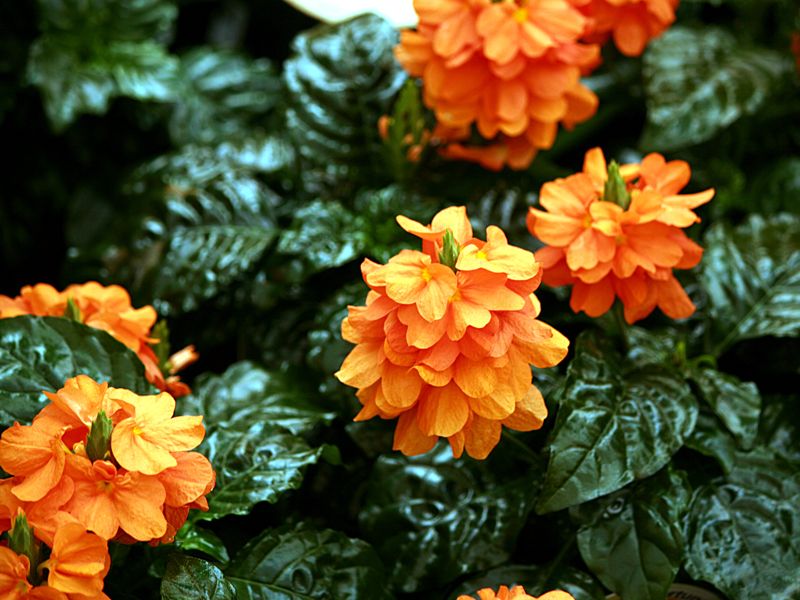
Appearance and characteristics of crossandra
A shrub or subshrub plant with extensive branching. It grows up to 1 m in the wild, and up to 50 cm when grown indoors. The shoots are erect and have rich green, smooth bark that turns brown as the flower matures.
The evergreen foliage is attached to the trunk on long, thickened petioles. Arranged oppositely in pairs, the foliage is ovoid or cordate. The surface is glossy and dark green. They grow from 3 to 9 cm in length. Occasionally, the foliage has variegated patterns along the veins.
The dense, spike-shaped inflorescences are orange in color. The tubular buds have delicate, soft petals. The flowers are replaced by seed capsules that open when wet.
The dormant period lasts from October until the end of February. During this time, crossandra requires good light and humid air.
In southern regions, it can bloom year-round, but in northern areas, wintering is essential, otherwise flowering problems may occur. In cold weather, it retains its decorative appearance thanks to its dark, glossy foliage.
Varieties and cultivars of crossandra
Several varieties of crossandra are suitable for indoor growing:
| View | Description | Leaves | Flowers |
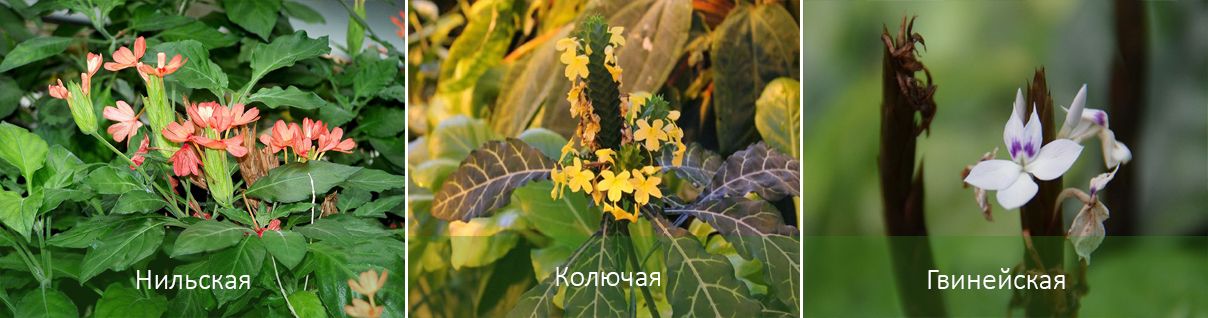
| Nile | Native to Africa, the shrub grows up to 60 cm. | Slightly pubescent, dark green. | They have five petals fused at the base. The color ranges from brick red to red-orange. |
| Prickly | An African shrub reaching 50 cm in height. The bracts have small soft spines. | Large (up to 12 cm in length), with a silvery pattern along the veins. | Yellow-orange. |
| Guinean | The most miniature species, growing up to 30 cm. | Heart-shaped, dark green. | Delicate lilac color. Inflorescences are in the form of spikelets. |
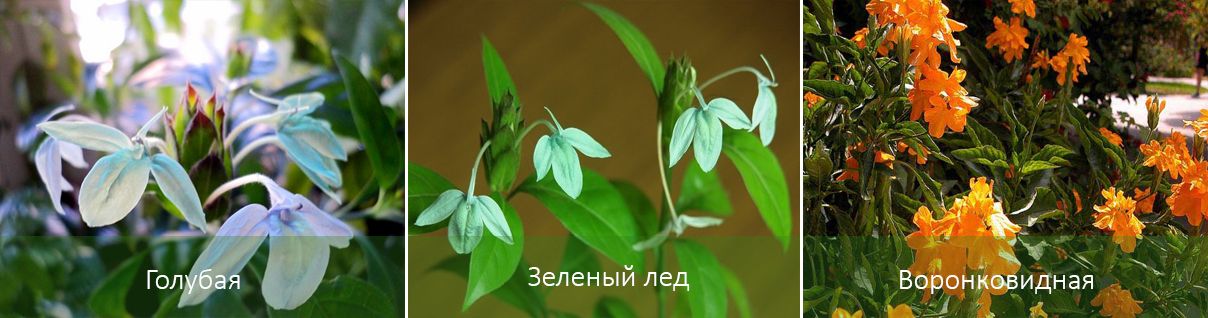
| Blue (Blue Ice) | Reaches 50 cm. | Colour: light green. | Light blue. |
| Green ice | A rare species, found only in Africa. | Heart-shaped. | Turquoise. |
| Funnel-shaped | In nature it grows up to 1 m, when grown indoors – about 70 cm. | Dark green, slightly pubescent. | The buds are about 3 cm in diameter, funnel-shaped. The colors are fiery. |
| Funnel-shaped crossandra varieties | |||
| Mona Wallhed | One of the oldest varieties, created by Swiss breeders, this plant pioneered indoor cultivation. It grows as a dense, compact shrub. | Rich green. | Sunny scarlet. |
| Orange Marmalade | A relatively new variety, it has the appearance of a spreading bush. | Juicy grassy hue. | Orange. |
| Nile Queen | Resistant to sudden temperature changes, easy to care for. | Ovoid, medium sized. | Terracotta red. |
| Fortune | A shrub up to 30 cm high. It has a long flowering period. | Dark green. | Orange-red, inflorescences reach 15 cm. |
| Tropic | A hybrid variety reaching 25 cm. Grown indoors and in open ground. | Heart-shaped. | Different shades of yellow. |
| Variegated (Variegated) | Grows up to 30-35 cm. | Covered with white spots and lines. | Coral. |
Actions after purchasing Crossandra
If you purchased a flowering crossandra, wait until all the flowers have faded before repotting. Then, completely change the soil, leaving only the soil ball that's firmly attached to the root system. To stimulate flowering, the plant is often treated with harmful chemicals, which is why the soil is changed.
Crossandra purchased after flowering is transplanted to new soil after 1-2 weeks. This waiting period is necessary to allow the plant to acclimate to the conditions, as transportation and repotting are stressful.
Caring for Crossandra
When caring for crossandra at home, you should mainly focus on the season of the year:
| Factor | Spring-summer | Autumn-Winter |
| Location/lighting | Place on any window except the south-facing one. Provide soft, diffused lighting. Move to a balcony or garden, as the plant enjoys fresh air. | They provide additional illumination with a phytolamp. |
| Temperature | +22…+27 °С. | +18 °С. |
| Humidity | Level – 75-80%. Spray regularly, place the pot in a tray with moistened pebbles and peat. | Level – 75-80%. Continue spraying. |
| Watering | 3-4 times a week. Use soft water. Do not allow the soil to dry out or become waterlogged, as this may kill the plant. | Gradually reduce to 2 times a week, and then to once a week. |
| Top dressing | Once every 2 weeks. | Once a month. |
Transplanting crossandra and shaping the bush
The plant takes a long time to acclimate to its pot, may prolong its flowering period, or lose its foliage. Therefore, repotting is necessary if the root system has grown over the entire soil and is visible at the bottom of the container. If this is noticeable, the crossandra should be moved to a new container the following spring. Repotting is done by transshipment, preserving as much of the root ball as possible.
Choose a pot 2-3 cm larger than the previous one. A wide container is not necessary, as the plant will begin to grow a rhizome, then an above-ground portion, and only then will flowers appear. Large containers retain water, which increases the risk of root rot. The pot should have plenty of drainage holes.
The soil should be porous and of medium fertility. It should be neutral or slightly acidic. General-purpose soil is often chosen, with some crushed moss and coarse sand added.
You can also make your own soil mixture using the following components in a 2:2:1:1 ratio:
- leaf and peat soil;
- turf soil;
- sand.
For drainage, choose crushed brick, small pebbles and expanded clay.
After preparing the soil, transplant the crossandra, following the plan:
- The prepared soil is steamed, and the new container is doused with boiling water.
- Place a drainage layer at the bottom of the pot and a little soil on top of it.
- Stop watering the plant 2-3 days before replanting. Once the soil dries out, it will be easier to remove the flower from the old container.
- The crossandra is removed from the container, the soil is separated from the walls with a knife or shovel, and the root system is examined.
- The rotten and dried rhizomes are cut off and several extreme shoots are cleared of soil.
- The flower is treated with a growth stimulant; Epin or Zircon will do.
- Crossandra is placed in the center of the new pot.
- Empty areas of the container are filled with soil, which is compacted, being careful not to touch the roots.
- The plant is watered and its crown is sprayed.
Reproduction of Crossandra
This indoor flower is propagated by cuttings and seeds.
The first method is considered more popular due to its simplicity. The optimal time for rooting cuttings is March-April.
Crossandra is propagated by cuttings according to the following algorithm:
- Prepare a shoot of an adult flower, approximately 10 cm long.
- They create soil from peat, sand, leaf and turf soil (all components are taken in equal proportions).
- The cutting is placed in the substrate and left for about 3 weeks.
- When the plant takes root, it is transplanted into a new pot, not forgetting about the drainage system.
Crossandra is rarely propagated by seed, as the plant is stingy with such planting material. If you do decide to use this method, follow the plan strictly:
- A substrate is made from sand and peat, the components are taken in equal proportions.
- Seeds are sown into the soil.
- Provides +23…+24 °C.
- Spray once a week.
- The first shoots appear after 2 weeks.
- When the seedlings have 4 or more leaves, they are planted in separate containers.
Crossandra care mistakes, diseases and pests
Growing crossandra entails attacks from various pests and diseases, which is often caused by poor care:
| Symptoms (external manifestations on leaves) | Cause | Methods of elimination |
| Twisting and falling. | Low air humidity, excessively bright lighting. | Increase indoor humidity by misting the plant and placing it on a tray filled with wet pebbles and peat. Protect the plant from direct sunlight. |
| Yellowing. | Nutrient deficiency. Root rot caused by waterlogged soil combined with low temperatures. | The plant is fertilized. The root system is checked for rot, affected areas are removed, and the plant is replanted in new soil. |
| Falling off immediately after emergence. | Temperature fluctuations, drafts. | The room temperature is adjusted. The plant is moved to a new location, protected from drafts. |
| Lack of flowering. | Poor lighting, poor care, old age. | Move to a brighter location, but protect from direct sunlight. Periodically prune and pinch. If the plant is more than 3-4 years old, replant it, as flowering vigor is related to age. |
| Dry ends. | Insufficient air humidity. | Mist regularly. The pot is moved to a tray filled with moistened peat. |
| Brown spot. | Burn. | Shade. Stop spraying in intense light. |
| Discoloration. | Excessively bright light. | The plant is shaded. |
| Blackening of the stem. | Fungus. | For minor damage, treat with Topaz or Fitosporin-M. For severe damage, remove a healthy cutting and replant. |
| Powdery mildew. | Leaf mold. | Reduce watering frequency. Move the plant outdoors and remove damaged foliage. Spray with fungicides Fitosporin-M and Topaz. |
| White dots. | Aphid. | The foliage is treated with a soapy solution. Spray with garlic or dandelion infusion. Insecticides such as Aktara and Iskra are used. |
| Small white insects. | Whitefly. | |
| Yellowing, thin white web visible. | Spider mite. | Increase air humidity, as ticks thrive in dry environments. Spray with Fosbecid and Decis. |
If you notice these symptoms in time, the problem can be eliminated and the crossandra will delight you with a healthy appearance and long flowering.