Globeflower (Trollius) belongs to the Ranunculaceae family. It grows in Europe, throughout Asia except for the southern parts, and in North America. The genus comprises approximately 30 species. Only 20 of them grow in Russia, and not all of them are suitable for cultivation.
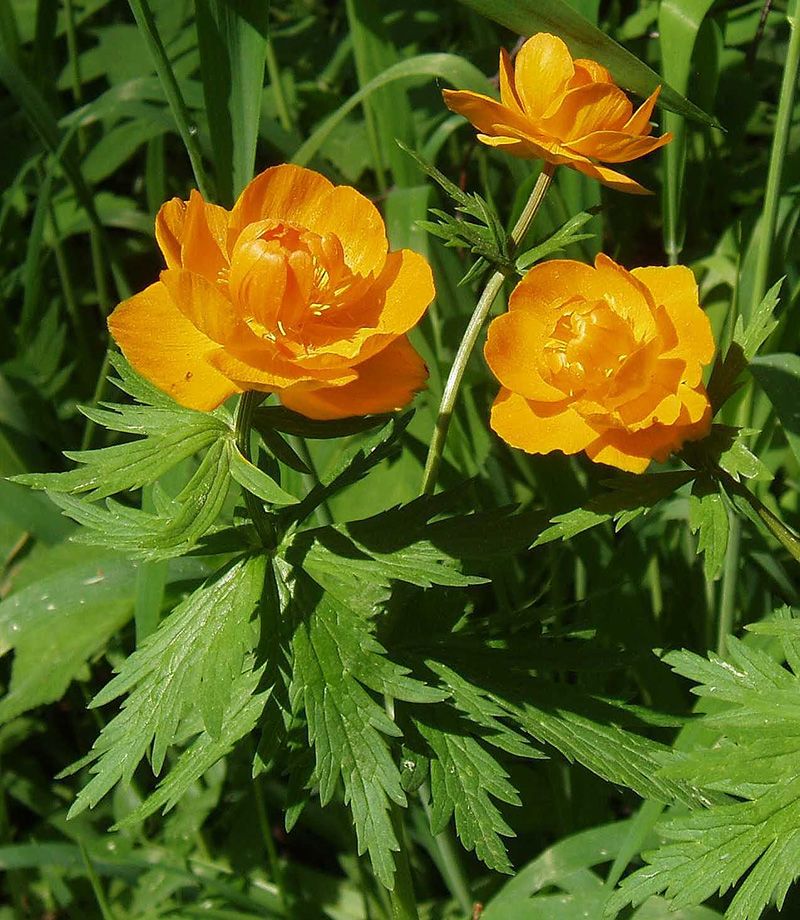
Globeflower, description of the culture
There are several versions of where the plant's name came from:
- Trollius comes from the German trollblume, literally meaning troll flower. According to ancient legends, the trollius was a favorite flower of these mythical creatures.
- Trulleus in Latin means a round vessel, cup.
- Translated from Old German, troll means ball.
The Russian name refers to the globeflower's habitat. It prefers damp places.
This is a perennial herbaceous plant, reaching 0.5-1 m. The stems are erect, branching in some varieties. The root system is well developed. The leaves are dark green, maple-shaped, and grow at the base and on the upper part of the shoot.
One to two large, spherical flowers are located on a single stem. The petals are golden-yellow and glossy. The corolla consists of 5-20 sepals, arranged spirally, overlapping their neighbors. The buds are semi-open or open, with thin, linear nectaries.
All varieties are nectarine. Flowering occurs from late spring to autumn. After this period (about a month later), the sepals fall off. In their place, a spherical fruit begins to form. The seeds are small, dark, and glossy.
When in bloom, it exudes a fresh aroma. The plant is poisonous; its sap can burn skin and mucous membranes. Gloves should be worn when handling the flower. Keep children and pets away from it.
Popular varieties of globeflower
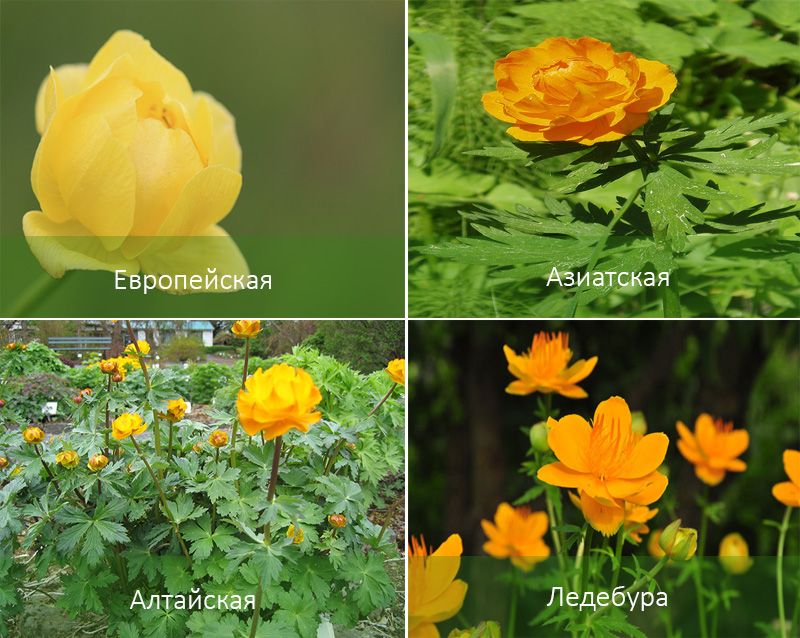
Only a few varieties are cultivated:
| View | Description | Flowers/their period of appearance |
| European | Up to 1 m. In the axils of the stem greenery there are shoots with small flowers. Listed in the Red Book. |
Up to 5 cm, from soft yellow to golden lemon. Sepals are bright orange, identical in size to the petals. May-June. |
| Asian | Up to 0.8 m. The stem has sparse shoots. |
Up to 5 cm, reddish-scarlet. Nectaries widen towards the top. Late spring-mid summer. |
| Altai | Up to 90 cm, there are also low-growing varieties up to 20 cm. |
Up to 6 cm, solitary, semi-open. Orange or golden sepals are twice as long as the rusty petals. May-June. |
| Ledebour | Up to 0.7 m. |
Up to 8 cm, open, with wide, oval, rust-colored petals. The second decade of summer. |
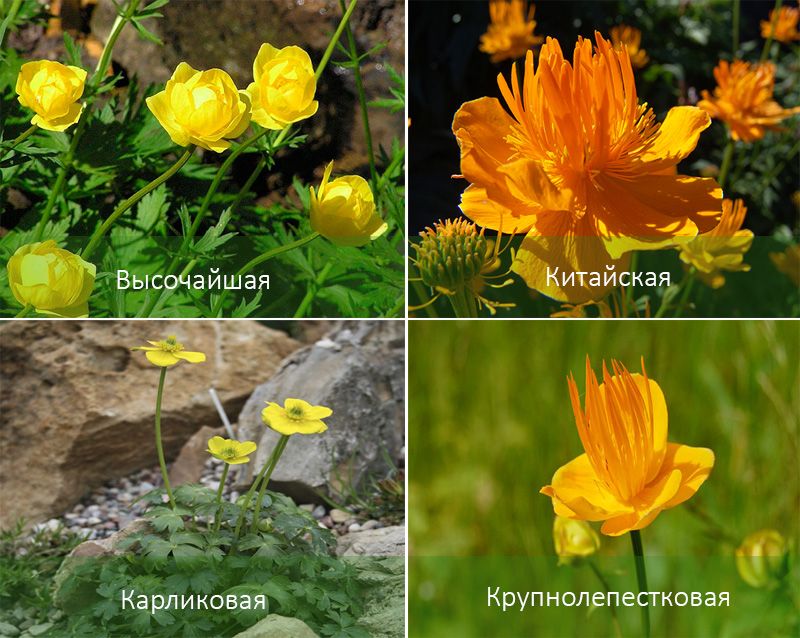
| The Highest | The tallest variety, reaching 1.5 m. The leaves are collected in a rosette 60 cm high. |
Located on a branched inflorescence. Up to 6 cm, greenish-amber. May-June. |
| Chinese | A rare species. The plates are compacted and dissected along the perimeter. |
Single, open and semi-open. The reddish petals are thin and elongated. July-August. |
| Dwarf | Low-growing, no more than 30 cm. |
Flat, bright lemon, with a reddish tint in some varieties. Late spring - first ten days of summer. |
| Large-petaled | Up to 1 m. |
Large, with orange, open petals. June. |
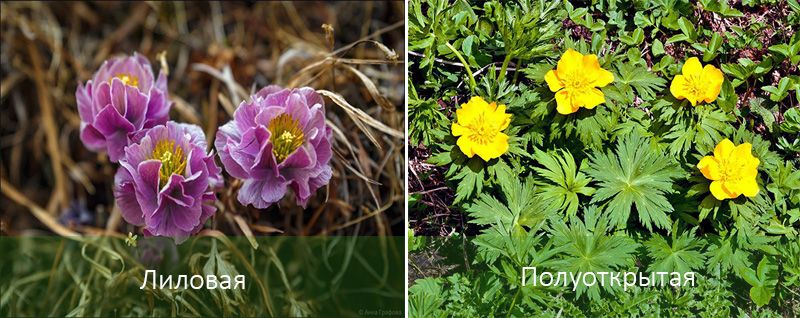
| Purple | A low-growing species that is rarely cultivated. |
Purple, with amber stamens on peduncles up to 10 cm. July. |
| Semi-open | Low, up to 0.3 m. Stem erect, branched. |
Golden, on underdeveloped peduncles that lengthen as the fruit ripens. Petals are tapered, linear, and half-open. July-August. |
Globeflower, planting in open ground
If the plant is grown from seeds, it must first undergo stratification:
- Sowing should be done in autumn.
- Move to a cool place and leave until spring.
- The first shoots can be observed at the end of March - beginning of April.
There is another method of stratification:
- Mix freshly collected seeds with wet sand.
- Pour the mixture into a plastic bag.
- Place in the refrigerator in the vegetable compartment (+2…+4 °C).
- Keep for 3-4 months.
- Sow in March.
- Keep at +20 °C.
- The shoots will emerge in late April to mid-May.
Caring for seedlings before planting in open ground:
- Protect from direct sunlight, regularly moisten the soil mixture.
- Transplant after 2 true leaves have formed.
- When picking, leave 0.8-1 cm.
Planting in a permanent location is carried out in August:
- Dig holes at a distance of 30-40 cm, corresponding to the size of the roots.
- Move the shoots together with the root ball.
- Flowering can be observed in 3-4 years.
Caring for Globeflower in the Garden
To ensure the plant develops well and maintains its decorative qualities, it needs to be provided with favorable growing conditions:
| Factor | Recommendations |
| Location | Areas with diffused sunlight, such as near spreading bushes and trees. |
| Soil | Light, nutritious soil: medium or light loamy, rich in humus, neutral pH. If the soil is poor, add equal parts peat and compost. This helps absorb and retain moisture. 5 kg of the mixture is needed per square meter. |
| Top dressing | Fertilizers are used in small doses:
They do it at the beginning of May and before flowering. |
| Watering |
During the growing season, the soil should be kept moist at all times, but care must be taken to prevent water stagnation. Too little or too much moisture will cause the plant to stop flowering and growing. Water with settled water warmed by the sun. Place a bucket of liquid on the plot in the morning, and water in the evening. |
| Wintering | The plant's distinctive feature is its frost resistance. It tolerates cold temperatures well. Before winter dormancy, the above-ground part is cut back, leaving only 3 cm. |
| Other care |
The top layer of soil is periodically renewed by adding fertile soil to the base. After the petals fall, the flower stalks are cut off to encourage the buds to appear again. |
Propagation and transplantation
Growing from seed is a lengthy and complex process, and gardeners rarely use it. Dividing the clump is preferred.
Healthy, strong plants aged 5-6 years are suitable for propagation.
Repotting is done every 5 years, in late August or early September. The step-by-step process:
- Carefully remove the mother bush, clean it from soil, and wash it.
- Using a disinfected, sharp knife, divide the plant into pieces so that several rosette stems with roots remain on the cutting.
- Treat the cut areas with a solution of potassium permanganate or wood ash.
- Place the cuttings in planting holes located at a distance of 0.3-0.4 m from each other.
- The root collar is buried 20-30 mm.
- Remove the green foliage from the cuttings. New foliage can be seen after 10-14 days.
Prevention and control of globeflower pests and diseases
Globeflower is virtually disease-resistant, and insects rarely infest it. To minimize the risk of damage, treat it with ash in the spring and water with nitrogen-containing fertilizers. Later, switch to complex mixtures. Spraying with Epin is recommended before the growing season. To prevent fungal infections, remove old leaves in the fall.
Rarely, if not cared for, the globeflower may become ill:
| Disease/pest | Signs | Control measures |
| Septoria |
|
|
| Smut |
|
Use the drugs Klad, Ferazim. |
| Nematodes |
|
Use poisons Fosfamide, Heterophos, Lindane. |
The place of globeflower in landscape design
Low-growing varieties are suitable for rock gardens. Long-growing varieties adorn forest edges, lawn corners, and areas near bodies of water.
Trollius is planted alone or in combination with:
- delphinium;
- primrose;
- cornflowers;
- irises and other garden flowers in sky-blue, violet, canary yellow, and orange tones.
The plant looks beautiful in a colorful composition: dwarf globeflower in the foreground, tall bushes in the background that bloom at the same time as the trollius (for example, lilac).
The use of globeflower in folk medicine
Although the flower is poisonous, it has medicinal properties. In folk medicine, it is used to treat many ailments:
- pathological conditions of the liver and gastrointestinal tract;
- abscesses, tumors, swelling;
- diarrhea;
- dropsy;
- scabies;
- epileptic seizures;
- menstrual problems;
- angina pectoris and other heart diseases;
- cancer and precancerous conditions;
- blood diseases.
Folk remedies containing the flower have contraindications and side effects. Before using them, consult a doctor. If your doctor approves this alternative treatment, follow the instructions carefully to avoid poisoning. Globeflower venom can cause serious brain damage, severe burns, and severe intoxication.