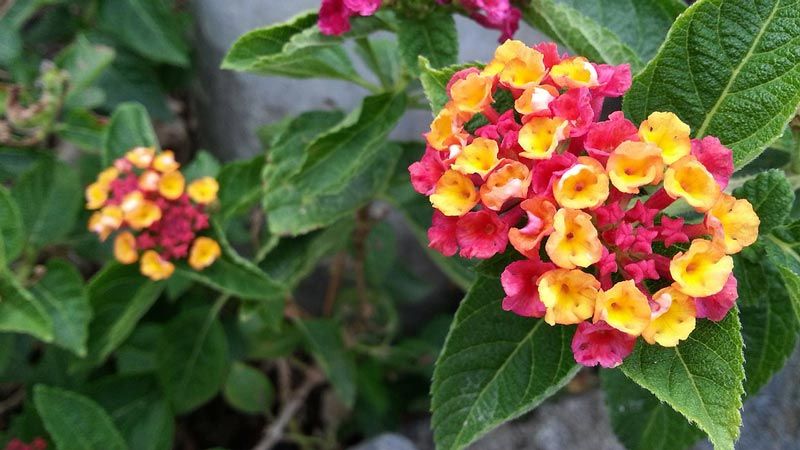
A tropical perennial shrub of the Verbenaceae family. It grows and develops rapidly, requiring a spacious room and a large container.
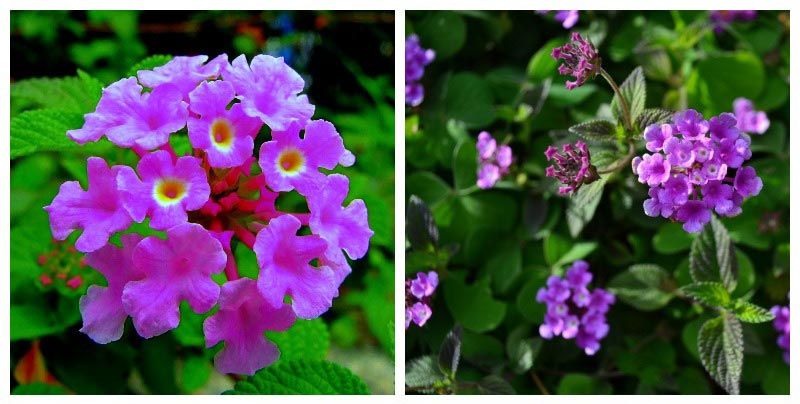
It reaches 3 meters in length. The branches are large and covered with bark. Thorns are rarely present. The leaves are green and heart-shaped. The flowers are arranged on a peduncle, forming a ball. They change color during the growing season, which lasts from May to October.
Types
Only two species of lantana are grown indoors. More than 150 are known in the wild.
| View | Description | Variety | Blooming period |
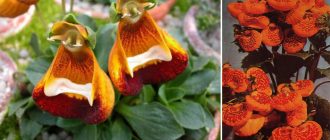
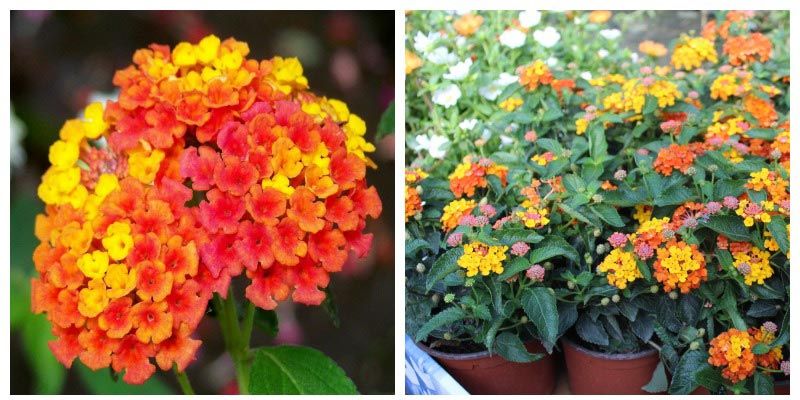
| Kamara (vaulted) | The stem is twining and covered with spines. The leaves are gray-green and oval. The top is smooth or rough, the bottom is covered with hairs. |
|
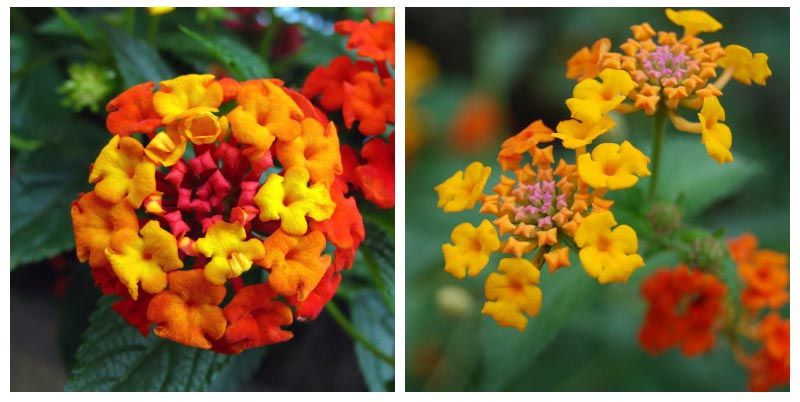
Tubular in shape, gathered in inflorescences. The coloring changes from yellow to orange, from pink to red. From the beginning of May to the end of August. |
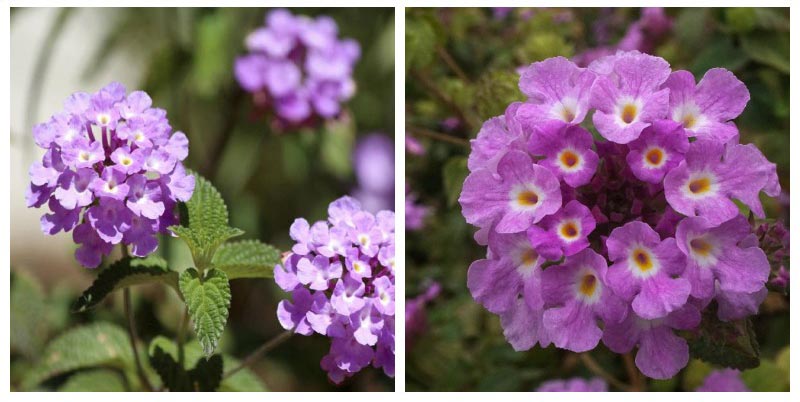
| Montevidean (Sellovian) | The branches twine along the ground. The leaves are small, green, and ovoid. | None. |
Small. Purple and pink in color. They form a shield in the inflorescence. From June to October. |
Lantana: Home Care
Tropical lantana feels comfortable in home conditions and does not require special care.
| Factor | Conditions |
| Location/lighting | Choose any direction except north. The plant does not tolerate cold or drafts. It loves light and can be exposed to direct sunlight for up to five hours a day, but prefers diffused light. In winter, it requires supplemental lighting. |
| Temperature | During the dormant period, the temperature should be +5…+10 ºC. In spring, gradually increase the temperature to +15…+18 ºC. During the flowering period, the temperature should not fall below +20 ºC, and is optimally +22…+28 ºC. |
| Humidity/Watering | It thrives in 40-50% humidity. Daily foliar misting is recommended, but avoiding direct moisture onto the flowers. A drainage tray should be placed in the tray to retain water. |
| Soil | Loose, fertile, and nutritious. Allows air to pass through. It consists of a mixture of sand, peat, and turf in a 1:1:1 ratio. |
| Top dressing | 2 times a month during the flowering period with complex fertilizer. |
Top.tomathouse.com recommends: replanting
Lantana's root system develops quite quickly and requires regular repotting. Young plants should be repotted once a year, while older plants should be repotted every 2-3 years. Choose a roomy, wide, and deep pot for repotting. Line the bottom with permeable drainage material (expanded clay or pebbles).
When repotting, the plant's roots are cleared of old soil to extract beneficial nutrients from the new soil. The substrate is mixed in a 1:1:3:4 ratio of humus, sand, turf, and leaf mold.
Lantana from seeds and cuttings at home
They are grown from seeds and cuttings. The latter method is simpler, but seeds produce more plants at once. However, there is a risk that the lantana will not retain the characteristics of the mother plant.
- Seeds are sown in late autumn, first soaked in hot water at 50…60ºC for 2 hours. They are then treated with stimulants. They are planted in a mixture of peat and sand. Greenhouse conditions are established, maintaining an air temperature of 20…22ºC. The first shoots appear in 3-4 weeks. Then, the temperature is lowered to 10…12ºC, and the amount of light is increased. After the first 2-3 leaves appear, the lantana is transplanted into individual containers.
- Propagation by cuttings is done in the spring, when the plant is pruned. Select branches 10 cm long with 3-4 leaves. Plant in porous, fertile soil. Cover with plastic wrap or a glass jar. Choose a bright, warm location. After two weeks, begin airing the greenhouse for a couple of hours a day. After a week, remove the greenhouse completely.
Potential problems, diseases and pests
If you follow simple care rules, lantana will not be susceptible to disease or pest attacks. If this occurs, steps must be taken to eliminate the cause. The first sign of disease is a lack of flowering.
| Symptoms | Cause | Elimination measures |
| They are falling off. | During the flowering period, low humidity and heat are common. This is normal when the growing season ends. | Increase room humidity to optimal levels. In the fall, prepare the plant for its dormant period. |
| They turn black. | Abundant watering and lack of spraying. Dry air. | Reduce watering, add misting or showers. Humidify the air. |
| Pale spots appear. | Burns from direct sunlight. | The rays of light are scattered, creating partial shade. |
| They curl into a tube, the ends turn black and dry out. | Low humidity, rare watering. | Increase the volume and frequency of watering until optimal conditions are reached. Humidifiers are installed indoors to combat drought. |
|
The substrate becomes moldy and gives off an unpleasant odor. The shoots turn black. Dark spots appear. |
Root rot. | Treatment is limited to the initial stage. To do this, remove all affected parts of the plant and treat the cuts with charcoal or chalk. Soak the roots in a 2% fungicide solution, after clearing them of soil. Prepare a new sterile container and a new substrate with Gliocladin. Water with a solution of Baikal-EM and Skora for three months. |
| They become covered with a layer of gray-black fur with beige spots. They turn black, rot, and fall off. | Botrytis fungus (gray rot). | For preventive purposes, spray with a 0.1% solution of Fundazole once a month. If infected, remove rotted shoots, and dust the exposed surface with chalk or charcoal. Prepare chemicals (Horus, Zineb) for treating the plant and soil according to the instructions. Alternate watering with a 0.5% solution of Topaz or Skor for a month. |
| The lower part is covered with raised orange spots. | Rust. | Remove infected foliage. Spray the plant with a 1% solution of Baktofit or Abiga-Peak. Repeat the treatment after two weeks. |
| The top is covered with light spots. The bottom turns yellow, and a gray coating appears. | Brown spots. | Destroy diseased leaves. Treat with Fitosporin and Vectr. Repeat once a week for a month. |
| The plant is covered with small insects of light yellow or dark brown color. | Aphid. | Wash with soapy water and spray with an infusion of garlic, orange, and other strongly scented herbs. Repeat this procedure once a week for a month. If necessary, use an insecticide (Iskra-Bio, Biotlin). |
|
The flower dries up and fades. Covered with white larvae. They are falling off. |
Mealybug. | Wash with a soap-alcohol solution. Trim off damaged leaves and buds. Treat with an insecticide (Actellic, Fozalon). Repeat 2-3 times, 10 days apart. Neem oil can be used as a preventative measure. |
| Lantana is covered with small white butterflies. | Whitefly. | Vacuum the insects daily. Place a fumigator and fly tape near the plant. Spray it with hot pepper or tobacco infusion several times a day. If these folk remedies don't work, use chemicals (Fitoverm, Aktara). |