Daylily (Hemerocalis) is a herbaceous perennial plant that belongs to the Xanthorrhoeaceae family.
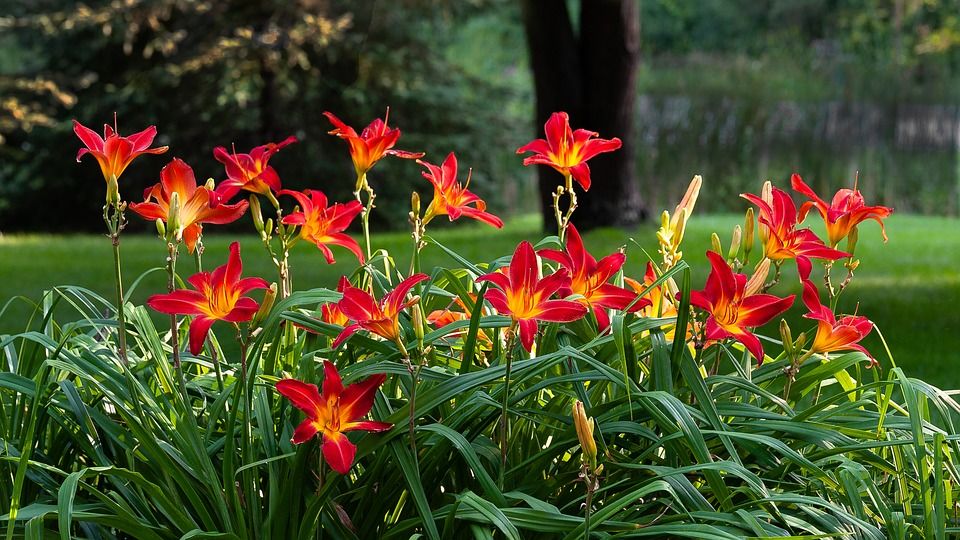
The plant is native to southern Europe, Mongolia, and China. It has been cultivated for centuries.
Description of daylily, photo
The plant has a fibrous root system with cord-like roots on the sides. The trunk grows up to 1 m in height.
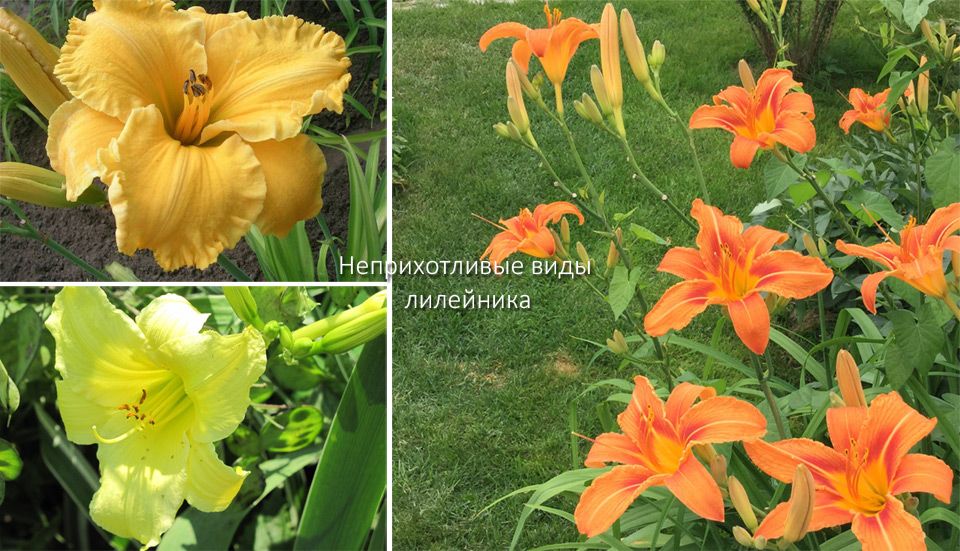
The foliage is elongated, with slightly tapered, smooth edges. It is dark green in color and arises from a basal rosette.
Large beige, pink, or red buds (up to 20 on a single stem) are tubular or funnel-shaped. They bloom at different times. The flowering period lasts 1-2.5 months.
The fruit is a round, triangular capsule containing several dark seeds.
Types of daylily
Natural daylily species are widely used in floriculture because they have an attractive appearance and low maintenance requirements.
These plant varieties include the following:
| View | Description | Flowers | Flowering period |
| Orange | Discovered in 1890. The foliage is tough, rich green, about 3 cm wide. The trunk grows up to 1 m. There is no smell. |
Asymmetrical, the buds reach 12 cm in diameter. The color is reddish-brown, the center is orange. | July. |
| Lemon-colored | Native to central China, it blooms at night and resembles a lily. The shrub grows up to 90 cm tall. Pleasant rich smell. |
Yellow, peduncle is about 14 cm long. | Mid-July – late August. Duration: approximately 40 days. |
| Dumortier (wolf locust) | First described in 1830, it is native to northern and eastern China. It is a compact shrub growing up to 70 cm. The leaves are rich green and up to 2.5 cm wide. | Sunny. The buds are up to 5 cm in diameter. | July. |
Daylily varieties with photos, names, and descriptions
The daylily species and varieties developed by breeders also deserve special attention:
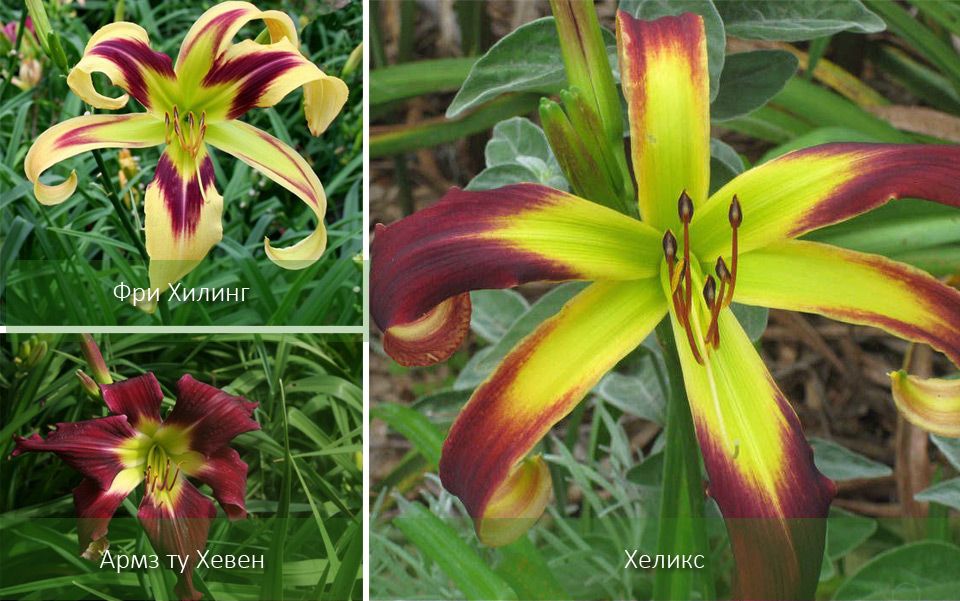
| View | Varieties | Flowers |
| Hybrid (garden) | There are more than 60 thousand. | They come in a variety of shapes and colors, with orange and yellow shades predominating. |
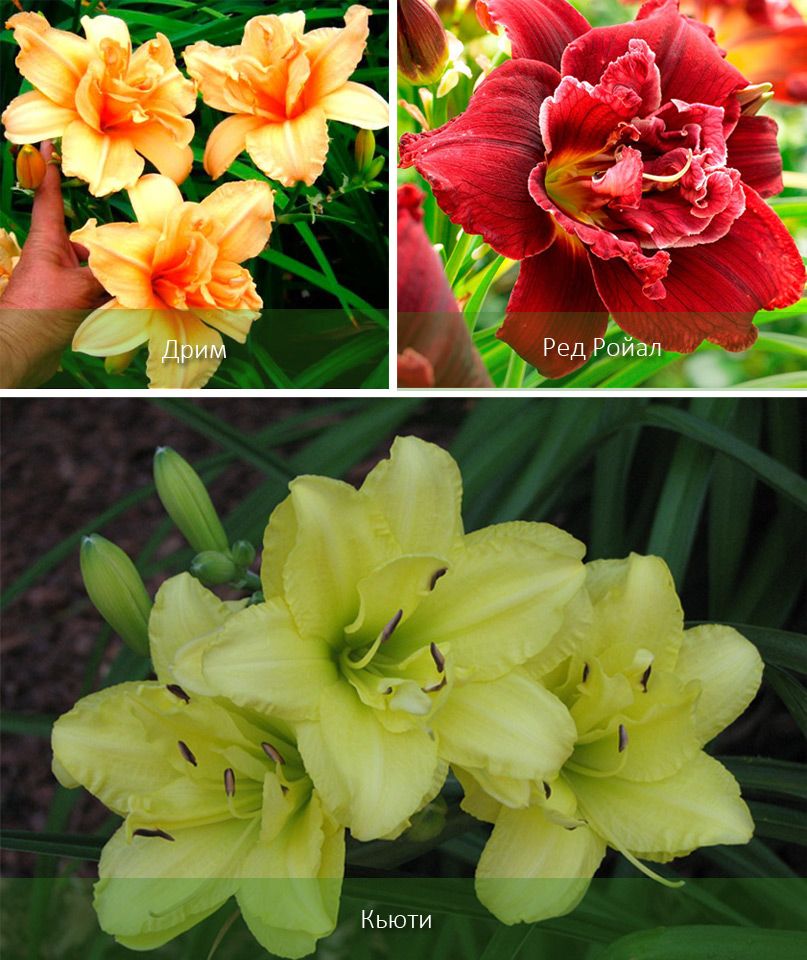
| Terry (Double group) | Cutie | Colour: chartreuse, bud diameter: up to 10 cm. |
| Dream | Apricot-shaped, with a dark orange center. The buds reach up to 12 cm in diameter. | |
| Red Royal | Burgundy, with an original shape - the outer petals are large, the inside ones are small, formed into an openwork rosette. | |
| Arachnid (spider) | Helix | Yellow-green buds with dark crimson edging. |
| Arms to Heaven | The color is purple-red, the throat is yellow-green. | |
| Free Healing | Large, creamy yellow in colour, with a red core. | |
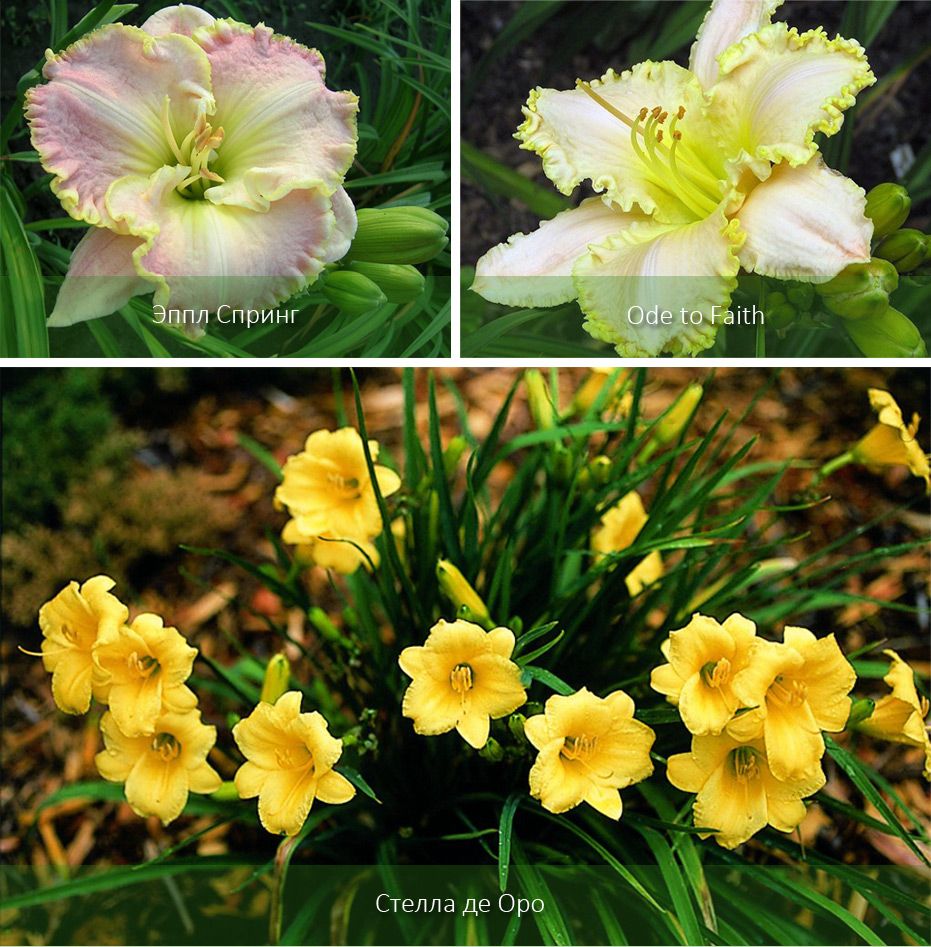
| Fragrant | Apple Spring | Light pink, with a greenish-yellow edge. The buds reach 15 cm in diameter. There are 28 buds per stem. |
| Ode to Faith | Bright yellow with a pinkish tint in the center, green throat. Diameter: about 15 cm. | |
| Stella de Oro (low-growing, one of the varieties that blooms all summer) | Funnel-shaped, dark yellow in color. Bud diameter: up to 7 cm. | |
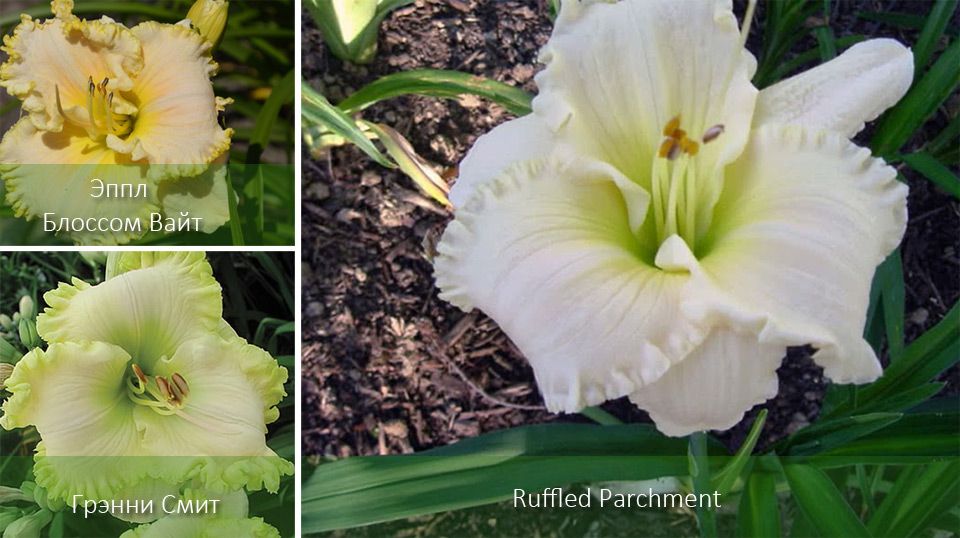
| White | Apple Blossom White | White, with yellow corrugated edging along the edges. |
| Ruffled Parchment | Creamy white, with a yellow throat. The buds reach up to 13 cm in diameter. | |
| Granny Smith | White, with a greenish corrugated edge. |
Daylily varieties that bloom all summer include Stella de Oro, Frans Hals, and Strawberry Candy. Among the relatively modern varieties, the 'Voroshilova Anna Borisovna' daylily (purple-green) stands out, widely used to decorate loggias, balconies, and winter gardens.
Daylily: Planting and Care in Open Ground
The time for planting the flower is selected taking into account climatic conditions; at least 4 weeks are allocated for rooting.
When growing daylilies in the middle zone, the optimal period is May-August.
- Store-bought planting material is immersed in a humid environment or any mineral fertilizer for several hours. This promotes root development, and the strongest roots are selected and shortened to 20-30 cm.
- For each shrub, prepare a planting hole about 30 cm deep and 60 cm apart, as it grows quickly. Fill each hole with a mixture of peat, humus, and sand (used in equal parts), then add a small amount of phosphorus-potassium fertilizer.
- Place the plant in the hole, carefully straighten the root system, and check for any voids. Fill the holes almost to the top with soil. Support the bush with your hand, water the soil, compact it, and repeat until the trench is completely filled.
- When planting, be sure to ensure that the root collar of the plant is not buried more than 2-3 cm deep, otherwise growth problems and rotting are possible.
A bush can grow in one area for up to 15 years, but over time the appearance of the flowers deteriorates, and then a transplant is performed:
- the plant is dug around its outer border;
- carefully remove it along with a lump of soil;
- the rhizome is washed under the shower and then divided into parts;
- Plant in a new area in cloudy weather conditions, after shortening and removing all damaged areas.
Daylily care
If you follow the rules for planting and caring for your daylily in open ground, it will delight you with its blooms for a long time.
To ensure this, select neutral or slightly acidic soil for the plant. In some cases, highly acidic or alkaline soils are used, adding lime. Fertile, loose soil is preferred. Clay soils are unsuitable, as they increase the risk of water stagnation and rhizome rot. A sunny site is recommended, as this will positively influence flowering.
The plant loves moisture, so it is watered 1-2 times a week.
Fertilize the flower twice a year:
- In April, dry complex mineral additives are applied, followed by thorough watering of the soil.
- 20-30 days after flowering, phosphorus-potassium fertilizers are used to increase flower bud formation.
Propagation of daylilies
The plant is propagated by dividing the bush. The optimal time is during transplantation, in August. Seeds are also used, but this method causes the flowers to lose their maternal characteristics (this method is primarily used by plant breeders).
When the shrub is 3-4 years old, it is propagated by separating daughter rosettes from the root system. To do this, take a sharpened shovel and place it vertically at the desired cutting site. Then, press down on the tool with your foot and cut off the desired section, trimming it from below and pulling it out of the ground. The damaged areas are covered with crushed charcoal or wood ash. The best time to do this is spring or fall.
Top.tomathouse.com recommends: fighting diseases and pests
Daylily is a plant that is resistant to external factors and changes in weather conditions, but it is often attacked by pests and diseases:
| Symptoms | Reasons | Elimination measures |
| A sharp deterioration in the condition of the plant, the leaves turn yellow and wither. | Exposure to bacteria or viruses. | The plant is dug up and removed from the area. |
| Spotting on flower stalks and seeds. Felt-like fluffy coating. | Fungus. | Severely damaged shrubs are removed from the soil and discarded. The remaining plants are treated with a soapy solution, the affected areas are removed, and they are replanted. |
| Yellow-brown stripes on leaves. | Striped foliage. | Treat with any fungicides. |
| Yellow-orange pustules. Slow growth, leaf fall. | Rust. | Spray with a garlic solution. For severe infestations, use various fungicides. If necessary, replant the shrub away from the patrinia. |
| Wilting of stems, blackening of the root collar. | Fusarium. | They are treated with products such as Benomyl and Carbendazim. Fitosporin-M is added to the irrigation water. |
| Yellowing and dying of foliage, softening of the root collar, specific odor. | Root collar rot. | The bush is dug up, the rhizome is washed under running water, placed in a strong solution of potassium permanganate for 15-20 minutes, and then dried. Then, it is replanted in a new location. |
| Withering of buds, appearance of white larvae in them. | Daylily mosquito. | Damaged and deformed buds are removed, insects are collected by hand. |
| Foliage discoloration, bud drop. | Thrips. | Adjust the watering regimen. Treat the plant with a soapy solution. If the infestation is severe, dig up and burn the plant. |
| Leaf deformation. | Aphids, slugs. | The bushes are sprayed with Actellic. Slugs are collected by hand. |
| Root system damage, wilting. | Water voles. | They use preparations aimed at combating garden rodents. |
With timely detection and control of diseases and pests, especially given daylily's winter hardiness, it can be widely used in landscape design. The shrub also decorates gardens and flowerbeds.