Lithops, a perennial plant of the succulent family Aizoaceae, is often called living stone. It grows in the deserts of Africa (South Africa, Botswana, Namibia, and Chile). Collectors love it for its diverse colors and unique leaf patterns.
The word "lithops" itself is of Greek origin and literally translates as "having the appearance of a stone." The plant was first introduced to Europe by botanist John William Burchell. He encountered the lithops at the Cape of Good Hope and described it in his geographic catalog, published in 1815.
Content
Description of Lithops
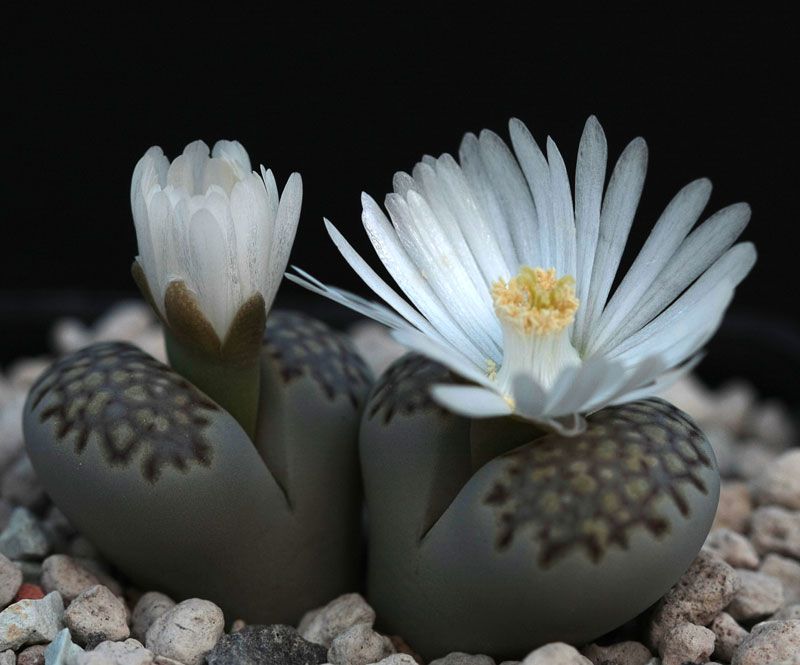
On the soil surface, the plant looks like two fused, falsely truncated fleshy leaves, separated by a narrow groove and resembling smooth small stones or sea pebbles. Lithops have learned to mimic the color and texture of the soil, assuming colors ranging from light green to blue, beige to brown.
- This tiny plant, no more than 4 cm in height, grows up to 5 cm in width. Lithops have no stem.
- The leaves are small, rounded on the sides and flat on top. They are approximately equal in height and width—up to 5 cm. New shoots and the flower stalk emerge from a crevice between a pair of older leaves.
- The flowers, 2.5–3 cm in diameter, resemble daisies and are white, yellow, and, in some species, orange (Lithops fulvus). Some have a distinct scent. The buds first open at midday. Flowering lasts a little over a week.
- The root system of plants is highly developed, several times larger than their above-ground portion. During severe drought, the roots pull the leaf blades into the soil, thereby protecting them and themselves from death.
Popular types of lithops
A total of 37 Lithops species have been registered and described. However, these plants are rarely available for sale.
Most popular:
| Name | Leaves | Flowers |
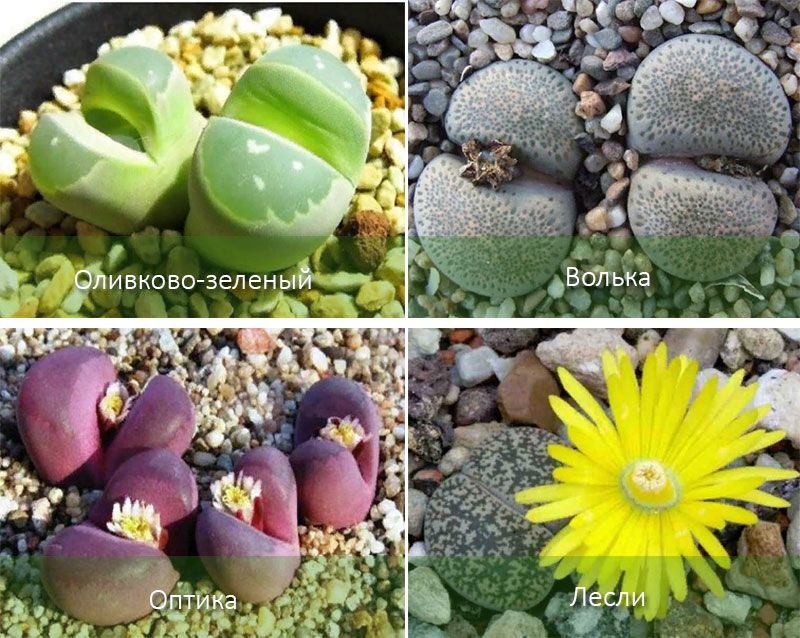
| Olive green (Lithops olivacea) 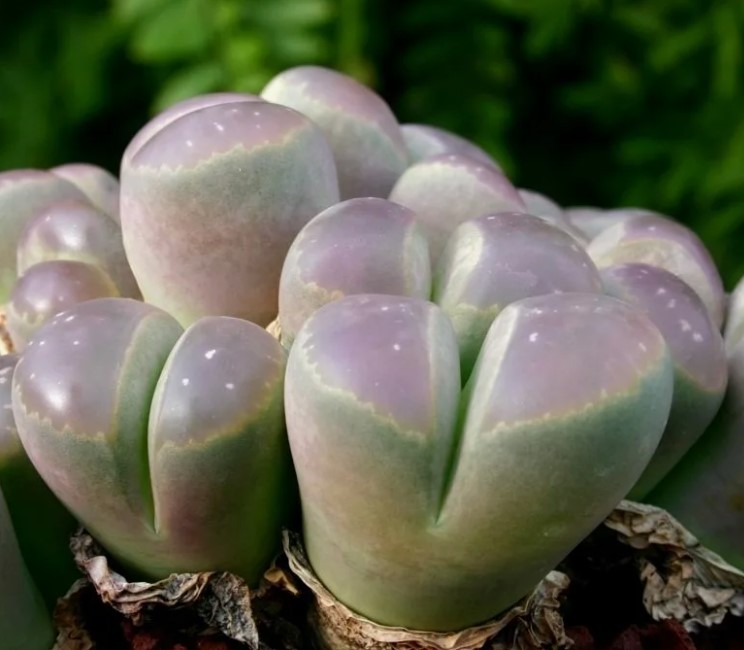 |
Malachite-colored with light spots along the upper edge. Fused almost along the entire height, 2 cm in diameter. | Yellow |
| Optics (Lithops Optica) 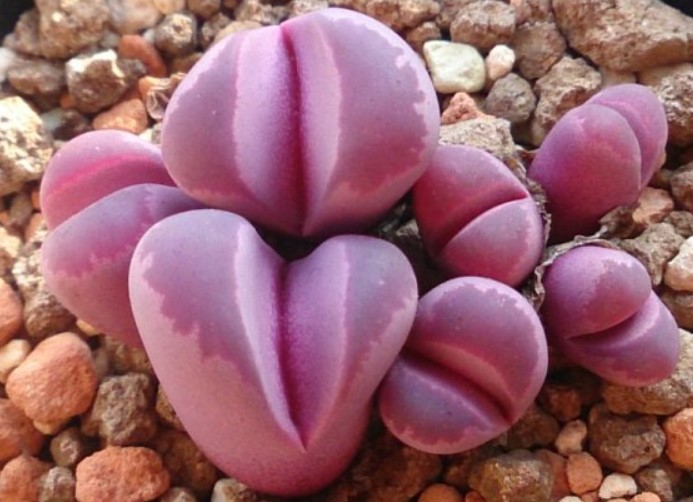 |
They are divided almost from the base, slightly elongated upward. The color is muted green or gray. Purple specimens are also found. | White, with cream stamens. |
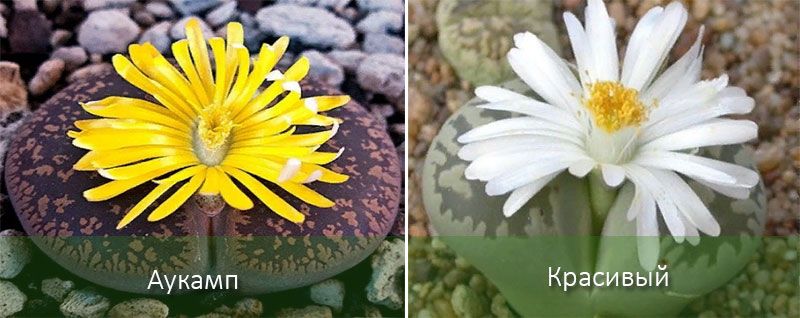
| Aucamp (Lithops aucampiae) 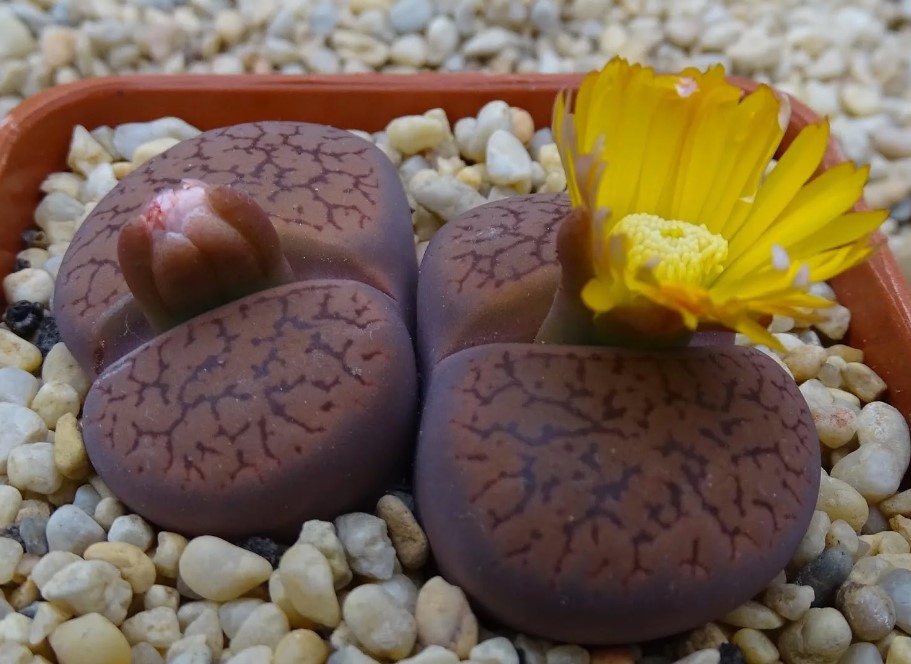 |
Dark, gray-green in color, brown on the surface. 3-4 cm in height. | Yellowish, relatively large, up to 4 cm in diameter. |
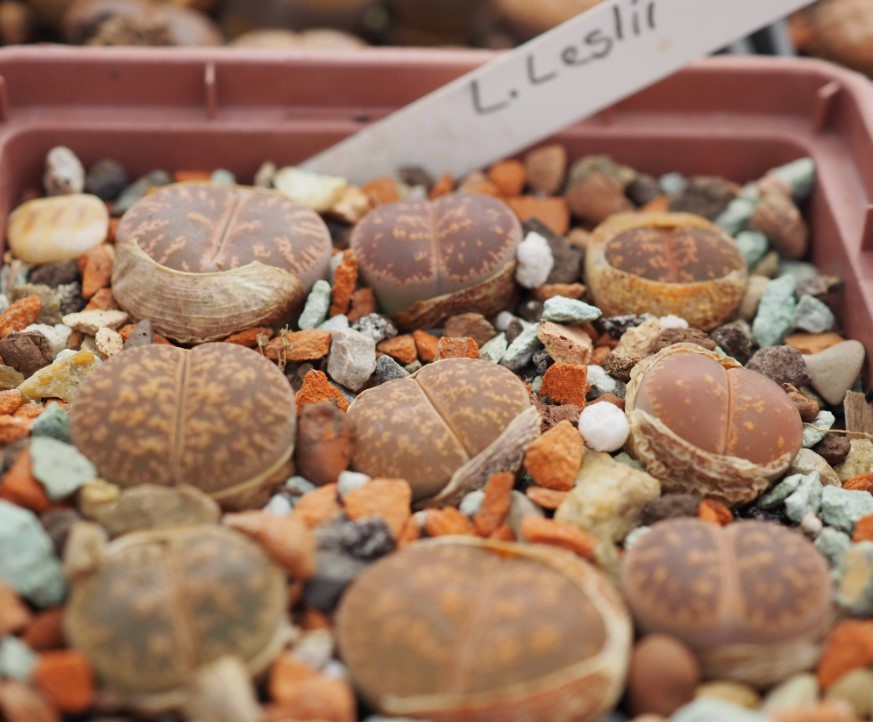
| Leslie (Lithops lesliei)
|
Small, no higher than 2 cm. Bright green, dark and speckled on top. | White, with a distinct pleasant aroma. |
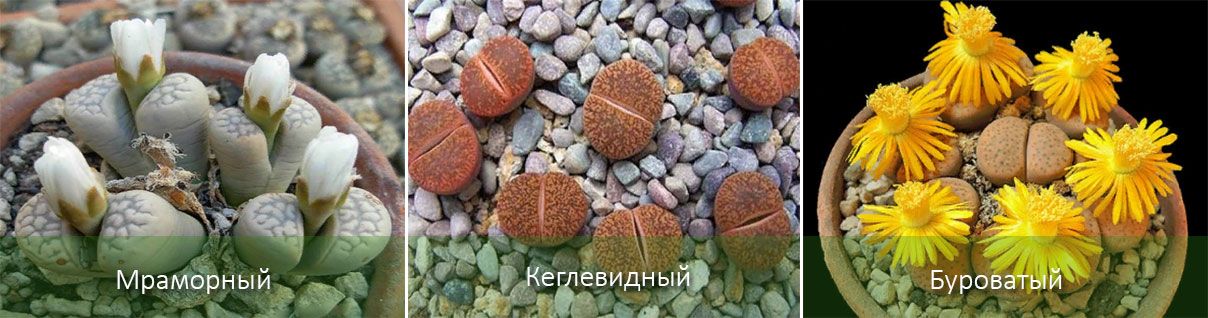
| Marble (Lithops marmorata) 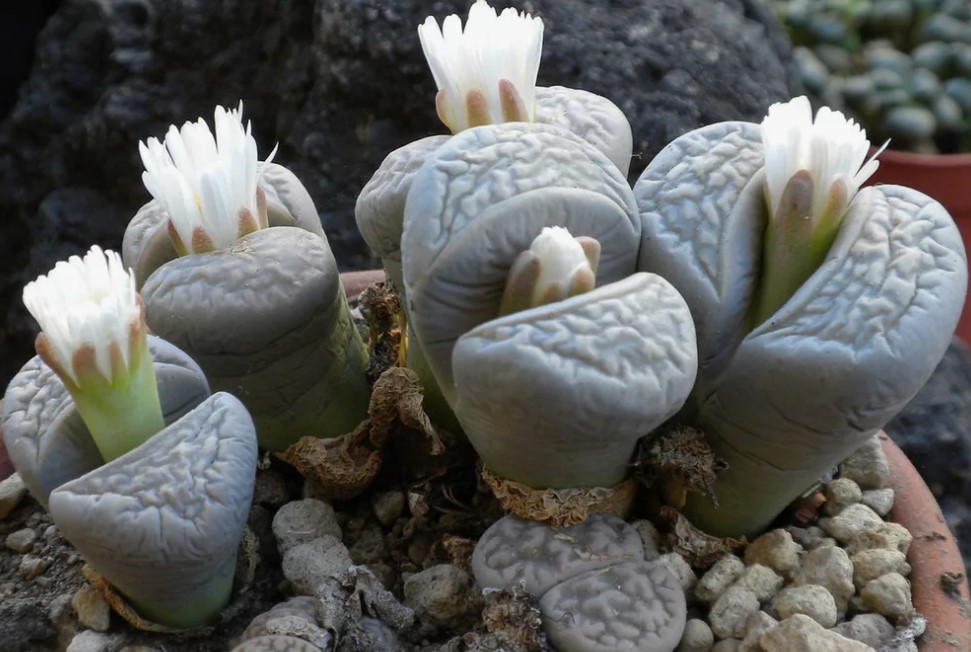 |
Gray, with a color transition from light to dark from bottom to top. They widen toward the top, giving the plant a heart-shaped appearance. | Larger in diameter than the leaves (5 cm). Sand-colored. |
| Brownish (red-headed) Lithops fulviceps) 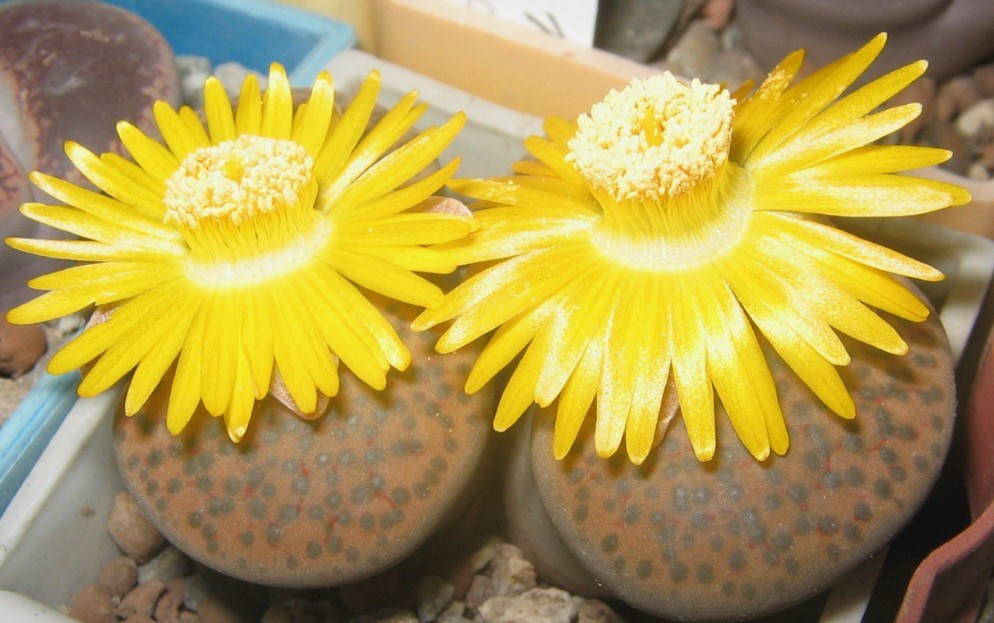 |
Cylindrical, flattened at the top. Brownish in color with brown, almost chocolate-colored and reddish specks and stripes. | Large lemon yellow. |
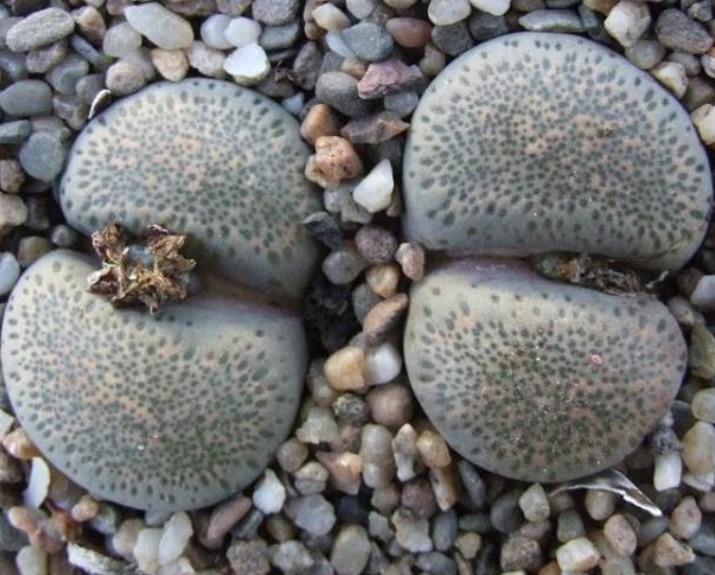
| Volka
|
Barrel-shaped, with a whitish sheen, the leaves range in color from blue-gray to brownish-purple. The surface is mottled with spots resembling raindrops. A shallow cleft divides the leaves into unequal lobes. | Golden. |
| Cone-shaped (Lithops turbiniformis) 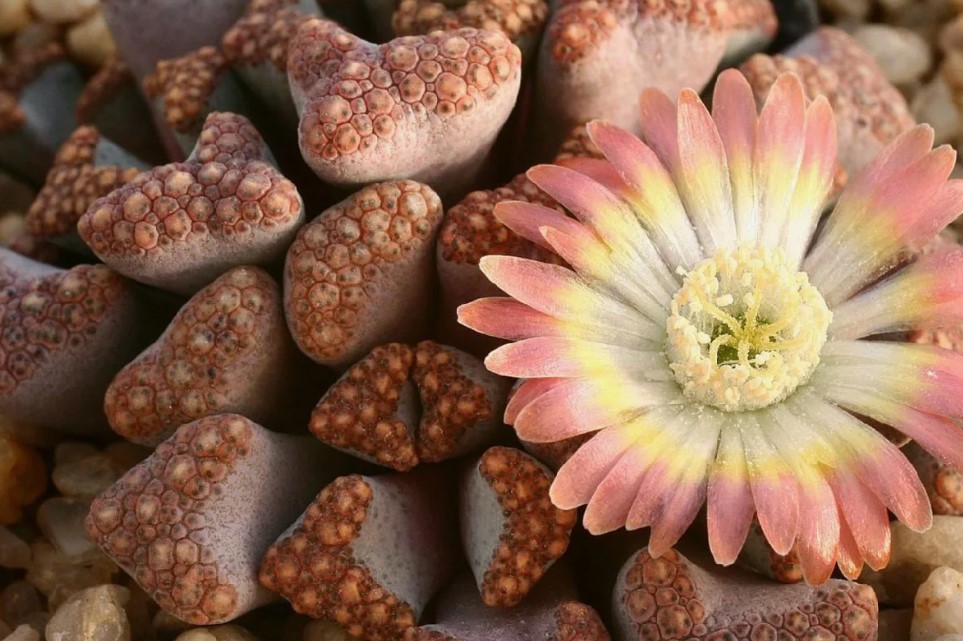 |
Brown with a brick-red tint. Together, they have an elongated shape, reminiscent of a coffee bean. | These are among the most beautiful and largest, reaching 4 cm in diameter. Their color ranges from white at the core to pink in the center and coral-red at the edges. |
| Beautiful (Lithops bella) 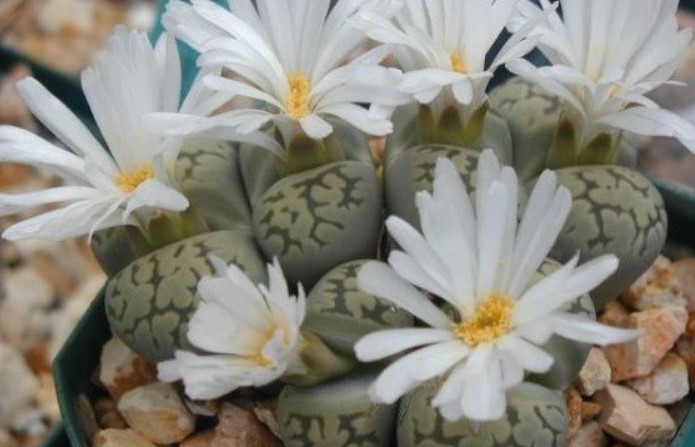 |
Matte green with a smoky sheen. Rounded, deeply dissected, each one individually resembles a drop, and when connected in pairs, they look like a broken heart. |
White with a dark yellow center, they bloom in September and emit a pleasant aroma. |
Scientists are still discovering and describing new species of lithops. The latest, Lithops amicorum, appeared in 2005.
Lithops in the wild
In natural conditions, the life and development of these plants depend on the time of year, i.e. the dry and rainy seasons:
- In summer, during the dry period with long daylight hours, the plant is in a dormant state.
- During the rains that occur in autumn, the lithops grows actively, produces an arrow with a bud, blooms, and forms a fruit.
- In winter, when daylight hours are short, a new pair begins to develop under the cover of older leaves. It feeds and grows at the expense of those on the surface, gradually drying them out and thinning them out.
- In spring, the rainy season returns, and the old leaves burst open, making way for new ones. These, in turn, absorb moisture and swell to the size of a mature leaf.
In their native habitat, lithops depend on adequate moisture, warmth, and photoperiod (i.e., light). These factors should be taken into account when growing indoor plants.
Interestingly, the gap between each new pair of leaves is perpendicular to the previous one. Sometimes, instead of two, four leaves may emerge, fused in pairs. In this case, they share a common root system. This is how a colony of lithops grows over the years. They appear as independent plants, but share a common root system.
Caring for Lithops at Home
Lithops have learned to survive in places where other plants would die. They grow well and even bloom indoors with careful care. To do this, you need to follow a few rules.
Watering
3-4 teaspoons of water are sufficient. They should be distributed evenly along the rim of the pot and used to moisten the tray. Avoid allowing water to drip onto the leaves, much less linger in the axils.
The soil should dry out completely between waterings. A slight wrinkling of the leaves will indicate that the plant needs moisture.
Lithops are especially susceptible to overwatering. The leaves are designed to accumulate moisture, and if overwatered, they can rot. Saving such specimens is virtually impossible.
Pot, soil, drainage
To ensure the full development of a strong root system, a deep, wide pot is needed, with a drainage layer at the bottom. To prevent the soil from drying out, pebbles or decorative stones can be added. The soil should be the same as for cacti: light and breathable.
Location, lighting
Like all succulents, they prefer bright locations. They thrive on south- or east-facing windowsills. They can be burned by direct sunlight.
It's important to keep lithops in one place; they shouldn't be moved or rotated, as this can cause them to become diseased. They don't tolerate drafts or overheating in winter.
Fertilizers, processing
They don't require fertilizer. However, they prefer soil changes and repotting at least every two years. Every year, in late fall, the leaves and soil beneath them should be treated with insecticides (Aktara, Iskra, etc.). However, caution should be exercised when doing this, as these products are toxic.
Seasonal care features
| Season | Conditions | Watering |
| Summer | Rest period. | Stop. If absolutely necessary, only the top layer of soil is moistened. |
| Autumn | The plant is in the awakening stage. | A generous but sparse supply is required. A flower stalk appears between the leaves. The flower blooms. |
| Winter | Growth is slowing. | Stop. The mature pair of leaves begins to dry out. The room temperature is reduced to +10…12 °C. |
| Spring | Old leaves die off and are replaced by new ones. | They are resuming. |
Reproduction, transplantation
It's easy to grow lithops from seeds at home. It's best to sow them in early spring.
Step-by-step instructions for growing from seeds:
- Prepare the soil. Mix equal parts peat, river sand, garden soil, and crushed red brick, and heat.
- Place the soil in a planting box with low sides, level it, compact it lightly, and moisten it thoroughly.
- Soak the seeds in a manganese solution for 6 hours.
- Spread raw over the soil surface.
- Cover the box with a thin layer of soil. Cover the box with glass or cling film.
- Set the fluctuation of night and day temperatures from +10 °C to +20 °C.
- Every day, ventilate the room for a few minutes, open the glass, wipe away the condensation, and moisten the soil with a spray bottle.
- With proper care, the seeds will germinate and shoots will appear in 6-8 days.
- Start watering carefully, make the ventilation longer, but do not remove the cover completely.
- After 1.5 months, when the plants have formed and strengthened, transplant them into pots, 2-3 at a time. They grow more vigorously when planted in groups.
Lithops should be repotted when they have grown significantly. Do this carefully to avoid deepening the growth zone and exposing the roots. It's best to use light-colored pots to prevent the root system from overheating.
Diseases and pests of lithops
| Disease | Signs | Elimination measures |
| Mealybug | The leaves are covered with a white coating and yellow spots appear. | Wash with soapy water and treat with insecticides (Aktara, Iskra, etc.) |
| Root mealybug | The edges of the pot are covered with a white coating, the roots are grey. | Repotting. The roots are washed with hot water and treated with insecticides. The pots are replaced. |
| Aphid | The leaves and container are covered with a sticky, transparent coating resembling sugar syrup. Insects are visible. | Wipe with soapy water, spray with tobacco infusion or insecticidal preparations. |
Once purchased, it's impossible to remain indifferent to this amazing plant, which resembles cold stones in appearance, yet holds within itself a piece of the sultry desert. Unpretentious and welcoming, the lithops responds gratefully to care and delights with its modest blooms and delicate fragrance each year.
Reviews of lithops cultivation from gardeners
Lithops (living stones) is a very unusual plant, perfect for people who are often on the move and for those who love everything unusual, as well as for fans of succulents and compact plants.
I've had my eye on lithops for a while now, because they're such cute and unusual plants. They look a lot like stones or brains. Plus, I've recently become fascinated with succulents because they're easy-to-grow and don't require much water.
These little plants are so cute, it's hard to resist buying them. I chose the brown-leafed variety, which I find more unusual, but there are also varieties with green leaves, but they look more like regular succulents.
In general, there are many species of these plants.
The species I bought is called, I believe, Lithops aucampiae
Small lithops are inexpensive - 6.5 Belarusian rubles / $2.9
I bought them at the Materik home improvement store in Minsk, which has a very large plant section. I couldn't decide which pot of lithops to get; they were all so beautiful!
Here are my babies:
Lithops
I bought them in winter, so I haven't watered them at all yet, as overwatering is fatal—they'll simply rot. So, this plant is perfect for those who frequently travel for business or business, but those who regularly overwater their plants should be careful.In nature, these beauties grow in a rocky desert, which is why they mimic stones and are undemanding to a dry climate.
Lithops are able to tolerate large temperature fluctuations.
This plant is in bloom, so I hope to admire this beauty for a while longer: when a cute little flower emerges from the middle of two forked petals.
Lithops consists of two fleshy leaves that are renewed over time, gradually revealing more and more young leaves, while the old ones gradually open and begin to dry out, becoming like a dried film. This film can slightly spoil the appearance of the plant, but it should never be removed prematurely; it should fall off on its own, because the old leaves give life to new ones due to their moisture and nutrients.
This process reminds me of the skin renewal process in reptiles.
Lithops do not like to grow alone, so do not plant them in separate pots.
These little plants love good light, and the soil should be permeable and loose to allow air to reach the roots and prevent stagnant moisture, as overwatering is harmful. Therefore, pure peat soil is not suitable for them.
Watering should be done twice a month during periods of intensive growth. During the dormant period, which lasts from January to March, there is no need to water. If the room is very warm and dry, the lithops can be watered (no more than once every four weeks).
After the buds have formed, the plant should not be watered.
This plant tolerates dry soil well, but reacts extremely negatively to overwatering. If the soil remains wet for a long time, the "living stone" will rot. However, you won't know this right away, as it will initially appear quite normal, but then suddenly shrivel and dry out.
Proper watering is essential for this plant. It should be infrequent and abundant. After watering, the soil, including the roots, should be completely soaked. However, any excess liquid should drain out of the pot very quickly. The moisture retained in the sand and pebbles is sufficient for the plant.
Some gardeners believe that avoiding liquid on lithops foliage when watering is unacceptable. However, this is not true. Water splashed on the leaves can only harm the plant if it is exposed to direct sunlight (it will cause sunburn). In nature, such "pebbles" are found on rocks near the seashore, where heavy fog is common at night.
The plant can be propagated by seeds. If I get any during the process, I'll tell you how it turned out. However, for me, it's easier to buy a ready-made plant, since it's quite inexpensive.
I recommend this plant.
Update, new lithopsics
I couldn’t resist and bought myself some more “living stones”:
Lithopsics
I also took another big green one, it looks very unusual:
Green Lithops
Advantages
Lithops is blooming
Small size
Does not require frequent watering and fertilizing
A very unusual plant
Looks like living stones
It's inexpensive
Flaws
If watered frequently, they may rot.
Veronika62003
recommends
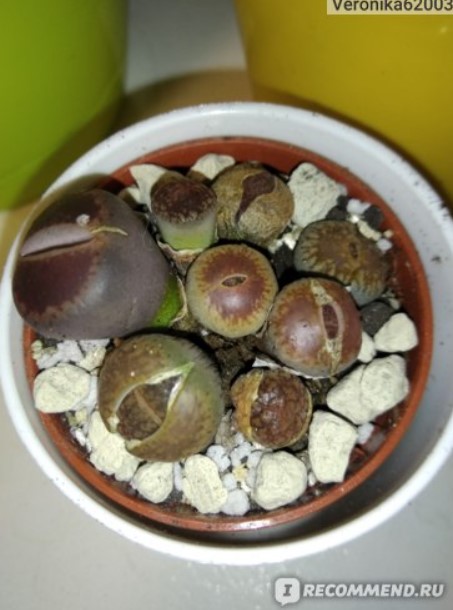
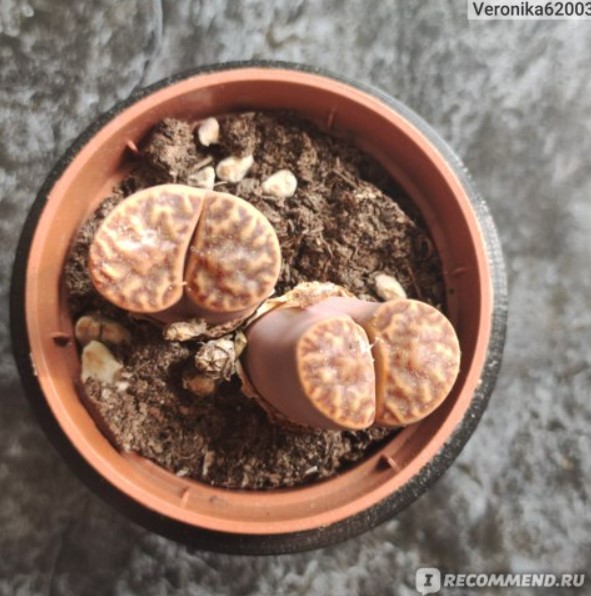
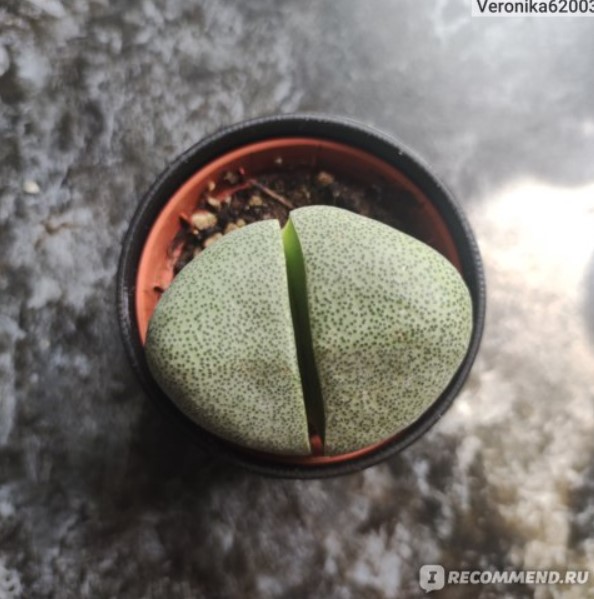
Lithops (living stones) from seeds. Planted February 20, 2020, and photos as the plants grow and develop.
I love houseplants and love growing them from seed. I saw lithops in the flesh a long time ago at a flower shop, when I wasn't particularly interested. Now I try growing whatever catches my eye, especially readily available seeds. I find it more interesting, even though it's more difficult and takes longer.Lithops, or Living Stones, are leafy succulents (as opposed to prickly cacti). They require direct sunlight, special soil, and specific watering to grow and thrive.
I have seeds from Gavrish, a Russian company. I know people order from AliExpress, but I haven't seen any results.
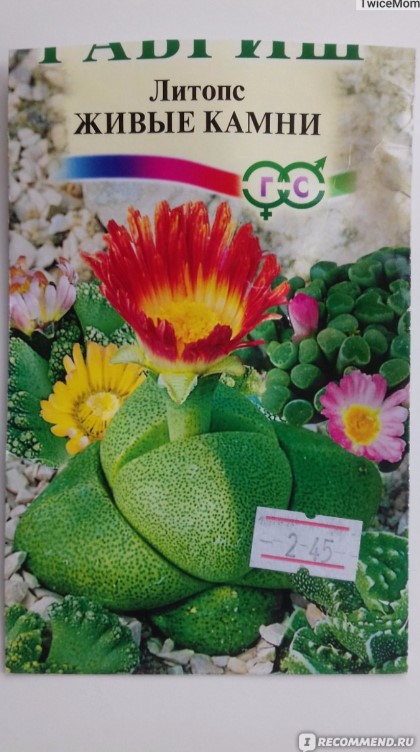
On the packaging is a lithops in its most interesting state:
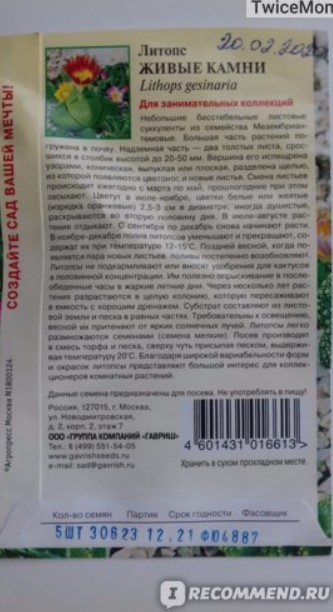
The price on the packaging is in Belarusian rubles.On the reverse side there is brief information about the plant and how to propagate it by seed.
Unfortunately, I don't have a photo of the seeds themselves. I didn't think I'd be writing a review. But I will say this: you'd hardly be able to see them in a photo. They're microscopic, almost invisible specks. They were in a special capsule, and I couldn't even count whether there really were five of them, as stated on the package.What is needed for sowing?
Seeds, soil, a pot or other container of a suitable size, something to cover the seeds with at first, water for watering.
I used soil from the company “Garden of Miracles”, special for cacti.
A ceramic cup serves as a pot. Therefore, it has no drainage hole and no tray or stand is needed.
I chose a cup because I couldn't find any other suitable pot for such small plants. I think it will definitely serve as a home for living rocks for several years.
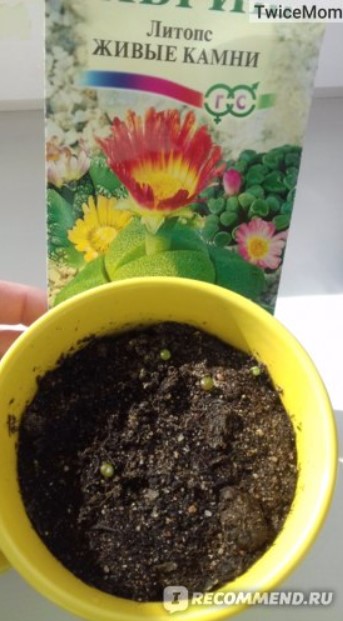
So, we filled the container with special soil, lightly moistened it with water, and scattered the seeds over the surface (not burying them deep). I didn't even touch the seeds themselves; I simply tried to carefully shake them out of the special capsule (which was in the package). At that point, I also didn't realize how many seeds were on the surface of the soil. But it seemed like only two.
After that, I very carefully sprayed the soil with a spray bottle so as not to scatter the seeds. I didn't sprinkle any soil on top. I covered the plant with a clear plastic lid to create a greenhouse effect. I placed it on a south-facing windowsill and waited.
The seedlings emerged 3-4 days after planting. That's very fast. Other plants don't sprout so quickly.
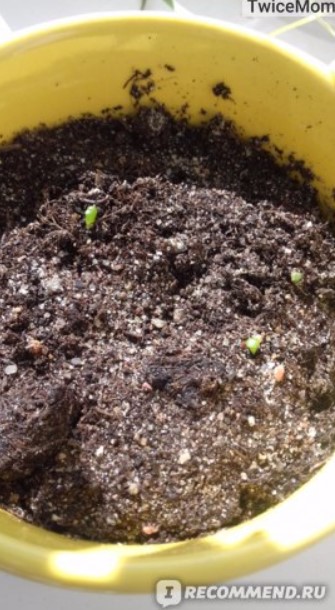
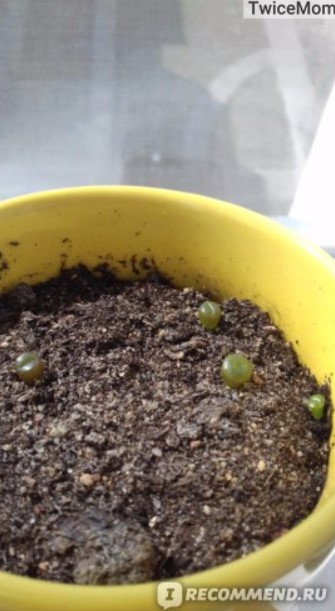
Here are these little ones. Photo taken 5 days after sowing the seeds.
Day 5
Three lithops sprouted. That is, one seed was invisible to my eye. After these little buds appeared, I opened the greenhouse slightly for ventilation and carefully watered the soil drop by drop. I kept the greenhouse closed for about two weeks, opening it only for ventilation. After two weeks, I removed the cover completely and discovered a fourth sprout! It was just a little late in its emergence.During the first month, the care conditions remained the same. This included watering every five days. As a reminder, the greenhouse was already open, meaning the babies were already growing in their pots like adults after two weeks. They were placed on the south-facing windowsill. So, I immediately assigned them to their permanent home.
Exactly one month later my living stones looked like this:
1 month
They've grown a little, gained a little weight. And most importantly, all four lithops are safe and sound.But still, the promised one never appeared, unfortunately.
The lithops are two months old. They've grown noticeably, and the crack at the top of the plant is now clearly visible, from which new leaves and flower stalks will emerge in the future.
2 months from planting seedsAdvantages
Interesting life cycle
Lithops is blooming
Small size
An unusual appearance
Looks like living stones
It's inexpensive
TwiceMom
recommends