Ludisia, or Hemaria, is an unusual houseplant from the orchid family. Unlike other orchids, it is prized not for its flowers (which are rather inconspicuous), but for the extraordinary beauty of its foliage.
Basic information about the Ludisia orchid
Ludisia is native to the tropical forests of Southeast Asia, where it grows on mossy rocks and soil. Because of this, its root system branches extensively, often forming lateral shoots, but is not particularly long.
The thick, curved stem is covered with numerous small hairs. Its height rarely exceeds 15 cm, as the plant prefers to grow outward.
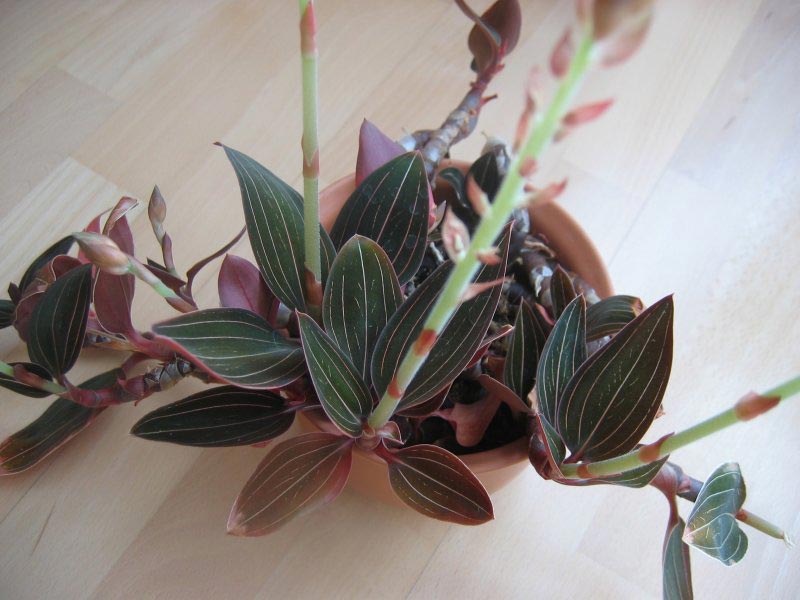
Large, velvety leaves are arranged in rosettes. Their color ranges from dark green to burgundy, and the surface is decorated with a pattern of silvery or reddish veins. They reach 7 cm in length and 4 cm in width.
The lifespan of one leaf is several years, after which it falls off, leaving a brown belt on the stem.
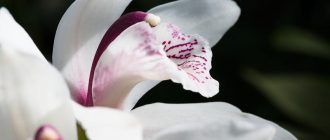
Hemaria orchid blooms in late fall and early winter with small (up to 2 cm) white flowers studded on long stems arising from the leaf axils. These inflorescences are compared to a scattering of pearls, leading this species to be called the "precious orchid."
Types and varieties of Ludisia orchids
In the wild, Ludisia is represented by only one species, Discolor (Colorless). This is a creeping plant whose stem ends in a rosette of leaves and a long peduncle. The leaves are bicolor: dark green on the upper side and reddish on the back, with five light veins running along them.
Several ornamental varieties for home cultivation have been developed based on this species.
| Variety | Leaves | Veins |
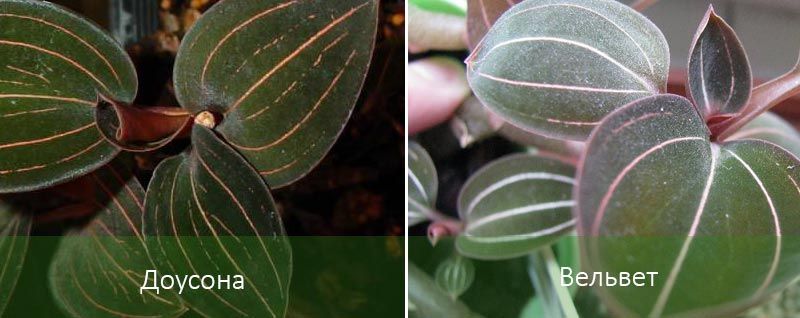
| Dawson | Dark, large. | Longitudinal, clear, reddish tint. |
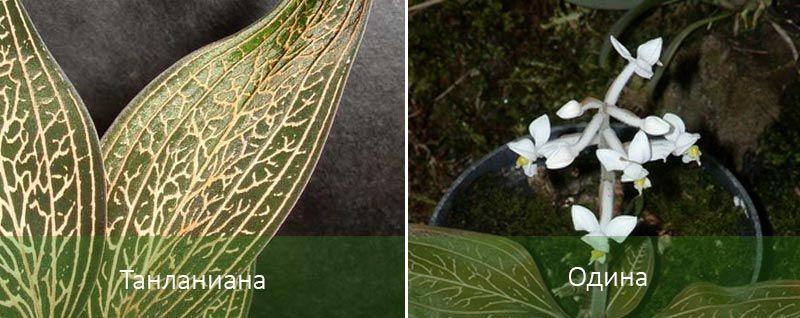
| Odin | Very dark. | Longitudinal, with lateral branches from the central vein. |
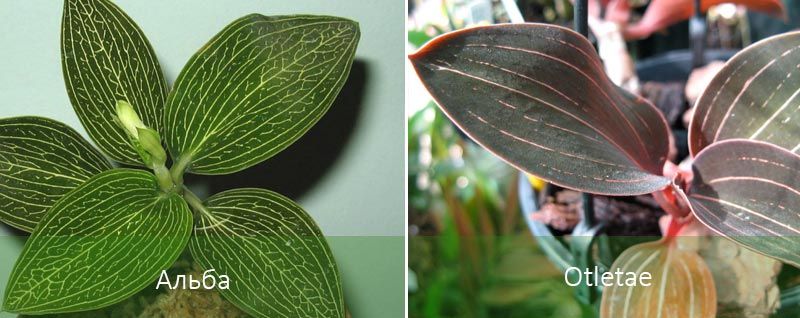
| Alba | Bright green leaves without red tones. | Branching light network. |
| Otletae | Almost black. | Orange-pink, longitudinal, sometimes intermittent. |
| Tanlaniana | Narrow and elongated, dark green. | A dense golden network. |
| Velveteen | Dark green, fuzzy. | Longitudinal, reddish. |
Rules for growing ludisia at home
Ludisia is a shade-loving plant, but at the same time it is very demanding in terms of humidity and temperature.
To ensure proper care at home, remember that it loves abundant watering, is afraid of direct sunlight and hot, dry air, and begins to bloom only in colder conditions.
| Parameter | Favorable conditions | Unfavorable conditions |
| Place | North-east and north-west windows. | South-facing windows without shading. Proximity to radiators. Cold drafts. |
| Lighting | Diffused light for at least 12-13 hours per day. During periods of insufficient sunlight, supplemental lighting with phytolamps is recommended. | Direct sunlight in the middle of the day. |
| Temperature | In summer, +22…+25 °C during the day and +17…+20 °C at night. During the flowering period, +18…+20 °C. | Below +15 °C and above +30 °C. Sharp changes. |
| Humidity | Air humidity 75-80%. If necessary, use an electric humidifier or place a cup of water or damp moss nearby. | Humidity below 70%. Spraying with a spray bottle. |
| Watering | Keep the substrate slightly moist. Use filtered water at room temperature as the top layer dries. Alternatively, water through the drainage holes by submerging one-third of the pot in water for 15 minutes. Be sure to remove excess water from the tray. | Overwatering or overdrying. Using raw or cold water. |
| Fertilizer | Special orchid complexes added to water for irrigation. Apply every three weeks in spring and summer, and every five weeks in fall and winter. The frequency can be increased while reducing the dosage. | Overdose of fertilizers (leads to damage to the leaf pattern). |
| Trimming | Remove flower stalks immediately after flowering. Trim back prematurely emerging flower stalks on young plants. | Flower stalks remaining after flowering (produce extra lateral shoots). Flowering of young ludisia (takes too much energy). |
Soil and transplanting rules
Hemaria is repotted in the spring, when active growth begins. This should be done as needed, whenever the root system becomes overcrowded in the pot. Signs of this include root tips protruding from the drainage holes. This usually happens every two or three years, sometimes less frequently.
Another reason for replanting is substrate deterioration (caking or rotting) or plant disease.
As a soil, it is recommended to choose specialized substrates for orchids or mix the soil components yourself in a ratio of 4:4:4:4:1:1, respectively:
- leaf soil;
- high-moor peat;
- pine needles;
- crushed sphagnum;
- birch charcoal;
- foam plastic.
When choosing a pot, you should take into account the characteristics of the root system: Ludisia's root system grows more laterally than in depth, which means the container needs to be wide but not deep.
A mandatory requirement is the presence of large drainage holes in the bottom and walls to ensure adequate air exchange.
The transplant is carried out in several stages:
- Drainage (expanded clay or gravel) and a layer of soil are poured into the bottom of the pot.
- The plant roots are removed from the pot and carefully cleaned of the substrate, after which they are washed in clean water at room temperature.
- Ludisia is placed in the center of the pot and covered with substrate to the level of the previous soil.
- Moss, previously soaked in warm water, is spread around the stem of the plant.
- Watering is not carried out immediately after transplanting; the soil is moistened in advance.
Methods of reproduction
The most convenient way to propagate ludisia is by cuttings, stem segments or division of the bush.
Cuttings are recommended to be taken during the active growing season—late spring and summer. At this time, the cuttings have a better chance of rooting.
Algorithm:
- Cut off the top of the stem with two or three growth points.
- Treat the wounds with activated charcoal.
- Stick the cutting into the moistened moss so that the leaves lie on the surface of the moss.
- After rooting, transplant into a pot with substrate and care for it as for an adult plant, initially cutting off emerging flower stalks.
Propagation by stem segments is also a simple method. To do this, take a stem section with five or six growing points, remove leaves, and place it horizontally on damp moss. You can carefully push the segments deeper, but the top should remain exposed. After roots appear, plant the plant in a pot.
Dividing the bush is combined with replanting. It's important to remember that only those plant fragments with at least two shoots are viable.
Florists do not usually practice growing hemaria from seeds, because this process is very labor-intensive and unreliable.
Pests and problems of growing Ludisia
Ludisia is a plant susceptible to disease and pest attacks. If you notice any of the following problems, take immediate action to prevent the plant from dying.
| Signs on leaves and other plant parts | Cause | Treatment | Prevention |
| Wilting and yellowing. Root odor. Darkening of roots. | Root rot. | Remove the roots from the pot, trim off any damaged areas, rinse with water containing potassium permanganate, and dry. Repot in completely fresh soil. Do not water for several days. | Maintain proper watering regime. |
| Wet brown spots, including on the stem. | Stem rot. | Clean the damaged area and treat it with activated charcoal. Repot the plant in new, disinfected soil. In severe cases, cut off any unrotted tops and root them using cuttings. Discard the remaining plant. | |
| Wilting of the tops, paleness, and sometimes a white coating and mucus on the roots. White formations on the cut stems. | White rot. | Treatment is usually ineffective. It is recommended to discard the plant and its pot. | Water, maintain the required level of air humidity, and systematically add fertilizer to the substrate. |
| Thin web on the back side. | Spider mite. | Treat with a soft cloth soaked in soapy water. If this doesn't work, apply insecticides (such as Mospilan, Fitoverm, or Aktara). In severe cases, repeat the treatment every week for a month. | Maintain the required level of air humidity. |
| Yellowing and leaf drop. Sticky, cotton-like growths, including on the stems. | Mealybug. | ||
| Yellowing and falling off. Brown growths, also on the stems. | Scale insect. |