Buttercup or ranunculus is an annual or perennial herbaceous plant of the Buttercup family.
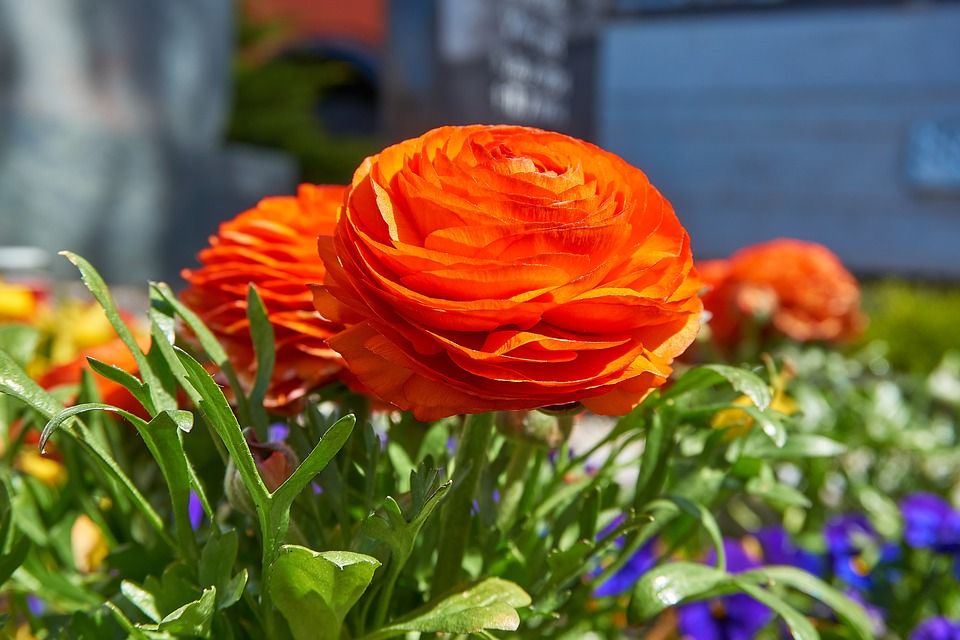
The flower's name comes from the Italian word for "frog" because it loves water and grows in marshy or damp places.
Content
- 1 Description of buttercup
- 2 Types and varieties of buttercup: caustic, creeping, poisonous and others
- 3 Garden buttercup and its varieties
- 4 Planting buttercups in open ground
- 5 Caring for buttercups in open ground
- 6 Growing buttercups at home
- 7 Diseases and pests of buttercups
- 8 Top.tomathouse.com recommends: the medicinal properties of buttercup
Description of buttercup
Buttercups have a rhizome or tuber-like system and branching stems ranging from 20 cm to 1 m in height. The foliage can be entire, spatulate, palmate, or dissected, and is approximately 6 cm long. The leaves come in all shades of green.
Different varieties bloom at different times, but all flowers open by July. They can be single or double, up to 10 cm in diameter. Petals range in color from white to red and even purple. Blooming lasts about a month.
It is pollinated by insects. Seeds appear in late summer, collected in a polypod.
Most species have poisonous sap that is dangerous to animals and humans. Some are used medicinally.
Types and varieties of buttercup: caustic, creeping, poisonous and others
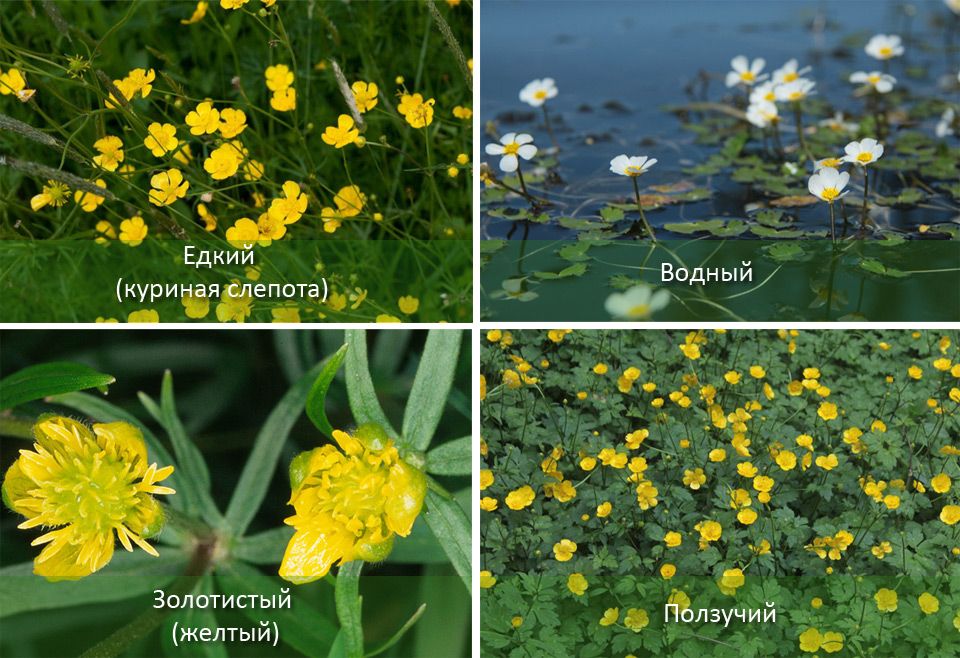
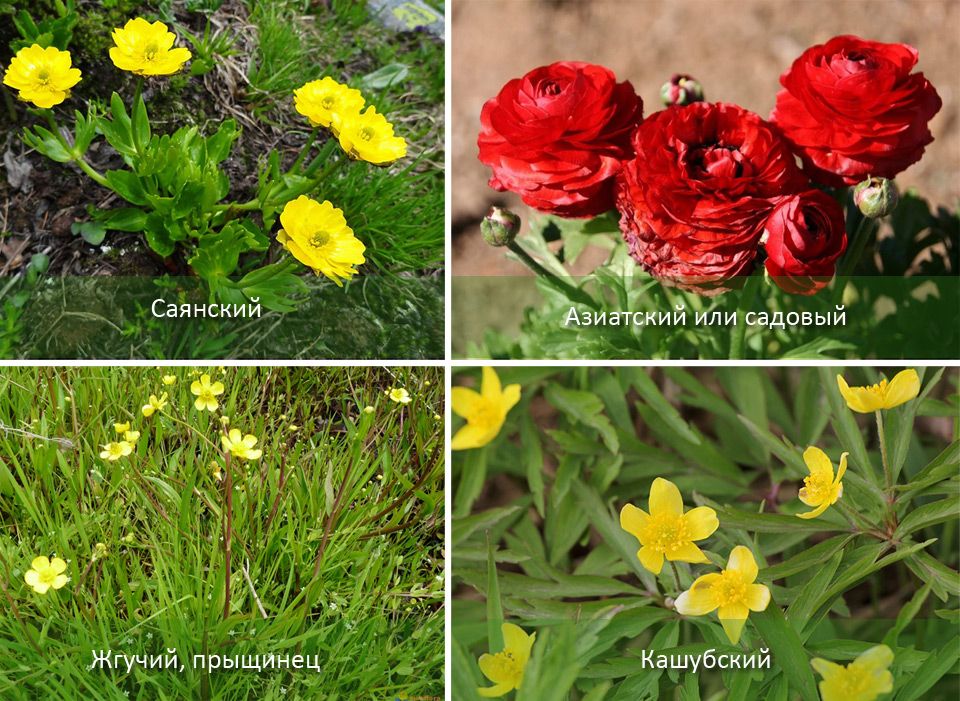
There are about 600 species of buttercups, 54 of which are used for decorative purposes. Some, like garden buttercups, are used frequently, others rarely.
| View | Description | Leaves |
Flowers Flowering period |
| Caustic (night blindness) | Height up to 1 m, stem straight, slightly pubescent. It is winter-hardy and undemanding. | The lower ones are large, with a long petiole, the upper ones are dissected. |
Yellow, numerous with 5 petals. June. |
| Golden (yellow) | Perennial, up to 40 cm, straight stem. | Heart-shaped at the base, dissected above. |
Yellow up to 2 cm, petals up to 10 mm. May, June. |
| Creeping | The stem is branched, up to 40 cm, slightly pubescent. | The lower leaves are tripartite, the upper ones are entire, green in color, on petioles. |
Numerous yellow flowers with 5 petals. June. |
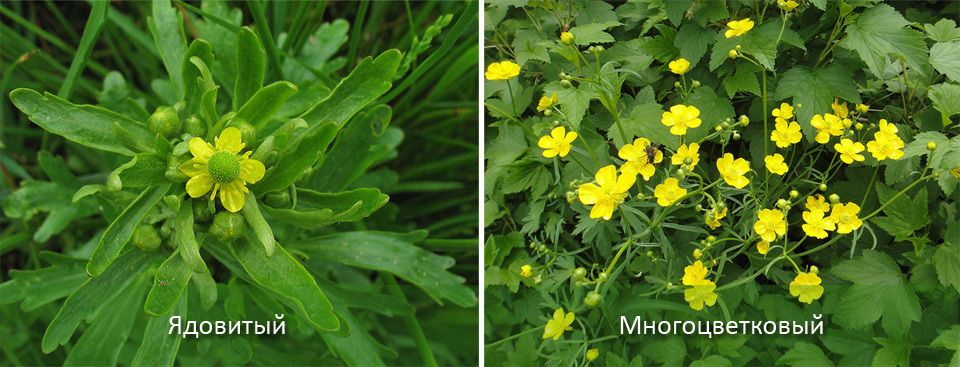
| Poisonous | Ascending stems up to 50 cm. The plant is poisonous. | They have an oblong ovoid plate, the lower ones are long-petiolate. |
5 yellow petals up to 4 mm. From May to September. |
| Water | Used in aquariums, up to 20 cm in height, creeping shoots. | Very carved, reminiscent of stars. Rich green color. |
Small yellow ones. It blooms only in greenhouses and hothouses in shallow water. The timing depends on the month of planting. |
| Multi-flowered | A medicinal plant. Stems are erect and pubescent. | Dissected, having 3 or 5 lobes. |
Shiny chicken-colored. June, July, August. |
| Sayansky | The stems are slightly curved, covered with hairs up to 30 cm. The fruits are small. | Cordates are dissected into 2 or 5 parts. |
Sunny, rich color, single. From mid-July to mid-August. |
| Kashubian | Up to 60 cm in height, the stem branches only in the upper part. | On long petioles, the lower part is cordate. The upper part is palmate and dissected. |
Yellow with 5 petals. From mid-April to June. |
| Asian or garden | Slightly branching, straight shoots up to 50 cm long. Tuberous roots. | Tripartite, pubescent. |
Large, up to 6 cm, available in all sorts of shades. July. |
| Burning, pimple | Ascending stems up to 50 cm. The plant is poisonous. | They have an oblong ovoid plate, the lower ones are long-petiolate. |
5 yellow petals up to 4 mm. From May to September. |
Garden buttercup and its varieties
Ranunculus orientalis is a plant bred through selection from the Asian buttercup:
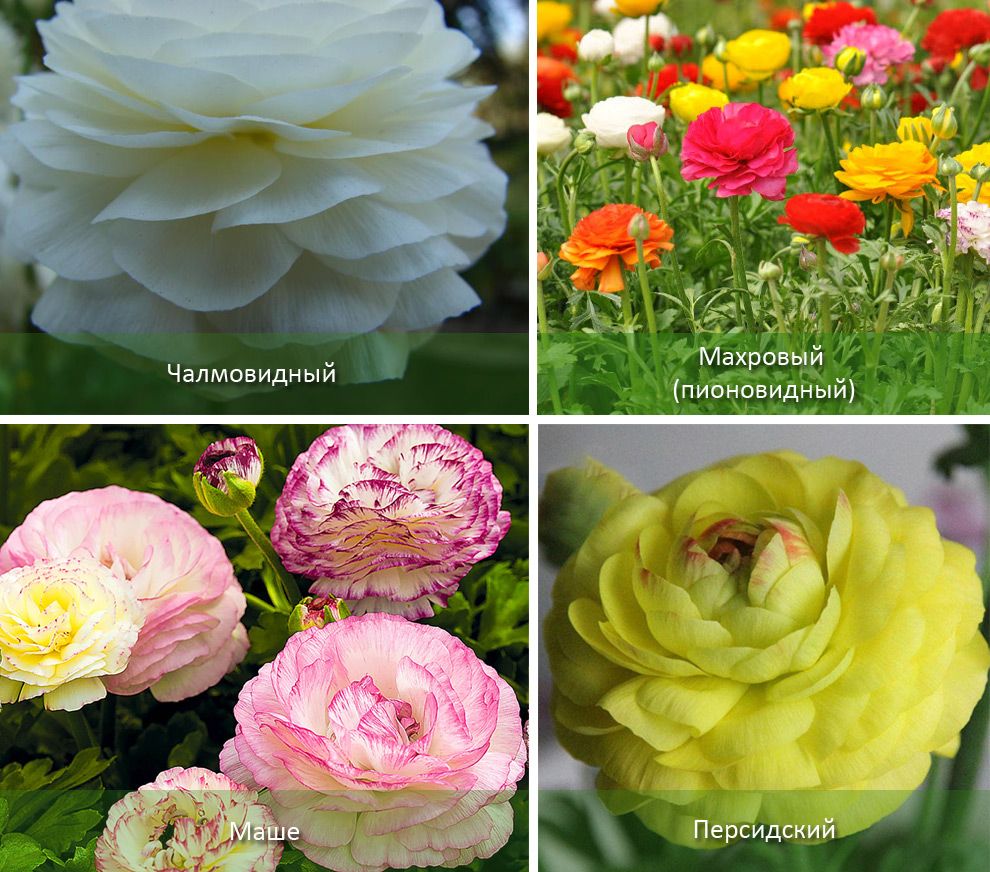
| Varieties | Description | Flowers |
| Masha | A small, branched plant up to 40 cm tall, with pinnate leaves. | Terry in various shades, including white and pink. |
| Terry (peony) | One of the most beautiful of the buttercups, it is called the “bride’s flower”. | Large terry flowers in various shades, including purple. |
| French | As the name suggests, it was obtained by European breeders. | Semi-double in various shades. |
| Persian | Up to 40 cm in height, leaves are pinnate. | Semi-double medium. |
| Turban-shaped | The leaves are slightly dissected. | Large, spherical, petals curled inward. |
Planting buttercups in open ground
To plant buttercups in flower beds, carefully prepare the soil, adding mineral fertilizers and digging it up.
Seeds
Since ranunculus is a heat-loving plant, its seeds shouldn't be planted directly in the garden. They are germinated in February. To do this, first treat them with a fungicide and scatter them over the soil surface in prepared containers, spacing them 1-2 cm apart. Then lightly cover them with soil and spray. Cover them with transparent film or glass. Place the containers in a sunny spot. The seeds take about two weeks to germinate.
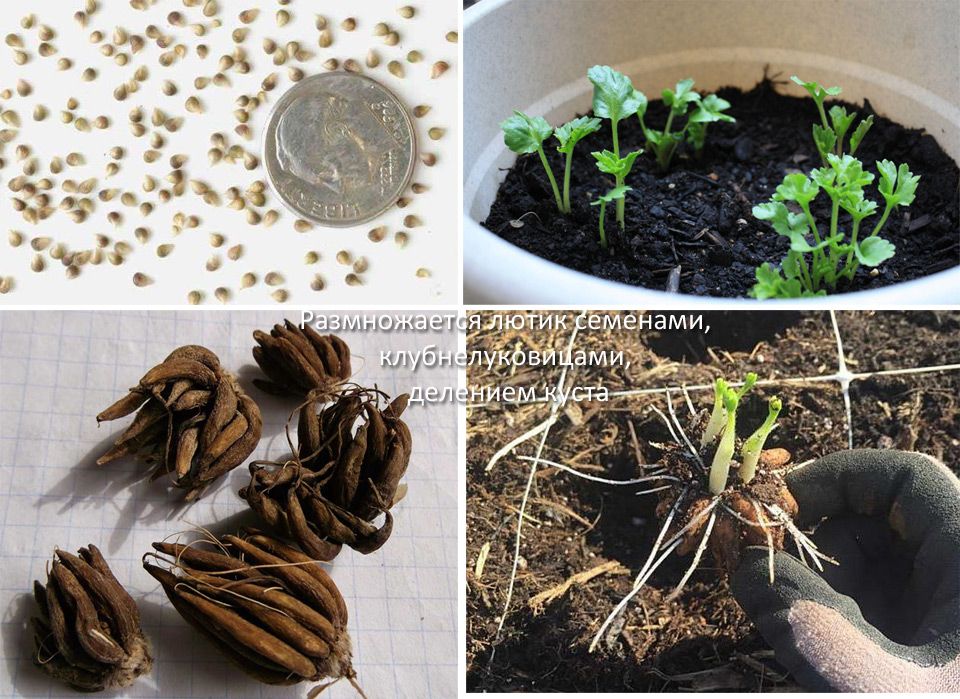
After two true leaves appear, the plants are pricked out, leaving 5 cm between them. The seedlings are transplanted into open ground only after the onset of warm weather and when three pairs of leaves appear on the stems.
Tubers
Buttercups are planted outdoors no earlier than May. Before planting the tubers, add humus and fertilizer to the soil. The roots themselves are soaked in a pink solution of potassium permanganate or a biostimulant for several hours.
Plant the tubers in a sunny spot but away from direct sunlight, spacing them 20 cm apart. Water them thoroughly. Seedlings will appear in two weeks.
Caring for buttercups in open ground
Although ranunculus is easy to grow, like any other garden flower, it requires care. Ranunculus thrives in moist soil and therefore loves water. However, overwatering can kill it, or cause mold to develop on its roots. Also, don't let the soil dry out. After flowering, reduce watering.
To ensure oxygen reaches the roots, the soil around them is periodically loosened and wilted parts are removed to direct the nutrients to the living flowers.
While the leaves are developing, buttercups are fed with nitrogen fertilizer every two weeks. During flowering, phosphorus and potassium are added at the same frequency.
If the plant has grown too much, remove excess shoots.
Trimming
Ranunculus pruning is done in the fall after the above-ground portion of the plant has completely died back. The flower stalks are trimmed completely, leaving just a little above the ground.
Storing tubers
At the end of summer, when the stems and leaves of the ranunculus have withered, they are dug out of the ground, the remaining soil is removed from the tubers, they are treated against diseases and rot, and stored.
One method: place the rhizomes in cardboard boxes or paper bags, then store them in a cool room for the winter, where the temperature does not drop below +4 °C.
Another option: storing in sand. Dry the sand, fill it into boxes or crates, and place the bulbs in them.
Growing buttercups at home
Buttercups are also used as houseplants. Ranunculus, or Asian buttercup, grows beautifully indoors. It is the most decorative.
Growing from seeds
If the flower is grown from seeds, they are first soaked in water. Expanded clay or drainage material is placed at the bottom of the pot or container. The seeds are then placed 3 cm into the soil, and the soil is moistened. The pots are covered with glass or film to create a greenhouse effect.
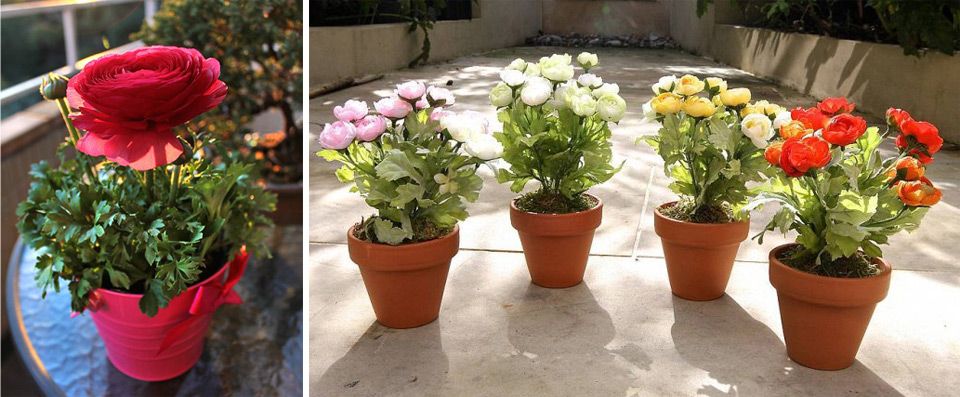
After the true leaves appear, the seedlings are pricked out, leaving 5 cm between them.
Dividing rhizomes
Growing ranunculus from seeds is quite difficult, so for propagation, they use the method of dividing the rhizome or planting tubers, which are buried 5 cm deep, leaving only the very top of the root above the surface.
During the initial germination period, the flower should be kept in a room with a temperature no higher than 15°C. For further development, choose a sunny location.
Caring for indoor buttercups is virtually the same as caring for those planted outdoors. An additional consideration is periodic misting. In warm weather, the flowers can be moved outdoors.
After the flower stalks and leaves have faded, the plant is given a resting period of about a month. During this time, the pots are placed in a cool place, with a temperature of 6 to 10°C, and watering is reduced. After a month, the plants can be forced.
Diseases and pests of buttercups
Buttercup is one of the few flowers that are almost not susceptible to diseases and are little noticed by pests.
If watered improperly or after a rainy summer, powdery mildew may appear on the leaves and rot on the roots. Various fungicidal solutions and aerosols can help. Nematodes sometimes attack buttercup roots, and cabbage white butterflies are attracted to the leaves. Spider mites also attack the plants. To combat these pests, treat the plant with insecticides. Nematodes can be eliminated by digging up the bush and rinsing the roots in warm water with potassium permanganate.
Top.tomathouse.com recommends: the medicinal properties of buttercup
The sap of some buttercup species is poisonous, so it's rarely used in traditional medicine. However, since ranunculus is a medicinal plant, it is used by folk healers. It's used in decoctions, poultices, and infusions. The plant contains vitamins P and C, carotene, and amino acids.
Buttercup is used in the following cases:
- Anesthesia.
- Disinfection and wound healing.
- Stopping bleeding.
- Treatment of skin diseases.
- Muscle and joint pain.
- Rheumatic pain.
- Increased hemoglobin levels.
- Calming the nervous system.
- Boosts immunity. Reduces fever and clears mucus from the lungs. Provides antiseptic and antimicrobial effects.
- Reducing the level of blood clots.
- Normalization of cardiovascular and circulatory system function. Narrowing of vascular walls.
- Reducing pressure.
- Improving the functioning of the gastrointestinal tract.
- Preventing the destruction of hyaluronic acid.
- Helps remove heavy metals and free radicals from the body.
- Restoration of metabolic processes.
- Protection against cancer.
It is not recommended to use even in small quantities without a doctor's prescription.
Contraindications:
- Pregnancy and lactation period.
- Childhood.
- Allergy to substances contained in the juice.
Buttercup on the farm:
- Extermination of bedbugs, flies, and moths
- Protection of garden and vegetable garden.
Buttercup is a wonderful ornamental plant that can quickly cover up unsightly spots in a garden and looks charming among other flowers.