Evergreen magnolia trees and shrubs are renowned worldwide for their purity and harmony, as well as their beauty, especially during flowering. The plant was named after the renowned French botanist Pierre Magnol.
Content
Description of magnolia
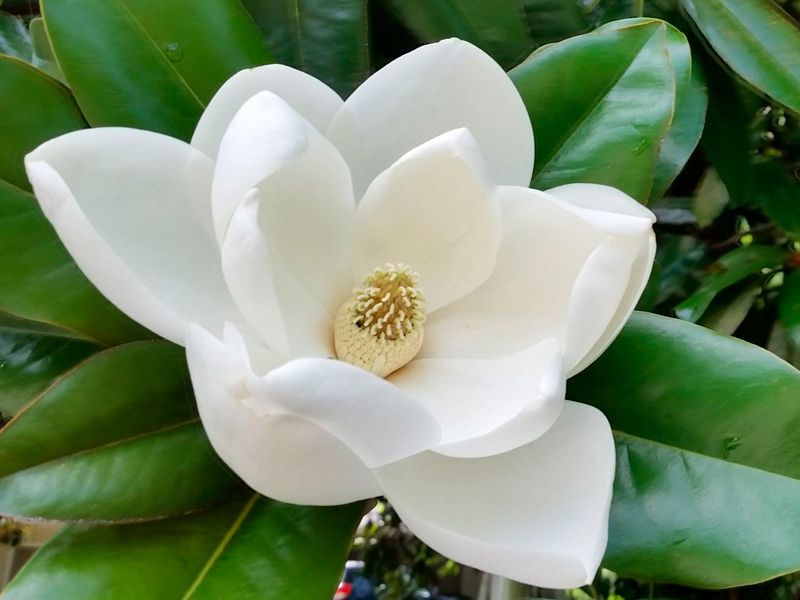
Magnolia is a shrub or deciduous tree growing up to 20 meters tall. Its stems are covered with brown bark, which can be scaly or furrowed. The green leaves are quite large, oval, and lightly pubescent.
The single flowers exude a distinctive fragrance and range in diameter from 6 cm to 35 cm. Each individual flower is composed of 6-12 petals in shades of red, white, or pink. Magnolia blooms vary by variety, with some specimens blooming in early spring. The triangular seeds cling to the leaflet by threads after it opens. In addition to its high ornamental value, especially in spring, magnolia also exhibits medicinal properties.
Types and varieties of magnolia
Magnolia has become widespread worldwide due to its aesthetic appearance and wide variety of cultivars. Some of the largest collections are located in the United Kingdom and in Kyiv, Ukraine.
| Types | Description, varieties |
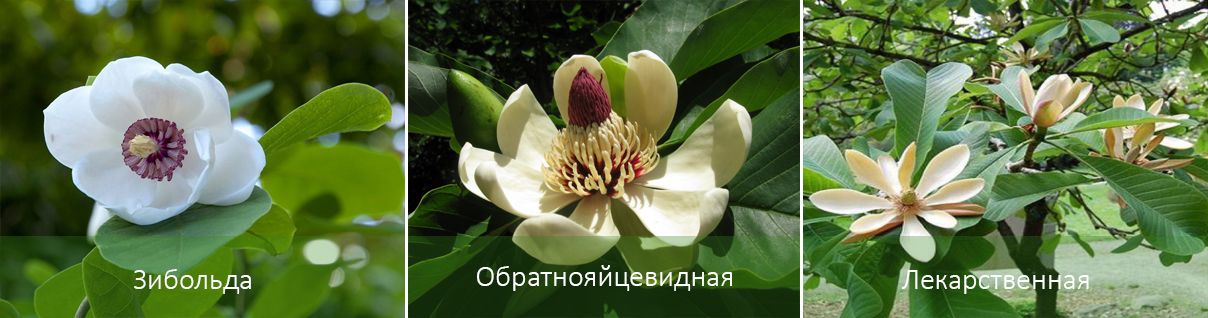
| Siebold | This magnolia is often a shrub, rarely a tree, reaching 10 meters in height. The leaves are shaped like a shortened oval, growing up to 15 cm in length. The cup-shaped flower is borne on a weak peduncle and reaches 10 cm in diameter. This winter-hardy specimen can tolerate temperatures down to -36°C, albeit only for a short time. Sieboldii has been cultivated since the second half of the 19th century. |
| Obovate or white-flowered | This deciduous tree, native to one of the Kuril Islands, reaches a height of 15 meters. The stems are covered in smooth gray bark and terminate in 8-10 leaflets. The flowers are large (about 16 cm in diameter), come in creamy shades, and exude a strong fragrance. The plant tolerates cold and shade well, but is sensitive to moisture levels and soil composition. It has been cultivated since the second half of the 19th century. |
| Medicinal | A shrub with large leaves and strongly scented flowers that are pointed at the top. This plant is native to China, where it is widely used medicinally. It is virtually uncommon in temperate climates. |
| Pointed or cucumber | This deciduous tree originated in North America and spread through larch forests and rocky areas across the continent. This species can grow up to 30 meters in height. Young plants have a pyramidal crown, while mature plants have a rounded crown. The foliage is sparsely hairy, with the shaded side having a more grayish tint, while the upper side is dark green. Small flowers (up to 8 cm) are bell-shaped and formed by yellow petals tinged with green. This species is the most cold-hardy of all other magnolia trees. In America, the Brooklyn magnolia was bred from this species. |
| Star-shaped |
It is notable for its decorative qualities, particularly the shape of its flowers, formed by elongated white petals resembling a star. The plant is small, reaching about 2.5 m. The stems are brown. The most common varieties and hybrids:
The Susan variety has a rich red hue with a paler center. |
| Lily-flowered | One of the most common species, cultivated since the late 18th century, owes its popularity to the rich blooms and subtle fragrance. The flowers resemble lilies, but reach up to 11 cm in size. They are purple on the outside and white on the inside. The Nigra variety, with its ruby-colored outer surface, deserves special mention. |
| Kobus | This deciduous tree grows up to 25 m in the wild, but cultivated specimens do not exceed 10 m. The leaf tip is pointed. The leaf surface is bright green, while the shaded side is a more subdued shade. Fragrant white flowers reach 10 cm in diameter. Kobus will bloom for the first time only at the age of 9 to 12 years. It is considered a frost-hardy species. |
| Large-flowered |
Young plants exhibit slow growth and poor frost resistance, but the large flowers (up to 25 cm in diameter) and their pleasant scent compensate for these shortcomings. The plant adapts well to urban conditions and is resistant to insects and various diseases. The fruit is shaped like a pine cone. The most common forms are:
Gallisonskaya (cold resistant). |
| Soulange | There are several dozen forms of this plant, distributed worldwide. This species grows no taller than 5 meters, and its leaves reach approximately 15 cm in length. Flowers range in size from 15 cm to 25 cm, and sometimes they are practically fragranceless. They come in a wide range of colors: purple, pink, and white. The latter is exceptional. The plant is not considered fussy. |
Planting magnolia in open ground
The plant's intense sun-loving nature significantly limits its potential habitat, so a well-lit, shade-free site is ideal for sowing. Another important requirement is protection from strong gusts of wind.
The soil should not contain excessive amounts of salts, lime, moisture, or sand. The seedling can be planted outdoors at any time of year except winter, but mid-autumn is preferable, as statistically, this guarantees a 100% survival rate. If planting in spring, it's best to plant mid-autumn.
Planting technology
The planting hole should be twice the size of the seedling's root system. It's recommended to dilute overly heavy soil with sand, and mix the remaining soil with well-rotted compost. First, ensure drainage by adding a 20 cm layer of broken brick. Then add a 15 cm layer of sand, and top with a special soil mixture. Then place the seedling, fill the empty spaces with soil, and compact the top layer. Then, moisten it thoroughly, and once the water has been absorbed, sprinkle peat around the trunk and lay dry bark of any conifer. These measures will prevent drying out.
Caring for magnolia in the garden
This involves abundant, regular watering with warm water only, careful loosening of the soil afterward, and fertilization in the third year of growth. This is accomplished using both mineral and organic mixtures. The composition of one or more possible fertilizers:
- 10 liters of water;
- 1 kg of cow manure;
- 20 g of saltpeter;
- 15 g urea.
A mature specimen will require at least four buckets of fertilizer per feeding. Fertilize no more than once a month, using it as an alternative to watering. Drying foliage is the first sign that the plant is overfed. To save the magnolia, reduce the concentration of the mixture and increase the amount of moisture.
Transfer
Mature magnolias are sensitive to transplantation, so it's only done if it's unavoidable. The procedure is virtually identical to the planting technique described above.
Magnolia propagation
There are three methods to accomplish this, and when choosing each, it's important to consider the specific magnolia species being propagated. Each method has its own advantages and disadvantages.
Cuttings are carried out as follows:
- In March, prepare shoots with flowers and leaves that have not yet blossomed (it is worth giving preference to young plants);
- Leave 2 leaves on each shoot;
- Stimulate root formation by treating the lower part with a special agent;
- Prepare a mixture containing peat, vermiculite and perlite;
- Plant the branches in a container;
- Cover with plastic;
- Moisturize regularly;
- Ventilate daily and maintain the ambient air temperature at +23 °C;
- After a week (after the roots have formed), plant them in separate containers.
It is important to understand that propagation by horizontal layering is applicable only to shrubs, while aerial layering should be used for trees.
Horizontal layers:
- Tie the base of a low-growing branch with wire;
- In the place where the stem will touch the soil, make a circular cut in the bark;
- Bend it to the ground and bury it;
- After 1-2 years, when the root system is formed, transplant the cutting from the parent plant.
Air layering:
- Make a circular cut on the selected branch, being careful not to damage the wood;
- Treat the wound with Heteroauxin;
- Apply moss to the area and wrap with cling film;
- Secure the branch so that it does not fall;
- Add moisture to the moss using a syringe;
- In October, separate the cutting from the parent magnolia and plant it in a separate container;
- Let the plant overwinter at home;
- Transplant into open ground in spring.
Seed propagation is carried out as follows:
- Collect ripe seeds in the first half of autumn;
- Soak for 3 days;
- Rub through a sieve;
- Wash with soap and rinse in clean water;
- Dry;
- Sprinkle with wet sand and place in plastic;
- Stratify in the refrigerator for 3 weeks;
- Disinfect in a solution of manganese;
- Keep wrapped in damp gauze until sprouts emerge;
- Prepare a container (at least 30 cm in height);
- Fill with soil;
- Place into the ground no deeper than 1 cm;
- Transplant into open ground in spring.
Pruning magnolia
The shrub requires no pruning other than decorative. Dry branches should also be removed, but this should only be done in the fall, after the fruit has ripened. It is strictly prohibited in the spring, as the plant's sap content increases at this time.
Magnolia in winter
The shelter should be made no later than the end of November, for which you should:
- Carefully wrap the trunk with burlap in several layers;
- Mulch the tree trunk circle after the first frost.
Pests and diseases
The shrub is virtually immune to diseases and pests. The only real threat is Verticillium wilt, the first symptom of which is yellowing of the foliage. The fungus can kill the magnolia within a week. If the disease is detected early, the plant can still be cured by spraying with Fundazol.
Top.tomathouse.com informs: the use of magnolia
Although magnolia contains a number of beneficial substances, it is important to know that it is poisonous. An infusion of the plant's extract normalizes blood pressure, promotes recovery from bronchial asthma, and is also used as an antiseptic. An extract of the shrub is used by those with hypertension. To prepare it, mix crushed seeds (2 teaspoons) with 0.2 liters of 70% alcohol and let it steep for two weeks. Take 25 drops daily before meals.
If you steep 3 tablespoons of crushed leaves in 1 liter of boiling water and let the mixture sit for 24 hours, you will get a rinse that promotes strengthening.