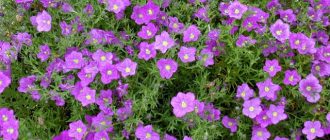
Mahonia is an evergreen shrub or tree in the genus Berberidaceae. It is found in East and Central Asia and North America. The plant is named after B. McMahon, who brought it from the western United States to the east. The genus includes about 50 species, including Magnolia aquifolium, also known as "Oregon grape."
Content
Description
Mahonia tolerates drought well, is frost-resistant, and shade-tolerant. It is undemanding of soil and can thrive in virtually any conditions. It produces delicious fruits, which also have medicinal properties.
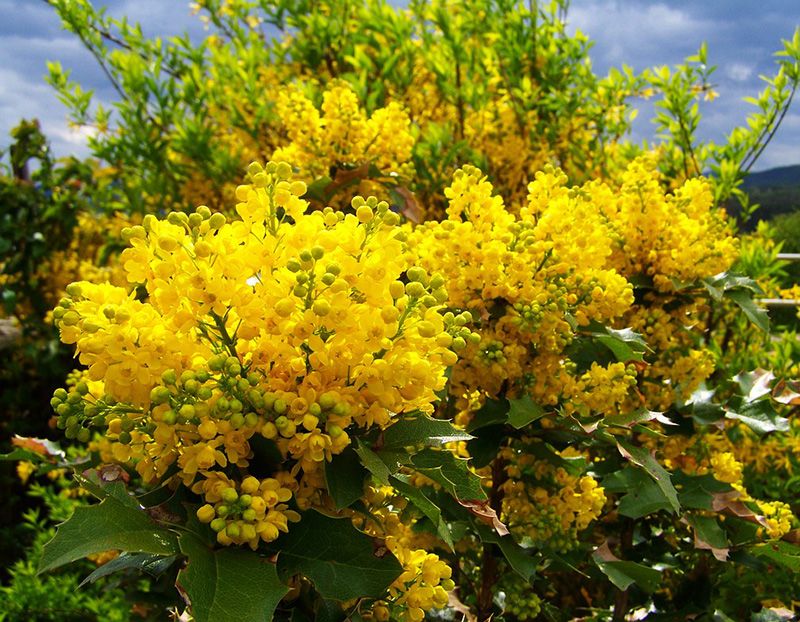
Mahonia has pinkish-gray or gray-brown shoots. Its leaves are leathery and dark green. In April and May, buds of all shades of yellow appear. Flowering lasts twenty to thirty days. The bluish, almost black fruits (sweet and sour berries) are used to make confectionery and wine. Therefore, the question of whether they are edible or not is irrelevant. Ripening and harvesting occur in late summer and early fall.
Types for the middle zone
The following varieties of mahonia are popular in our area:
- Aquifolium: a shrub reaching one and a half meters in width and one meter in length. It is distinguished by its fertile rootstocks.
- Creeping: a spreading shrub growing up to 45 centimeters. Used for groundcover and decorative rock gardens.
- Japanese: grows up to two meters tall and three meters wide. The leaf blades are up to 30 centimeters long. It has reddish petioles.
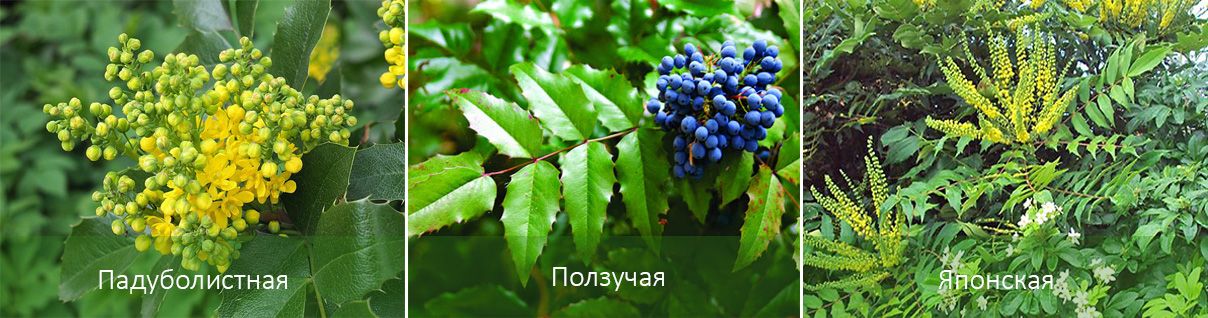
Mahonia aquifolium is the most common of these species in Russia. It is prized for its fruit. It is resistant to low temperatures, surviving temperatures down to -30°C.
Planting in open ground
To ensure Mahonia takes root and bears fruit, planting it outdoors must be done according to all the rules. The choice of location is also crucial.
Timing, location, soil
Planting takes place from early spring, once the snow has completely melted, until late fall. The most favorable time is considered to be March 1-15.
The plant thrives in open, sunny areas. However, it requires some partial shade for a few hours a day. Therefore, it's best to have tall trees nearby to block the sun. The location should be protected from drafts and strong gusts of wind.
Excessive shade is detrimental to mahonia: the fruit becomes worse and their number decreases. Prolonged exposure to direct sunlight burns the tree's greenery.
It thrives in any soil. However, young specimens are best replanted in soil rich in humus. Fill the planting hole with a mixture of turf and compost in a 1:2 ratio.
Rules and step-by-step instructions for planting Mahonia
The landing is carried out as follows:
- Prepare a hole for the seedling three times larger than the rhizome. The hole depth should be 50-60 centimeters.
- Fill the bottom of the hole with a mixture of humus, garden soil and sand.
- Place the seedling vertically in the hole. If the rhizome is closed, it's important not to disturb the root ball. If the root ball is open, straighten it out.
- Fill the hole with the remaining soil, without compacting it too much.
- Water, making sure that the soil remains airy.
- Mulch the tree trunk circle.
- Afterwards, water when the soil dries out.
Rules to follow when landing:
- The neck of the seedling is at the same level as before planting, or two to three centimeters lower.
- If water accumulates in the planting area, a drainage layer is necessary: add eight to ten centimeters of brick or crushed stone to the bottom of the hole. This will prevent root rot and improve growth.
- When plants are grown in groups, the distance between them should be at least a meter.
Mahonia quickly takes root in open ground. If planted according to all the rules and recommendations, subsequent care is straightforward. Repotting causes no discomfort to the plant.
Top dressing
Fertilizing the plant at least twice per season is recommended. The first feeding is done in early spring. Use a nitrogen-containing mixture. These fertilizers promote rapid and abundant leaf growth. The second feeding is done during the flowering period. Use a complex mineral fertilizer.
Trimming
Mahonia tolerates this well. However, don't prune the branches too short, as this will stop the plant from producing buds. You can train the plant after flowering. Avoid cutting branches with ovaries, as these will produce fruit. Flower buds only appear on two-year-old branches. To harvest next year, you can cut them back by half.
Reproduction
The plant is propagated by cuttings, root suckers, layering, or seeds. The latter option is less popular due to its complexity:
- the need for stratification (pre-soaking of seeds);
- Most specimens are hybrids: the probability of varietal is reduced to a minimum;
- seedlings take a long time to germinate;
- flowering only three years after planting.
The other three propagation methods don't present these difficulties. Step-by-step propagation of mahonia by cuttings:
- Semi-woody material is cut with 6-8 buds in spring or autumn.
- The cuttings are treated with Kornevin and placed in the soil to a depth of two buds.
- The root system should be kept warm, while the tops should be kept moderately cool. Often, the seedling container is placed near a radiator, with the greenery above the windowsill.
The cuttings should be pinned to the ground in the spring. They are separated from the mother plant in the fall. The percentage of high-quality seedlings produced is higher than with cuttings. Root suckers are also excellent propagation material.
Proper wintering in the Moscow region and other regions
Mahonia tolerates low temperatures well. Only young bushes planted one or two years ago need to be prepared for winter. This is done as follows:
- In October, the root system is hilled. The crown and trunk circle are covered with soil (the higher the soil, the better).
- Mulch with straw, sawdust, or hay. Cover the base of the bush with spruce branches. This will help prevent the rhizome from freezing.
- Mahonia branches are protected by covering them with snow. This isn't necessary, but it helps during frosty weather.
Mulch and spruce branches are removed as soon as the snow melts. This allows the soil to warm up. The soil around the plant is leveled.
Pests and diseases
The plant is rarely affected by insects and diseases. Sometimes, the following may appear on mahonia:
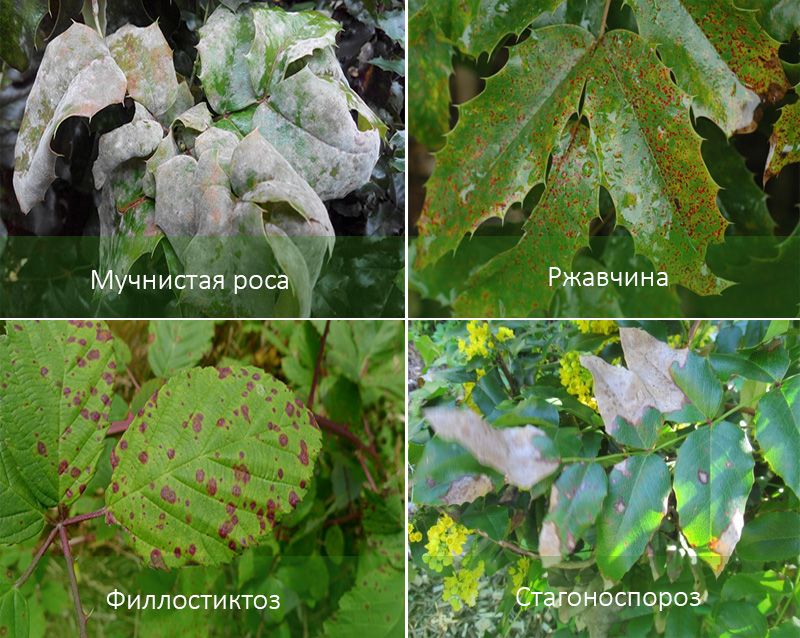
- Powdery mildew. White spots appear on the upper surface of the leaves, which eventually spread to the entire above-ground part. Upon closer inspection, you may see webbing and lumps of cotton wool. Powdery mildew spoils the appearance of the mahonia but does not kill it. Spraying with Fundazol, Topsin-M, or Karatan can help control the disease. Apply once a day for 10-12 days.
- Rust. Pustules of varying sizes and shapes form. When damaged, these pustules release a "rusty" powder containing fungal spores. Fungicide solutions such as Zineb, Abiga-Peak, Bayleton, and Oxychom can help treat this condition.
- Phyllosticta leaf spot is a fungal disease that causes large spots to form on the foliage. Pycnidia appear at the tips of the spots. The fungus produces several generations per season. The plant loses its decorative appearance. Leaves fall prematurely. Flowering and fruiting are reduced. To combat the disease, collect and destroy the affected leaves in the spring. The mahonia itself is treated with Oxychom, Captan, or Phtalan before the sap begins to flow.
- Stagonosporosis. Characterized by the appearance of oval, bordered spots along the edges of leaf blades. Round pycnidia form on the surface of these spots. The mahonia wilts and dies. Treatment is the same as for phyllosticta.
Top.tomathouse.com recommends: Mahonia – beauty and benefits
Mahonia is grown for decorative purposes. The shrub retains its ornamental appearance year-round. The plant tolerates heavy air pollution and smoke well.
Mahonia is used in a variety of landscape applications due to its versatility:
- planted near buildings;
- decorate the slopes;
- decorate lawns, squares, parks, alleys;
- create hedges and low borders;
- complement the alpine slides;
- planted along highways and roads.
The shrub combines beautifully with other plants, such as magnolias and begonias. Mahonia is often planted against a backdrop of rocks, which makes it look even more striking.
The plant's fruits are edible. For the winter, the berries are frozen or ground with granulated sugar. They are used to make jams, preserves, purees, marmalades, and compotes. Mahonia berries also serve as a natural dye.
The rhizome is used in alternative medicine because it is enriched with ascorbic acid, tannins, acids, and alkaloids. Thanks to this composition, mahonia-based remedies provide the following therapeutic effects:
- tone the body, increase its protective functions;
- improve appetite;
- prevent premature aging;
- strengthen vascular walls, improve blood circulation;
- eliminate the negative effects of free radicals;
- help with pathological conditions of internal organs: cholecystitis, hepatitis, dysbacteriosis;
- destroy pathogenic microorganisms;
- relieves pustular rashes, herpes, eczema, psoriasis;
- They lower the concentration of glucose and lipids and promote the natural synthesis of insulin (this is good for diabetes).
Despite its many beneficial properties, the plant extract also has contraindications:
- intolerance to components;
- period of pregnancy and breastfeeding;
- childhood.
Mahonia-based products have a number of other limitations. Consult a doctor before use.