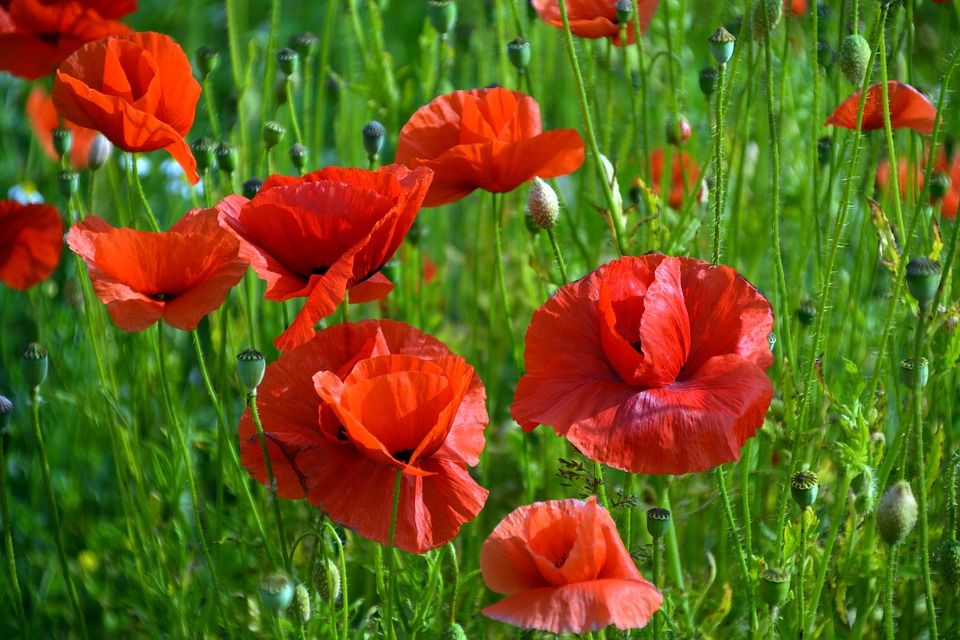
The poppy is a plant known since ancient Roman times—"povas" means milky sap. There are about 100 known varieties, but 75 grow in our country. The plant originates from the deserts of Australia and Central Asia with their hard, rocky soil. A single flower appears on a smooth or needle-like stem, ranging in color from red, pale pink, orange, yellow, bicolor, or other delicate shades. The petals of garden poppies are delicate, typically scarlet, with a black center, and contain seeds in a capsule.
It is because of their seeds that the cultivation of certain poppy varieties is prohibited in Russia. Many varieties contain opium, which, despite its medicinal uses (for treating insomnia and depression), is a narcotic substance (opium dens have been known since ancient times in Arab countries and China).
Types of poppy: peony, oriental and others
Prohibited for cultivation:
- Soporific, opium (P. somniferun).
- Setiferous (P. setigerum).
- Bract (P. bracteatum).
- Eastern (P. orientale).
Annual poppies
| View Variety |
Description | Flowers |
Soporific, opium (P. somniferum)
|
Up to 100 cm tall, the stems are dark green and glossy, and the leaves become more elliptical the closer they get to the inflorescence. Flowering lasts for 4 weeks. |
About 10 cm, petals can be either regular or double, of various colors - red, yellow, dark burgundy, purple with dark or white spots, they fall off by sunset. Prohibited for cultivation. |
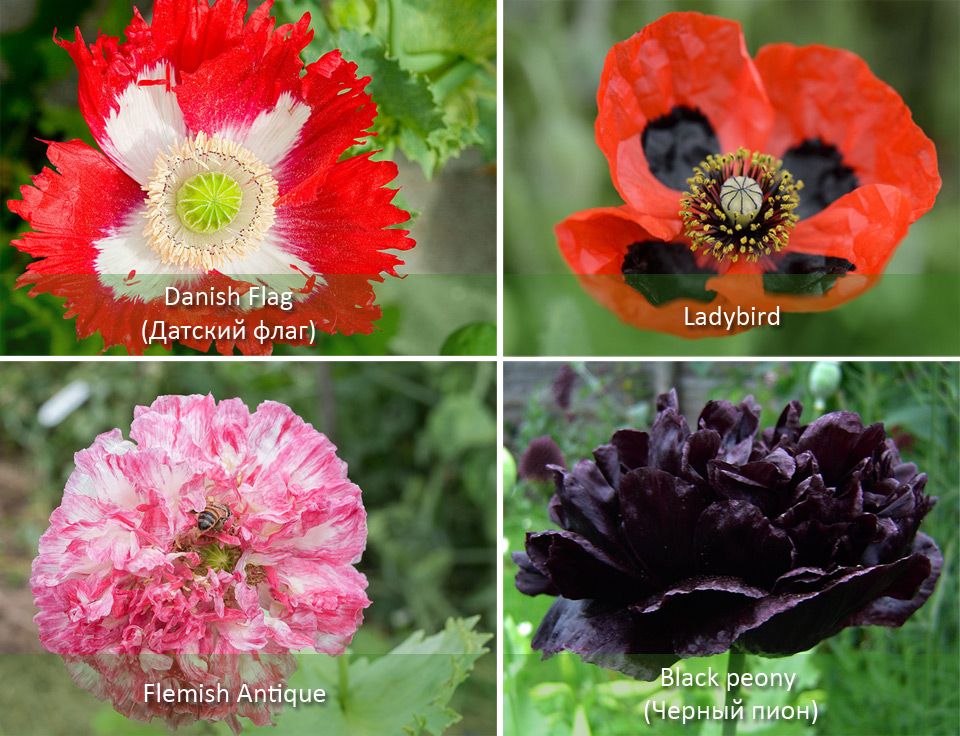
| Peony, soporific (P. somniferum)
|
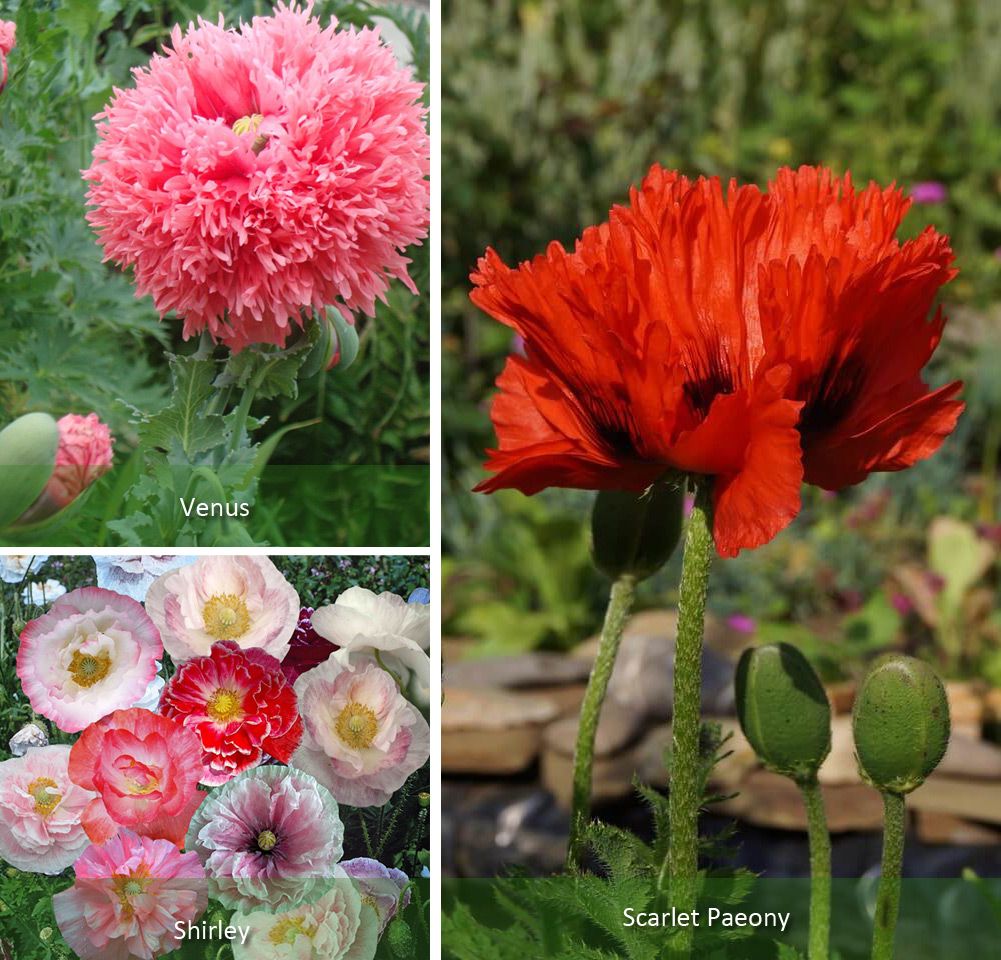
They resemble a peony, measuring 15 cm. The color ranges from inky to black, two-tone with jagged tips, delicate pink, scarlet and snow-white. | |
| Self-seeding, wild (P. rhoeas)
|
The stem grows up to 60 cm, covered with hairs, closer to the root the leaves look pinnate, separate, on the stem they are three-parted. | They come in white, scarlet, coral with dark edges, and pink with a dark core. The inflorescence is less than 10 cm wide, simple or double |
| Caucasian Red (P. commutatum) or Modified (P. commutatum)
|
Grows up to 70 cm. |
Feathery, two-partite with a black core, up to 20 cm. Blooms from July to September. |
| Peacock (P. pavoninum) |
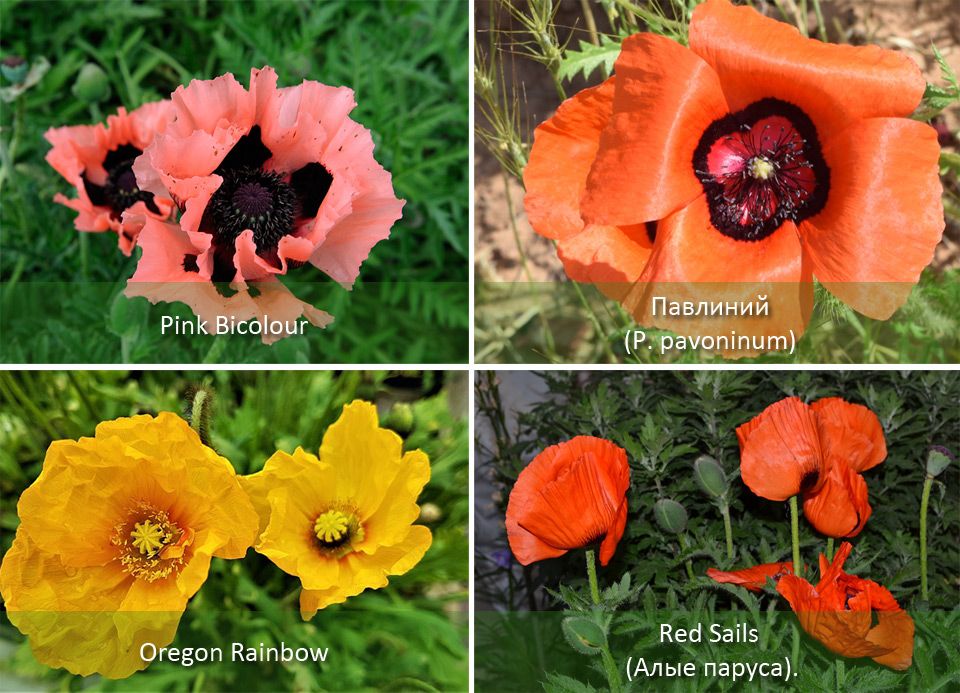
The branches are rounded at the ends, 3-5 cm, the stem is bristly, the leaves are green, pinnately dissected. | They can be of different shades, both terry and regular. Blooms in midsummer. |
Perennial poppies
| View Variety |
Description | Flowers |
|
Oriental
|
Reaches 1 m, the stem is straight, thick, and hairy, the foliage is pinnate, dissected, and shorter towards the bottom. It blooms for only 2 weeks. |
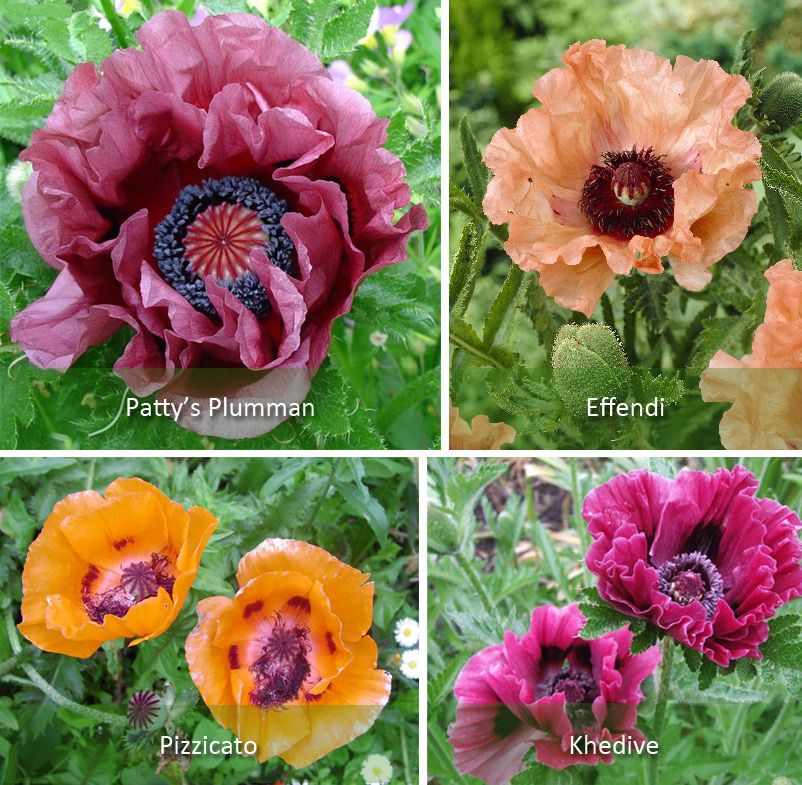
Bright scarlet flowers up to 20 cm in size with a black center. Coral-colored varieties with a small dark center have been developed, with flowers ranging from ash-white to pale pink. Prohibited for cultivation. |
| Alpine (P. alpinum L.) |
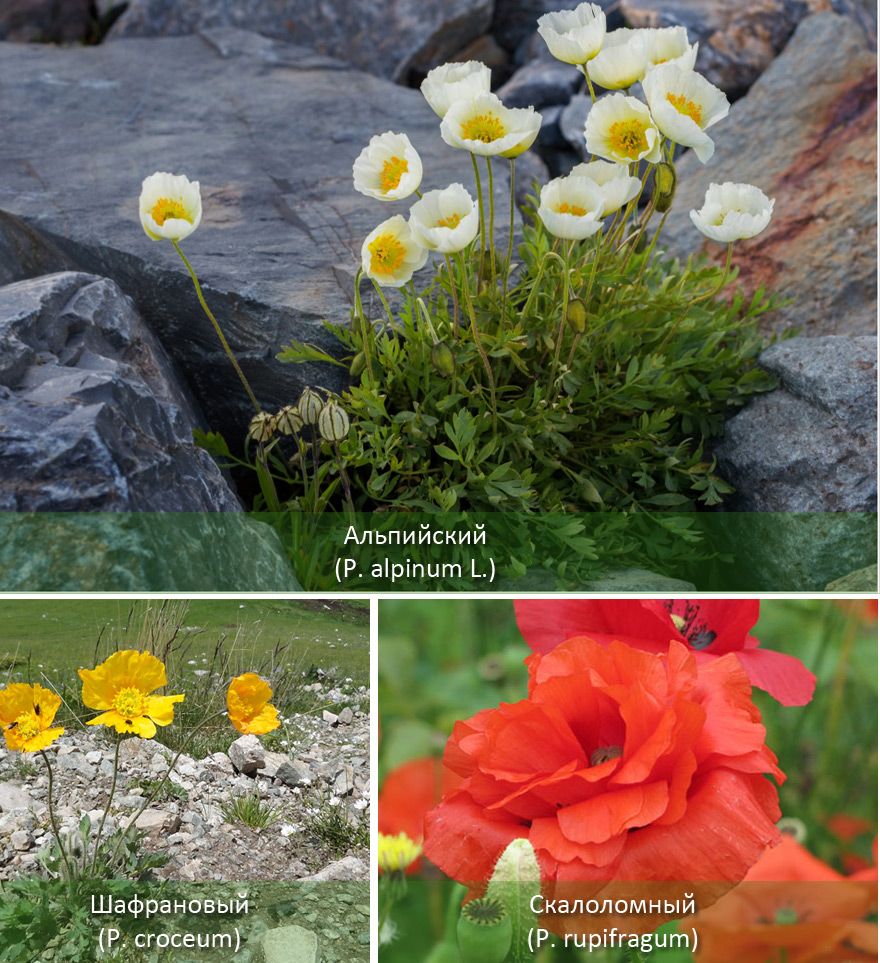
A low plant up to 0.5 m, with an abundance of hairy leaves. | The size of the inflorescence is no more than 4 cm, the flowers can be orange, white and red. |
| Rock-breaking (P. rupifragum) |
A biennial plant, it blooms in the 2nd year at the beginning of spring, grows about 45 cm, with a dense number of leaves. | A multitude of glossy flowers ranging from dark orange to brick red appear on the stem. |
|
Naked-stemmed, Icelandic
|
It grows up to 0.5 m, has a prickly stem, and pale green, downward-facing foliage. It blooms in May and continues until the end of September. It can be placed in vases. | The inflorescence size is up to 5 cm, can be single or double, flowers are red, yellow, white or pink with a yellow border. |
| Saffron (P. croceum) |
It grows up to 30 cm, with dark green or light, hairy leaves. Blooming from early spring until October, this variety is native to Eastern Siberia, Central Asia, and Mongolia. The plant is completely poisonous (from the stem to the flower). |
The size of the inflorescence is up to 20 cm, the color of the petals is from yellow to orange. |
Sowing poppy in open ground
Poppy blooms from August to September and lasts for about a month. The plant is unpretentious.
Self-seeding is best for all poppy species, especially garden poppies. When the capsule bursts and the seeds are carried into the soil by the wind or bees during the winter, the garden poppy will delight you with early shoots.
Any soil will do - super sandy and neutral.
To ensure that the plant blooms for a long time, it should be pruned as soon as the capsules begin to form.
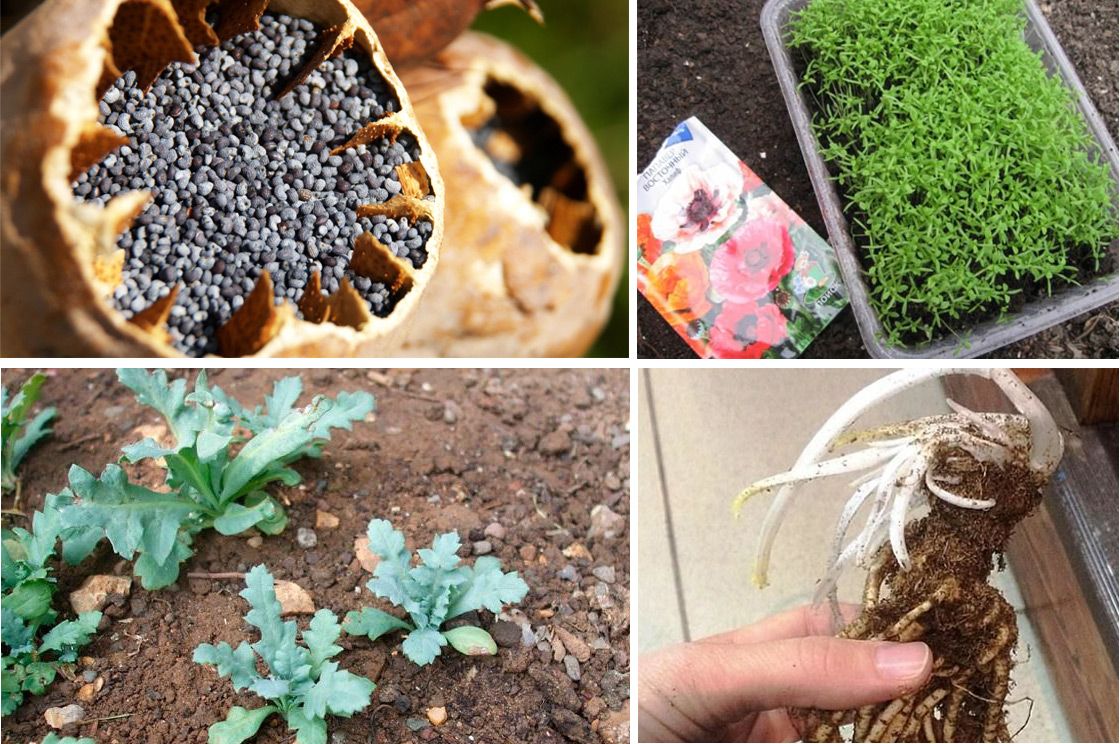
Besides self-seeding, poppies can be planted in the garden using seeds from the same capsule. When the leaves have wilted and the capsule has cracked at the edges, you can remove the seed.
It's best to sow it in spring; it will delight you with its blooms all summer long, provided the soil doesn't have a high water table. Sunny locations are preferable, as this plant originates from desert areas. It's best to prepare the soil from regular garden soil or use compost mixed with soil. It's best to plant the seeds 3 cm deep, 5-10 cm apart, and water them thoroughly.
Caring for poppy seeds
Garden poppies are easy to care for—they don't require winter shelter. During drought, watering and fertilizing are recommended, but not necessary. It's a good idea to loosen the soil and remove weeds.
An annual plant is pulled out of the ground after flowering and thrown away, while a perennial plant is cut back.
Poppy propagation
Poppy can also be propagated by cuttings: after flowering, the side shoots (rosettes) are cut off and planted in the ground; when the cuttings take root, they are replanted and grown for another 1-2 years.
Poppy diseases and pests
| Name | Signs
Manifestations on leaves |
Methods of elimination |
| Powdery mildew | Covered with a white coating. | Dilute 50 ml of soda in an aqueous solution or 40 g of copper chloride in 10 liters of water, rinse the leaves. |
| Downy mildew | They become deformed and covered with grey-brown spots, turning purple on the inside. | The same means are used as for powdery mildew. |
| Fusarium | The leaves and stems become covered with dark spots, and the capsules wrinkle. | The plants are removed and the soil is watered with a fungicide solution. |
| Alternaria | Green spots on the leaves. | Poppy seeds are watered with Bordeaux mixture, Cuprosate, Fundazol. |
| Weevil | The beetle, which eats the leaves of the plant, settles in the ground. | Before planting in the soil, add 10% Bazulin or 7% Chlorophos. |
| Aphid | Black, fine coating of bugs on leaves and stems. | Wash the leaves and stem with Antitlin or soap solution. |
To avoid fungal infections, it is better to plant poppies in the same place with a difference of three years.
Useful properties of poppy seeds
Poppy seeds contain almost all microelements:
- alkaloids;
- flavonoids;
- organic acids;
- fats and glycosides;
- proteins.
Poppy seed oil is a valuable raw material used in the production of cosmetics and in pharmacology.
The poppy's pain-relieving and sleep-inducing properties have been known since ancient Greece. More recently, its seeds have been used as a cough remedy, and to treat stomach ailments, sciatica, insomnia, hemorrhoids, dysentery, and diarrhea.
Poppy seeds should not be taken by children under 2 years of age, the elderly, people with pulmonary emphysema, or those with alcohol dependence.