Maranta is a herbaceous perennial native to the forests of South and Central America. Named after a medieval physician and botanist from Venice, Maranta is the name of a genus that includes 25 species.
Description of arrowroot
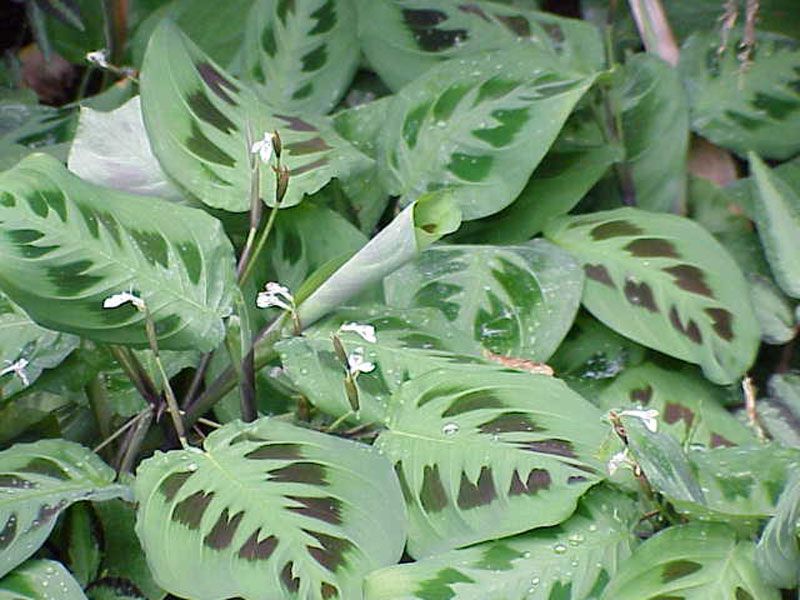
This low-growing herb, up to 20 cm tall, has leaves that grow singly from the roots or in pairs on the stems. It is prized for its beautiful coloration: the green leaves are spotted and have vibrant veins.
It has a distinctive feature: its leaves can change their position depending on external conditions. If the maranta is comfortable, it lowers its leaves horizontally, but if it lacks something, it curls up and rises higher. Hence its second name, "praying herb."
From my relative calatheas Maranta is distinguished by:
- dimensions (the first one above);
- leaves (in the first one they are located on the petioles in two rows);
- flowering (calathea has much brighter flowers).
Maranta is not a poisonous plant, so it is completely safe for children and pets.
Types of Maranta for Indoor Cultivation
Maranta is a deciduous ornamental plant. Its flowers are inconspicuous.
| View | External signs |
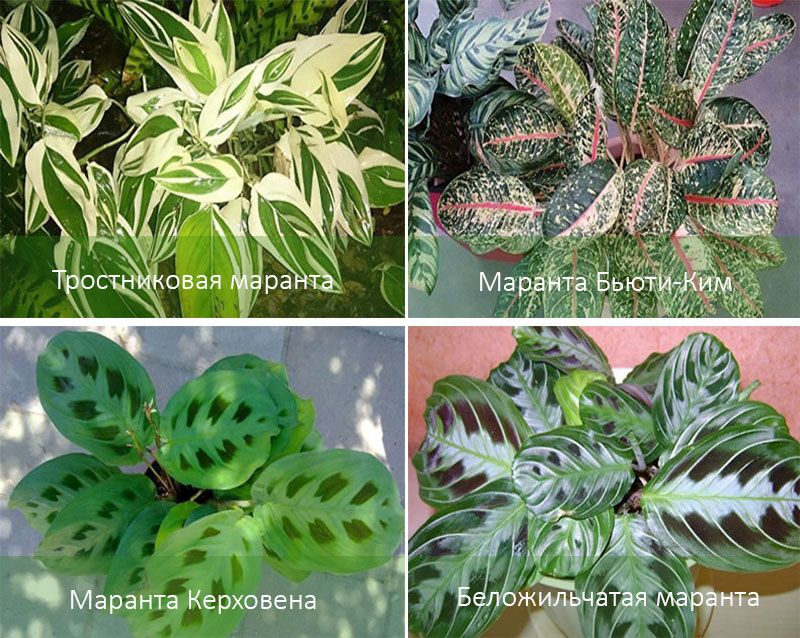
| White-veined (white-veined) | 26-30 cm, dark green leaves with silver stripes down the center and on the side veins. |
| Masanzha (white-veined variety) | Stripes extend from the light veins, and brown spots are visible between them. |
| Kerkhoven (Kerkhoveana) | On the surface of the leaves there are dark dots that look like feathers and a white stripe in the center; the underside of the leaf blade is red. |
| Two-tone | The leaves are oval with a wavy edge, stripes of two shades of green. |
| Reed | Up to 1 m in height, large dark green leaves with a grey pattern. |
| Comb | It grows up to 40 cm, with wavy leaf edges. Along the central vein is a light green stripe—a "comb"—with dark, broad strokes on either side. |
| Maricella | Dark green leaf with lighter veins. |
| Beauty Kim | A variegated variety with stripes across the entire surface of the leaf blade. |
| Gibb | Beautiful purple flowers collected in panicles. |
| Red-veined (three-colored, tricolor) | Velvety leaves in three shades: dark green, light green and pink. |
Caring for Maranta at Home
The most important thing when caring for your plant indoors is to ensure comfortable temperature and humidity. Maranta is native to the tropics, so it thrives in a warm, humid climate.
| Conditions | Spring | Summer | Autumn | Winter |
| Temperature | +20…+22 °С. Avoid drafts and temperature changes. | +20…+26 °С. Do not allow the temperature to rise. | +18…+20 °C, a drop in temperature is destructive. | |
| Location/Lighting | Prefers partial shade and filtered light. Avoid direct sunlight, as the delicate foliage can burn. West and east exposures are suitable. In rooms with south-facing windows, place it in the back of the room. | Add artificial light if possible. | ||
| Humidity | Maintain high humidity: spray twice a day. | Spray every 2-3 days. | ||
| Watering | It's important to maintain a balance. The optimal time is when the top layer has dried out, but the soil still contains moisture. About every other day. | Once every 3-4 days | ||
| Water quality is equally important. It should be filtered, settled, and slightly warmer than the room air. | ||||
| Top dressing | Apply regular fertilizer (except nitrogen) twice a month. Use a much lower concentration than indicated in the instructions. Maranta does not like excess fertilizer. | Not required. | ||
A plant damaged by external factors (sun, pests) or an old one needs to be pruned. In the former case, the foliage is cut off at the root. Afterward, the pot is moved to a dark place and watered periodically. When new growth appears, the pot can be relocated.
Repotting: soil and pot selection, procedure
Young plants are repotted annually in the spring, while older plants are repotted every two years. During this time, root division is used for propagation.
The pot is wide and plastic. Ceramic doesn't retain heat well, so it's not ideal for heat-loving maranta. The pot's depth isn't important, as the root system is shallow.
The ideal soil for arrowroot is a mixture of leaf mold, pine soil, humus, and sand, with some charcoal added. Good drainage is essential.
Procedure for transplantation:
- disinfect the soil, pot, drainage;
- Place drainage on the bottom, in a 4 cm layer, use expanded clay or brick chips;
- add a small layer of soil and water it;
- remove damaged or dried leaves;
- carefully remove the arrowroot from the old pot without breaking the soil;
- check the roots and remove damaged areas if necessary;
- move to a new pot;
- carefully sprinkle with soil without tamping;
- water and spray;
- place in partial shade.
Reproduction
Maranta is propagated in two ways: by cuttings and by dividing the bush:
| Method | Deadlines | Actions |
| Division | Conduct at the time of transplantation. |
|
| Cuttings | The best time to take cuttings is spring or fall. The cuttings are the tips of branches, about 10 cm long, with several internodes. They are cut 3 cm below the node. |
|
Alternative method of growing
Maintaining the required humidity level for arrowroot can be challenging. Therefore, many experienced gardeners plant it in mini greenhouses or in both indoor and outdoor terrariums.
Features of planting and maintenance:
- use a container or aquarium made of glass or plastic;
- plants are chosen to be miniature and of tropical origin;
- the terrarium is placed in a bright and warm place;
- sometimes, when droplets of condensation appear, ventilation is arranged;
- Sometimes they take a shower and remove excess leaves.
Unlike an open terrarium, a closed terrarium doesn't require watering or ventilation. The plant is watered once when planting, and the closed terrarium system then creates its own microclimate.
In this case, the flower itself produces the oxygen it needs and maintains the required humidity. This option requires a container with a narrow neck and a tight-fitting lid.
These terrariums are called "gardens in a bottle." They look very impressive, but not everyone can handle planting them.
Bugs, diseases and pests
| External symptoms on leaves | Cause | Solution |
| They dry out at the edges, and the arrowroot itself doesn’t grow. | Low humidity level. | Increase spraying frequency and place the arrowroot in a tray with moss or damp pebbles. |
| They turn yellow and curl up. | Not enough moisture. | Increase watering frequency. |
| They turn yellow and curl up when the soil is wet. | Draft or low temperatures in the room. | Move to another location. |
| It doesn't rise. | The plant has outgrown itself. | Trim and replant into a larger pot. |
| Small, pale. | Excessive lighting. | Move to another location or shade. |
| White coating at the base. | Overwatering and low temperature. | Reduce watering, move to a warmer place. |
| Cobwebs. | Spider mite. | Increase humidity; in case of severe infestation, treat with preparations. |
| Whitish coating. | Mealybug. | Treat with insecticides. |
| The shoots turn yellow and fall off, drying up. | Chlorosis | Pour acidified water over it. |
Top.tomathouse.com recommends: arrowroot – benefits and harms
Maranta is an extremely useful plant. It was first cultivated by Native Americans 7,000 years ago.
During archaeological excavations, scientists discovered remains of starch flour made from its rhizome. They also used arrowroot juice as an antidote.
Benefits of the plant:
- Confectioners use starch and flour from the roots. The latter is excellent for dietary nutrition, stimulating digestive processes. The roots are also boiled.
- Contains folic acid, vitamins B and PP, rich in calcium.
- A drink made from arrowroot helps with infectious diseases and colds.
- Treats insomnia. A flower placed in the bedroom by the bed is believed to promote healthy sleep.
- Strengthens the immune system.
- Absorbs negative energy in the home, brings peace and understanding.
Contraindications:
- Do not use if you are prone to allergic reactions or have an individual intolerance. It is best to consult a doctor first.
- Contraindicated in the postoperative period and in cases of problems with blood clotting (arrowroot flour thins the blood).
- Do not use during exacerbation of peptic ulcer disease.