Medinilla is a perennial tropical plant belonging to the Melastomataceae family. Native to the Philippines, it is common in the forests of Africa, Asia, and the Pacific Ocean.
Botanical description of Medinilla
Low shrubby plants, rarely vines. They grow on the ground or on trees (epiphytes). They have a shallow root system. They reach heights from 30 cm to 3 m.
The trunk is dark brown, covered with bristles, and has a rough surface. The leaves are large, dark green, and covered with contrasting veins. There are 3 to 9 leaves per leaf. The edges are smooth, sometimes wavy, and the tips are pointed or rounded. The shape is oval. The leaves are sessile and petiolate.
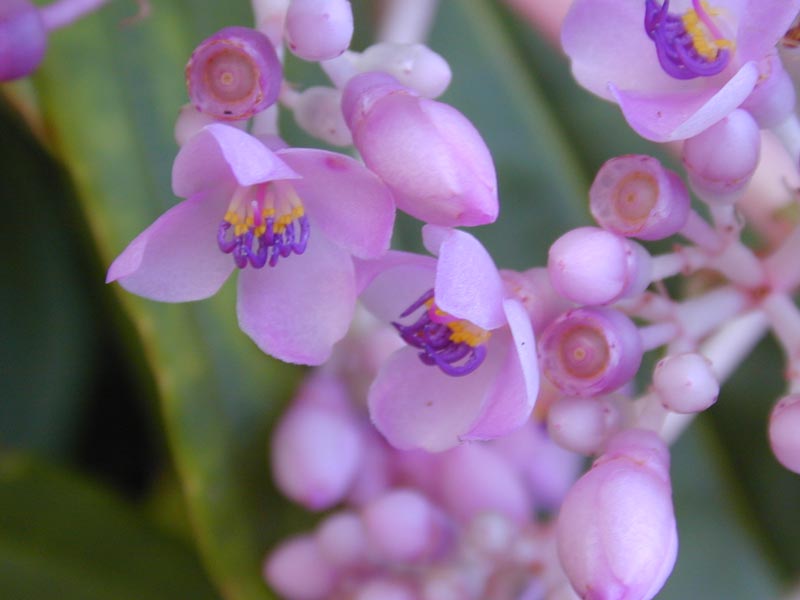
They bloom with small flowers in shades of pink, lilac, and scarlet. The Jadore Tresor variety has blue flowers. They are borne in clusters; some species lack bracts.
When pollinated, pink and blue berries ripen, containing seeds for propagation.
These plants are capricious and require a lot of effort to properly care for at home. Medinilla magnifica and, increasingly, Javanilla are suitable.
Popular types and varieties of medinilla
There are over 400 species in the wild. Only one species, Medinilla magnifica, has adapted to indoor cultivation.
| View | Leaves | Flowers |
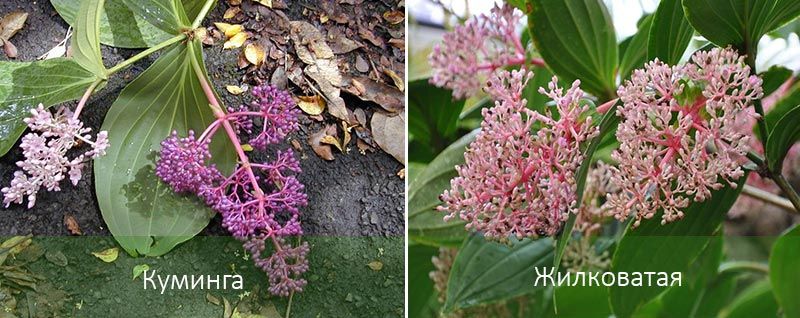
| Veined. A semi-epiphytic shrub native to Malaysia. | Dark, held on a short petiole, resembling an ellipse, up to 9 cm wide, up to 20 cm long, with sharp ends. | Small, less than 1 cm, collected in a few-flowered inflorescence, flesh-colored. |
| Kuminga is an epiphytic shrub native to the Philippines. | Heart-shaped. Scientists call this shape obovate. Width up to 20 cm, length up to 30 cm. The leaf has 7-8 clearly visible light veins. Petioles are absent. | Large, upright, pink. |
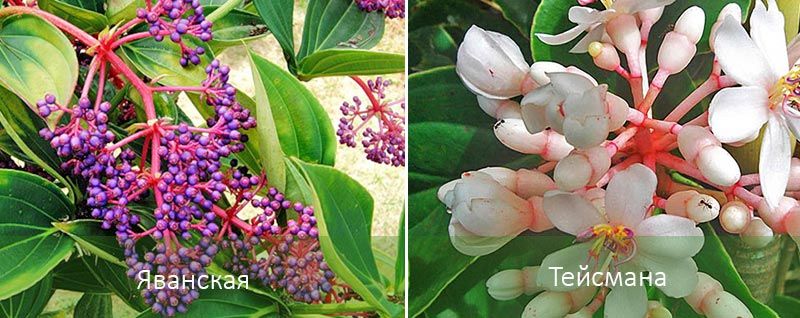
| Javanica. A large epiphytic shrub native to the Philippines. Adapts well to indoor conditions. | Dark, egg-shaped, covered with light veins, up to 5 on a leaf. | Small, gathered in drooping racemes. The color is bright, ranging from pink to lilac. There are no bracts. The plant is adorned with pink-blue clusters of berries. |
| Theismania. Native to Sulawesi Island, New Guinea. Similar in appearance to the magnifica. | Ovate, concave, large, up to 30 cm long, up to 20 cm wide, with 5 distinct veins. Petioles absent. | Large, erect. The racemes extend upward. Coloring: white, pink. Bracts absent. |
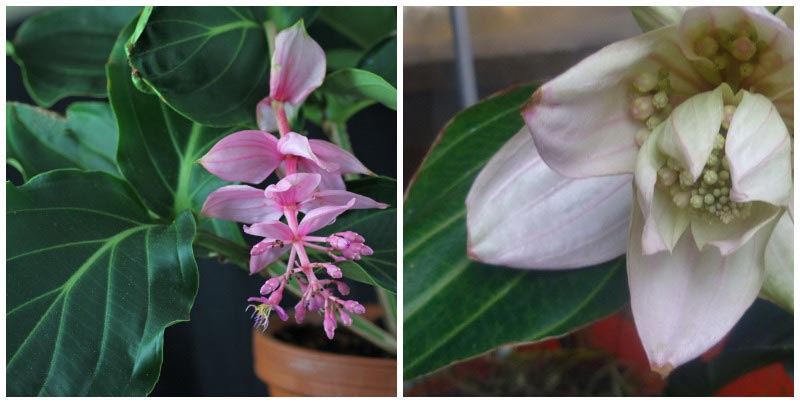
| Magnifica (beautiful). Tall shrubs native to the Philippines. They thrive in indoor conditions. | Oval, leathery, dark. 15 cm wide, 35 cm long. Wavy edge. The plates are pierced by distinct, contrasting veins. | The bracts are bright pink and scarlet, less than 1 cm in size, and borne in drooping, multi-flowered racemes 30-50 cm long. Several flower stalks emerge simultaneously. |
Scientists have developed hybrids that thrive in indoor conditions, using the Medinilla spp. as a basis:
- Dolce Vita is a low-growing shrub with massive, bright pink-hued flowers with narrow bracts, evenly distributed throughout the inflorescence.
- White - miniature plants, dense brush of flowers, salmon-colored bracts.
- Jadore Tresor is a compact variety with loose, drooping brushes and no bracts. Its distinctive feature is its white, lilac, and blue coloring.
Caring for Medinilla indoors
When caring for medinilla, a warm room with high humidity is a priority. It grows well in a terrarium. This tropical plant is capricious and, if not properly cared for, loses its beauty.
| Factor | Spring/Summer | Autumn/Winter |
| Location/lighting | Not recommended:
Necessary:
|
|
| Temperature | +20…+25 ºC | +15…+17 ºC; avoid drafts. |
| Humidity | At least 70-75%. This is due to the tropical climate in their homeland. To maintain optimal levels, it is recommended:
|
|
| Watering | 2 times in 7 days. | Once every 7 days, when the top layer of soil is 3 cm thick and dry. |
| Top dressing | 3 times a month, with organic matter or fertilizer for ornamental flowering plants. | They are removed during the rest period. |
Features of transplantation
The plant is repotted after flowering, in the spring. Choose a shallow pot with a large diameter. This is due to the plant's unique structure: a massive top and a weak, shallow root system.
Young shoots are sometimes repotted in the summer to stimulate growth. Mature plants are repotted less often than once a year. For larger bushes, simply replacing the top layer of soil is sufficient.
A ready-made substrate for epiphytic plants or orchids can be purchased or prepared at home: mix turf and leaf mold with peat and sand in a ratio of 2:2:1:1. If desired, you can add 1 part humus.
In the wild, medinilla grows in poor soil. At home, it's important to maintain the soil's looseness, porosity, and nutritional value. To achieve this, add coconut coir, coconut chips, and pine bark to the prepared mixture.
When watering, the soil should absorb moisture within 1-2 days, at an air temperature of 25 to 28 ºC. Otherwise, there is a risk of root rot. To prevent this, sprinkle broken brick, expanded clay, or perlite into the bottom of the pot. Beforehand, the soil and drainage should be calcined or steamed.
Methods of reproduction of Medinilla
Medinilla reproduces in two ways: by seeds and cuttings.
Seeds
Seeds can be obtained from a houseplant or purchased. Pay attention to the packaging. If a year has passed, the expiration date has passed.
Prepare the soil in advance, mixing river sand and turf soil in a 1:2 ratio. The seeds are planted 0.5 cm deep in flat, 7 cm-high pots. Planting is done between January and March. For germination, create greenhouse conditions: temperatures between 25 and 30 ºC and high humidity. Cover the container with glass or cling film. Heat is applied underneath to promote germination. Remove the cover for 20 minutes daily to allow airing and soil moisture.
After the first leaves appear, the greenhouse is completely removed and the seedlings are planted in separate shallow pots.
By cuttings
The chosen period is from January to March. The top of the flower shoot with 3-4 buds is cut off. The cut is covered with ash. This prevents the plant from rotting.
The process for planting cuttings is the same as for seedlings. After 5-6 weeks, when the first roots appear, the plant is transplanted into a larger pot. When repotting, pinch the seedlings to stimulate growth.
Possible problems when caring for Medinilla, pests and diseases
The plant's native land is the tropics. To maintain the plant in suitable conditions at home, it's important to monitor the room's temperature and humidity. Failure to follow proper care guidelines can lead to a number of problems or the appearance of pests.
| External manifestations on leaves | Cause | Elimination measures |
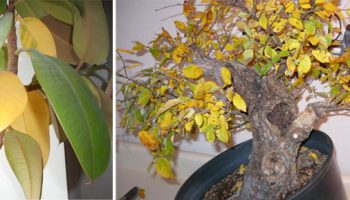
| They become smaller and there is no flowering. | Lack of humidity, low temperature. | Humidify the air, spray the leaves, remove from heating systems. |
| They fall off and wither. | Lack of light, drafts, new place. | Provide additional lighting (phytolamps), remove from drafts, do not move the pot, or spray in the new location (you can add the stimulant Epin). |
| Light spots appear. | Exposure to direct sunlight causes burns. | Create a small shade so that the plant is not exposed to direct sunlight. |
| Black spots appear. | Watering with cold, salty water. Overwatering. | Normalize the watering schedule (after the top 3 cm of soil has dried out) with warm water, and maintain an optimal temperature. |
| They dry out during the dormant period. | Stagnant moisture, over-watering, low air temperature. | Water if necessary, increase the air temperature to optimal levels. |
| They dry out during the summer. | Dry, hot air. | Humidify the air, set the optimal temperature, spray the leaves. |
Medinilla is susceptible to pests:
| Pest | Manifestation on leaves and plant | Treatment measures |
| Spider mite | They dry up, fall off, and yellow spots appear. | Treat with a soap or alcohol solution and wash off the pest with a warm shower. Insectoacaricides (Actellic, Fitoverm) are used. |
| Aphid | Leaves and buds become deformed and dry out. | Wash with an infusion of celandine, soap, and garlic. Apply preparations containing the active ingredient permethrin. |
| Mealybug | They become covered with white fluff-like lumps. They turn yellow, dry up, and fall off. | The pest is collected manually with an alcohol-soaked cloth and wiped with a soap or garlic solution. Tanrek, Aktara, or Confidor are used. |
| Scale insect | The flower turns yellow and becomes covered with hard brown spots. | Wipe with a damp cloth to remove the insect. Wash with soap or garlic infusion. Treat the plant and surrounding areas with an insecticide (Actellic, Fitoverm, etc.). |
| Botrytis fungus (gray mold) | They become covered with black, wet spots. | Remove affected areas. Treat cuts with brilliant green and iodine. Replace the substrate with new one. Apply a fungicide. |