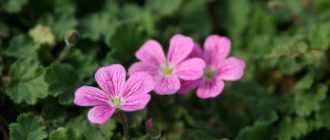
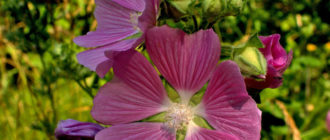
Lungwort is a genus of perennial herbaceous plants in the Borage family. The shape of its leaves resembles lungs, hence its other name, Pulmonaria, which comes from the Latin "pulmo" meaning lung. The flower has been used as a medicine since ancient times and is now popular in landscape design, decorating rockeries, borders, and flowerbeds. Lungwort contains nectar, and its honey is very beneficial. The plant is undemanding, frost-resistant, and shade-tolerant. It blooms for over a month and is the first to emerge after the snow melts.
Content
Description of lungwort
Lungwort has a straight, branched, rough stem, pubescent, up to 30 cm long, with basal and cauline leaf blades. The lower leaves are arranged in a rosette, lanceolate, pointed, and borne on petioles, up to 60 cm long in some species. The leaves appear after flowering and do not fall until frost. The upper leaves are sessile and small. They can be smooth, pubescent, spotted, or uniformly colored. The rhizome is long, creeping, and bears small tubers, arranged horizontally.
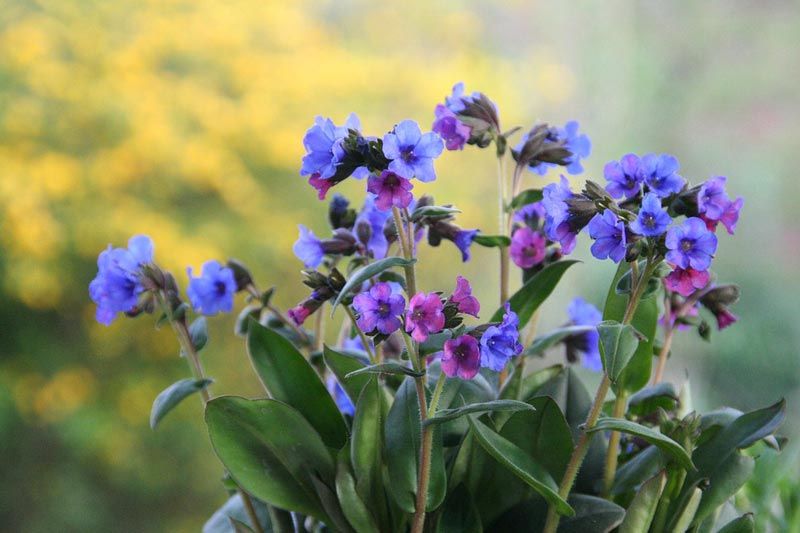
The bell-shaped flowers, with a calyx and corolla, are gathered in racemes at the top of the shoot. Some have short pistils and long stamens, while others have the opposite structure, which prevents the flowers from self-pollinating. The lungwort is characterized by the variable color of the corolla, initially pink, then blue. The fruit is a sickle-shaped bean containing a single seed.
Types of lungwort
There are up to 15 plant species classified, and breeders have developed about 20 varieties.
Unclear
A cultivar of unknown origin found in eastern Europe, its leaves are pubescent, rough, and spotted with white. It grows up to 30 cm tall. The flowers are bell-shaped and pink, then lilac. It blooms in early spring.
Red
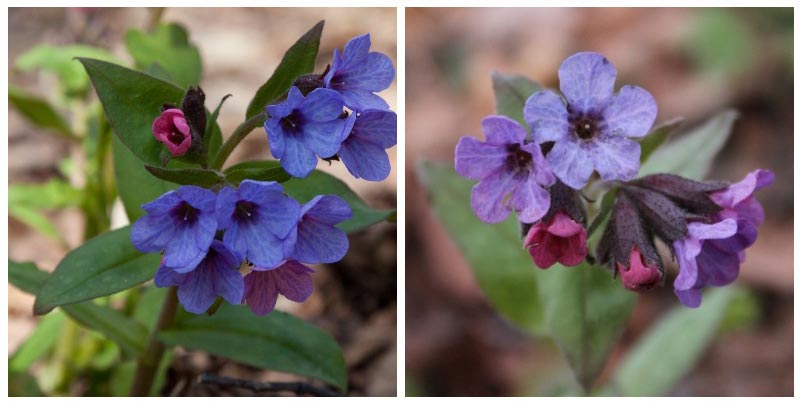
Red grows in subalpine and beech forests. Its leaves are glossy, uniform, and light green. It blooms profusely in red from May to June. It reaches 25-30 cm.
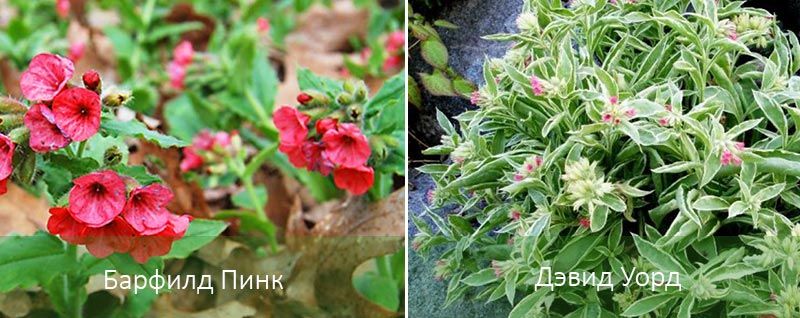
Varieties
|
Name |
Leaves |
Flowers |
| David Ward | Wide, greenish-blue with a border. | Coral red. |
| Barfield Pink | Light green. | White with pink-red strokes. |
| Red Start | Delicate light green with a thin white border. | Coral red. |
Medicinal
Lungwort is native to Central and Eastern Europe. Its shoots reach up to 30 cm, are frost-hardy, and its bell-shaped flowers with double perianths bloom from mid-May, initially red, then turning purple. This valuable species is listed in the Red Book of Threatened Species.
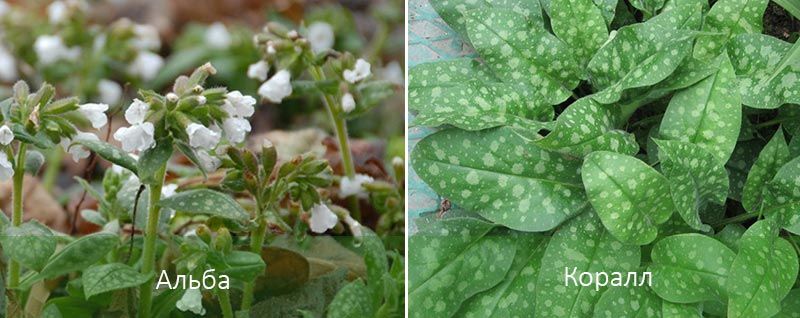
Varieties
|
Name |
Leaves |
Flowers |
| Alba | Wide in spots. | Snow-white. |
| White Wing | Green, spotted. | White with rosy eyes. |
| Coral | Large, bright green, with silver dots. | Soft pink. |
| Cambridge Blue | Heart-shaped, covered with spots. | Bluish-pink. |
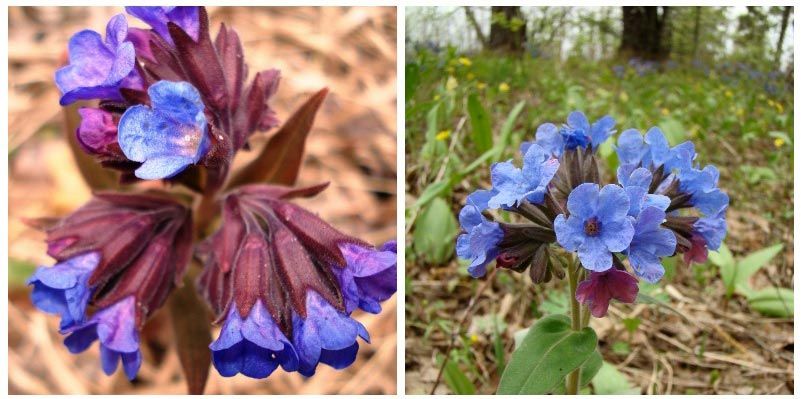
Soft
The softest lungwort (also known as the lungwort) is found in the Caucasus, Altai, and Eastern Siberia. Bushes grow up to 45 cm tall. It blooms in April and May, turning blue-purple, and continues until the end of June. The leaves are large, green-silver, and velvety. This variety is more tolerant of intense sunlight.
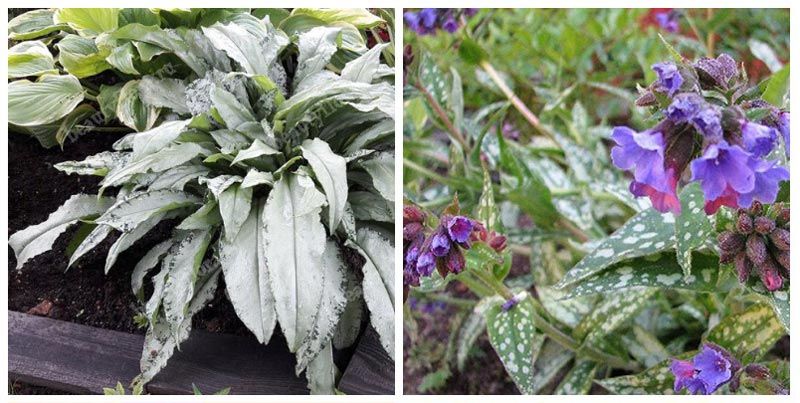
Shaft-shaped
This rare variety of Valovidnaya grows in the Apennines, in thickets of bushes, on sand, and in gravel. The leaves are silvery-gray with white spots. The flowers are purple-red. It grows up to 45 cm. It does not tolerate frost well.
Long-leaved
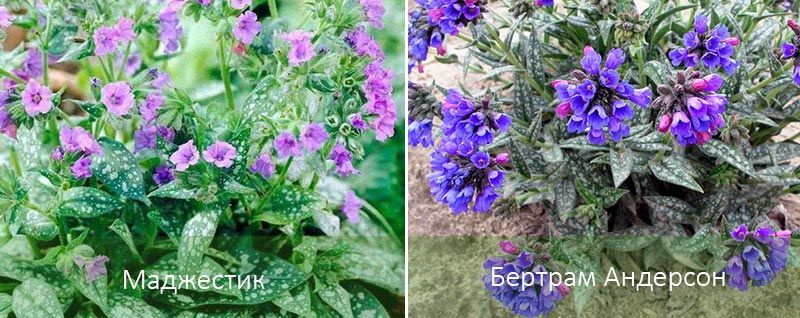
It grows in Europe, in forests and along riverbanks. It reaches 25 cm. The leaves are thick, pubescent, strap-shaped, pointed, up to 40 cm long, gray-green below, gray and spotted above. The flowers change color from pink to blue. It blooms in April.
Varieties
|
Name |
Leaves |
Flowers |
| Bertram Anderson | Spotted, emerald. | Blue-lilac. |
| Diana Clare | Narrow, long, white-green, wavy at the edge. | Blue-violet. |
| Majestic | Silvery, with a beautiful green border. | Pink-lilac, then purple. |
| Lewis Palmer | Dark with light spots. | Pink, then blue. |
Sugar
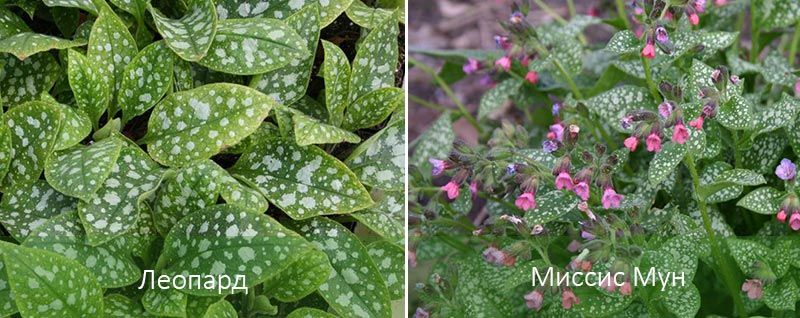
Sugarcane originates from southeastern France and northern Italy. It grows up to 30 cm, with large, oval leaves, green with silvery spots. It blooms in April-May, with crimson-purple flowers.
Varieties
|
Name |
Leaves |
Flowers |
| Leopard | Dark green with bright white spots. | Pink-red. |
| Mrs. Moon | Bright green with light silver spots. | Red-violet. |
| Sissinghurst White | Green with blurred white spots. | Snow-white. |
| Argenta Group | Completely grey in colour. | First red, then dark purple. |
| Janet Fisk | Narrow, mother-of-pearl, light gray with green edging. | Bright blue. |
Narrow-leaved
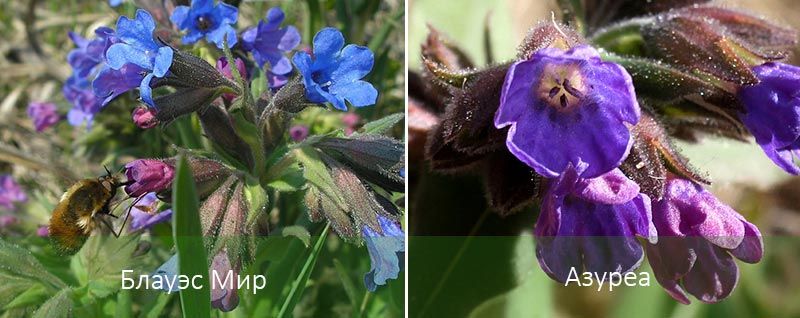
Narrow-leaved rhododendron is found in Asia Minor near rivers and in forests; its shoots reach up to 30 cm. The leaf blades are oval and pubescent. It blooms for 20 days from early May. Its color is crimson, then turns blue.
Varieties
|
Name |
Leaves |
Flowers |
| Azurea | Bright green, pubescent, long. | First wine-colored, then cornflower blue. |
| Blaues World | Light green, bright. | Blue with purple. |
| Bets Pin | Light, spotted. | Pink. |
| Munstead Blue | Monochrome, green. | Dark blue. |
Methods of propagation and planting
Lungwort reproduces by seed and vegetatively. It can grow in partial shade, under trees, shrubs, and along fences.
Seeds
Seed propagation is rare, as there's a risk that not all the variety's characteristics will be preserved. Sow in open soil after the snow melts, at a distance of 10 cm and a depth of 3-4 cm. Fertilize the soil beforehand, and thin it out to 10 cm after the seedlings emerge. With this method, lungwort will bloom in 2-3 years. Ants carry lungwort seeds, so it can appear in various areas of the garden.
By dividing the bush
In March or after flowering in September, the bush is dug up, divided, and the roots trimmed. Each division should have a growing point. They are planted 35-40 cm apart, at the same depth as the mother plant, and the soil is watered and mulched.
Rhizome cuttings
Using the sharp end of a shovel, separate several sections from the overgrown rhizome. Leave a bud on each section and plant them 15-20 cm apart.
Cuttings
Use easily detachable shoots with rosettes and roots. Sprinkle the cut area with charcoal and plant them 20 cm apart and 4 cm deep. Water and care as usual.
Landing
Growing the plant in too-dark locations is not recommended, as it will lose its decorative appeal. Lungworts dislike high temperatures and scorching sun. A week before planting, weed the soil, add compost, and dig it over. It prefers light, fertile, and loose soil. Suitable soils range from slightly acidic to alkaline to neutral.
Purchased seedlings are placed in the flowerbed after the last frost, when the soil has warmed. When choosing, pay attention to their appearance—free from damage, signs of disease, and pests. Holes are dug deep enough to accommodate the roots and their root ball, filled and compacted, and planted at intervals of 20 cm. For Valovidnaya, Krasnaya, and Medicinal, 30-35 cm is recommended.
If water stagnates in the area after rain, create drainage at the bottom of each planting hole. This can be small pebbles, crushed stone, or coarse sand.
Caring for lungwort
Caring for the plant is not difficult; even novice gardeners can follow the basic rules:
- Water regularly, avoiding over-watering or over-drying of the soil, especially during bud formation and flowering.
- If the lungwort grows in partial shade, water it less often than flowers in the sun.
- In sunny areas, it is better to mulch the soil around the bush so that the moisture does not evaporate too quickly.
- Weed out the weeds.
- Loosen the soil.
- Feed with mineral mixtures in the spring during leaf growth.
- In spring, remove last year's leaves.
- After flowering, get rid of the flower stalks.
There's no need to remove leaves for the winter, only dry, old ones. In cold regions, cover the bushes with spruce branches, dry leaves, sawdust, or hay. Repot the bushes every 4-5 years.
Diseases and pests
Lungwort is resistant to diseases and pests. During heavy rains, it can become infected with root rot. In such cases, the affected parts are destroyed and the bushes are treated with fungicides. Colloidal sulfur helps against powdery mildew. It can sometimes be attacked by snails and slugs. To combat them, use Slizneed (Slug Eater) and Ulicid (Ulicid).
To avoid this, you should not allow water to stagnate in the soil, plant too densely, and clear the soil of weeds.
Top.tomathouse.com recommends: Lungwort – a remedy for the flowerbed
Lungwort is not only a beautiful flower with decorative leaves, but also a medicine with a broad spectrum of action and is used in the complex treatment of various diseases.
Procurement of raw materials
The flowering period, or before the buds open, is the time to harvest the medicinal herb. The stems, along with the flowers, are cut, and the dry foliage is removed. They are tied into bunches and hung to dry in the shade. They are then baked in the oven, at a temperature of 104°F (40°C). They are then ground into a powder and placed in cloth or paper bags. The dried herb is stored in a cool, dry place.
Compound
The medicinal properties and contraindications of lungwort are determined by its components. The medicinal herb contains:
- anthocyanins;
- flavonoids;
- rutin;
- binders;
- polyphenols;
- allantoin;
- carotene;
- alkaloids;
- vitamin C;
- mucus;
In addition: copper, manganese, iron, iodine, silicon, potassium, calcium, saponins, tannins.
Benefit
Lungwort alleviates cold symptoms and has other unique properties:
- Improves the functioning of the heart muscle, normalizes intracranial pressure
thickens the blood, constricts blood vessels, stops bleeding. - Relieves inflammation, promotes expectoration.
- Calms the nervous system.
- Softens skin, improves the structure of hair and nails, slows down aging.
- Liquefies and removes phlegm.
- Strengthens the immune system.
- Removes waste and toxins, eliminates inflammation of the gastric mucosa.
- Prevents thrombosis.
- Prevents malignant neoplasms
Lungwort is indispensable for treating upper respiratory tract conditions, including inflammation of the bronchi and lungs, as an expectorant and cough suppressant, and also for tracheitis and laryngitis. It stops bleeding and helps with skin conditions. It is also effective for rinsing the mouth after tooth extraction.
Thanks to its silicic acid content, the herb relieves inflammation of the gastric and intestinal mucosa. It alleviates the symptoms of gynecological diseases and is used to prevent heart attacks and strokes, treat thyroid disorders, prostate problems in men, anorexia, dysentery, and hemorrhoids.
This medicinal plant helps remove stones from the bladder and is used in cosmetology, but you should consult a doctor first.
Traditional medicine offers numerous recipes for infusions, decoctions, and alcohol tinctures with lungwort. Tea is drunk for diarrhea, and freshly squeezed juice with vodka is used for anemia and leukemia. Herbal infusions are used to treat bladder and kidney conditions.
Salads and soups are prepared from the young leaves of this medicinal herb, an obscure plant. The British grow it specifically for culinary use.
Contraindications
Lungwort is contraindicated in cases of individual intolerance to its components, pregnancy, childhood, breastfeeding, constipation, or thrombophlebitis. Drinking decoctions and infusions on an empty stomach is not recommended.