Some call this plant a ficus or begonia, while others call it a cactus. Euphorbia is a succulent, a plant that stores a certain amount of moisture in its own photosynthetic tissues: its leaves and stems.
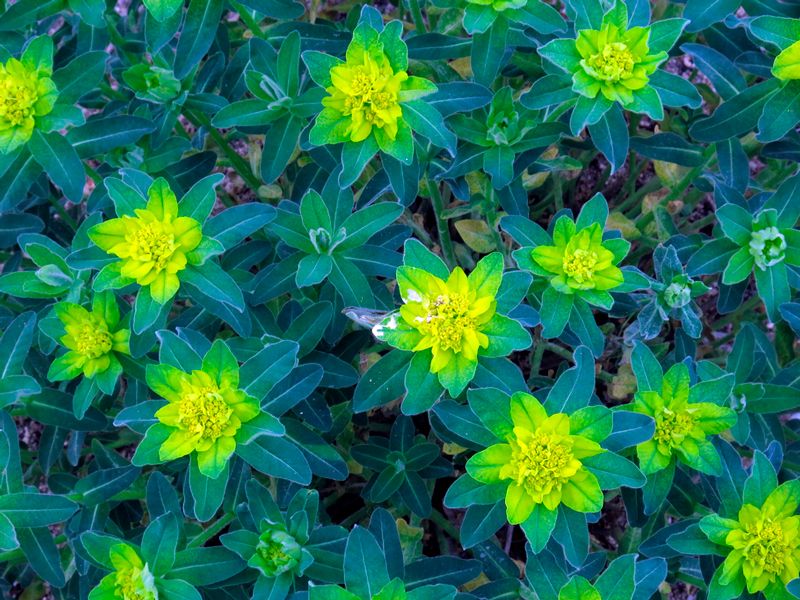
A distinctive feature of garden spurge, or euphorbia as it's scientifically known, is the milky, milky sap that exudes when the leaves are broken. It's quite corrosive and, in large doses, poses a toxic threat to humans and animals. Nevertheless, perennial euphorbia is a popular garden plant, prized for its unrivaled beauty and ease of cultivation and care.
Convergent traits of Euphorbia (when plants belonging to the same biological group of succulents are not related by the same species origin) despite some distance, share a common structural similarity with cacti. Thus, the African Euphorbia and the American cactus are very similar to each other.
Types of garden spurge
Garden euphorbias come in a wide variety of forms: some with bud scales, some with spines, some with flower buds, and some with a tough, fleshy stem. They can have smooth, faceted, or ribbed stems and leaves.
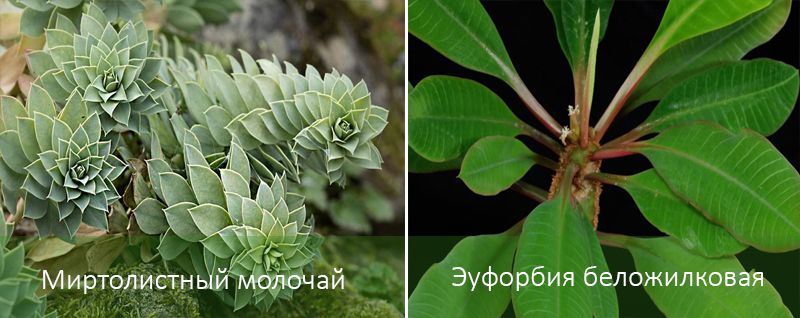
The most popular and beloved among gardeners are milkweeds:
| View | Description |
| Multi-flowered (Euphorbia epithymoides) 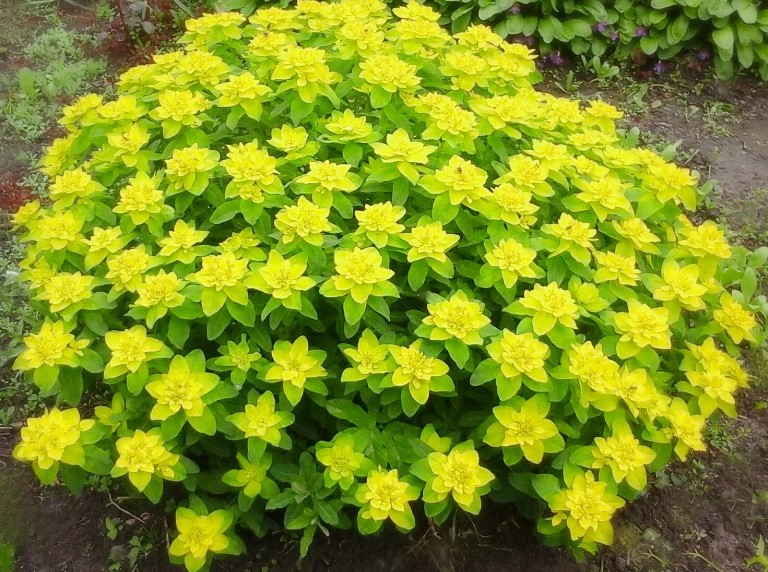 |
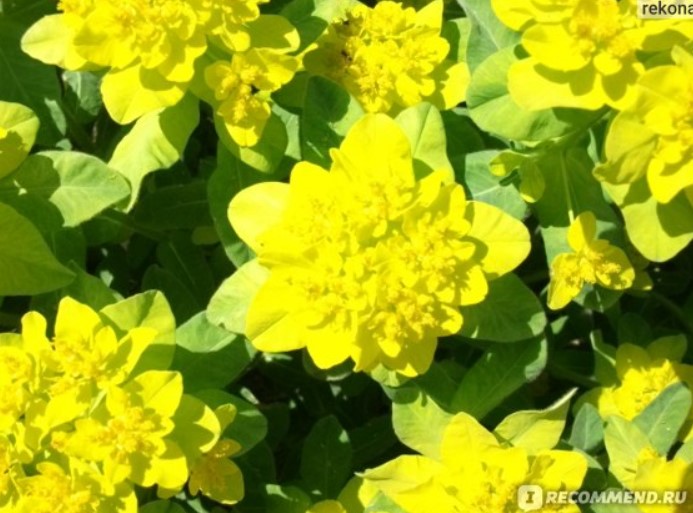
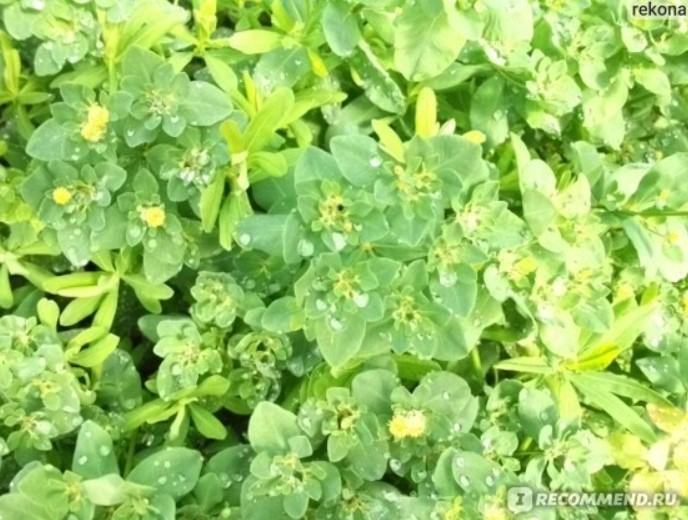
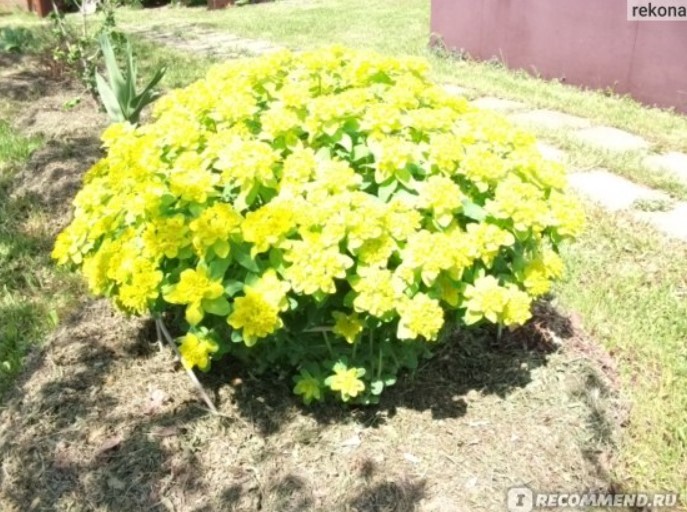
A frost-hardy, undemanding species. The bush grows up to 70 cm in height, with a large, spherical shape capable of growing to 140 cm in diameter. The leaves are small, oval, and about 7 cm wide. It is distinguished by its long flowering period, combining shades and iridescent colors of yellow, green, and orange, creating a stunning decorative flash effect. Widely in demand among landscape designers and flower growers. |
| Bordered (Euphorbia marginata) 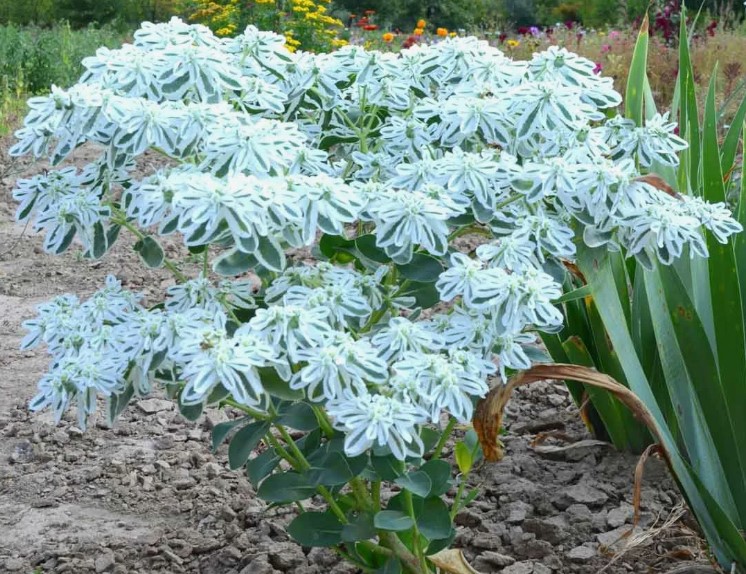 |
Grown as an annual, the plant grows to 80 cm tall. The leaves have a white edge. It produces small white flowers from July to September. |
| Cypress (Euphorbia cyparissias) 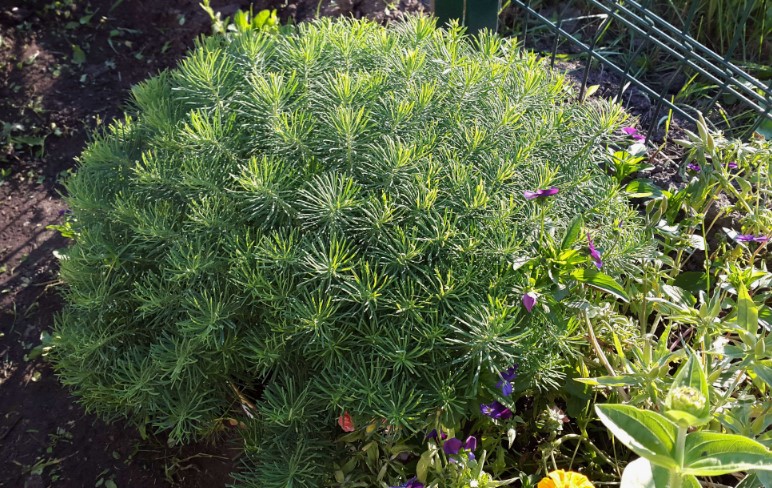 |
A small, dense, spherical bush of 40 cm, blooming in May and September, exuding a pleasant aroma. |
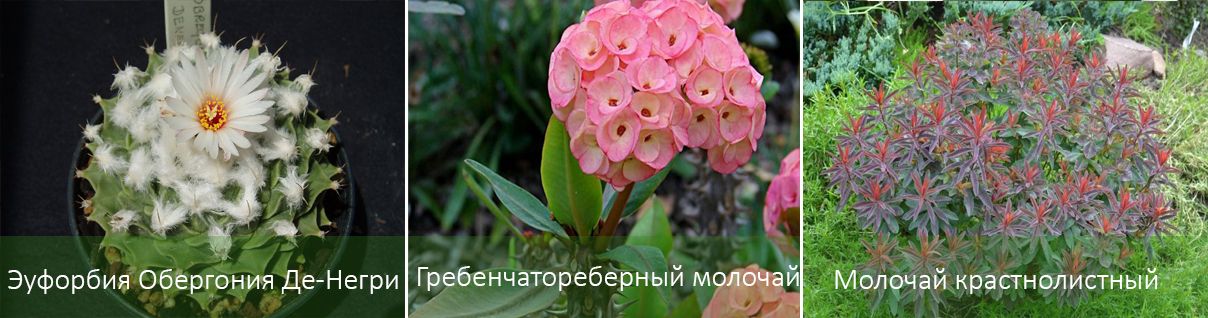
| Comb-rib (Euphorbia Lophogona) 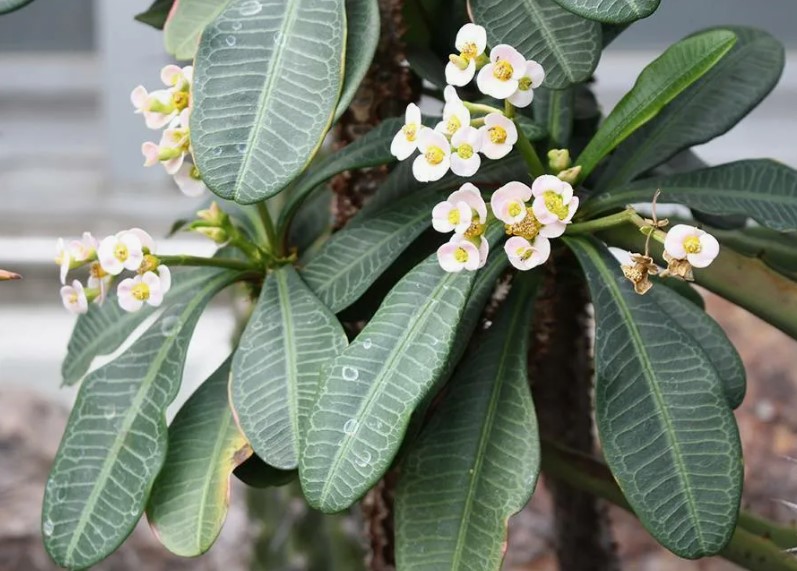 |
An evergreen euphorbia with a crested form. It blooms white or pink, starting in its first year. Its stem is a rich, dark green, pentagonal shape and unbranched. Large, elongated leaves, 13 cm long and 5 cm wide, are arranged in clusters with reddish petioles approximately 1.5 cm long. The plant reaches a height of no more than 1 m 20 cm. |
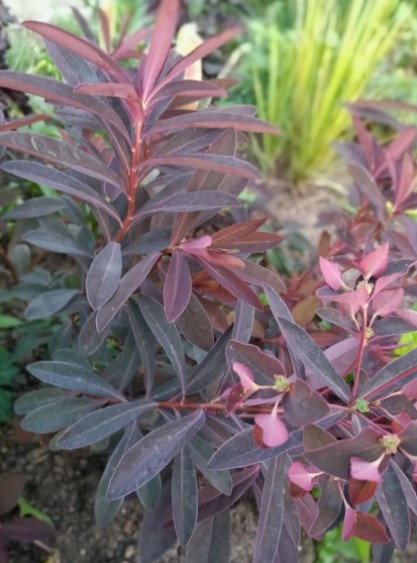
| Red-leaved
|
Reaches over 65 cm in height. An evergreen shrub, adorned with red-purple foliage. The elongated leaves are up to 20 cm long. A rather striking plant, especially in early summer when it blooms. |
| Mendaloid (Euphorbia amygdaloides) 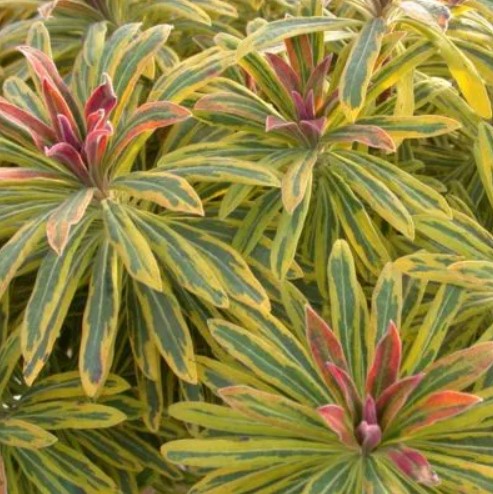 |
A tall shrub with unusual, decorative foliage. It is frost- and drought-resistant and is often used by gardeners. |
| Myrtle-leaved (Euphórbia myrsinítes) 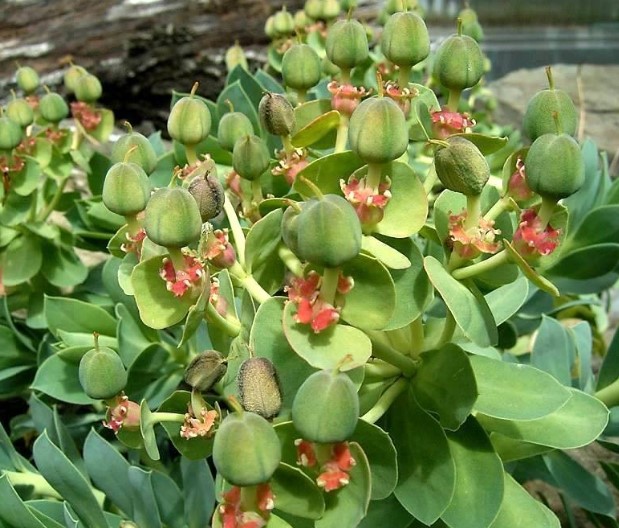 |
A low shrub, up to 25 centimeters tall, with creeping stems. Densely covered with small, diamond-shaped, bifid leaves, 1.5 to 3 cm long, and gray-blue in color. It blooms twice a year—in April and July—with small (up to 1.5 cm in diameter) pale yellow flowers. |
| Capitate (Euphorbia capitulata) 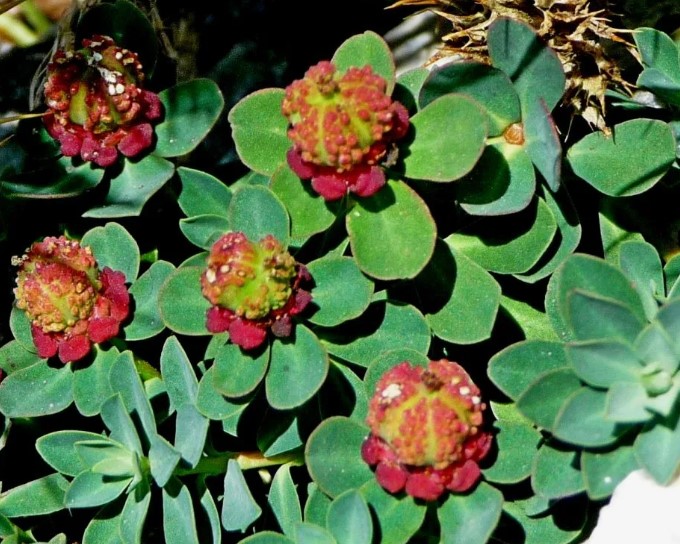 |
A small shrub, no more than 10 cm tall. It grows in rocky soil and prefers sunny areas. It blooms in late May. |
There are quite a lot of varieties and types of garden spurge, and despite all their splendor, without proper care, the beauty of the plant fades and loses its original grandeur and form.
Caring for garden spurge
Garden spurge tolerates dry summer periods and requires moderate watering only during hot, dry summers. However, overwatering is contraindicated, as it negatively impacts the oxygen supply to the root system, causing it to rot and die. In this case, the plant cannot be saved.
Euphorbia should be fertilized several times per season with complex mineral fertilizers. The greatest need for feeding occurs during the period of active vegetative growth. During this period, the recommended frequency of feeding is once every fourteen days. Well-rotted compost or wood ash can be used as an organic fertilizer, mulching them into moist soil.
Avoid mineral fertilizers with high nitrogen content, as these will cause plants to stop flowering, become vulnerable to fungal diseases, and subsequently have difficulty surviving the cold season.
Autumn care for garden spurge involves mulching it with peat or wood sawdust.
Reproduction of milkweed
Reproduction of garden euphorbia occurs in three possible ways.
Seeds
Prepare a mixture of sand and soil in a pot, moisten it, and plant the seed at a depth of 1.5 cm. To improve germination, maintain a temperature of 18…19°C. Pricking out should begin when the first shoots appear 1 cm deep.
Dividing the bush
Bush propagation is possible if you already have milkweed growing in your garden. When soil begins to form (April-May), carefully dig up the plant and divide it into small bushes. Make sure each bush has at least two or three buds when divided. Then plant them in pre-prepared spots in the garden.
cuttings
Propagation and planting of milkweed from cuttings should be done in early June. Select healthy young shoots and cut them diagonally with a sharp knife. Rinse off any milky sap with warm boiled water, and sprinkle the fresh cuts (both on the cuttings and the parent shoot) with finely ground activated charcoal powder. Leave the prepared cuttings in a warm place for a few days to dry, then plant them for rooting.
Diseases and pests
Euphorbia is quite resistant to pathogens and various insect pests. Its caustic milky sap helps with this. However, improper care can cause irreparable damage.
At low temperatures and excessive soil moisture, garden spurge is affected by fungal diseases:
- Powdery mildew.
- Spotting.
- Root rot.
- Fusarium.
Fungicides or cutting out and disposing of affected plants can help in treatment.
Insufficient light can disrupt photosynthesis and cause leaf and flower drop. In this case, the milkweed should be dug up and replanted in a brighter area of the garden.
Pests that affect euphorbia:
- Spider mite.
- Scale insect.
- Aphid.
- Nematodes.
Plants typically acquire such pests when planting material is of poor quality or when the planting is too dense. The problem can be eliminated with insecticides and thinning.
Top.tomathouse.com explains: Combining milkweed with other plants
Milkweed care is simple: moderate watering as needed, weeding, and fertilizing. If it grows excessively, it loses its shape; a wire frame or proper placement in the landscape will help.
Euphorbia prefers warm, sunny locations with some shade. In the wild, it grows on rocky mountain slopes and cliffs. Alpine gardens or landscapes resembling a desert oasis make good locations for spurge. Euphorbia's beauty stands out most vividly among solid-colored flowers, plants, stone arrangements, or rockeries. Individual specimens, such as the multi-flowered spurge, look spectacular planted alone in a flowerbed or in a mixed border—a limited growing area.
Plant euphorbia alongside thuja, low-growing juniper, antennaria, and yaskolka. It looks good next to irises, bellflowers, forget-me-nots, tulips, and climbing roses.
When caring for and replanting milkweed, wear gloves to prevent accidental contact with the plant's milky sap from causing an allergic reaction.
Reviews of garden spurge
Review: Garden plant "Euphorbia marginata" - Snow-white bride - decoration of the garden.
Advantages: Beautiful and unpretentious plant
Disadvantages: It can grow unpredictably)
Good day, Otzovik readers.Today I'd like to tell you about a plant that beautifies our garden and brings positive emotions. Although I'm not a fan of gardening, sometimes I really want to take a break from the hustle and bustle, admiring the colors of the flora, or hiding with a camera, trying to capture an insect fluttering over a flower. I hope these photos will lift your spirits, too.
Last year, my wife bought seeds of Euphorbia marginata "Vashe khozyaistvo" (Your Home) and planted them in a common flowerbed. Its flowering went unnoticed, blending in with the colorful carpet of other garden plants. However, this year, despite being unplanted, this domesticated weed sprouted all over the garden.
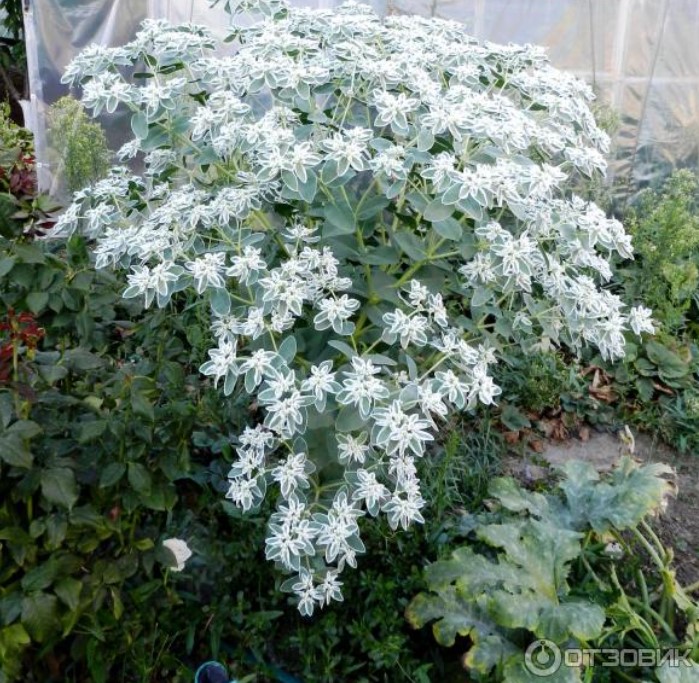
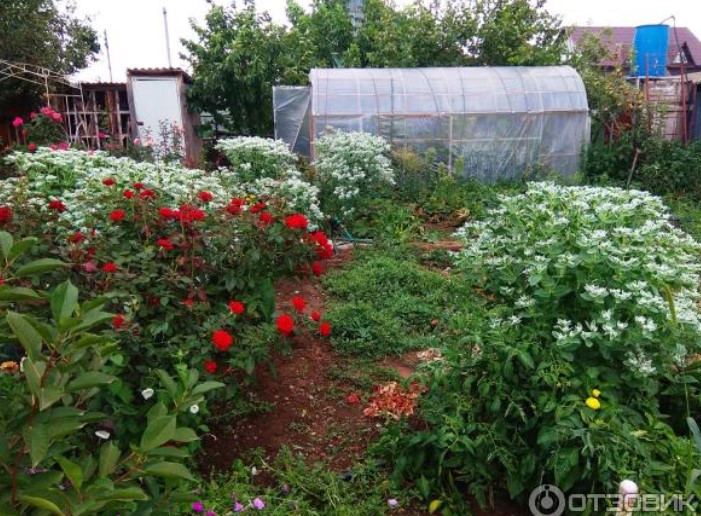
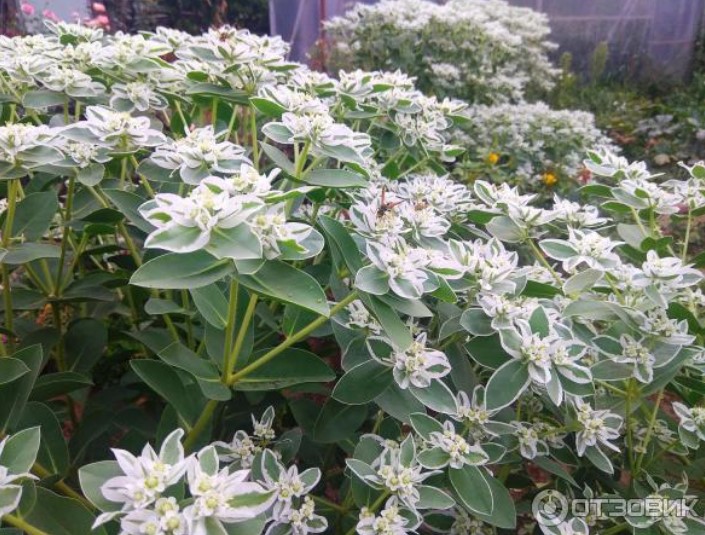
Moreover, by July, the exotic spurge bushes had reached a height of over one meter, resembling dwarf trees. They even outstripped the perennial roses growing nearby. Although other reviews claim spurge grows up to 60 centimeters, ours reached 120 centimeters, which I measured with a tape measure.
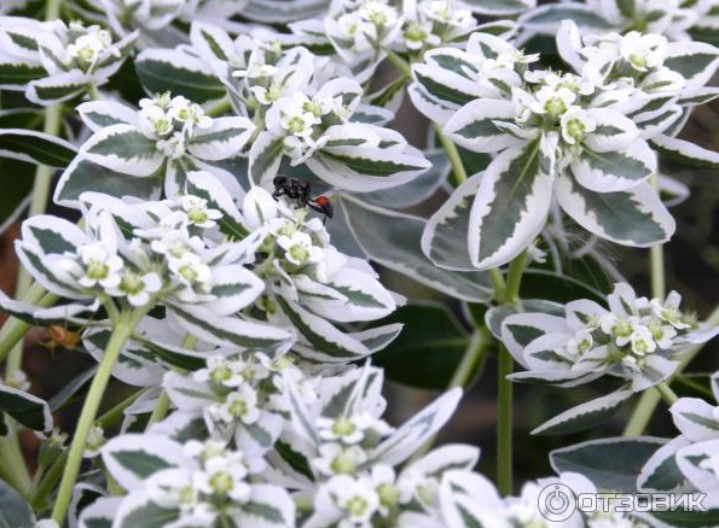
I only truly appreciated the beauty of this plant in midsummer, when its airy crown turned white and became involuntarily eye-catching. It consists of green leaves edged with white stripes and small, delicate flowers. People call this plant the "Rich Bride," and for good reason. Its lush, green and white crown truly resembles a wedding gown, embroidered with snow-white patterns.
The fluffy flowering crown is scentless, but insects apparently don't think so. There's always a buzzing and chirping sound around the milkweed. Wasps and bees are especially attracted to the milkweed flowers.
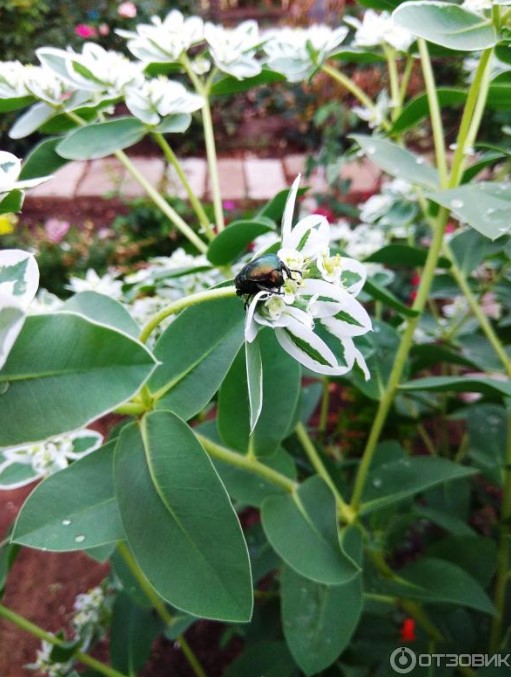
The May beetle decided to take a nap.
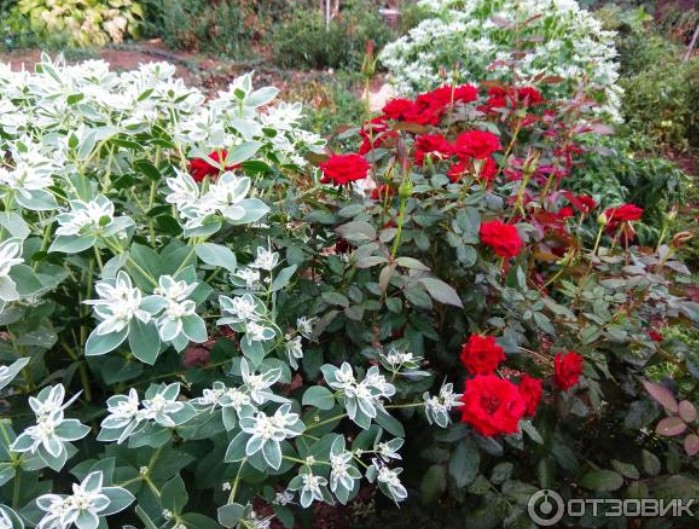
The snow-white and red brides live side by side in a completely friendly manner.
The plant is an annual, but once the seeds fall into the soil, they easily survive the winter and germinate the following year. Euphorbia is undemanding, doesn't require regular watering, but thrives in full sun. Therefore, it's a perfect addition to gardens and will survive with minimal care.
In the fall, I will definitely collect milkweed seeds to plant along the paths in the spring.
I recommend purchasing and planting the garden plant "Euphorbia marginata".
Thank you for reading to the end.
Usage time: 2 years
Cost: 50 ₽
Year of manufacture/purchase 2019
General impression: The Snow-White Bride is a garden decoration.
My rating
5
I recommend it to friends YES
it's impossible not to love
For official information about Euphorbia multiflora (multi-flowered spurge), see the description. I'll share my own experience growing this undemanding beauty.Many years ago, at the market, I saw a man selling a bush or maybe a flower of a stunning spherical shape. He was asking a hefty price. I was just a beginning gardener at the time and knew little about such wonders. So, I didn't risk buying it, fearing it wouldn't survive. I didn't really trust the seller's assurances that the plant was easy to care for and thrived in our central part of Russia, having had many unfortunate experiences with deception. So, I simply asked the name and decided to find out all the details myself. After reading numerous gardening encyclopedias, I realized I could easily grow this species of spurge at my dacha near the town of Borovsk in the Kaluga region. But no matter how hard I searched, I couldn't find a pre-grown plant.
I decided to grow it from seeds. I made several attempts, observing all the conditions. Only once did two seeds sprout, but for some reason the seedlings didn't survive. It's not for nothing that literature and online writers say that growing milkweed from seeds indoors is a Sisyphean task.
But providence was kind to me. Someone up there must have seen and sensed how much I loved this plant and how much I wanted it in my garden. And so, on one of my trips to the Sadovod market, I saw it, or rather, them. Somewhere off to the side, in a completely inconspicuous spot, stood two small pots, 10 cm in diameter. Tiny, skinny branches protruded from them, also no more than 10 cm in height. It was hard to guess which plant they belonged to. I don't know how I spotted them among a sea of luxurious, lush plants. Perhaps the one at the top directed my gaze in the right direction, and an inner voice said, "These are milkweeds, they've been waiting for you!" I don't even remember how much they cost. I bought both. My joy knew no bounds. I was absolutely certain they would thrive on our patch of land. And I was right.
When I arrived at the dacha again, I immediately planted these little ones. I'd read up on the size of the multi-flowered spurge, given the right conditions. Even though the plants looked rather stunted, I dug a substantial hole for each one—about 50 centimeters wide and deep. I filled the bottom with broken brick and my own prepared compost. On top, I filled the hole with regular garden soil, mixed with store-bought soil to create a looser texture, as our dacha is loamy. I filled the entire hole with this mixture. I watered it and left it until the next day to allow the soil to settle properly. Then I planted the seedlings and watered them thoroughly again.
A month later, they were unrecognizable. They had transformed into charming green balls. For their first winter, I covered the ground around the spurges with a layer of compost and spruce branches. Beforehand, in the fall, I cut all the branches back almost to ground level. In the spring, I removed the cover and saw many young shoots. That's it, I haven't covered the spurges since. They overwinter beautifully just like that.
Each year they grew significantly in diameter and height. They grow throughout the season. Euphorbia multiflora is very unique during flowering.
And even after that, its naturally spherical shape looks attractive and decorative.
My spurges have now grown to 1m 20cm in diameter and 70cm in height. At this size, they need support. My husband made two half-arches out of stiff wire for each plant. We install them in the spring, early. As the spurge grows, it ends up in the center of the circle. When young, it holds its "ball" shape well. But later, heavy rain or wind can cause the bush to fall apart, exposing the center. With support, spurges always look beautiful.
I don't fertilize them with anything special. I just lay it in a circle when I mow the first or second grass with the lawnmower.
This way, the soil beneath the bushes is always clean. The soil never dries out. With rain, the spurges receive natural micronutrients from the grass. By the end of the season, the grass has rotted, practically turning into compost. In spring, with the melting snow, the bushes immediately receive a boost of energy and flourish in all their glory throughout the season.
If you see it for sale, don't hesitate to buy a multi-flowered euphorbia and plant it as a solitary specimen in your lawn. It's worth it!
rekona
recommends