Powdery mildew is a rather unpleasant disease caused by parasitic fungi. It affects a wide range of plants, including vegetables, many grains, and houseplants and ornamental flowers. Violets are also susceptible. To effectively treat it, it's important to determine the cause.
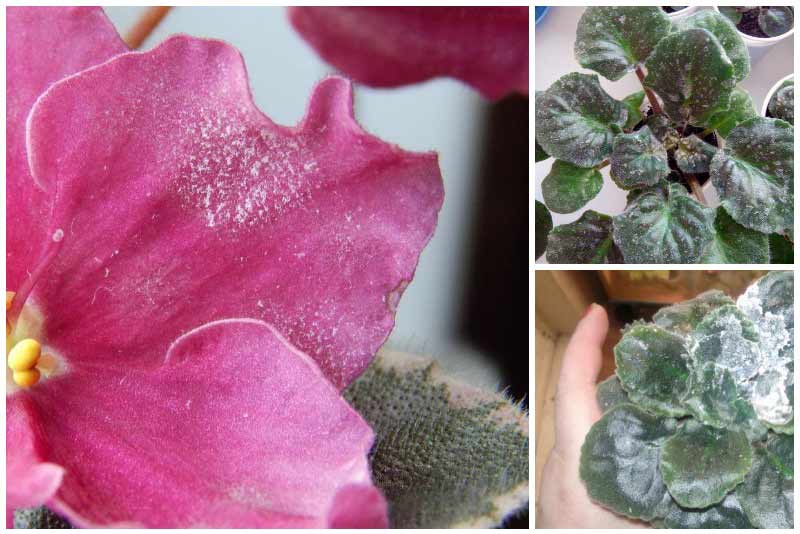
Signs of powdery mildew on violets
This disease is fairly easy to identify. Initially, pale spots appear on the leaves and stems, appearing as if they've been dusted with flour. This is where the name comes from. These are fungal spores, consisting of numerous conidia arranged in chains that are impossible to remove. The plant's appearance becomes untidy and dirty. Without treatment, the spots enlarge and develop into ulcers. Eventually, flower growth stops, the leaves die, and the plant dies. While it can be cured, it's best to prevent the disease from spreading. If the growing conditions (temperature, humidity, watering, etc.) are met, there's no reason for infection.
There are two types of this disease.
Downy and powdery mildew
The plant becomes covered in brown, red, and tan spots. These can be seen on the upper side of the leaf, while a whitish coating will be visible on the underside. The leaves will then begin to wilt, darken, and fall off. The violet will die within two months. This is a symptom of downy mildew. It occurs with high humidity and sudden temperature fluctuations.
If the plant is covered with a fine web or whitish dust that cannot be removed, it is true powdery mildew. Fungal spores settle on the leaves, other parts of the plant, and within the soil. The leaves will not wilt but will begin to dry out and fall off. The plant dies sooner – within three weeks.
Both types of disease pose a danger to violets.
How to cure powdery mildew on violets
Diseased plants are treated using ready-made medicinal products. A single application is sufficient. To consolidate the success, repeat the treatment after 1-1.5 weeks.
In addition to processing, it is necessary to perform a certain sequence of actions:
- Isolate infected plants. Carefully remove all affected parts (leaves, stems, flowers). Pick off any remaining flowers to prevent the plant from wasting energy on flowering.
- Rinse the violet under running water, being careful not to get into the middle of the flower.
- Clean and treat the outside of the pot and its tray with disinfectants.
- Replace the top layer of soil in the container with new one.
- Treat the entire flower and soil with the prepared medicinal solution.
- Spray again.
To achieve greater treatment effectiveness, different products are used for initial and repeated spraying.
Folk methods of struggle
Treatment can be done with ready-made chemical preparations or folk remedies, of which there are many known. They are quite effective. If the disease is not treated, the violet will quickly die.
|
Means |
Preparation |
Application/spraying |
| Sodium carbonate (technical soda) | Combine with liquid soap 25 and 5 g per half a bucket of water. | The plant and the top layer of soil every 1-1.5 weeks. |
| Copper sulfate | 5 g per 1 glass. This solution is gradually poured, stirring constantly, into another mixture: 50 g of soap per half a bucket of warm liquid. | The whole flower twice, every other week. |
| Dry mustard | Stir 30 g into a warm bucket of water and let cool. | Additionally, they also water it. |
| Garlic | 50 g per 2 l (cold). Let stand for 24 hours, then strain. | The whole violet. |
| Milk whey | Mix with water in a ratio of 1:10. | Apply three times every three days. Good for prevention. |
| Fresh horsetail | Leave 100 g per 1 liter for a whole day. Then boil for 2 hours. For use, dilute in a ratio of 1:5. | 3-4 times every 5 days. |
| Iodine solution | 5 drops per glass of liquid. | The whole plant. |
Fungicides for controlling powdery mildew on violets
Using chemicals is a more effective solution. Spray generously, allowing the liquid to run off the leaves.
|
Product/active ingredient |
Preparation |
Application |
| Bayleton / triadimefon 250g/kg | Solution: 1 g per 1 l of water. | Spray the entire plant. Pour the residue into the soil. The effect lasts for 2-3 weeks. Results are noticeable on the fifth day. |
| Topaz / penconazole 100g/l | 1 ampoule (2 ml) per 5 l. The concentration is increased in case of severe damage. | Treat the leaves on both sides. Repeat after two weeks. This is the most effective treatment. |
| Fundazol / Benomyl | 20 g of powder per 1 l. | Affects all parts of the flower. Greater effectiveness is achieved through absorption by the roots. |
Top.tomathouse.com informs: how to prevent powdery mildew on violets
It's easier to prevent a disease than to treat it later. Preventative measures include following these violet care guidelines:
- maintain the required temperature of +21…+23 °C;
- water regularly, avoiding over-watering;
- Feed with complex fertilizers containing K and P, do not use nitrogen during flowering;
- aerate the room, providing access to fresh air;
- Avoid exposure to sunlight for more than 2 hours a day;
- wipe the leaves with a solution made from laundry soap every 2 weeks;
- tear off the lower ones so that oxygen gets into the soil;
- carry out annual replanting;
- arrange a quarantine for a newly acquired violet;
- spray twice a year with Topaz solution;
- inspect plants daily, isolate diseased ones;
- disinfect the soil, pots, tools;
- Do not place cut flowers next to indoor flowers.