Foxglove is a perennial native to North Africa and Western Asia. Its name comes from the thimble-like shape of its flowers, but botanically, it is commonly known as digitalis. There are approximately 35 species of this plant. It is used for ornamental purposes and in landscape design. It is often grown by gardeners as an annual. It can be used medicinally, but in high concentrations, it is toxic and dangerous.
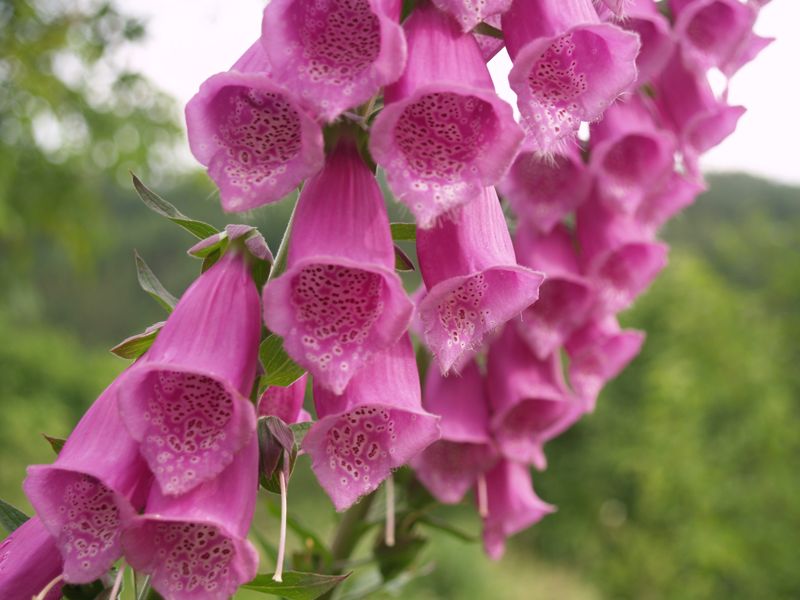
It is necessary to pay attention to this when planting, especially if there may be children present in the garden.
Content
- 1 Description and characteristics of foxglove
- 2 Purple, large-flowered and other species and varieties of foxglove
- 3 Growing foxgloves from seeds
- 4 Caring for foxgloves in open ground
- 5 Foxglove after flowering
- 6 Vegetative propagation of foxglove
- 7 Diseases and pests
- 8 Top.tomathouse.com informs: the harm and benefits of foxglove
Description and characteristics of foxglove
The stems of this herbaceous plant are notable for their rigidity, growing up to 1.5 meters in height. This perennial lacks lateral branches, and the petiolate leaves, mostly oval in shape, are gathered into a rosette. The dark green leaves have a distinct texture, growing up to 30 cm long and up to 10 cm wide. The shady side is densely covered with hairs, while the upper surface is shiny and ridged. In appearance, foxglove resembles a subshrub. In the wild, foxglove can be found in forests, clearings, and forest edges among other shrubs.
In summer, the foxglove produces a multi-flowered, racemose inflorescence formed by bell-shaped flowers.
The shades range from red to white, and yellow is also common. The throat is sometimes speckled. The small seeds ripen after pollination. One plant produces approximately 2 million seeds, and their viability remains for up to 3 years.
Purple, large-flowered and other species and varieties of foxglove
Despite the diversity of foxglove species, only 4 species are widespread in the middle zone.
Rusty
This species reaches a height of 120 cm and is covered with oblong foliage. Its dense, bell-shaped inflorescences grow up to 15 cm long and form a wave-like shape near the edge. The calyx resembles an orchid, usually no more than 4 cm in diameter. Flowering occurs in the summer months. The yellow petals have a pink pattern, and the throat has a golden hue inside. This species is highly prized for its ornamental qualities.
Purple (purple)
This biennial plant has leafless stems no taller than 1.5 m. The shoots are pubescent on the underside of the leaves. In early summer, a cluster-shaped inflorescence typically opens. It is asymmetrical and composed of flowers no longer than 13 cm each. The petals, which come in various shades, are speckled with black. This species originates from Western Europe, where it is widely cultivated. There are many varieties, including spotted, large-flowered, and gloxiniform.
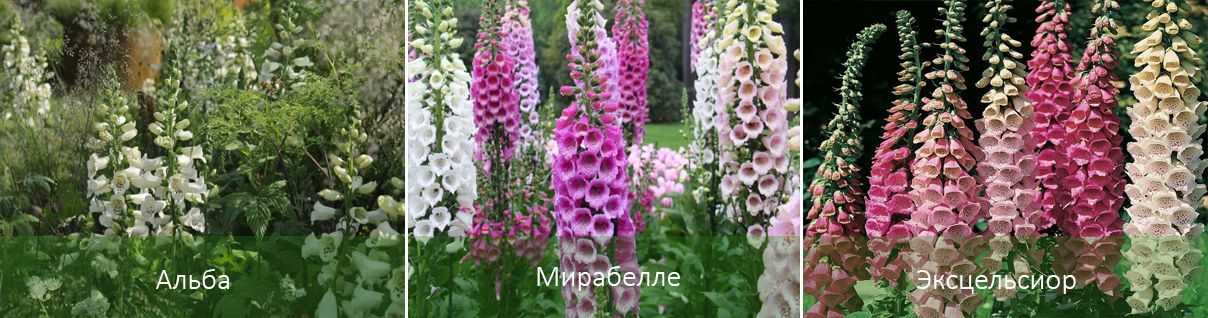
The inflorescence can be either unilateral or pyramidal. The most commonly grown varieties are:
- Alba. Petals are white, may be covered with dark spots.
- Mirabelle. Multi-flowered inflorescences in shades of pink.
- Excelsior. This hybrid reaches a height of 1.8 m. Its flowers are notable for their spiral-shaped arrangement.
- Peloric. This variety's flowers are the largest of all, borne on a stem up to 1.8 m tall.
Large-flowered
It grows up to 1.2 m in height, resembling a shrub. The stems have a stiff, hairy covering. The leaves are elongated toward a sharp edge, growing up to 25 cm in length and up to 7 cm in width.
In June, you can see the cluster of small flowers blooming at the top of the stem. They are yellow in color and covered with hair on the outer surface. The corolla divides into five petals at the edge. It is found in Western Europe, Russia, and Ukraine.
Woolly
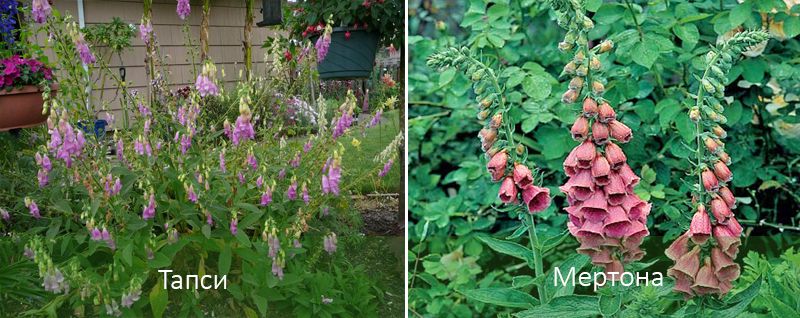
This small perennial grows up to 80 cm tall. Compared to other varieties, it has small flowers. The green leaves are gathered in a dense rosette close to the ground. On the shaded side, they are edged with cilia. In midsummer, a raceme of two-lipped sepals emerges, often resembling a pyramid. The flower is white, and as it moves away from the edge, it becomes covered with a brown pattern formed by the veins. Among the many varieties and hybrids, the following are the most popular:
- Tapsi. The bells on the brush are large, pink and crimson in color;
- Merton's. An early-blooming plant, the flowers are pink and can be seen as early as late spring.
It blooms in July and lasts no more than two months. It has medicinal properties and is found in the wild primarily in Moldova.
Growing foxgloves from seeds
This simple method, which includes several stages, is inferior to vegetative propagation only in speed.
Sowing for seedlings
Sowing of seeds is carried out in early spring and should include the following steps:
- Soaking in water, which needs to be replaced every 6 hours, while the entire soaking period should not exceed 1 week;
- Spreading seeds on the surface of prepared soil;
- Sprinkle with a small amount of sand;
- Spraying with growth stimulator;
- Covering the container with polyethylene or glass;
After which they need to be left for 2 weeks in a dark, warm place.
Growing seedlings
Foxglove seedlings emerge quite late; after 2-3 leaves have formed, the plants need to be pricked out. They are not particularly demanding in terms of container size—separate cups for each plant or a shared container will do. When planting together, maintain a distance of 10 cm between seedlings. The seedlings are easy to grow; simply water them as needed, gently loosen the soil, avoid drafts, and provide indirect lighting. Two weeks before planting outdoors, harden them off as follows:
- The plant should be taken out onto the balcony for 5 minutes, provided that there is no precipitation and the weather is warm;
- Repeat the procedure daily, gradually increasing the time the foxglove is exposed to fresh air.
Planting in the garden can be carried out after the plant can safely spend a whole day outdoors.
Sowing seeds in open ground
Throughout the spring period, foxgloves can be sown in open ground, but it is preferable to do this earlier.
First, it's important to properly prepare the soil: dig it thoroughly, level it, and give it enough time to settle.
When sowing, it is necessary to maintain a distance of 30 cm between rows, while the seeding depth should not exceed 2 cm.
The planted seed should be covered with a small amount of soil. In cold weather, it is permissible to cover the seedlings with lutrasil. The minimum distance between plants in a row is 10 cm.
Timing of planting seedlings in the ground
Seedlings are planted in late spring or early summer, following the lunar planting calendar. Earlier planting is also possible, but keep in mind that young plants will not survive subsequent frosts. The soil should be well-warmed, and the seedlings should have grown at least five leaves.
Foxgloves should be sown in an open, well-lit location, but they will thrive in partial shade. Areas near deciduous plants are unsuitable, as the soil around these crops is often overly moist and occasionally retains water. Under such conditions, foxgloves will survive, but will not bloom.
Foxglove planting technology
Soil requirements:
- Looseness;
- Nutritional value;
- Water permeability, meaning there is no moisture stagnation.
First, the soil is weeded and dug to a depth of at least 30 cm. Then, the soil is fertilized with compost at a rate of 5 kg per 1 m2.
When repotting, be careful not to disturb the plant's root ball, as the roots are very fragile. After planting, be sure to compact the soil and water generously. Don't expect flowering in the first year; the plant will only just form a rosette at this time.
Caring for foxgloves in open ground
The plant requires watering only during dry periods. After each watering, carefully loosen the soil to avoid damaging the foxglove's shallow root system. Fertilize with mineral fertilizer no more than twice per season, applied with watering. To enhance its decorative appearance, remove faded and wilted inflorescences.
Foxglove after flowering
Proper planting and care will ensure good growth rates and timely flowering of digitalis, but after this, you should not neglect the care of the perennial.
Due to the shallow root system, there's a high risk of partial root exposure. To prevent this, especially in the fall, cover the foxglove with a thin layer of soil.
Many varieties are noted for their resistance to low temperatures, but if there's little snowfall in winter, the plant is at risk of freezing. It's a good idea to cover the rosette with sawdust or leaves. Covering the foxgloves for the winter is especially important for young foxgloves.
Seeds can be harvested once the seed pods are fully ripe, which should be removed before they begin to split. First, dry the seeds in a well-ventilated room, then store them in paper bags in a dark, dry place.
Vegetative propagation of foxglove
This type of propagation is accomplished using basal shoots. First, remove the faded and wilted flower clusters, making sure to remove any dense inflorescences—they'll be useful for collecting seeds. Three weeks later, basal shoots will emerge from the base of the pruned plants. Each basal rosette will develop 7-8 leaf blades, which should be carefully removed and replanted. The shoots will become strong by fall and will survive the coming winter. The young plant will produce flower stalks and bloom no later than the following season.
Diseases and pests
Powdery mildew. The fungus spreads rapidly through the air, irrigation water, and tools. Affected plants turn yellow, shrivel, and die. At the first sign of the disease, remove the affected parts, then immediately treat digitalis with a fungicide. If the disease isn't treated in the early stages, the plant can't be saved in later stages.
Root rot. Affected foxgloves should be destroyed to prevent further spread. The affected plant's location should then be treated with a fungicide.
Leaf spot. It appears on leaves and stems as a result of various pathogens. This is a symptom of the dying off of the affected area. Both young and mature plants are susceptible. The disease causes premature leaf drop, drying, and deformation; it weakens the immunity of digitalis.
Insect pests. The plant is susceptible to attack by various types of aphids, which carry various diseases. These pests can be easily eliminated by treating the foxglove with an insecticide.
Top.tomathouse.com informs: the harm and benefits of foxglove
Historically, physicians used digitalis to treat various ailments, including as a pain reliever for skin conditions and to cleanse the body of constipation. However, if digitalis concentrations exceeded a certain level, the medicine caused nausea, diarrhea, and was often fatal.
In the 18th century, the flower began to be used in traditional medicine, primarily for the treatment of cardiovascular diseases. Today, foxglove is used for:
- Strengthen the walls of blood vessels;
- Normalize blood supply to muscles and tissues;
- Improvement of hemodynamic characteristics;
- Combating cardiosclerosis, hypertension, tachycardia;
- Normalize the heart rate.
Woolly foxglove is used more often than other plants as a medicinal raw material. Organic acids and glycosides are extracted from it. The leaves are ground into a powder, which is used in medications. Many types of digitalis tincture are used in alternative medicine.
All foxglove species contain a poison that is hazardous to health, so self-medication with this plant is not recommended. It is especially contraindicated for people with chronic lung and heart problems, those suffering from gastric tachycardia, as well as young children and pregnant women.
Use can cause rash, itching, vomiting, multiple signs of food poisoning, respiratory distress, body convulsions, and other similar symptoms. Prolonged use can lead to anorexia, loss of appetite, and hallucinations.