The only plant that represents the Nepentaceae family is Nepenthes (pitcher plant).
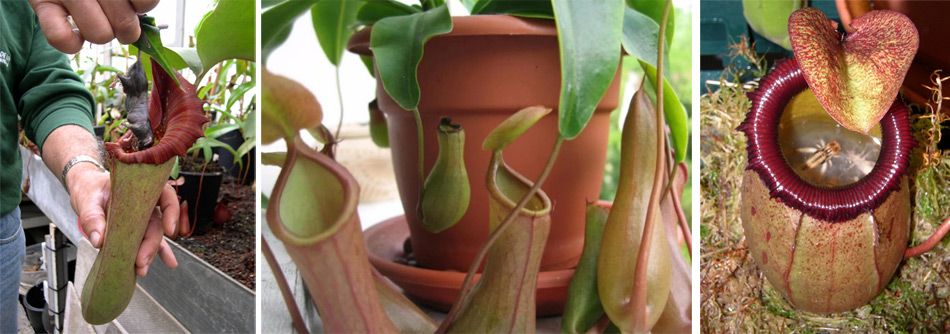
This carnivorous flower is named after the legendary herb of oblivion, nepenthe, from ancient Greek mythology. It is native to tropical Asia, including Borneo, the Seychelles, Madagascar, New Guinea, Caledonia, and northern Australia.
Content
Appearance and characteristics of Nepenthes
Its species are primarily semi- or shrubby vines, mixotrophs capable of utilizing a variety of nutritional sources, from soil nutrients to insects. They twine around neighboring trees with long, thin, herbaceous or slightly woody stems, and, climbing them, raise their inflorescences in clusters or panicles toward the sun.
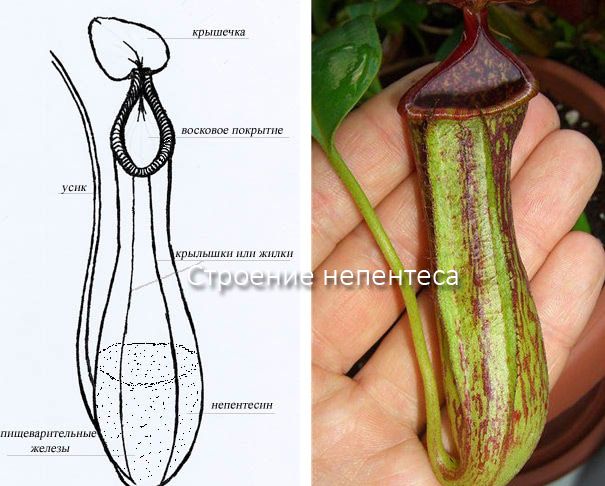
Nepenthes has two types of leaves. Some are large, simple, and prominently veined, arranged alternately. Others are pitcher-shaped, giving the plant its second name. They are attached by a petiole, the first part of which is green and flat, where photosynthesis occurs, and the second is long and thin, ending in a unique trap leaf. It is with this petiole that the plant captures insects.
Along its edges are cells that secrete a sweet liquid, along with stiff hairs that prevent the prey from leaving the pitcher. The prey slides down the wax secreted by the smooth surface of the leaves. The pitcher contains water, where the trapped insect drowns. A digestive enzyme is produced at the bottom of the trap, which digests the insect. This unusual leaf can reach 50 cm in length. Its color ranges from white to brown, usually very bright.
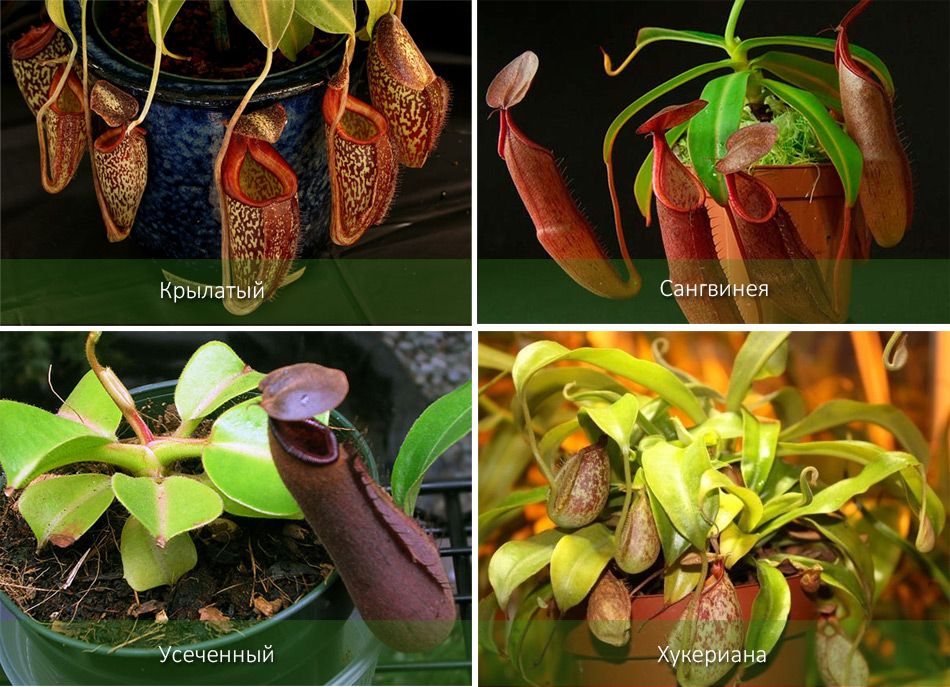
The flowers are small and inconspicuous, so pitchers are often mistaken for them.
Nepenthes species
Nepenthes has many varieties and various hybrids bred by breeders.
| View | Description |
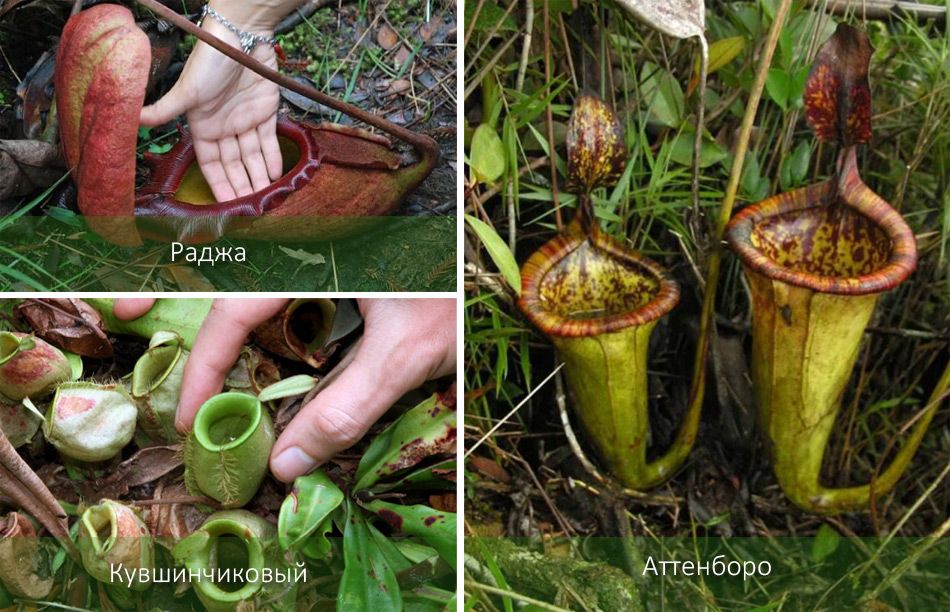
| Rajah | Its pitchers are burgundy and purple, reaching 50 cm. Even small animals and birds fall into them. It also releases mosquitoes, which help it reproduce. |
| Attenborough | Height: 1.5 m, stem thickness: 3.5 cm, light green leaf with purple veins: 25 cm. |
| Jug-shaped | Compact, the traps are small, light greenish, but there are a lot of them. |
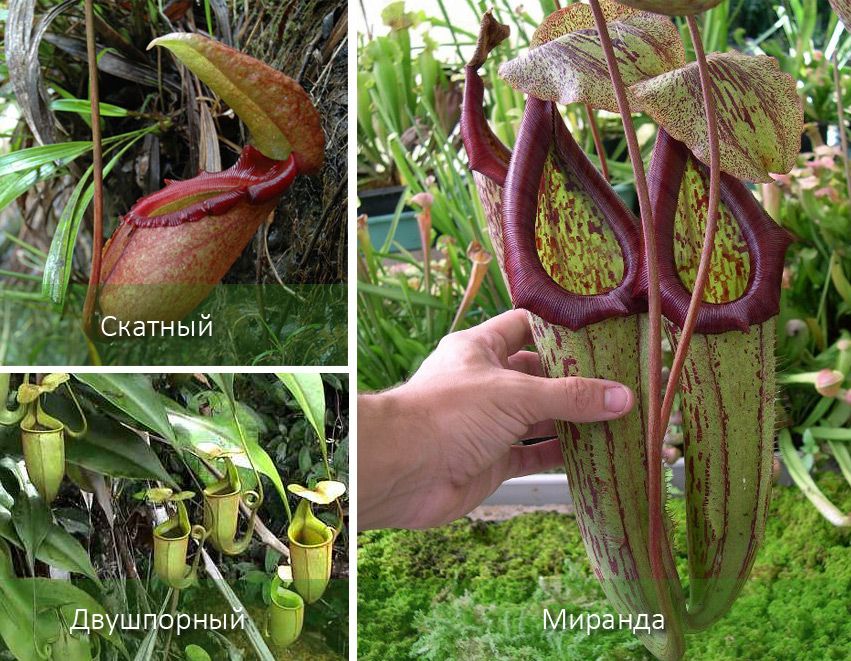
| Pitched | Large, looks like a rajah. |
| Miranda | An evergreen shrub with flask-shaped leaves with a bright red border and stripes along the entire length. |
| Winged | Height indoors: 2 m. It's widely used for indoor cultivation, as it's less demanding of humidity (50-60% is sufficient), compared to other varieties. The traps are green with red. |
| Sanguinea | The pitchers are blood-red in color, 10-30 cm, and can be orange or yellow. |
| Hookeriana | Requires high humidity. It is grown indoors only in a specially designed terrarium. The traps are yellow with spots on the sides. |
| Raffles | The first part of the leaf reaches 50 cm, and the second is small, no more than 20 cm, light green in color with scarlet spots, with a blue tint inside. |
| Double-spur | The wide part grows up to 60 cm, and the trap is about 15 cm. |
| Truncated | Jugs 50 cm, dark brown color. |
Caring for Nepenthes at home
This plant is very demanding and difficult to keep in the house.
| Factor | Conditions | |
| Spring/summer | Autumn/Winter | |
| Location | Southwest and southeast facing windows. Avoid rotating the plant, otherwise it will not produce new pitchers. If it has to be moved, the adaptation period will last two months. It does not tolerate drafts, although fresh air is beneficial. Support is essential; it should be provided when repotting a one-year-old plant. | |
| Lighting | Prefers good, diffused light (14-16 hours a day). | |
| Temperature | +22…+24 °C. At +35 °C and above it will die. | +20 °C. Temperature fluctuations are detrimental. |
| Humidity | For most varieties, the humidity is increased (at least 80%). It's best to keep the plant in a florarium or terrarium. | |
| Watering | Water the plant in a tray every two days; it does not tolerate prolonged overwatering. Regular misting is recommended, and water should not be allowed to get into the traps. Baths are recommended once a month. | Once a week. |
| Soil | Peat, sphagnum, sand (2:1:0.5). Orchid soil with added moss. | |
| Pot | Plastic, wide, shallow. Drainage at the bottom is 1/3. Cover the top with moss. | |
| Top dressing | Add one medium-sized insect to 1/3 of the pitchers once a month. Do not feed organic food (meat, fish), as this can cause the traps to rot. If insects are scarce, apply mineral fertilizer for orchids once a month. Use a dosage three times less than the instructions. Spraying is best. | Do not feed. |
How to repot Nepenthes
The plant doesn't like being disturbed (don't repot it after purchase). This is done only if the roots become overgrown (approximately after 2-3 years) or if mold appears.
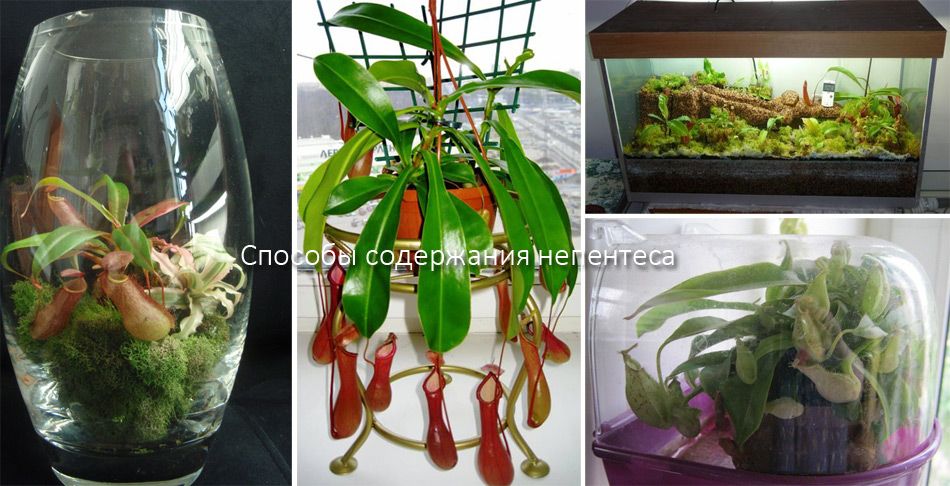
Step by step process:
- Using the transshipment method, the flower is moved into a wider and deeper pot.
- Drainage at the bottom and moss on top of the soil are essential.
- Nepenthes are not fed for a month. Watering schedules are strictly followed.
- Provide the correct lighting and temperature. Spray twice with a growth biostimulant.
Formation of Nepenthes
To create a more decorative, compact form and rejuvenate the bush, it is pruned and pinched. This stimulates the formation of new pitchers. The best time is spring. The first pinching should be done when the plant has at least six leaves.
The jug produces the enzyme only once, so if it spills, you cannot feed it; you need to pour 1/3 of purified water into it.
Features of Nepenthes reproduction
There are three methods to grow new Nepenthes:
- cuttings;
- layering;
- seeds;
- dividing the bush.
Cuttings
The most popular method:
- Cuttings are taken in the spring. A shoot with three leaves is cut off with a sharp knife.
- Treat with a disinfectant (Fundazol).
- Place in a jar with a solution of water and Kornevin. Keep at 26°C.
- The shoot will form roots in 6 weeks.
- Afterwards it is transplanted into a prepared pot.
Seminal
This is a labor-intensive and time-consuming process. The seeds must be fresh, as they quickly lose their viability. To obtain them, two plants—a male and a female—are needed, as the flower is dioecious. Also, Nepenthes rarely blooms indoors, and insect pollination is necessary for fruit set.
Planting is carried out as follows:
- Prepare a container with sand and sphagnum moss.
- Sow the seeds.
- Cover with film.
- Place in a warm, well-lit place (+22…+26 °C), with humidity of almost 100%.
- Sprouts will appear in 60 days.
Layering
A section of bark is removed from the flexible shoot of the vine. This section is then inserted into moist substrate and secured. After the aerial shoot develops roots, it is separated from the mother plant and planted in a separate pot.
Dividing a bush
When replanting a fairly mature Nepenthes, you can divide it into parts.
The operation is carried out carefully, as the plant's roots are very fragile:
- The bush is placed in a large container with warm water, where the soil is carefully cleared away.
- Using a disinfected instrument, cut off part of it along with the roots.
- The damage is treated with activated carbon.
- Each divided plant is planted in its own pot according to the usual pattern.
Pests, diseases and potential problems when caring for Nepenthes
Growing Nepenthes can be difficult if the conditions necessary for its maintenance are not met.
| Manifestation on leaves and other parts of the plant | Reasons | Elimination measures |
| Brown spots. | Stale indoor air, over-watered soil. This is a fungal disease. | Ventilate the room, maintain a regular watering schedule, and drain excess water from the tray. In severe cases, treat with fungicides (Aktara). |
| They are drying up. | Low humidity. | Methods are used to increase humidity (install humidifiers, place an aquarium nearby, place the plant in a florarium or terrarium). |
| Brown spots. | Sunburn. | They provide shade. |
| Yellowness. | Lack of nutrients. | They are fed with insects or sprayed with fertilizers. |
| Weakening of the plant, rotting. | Excess nitrogen. | They do not feed meat or fish. |
| Yellowing and falling off. The plant becomes smaller. | Chlorosis. | Change the substrate to the correct one. |
| The appearance of insects. | Aphids, mealybugs. | Remove with cotton wool soaked in a solution of laundry soap. |
| Stem elongation, leaf disease, lack of pitchers. | Lack of light. | They are moved to a more illuminated place and phytolamps are used. |