Nolina (Beaucarnea) belongs to the Asparagus family. The genus comprises approximately thirty species. It grows wild in southern Mexico and the United States.
Description
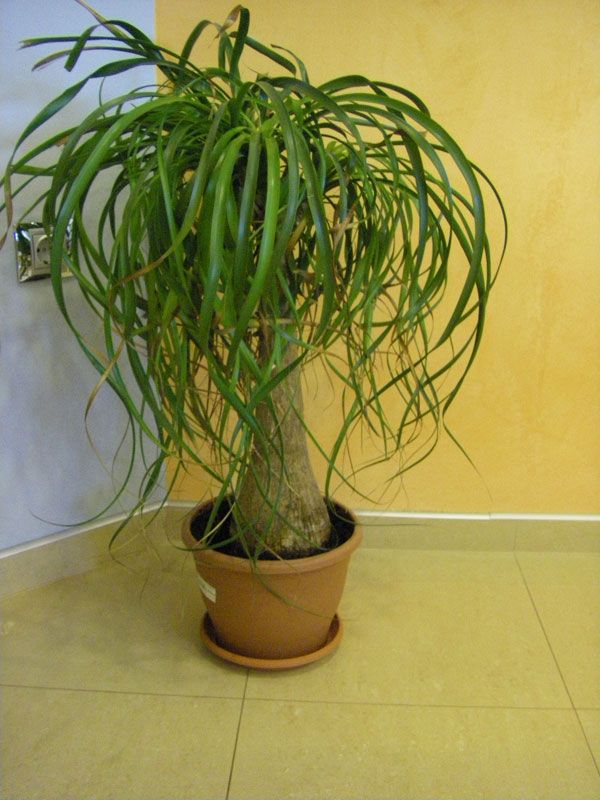
Nolina has a bottle-shaped trunk with a thickening called the caudex. From this stem, slender, woody stems emerge with cracked, thin, pale gray or ivory-colored bark. The caudex is where the plant stores moisture, which is essential because it grows in arid areas.
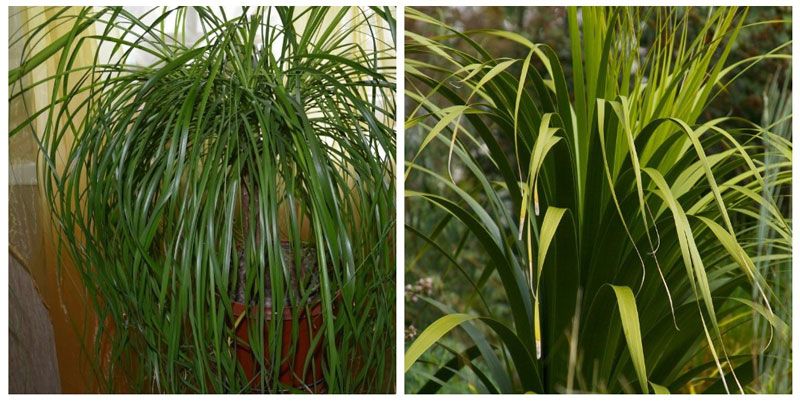
Beaucarnea resembles a palm tree: its leaves are clustered at the top. The leaves grow up to one meter long and are tough and veined. The foliage located at the base of the plant fades over time and is replaced by new leaves.
In the wild, it begins to bloom only after 15-20 years. Under domestic conditions, this does not happen at all. The flowers resemble a panicle of yellowish-white hue. The buds exude a pleasant aroma.
Species for indoor cultivation
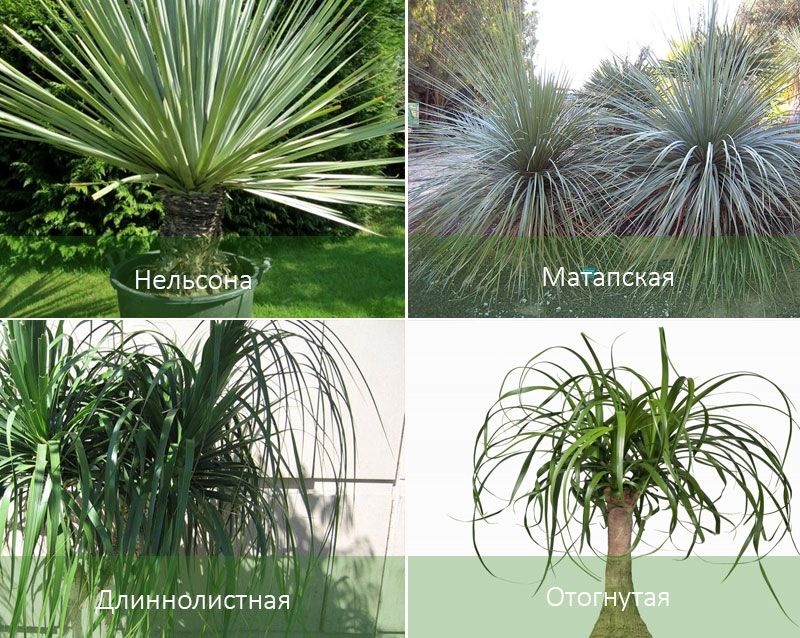
There are over thirty species of Beaucarnea. However, not all are suitable for indoor cultivation. The following varieties are commonly grown indoors:
| Variety | Peculiarities |
| Long-leaved | This is a large plant, often grown in special greenhouses. It has an upright trunk, widening at the base. The bark is corky, cracking in older specimens. The arched leaves are stiff and strap-like. They grow in tufts at the top. Over time, they dry out and droop, forming a "skirt" covering the trunk. |
| Recurved (recurvata) | The most popular variety for indoor cultivation. It reaches one and a half meters in height. The trunk is erect, widening at the base. Green, ribbon-like leaves form rosettes and hang from the top. Over time, they become "curly." It is about one meter long and one to two centimeters wide. |
| Matapskaya | It belongs to a low-growing variety. In the wild, it doesn't grow more than two meters tall. The leaves do not fall off after wilting, but instead form a "skirt" around the trunk. |
| Lindenmayer | A low-growing variety with a weakly defined trunk. The leaves are dense and elongated. The plant is popularly nicknamed "devil's shoelace." |
| Nelson | In young specimens, the trunk is almost impossible to see: it's covered in foliage. The glaucous-green leaves are stiff, serrated, and jut out to the sides. With age, they fall off, leaving the plant bare. It reaches three meters in height. |
| Tuberculate | It grows up to two meters, gaining three to five centimeters in height per year. A caudex is present in mature bushes that are twenty years old. |
Housekeeping
Seasonal home care chart:
| Parameter | Spring/summer | Autumn/Winter |
| Location/lighting | The plant enjoys fresh air. It is recommended to place it on a loggia or terrace. If this is not possible, place the nolina pot on a southwest or southeast-facing windowsill. Beaucarnea tolerates direct ultraviolet rays well. However, in strong sunlight, it is best to protect it from these rays (they may burn the foliage). Drafts and rain are also undesirable. Nolina requires bright, diffused light. Without it, the trunk will bend toward the light source. |
The plant's location should be the same as in summer. In autumn and winter, additional light sources are needed. Regular lamps can be used. Daylight hours should be extended by 10-12 hours. |
| Temperature | Nolina tolerates all temperatures well. Therefore, there is no need to create special conditions for it. If possible, it is best to maintain a favorable indoor temperature of 20–25°C. | In autumn and winter, the room temperature should be lowered to +10…15°C. |
| Humidity | The plant thrives in normal apartment humidity. | When the heating system is on, infrequent misting is necessary. It is recommended to wipe the leaves with a damp cloth to remove dust. Do not wash the plant in the shower, as this could damage the plant. |
| Watering | Regular and generous watering is essential. Excess water should be drained from the tray after each treatment. It is recommended to perform the procedure using the "immersion" method. | The frequency of watering is gradually reduced. Once every three to four weeks is sufficient. At temperatures below 10°C, watering can be avoided altogether. |
| Top dressing | To maintain health and beauty, fertilize once a month. Use a low-nitrogen fertilizer. | No need. |
Repotting: Pot, Soil, Step-by-Step Description
The pot should be shallow but wide, as the root system is shallow. The repotting container should have large holes for drainage.
For young plants, use plastic pots. For mature specimens, use ceramic pots.
Beaucarnea isn't picky about soil. However, the ideal soil type is loose, well-drained soil with a moderate acidity. You can make your own or buy ready-made soil.
How to properly plant a bush in a new container (step by step):
- a drainage layer is laid out;
- 1/3 of the container is filled with substrate (the container and soil are disinfected beforehand);
- planting is done by transshipment (the root ball must not be damaged);
- the roots are covered with soil, which is compacted;
- the bush should sit tightly in the soil (sprinkle with expanded clay or gravel);
- The transplanted nolina is placed in partial shade and not watered for three to five days.
Young specimens need to be repotted annually. Mature plants should be repotted every 3-4 years. The pot should be 3-4 cm wider than the previous one.
It is easy to understand that repotting is necessary: the root system will begin to emerge from the drainage holes.
Formation
Nolina does not bloom indoors. To ensure lush foliage, the plant requires medium-intensity lighting and regular watering.
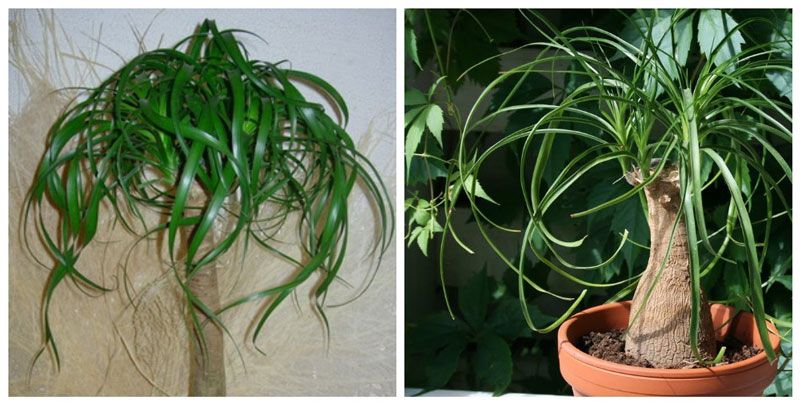
It's important to note that with this type of care, the Beaucarnea will lose the noticeable thickening at the rhizome. It's also recommended to trim the top to awaken dormant buds. The bush will grow toned, with lush foliage but a small caudex.
When you want the plant to have a strong thickening at the bottom of the trunk, it needs to be provided with bright light in winter with a minimum amount of watering.
The caudex will grow, the bush will not grow upward.
Reproduction
Beaucarnea is usually propagated by seed, as it rarely produces offshoots. This occurs as follows:
- the seeds are soaked in Zircon, Epine;
- a pot with substrate, the soil is moistened;
- the planting material is evenly distributed and covered with a thin layer of soil;
- the pot is covered with polyethylene and placed under a phytolamp, the temperature is maintained within the range of +21…25˚С;
- The condition of the soil is checked daily (it should always be slightly damp), the film is removed, and condensation is removed from it.
The first shoots appear in 3-4 weeks. Once the seedlings have strengthened and grown, they are transplanted into different containers.
If the nolina has produced shoots that can be separated from the mother bush, then propagation occurs as follows:
- the stalk is separated by hand, the injured area is sprinkled with charcoal powder;
- the cutting is planted in a pot with a moistened mixture of peat, sand, and vermiculite;
- the soil around the seedling is slightly compacted;
- the pot is covered with glass and kept at a temperature of +21…26˚С;
- regularly watered with water with a small amount of rooting agent, the above-ground part is sprayed with Zircon, the protective glass is removed daily to eliminate condensation;
- After the greenery appears, as soon as the shoots take root, the covering is removed.
Propagation of Beaucarnea by cuttings is a simpler method with a good germination rate, but not always possible.
Care errors and how to fix them
If improperly cared for, the plant can develop diseases. Mistakes in care and solutions:
| Description of the problem | Possible reasons | Methods of elimination |
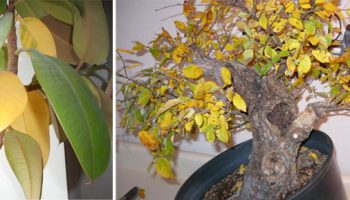
| The greenery turns yellow and falls off. | There is increased dampness in the room. | Ventilate the room regularly and maintain a comfortable temperature. |
| The stem dries out and becomes wrinkled. The leaves wither. | Drying out of the soil. | Water more often. |
| The tips of the leaf blades turn brown. | Overwatering. | Water according to recommendations. |
| During the season, foliage grows slowly. | Lack of nutrients. | Feed in spring and summer. |
| The greenery is wilted and drooping, and a darker shade than it should be. | Poor lighting. | Move the pot closer to the window or create additional lighting using lamps. |
| Soft plaques form on the trunk. The shoots soften, and the rhizome rots. | Constant moisture. Water getting on the barrel. This is exacerbated by low temperatures. |
|
| The lower leaves dry out and fall off, but new greenery grows quickly. | A normal phenomenon. | Everything is fine. The bush is healthy. |
| The trunk has softened. | Rotting due to excess water. | When the trunk rots, the beaucarnea dies. |
Diseases, pests
The plant rarely develops diseases. Because of its tough leaves, it is rarely attacked by pests.
Sometimes the following insects may appear on it:
| Pests | How to determine | How to get rid of |
| Scale insect | When infected by adult insects, brownish plaques form. Leaf blades become deformed and may turn yellow. | Spray with Aktara, Actellic, or Fitoverm. Best done outdoors, as these products are toxic. |
| Spider mite | The pest pierces the leaves to access the sap. Small punctures appear, and the foliage becomes covered in a web. | |
| Mealybug | The presence of white, cottony lumps. The bush weakens and turns yellow. The foliage wilts and falls off. Growth stops. |
Top.tomathouse.com recommends: Nolina – harmony in the home
The plant symbolizes strong family relationships.
There's a belief that the beaucarnea brings benefits to the home: harmony reigns. Residents become less aggressive, and there's complete understanding between them.
It is recommended to place a pot of nolina in the hallway or living room.