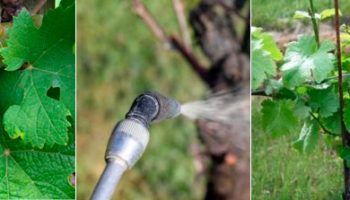
Grapes are a fruitful tree grown in many countries. Research is underway around the world to improve the flavor of their berries and increase their yield. However, this is pointless unless the plant is healthy. Treating grapes for pests and diseases in the spring will help prevent these problems.
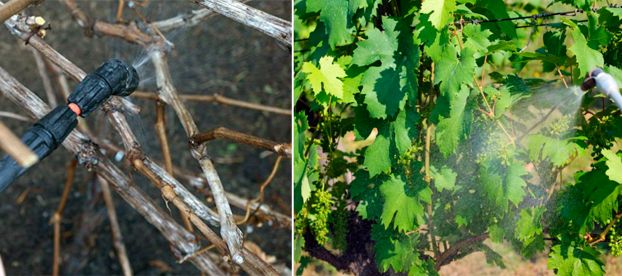
The need for processing grapes in spring
Spring treatment is necessary to prevent diseases and pest activity.
It is easier to prevent a problem than to spend a lot of time and effort to fix it later.
If the crop was treated in the spring, this doesn't mean that treatment won't be necessary in the summer. However, preventative measures reduce the risk of diseases and pests and increase the yield.
Processing can be carried out using:
- spraying;
- watering the soil around the bush, followed by loosening (13-15 cm), mulching with peat or compost.
You can use folk recipes, biological preparations, and chemicals.
The use of the first two options is advisable only for preventive purposes or in case of minor damage to grapes by diseases or pests.
In advanced conditions, you cannot do without chemicals.
Diseases
Grapes are most often attacked by fungal diseases that affect the berry vine. The spores survive the winter on plant debris.
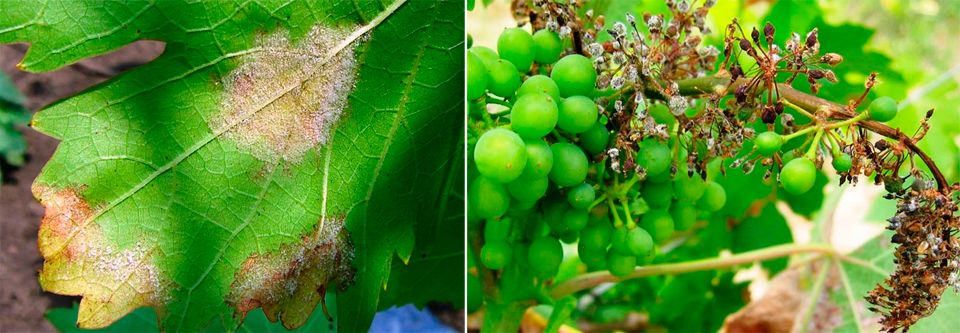
Moreover, they don't die at low or high temperatures. As soon as optimal conditions are created, the fungus begins its life cycle. Common and most dangerous fungi include:
- Downy mildew (mildew) – when affected, oily spots appear on the leaves. These quickly spread. It occurs due to high humidity. If left untreated, the grapes will die.
- Powdery mildew (oidium) is the main symptom: a grayish coating on the above-ground parts of the tree. Due to this infection, the berries crack, exposing the drupes.
- Anthracnose causes brown spots to appear, causing the foliage to die and fall off.
- Black rot, a pathogen that invades during flowering, attacks leaves as necrosis and destroys fruit. It is extremely dangerous for grapes; without treatment, they will die within 2-3 days.
- Gray mold most often affects young shoots and vines, destroying the harvest. It occurs due to planting density.
- Bitter rot is a black, ashy fungus that develops in the cracks of berries that come into contact with the soil. Wine made from these berries acquires a bitter taste.
- Black spot (marsonina) - appears in early summer as dark spots on the leaves, the berries darken, and the wood rots.
Mistakes in care can predispose to disease. If the disease has been cured, future cultivation conditions should be reviewed.
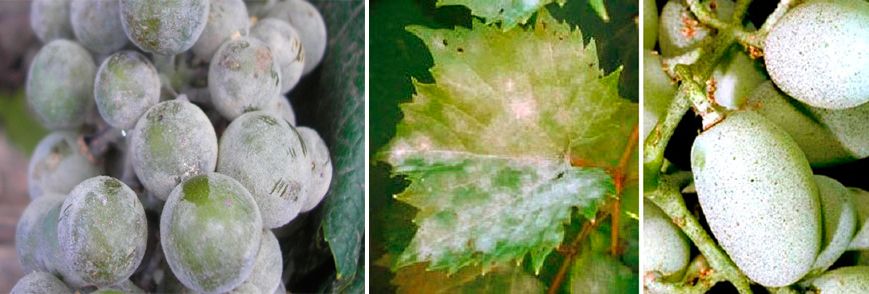
However, varieties have been developed that are resistant to the listed diseases.
Pests
Insects wait out the cold in fallen leaves and dense plantings. Individual pests won't harm grapes. However, they multiply quickly and, without treatment, will destroy the bush. Affected trees become weakened, making them susceptible to disease.
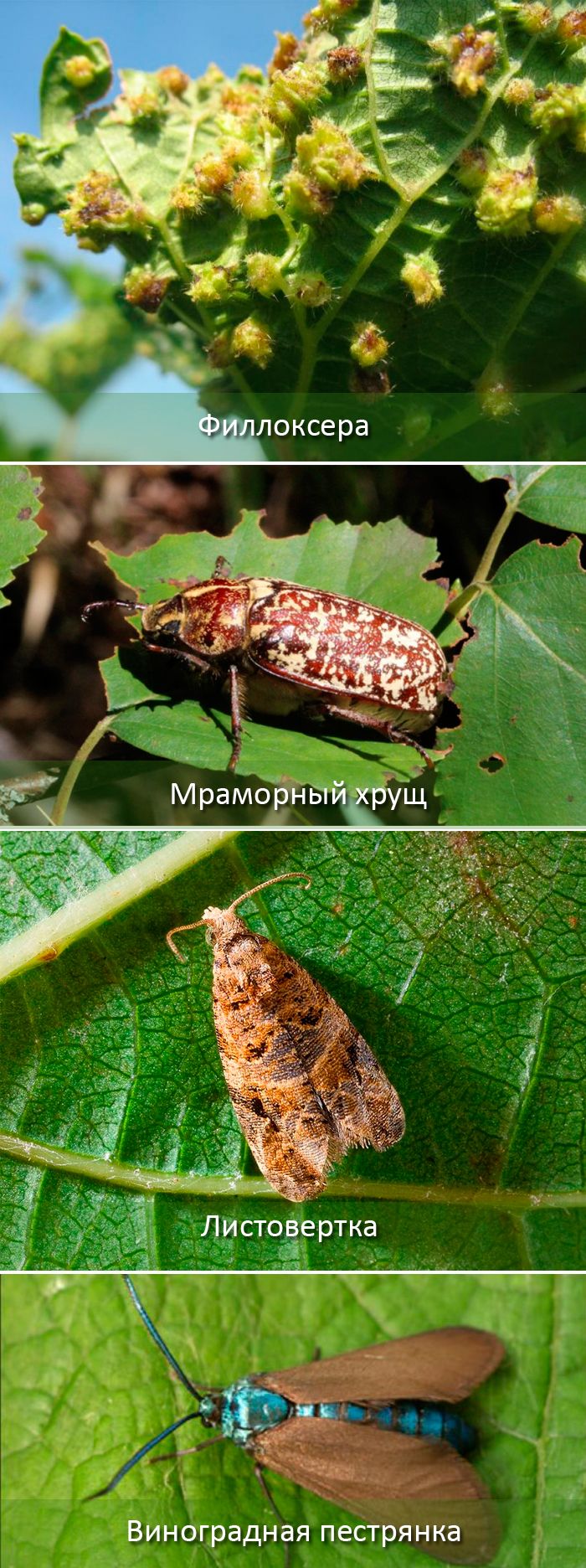
The most dangerous pests:
- Phylloxera is a microscopic insect, somewhat reminiscent of a dark aphid. It lives on the soil surface, sucking the sap from the rhizomes, which triggers the development of bacterial and fungal diseases. This pest is difficult to eradicate, so protection is essential.
- The marbled beetle is a large beetle (up to 3 cm) with a dark brown color. The larvae are particularly dangerous, infecting roots up to 300 cm long.
- Leaf rollers are caterpillars that eat buds and berries. Infestation can be identified by the webbing on young tree shoots.
- The grape variegated moth is a greenish-blue flying insect that breeds in high humidity. Its larvae feed on buds and leaves.
- Leafhoppers are jumping butterflies that feed on plant sap. This causes weakening and the spread of viral and fungal infections. In just one season, this pest can destroy all crops in a garden. They nest in plant debris and dense plantings.
- Spider mites are microscopic insects, virtually impossible to spot with the naked eye. They suck sap from young branches and leaves. They become active during dry weather and moisture shortages. Affected trees shed their leaves and wither. Spider mites can be identified by the fine webbing between leaves, bunches of grapes, and flat plaques on the underside of leaves.
- Wasps pollinate during the flowering period, but become pests towards the end. They feed on the berries, which hinders harvesting and spoils the fruit.
- Slugs and snails eat greenery and impair photosynthesis. They appear when there is excessive moisture.
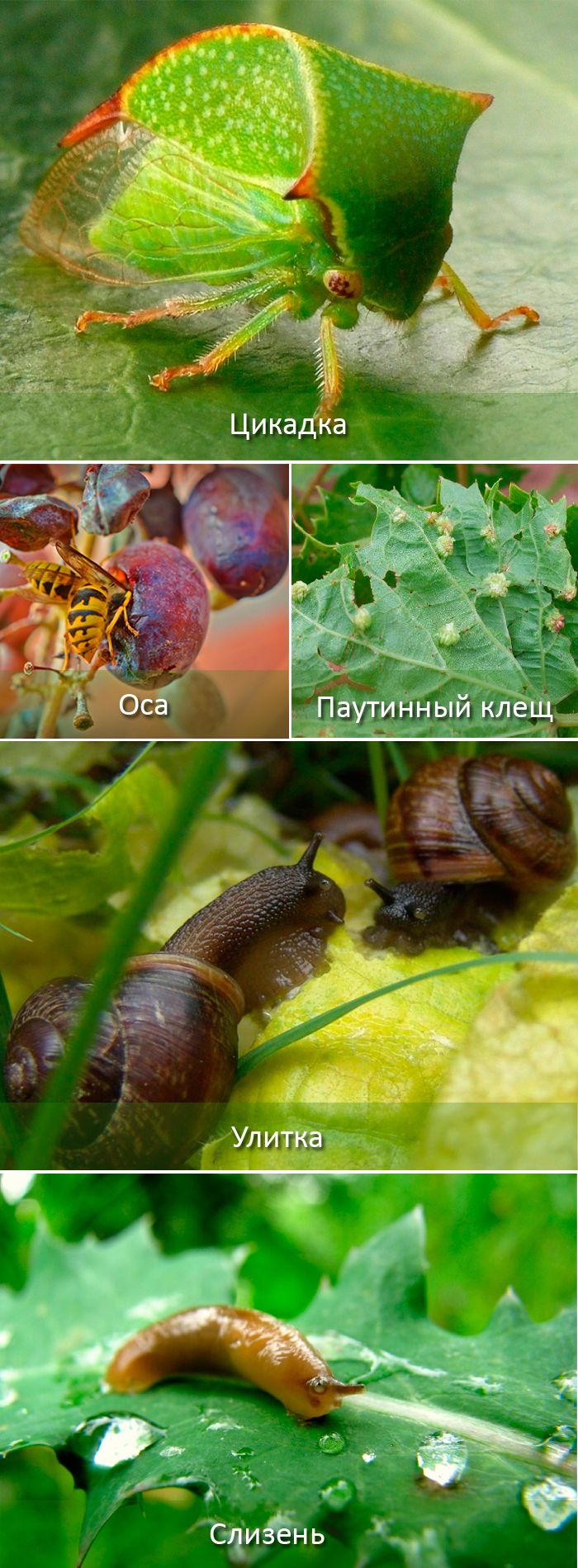
Eradicating these pests can be quite difficult. In most cases, the use of toxic pesticides is necessary, which is not ideal for fruit trees.
The procedure for spring treatment of grapes, rules for the use of preparations
Grapes are usually covered for the winter. In the spring, when temperatures stabilize, the tree is gradually uncovered and the branches are tied up. After the cover is completely removed, preparations for the upcoming season begin:
- After wintering (April 1-15 in central Russia, March in the south), treat with fungicides. Repeat the treatment after a couple of weeks.
- The second spraying is done in the second half of May, before flowering. Insecticides are used against insects and fungicides against diseases. If the tree has been infested with parasites, the treatment should be repeated after 10-12 days.
- The last spraying is carried out after flowering with contact insecticides and fungicides.
No treatments are allowed during bud formation. Treatments are carried out throughout the summer as soon as lesions are detected. A final treatment is carried out in the fall after the foliage has fallen.
How to treat grapes in spring against diseases and pests: 32 best products
| Medicine, folk recipe | Cooking standards | Diseases, insects | Processing |
| Abiga Peak | 40 g/10 l. | Downy mildew, powdery mildew, bitter rot, marsonina. | At all stages. |
| Albite | 3 ml/10 l. | Powdery mildew. | — Before the emergence of flowers. — During fruit formation. |
| Baktofit | 10 ml/10 l. | At all stages, every 1.5-2 weeks. | |
| Bordeaux mixture | 3-4%. | Downy mildew. | Irrigation before and during bud formation. |
| But | 0.15. | Oidium. | Triple spraying during the growing season with a frequency of 10-12 days. |
| Buzzer | 0.5-0.75. | Mildew, marsonina. | Spraying at all stages. |
| Cumulus | 6-8. | Powdery mildew. | Apply when symptoms appear. The minimum interval between sprayings is 10-12 days. |
| Cuproxate | 5-6. | Mildew. | Irrigation during the growing season. |
| Cuprolux | 25-30 ml per 10 l. | Spraying at all stages. | |
| Medea | 0.8-1.2. | Powdery mildew, rot, marsonina. | When symptoms of diseases appear at intervals of at least 1-1.5 weeks. |
| Hom | 15-20 g/10 l. | Mildew. | — If symptoms are detected at least 10 days before flowering. — Late flowering. — Appearance of fruits. - When the berries reach the size of a pea. |
| Rapid | 2.5. | Treatment during the growing season with a frequency of 1.5-2 weeks. | |
| Profit Gold | 4 g/10 l. | At all stages. | |
| Sporobacterin | 20 g per 100 sq.m. | Mildew, powdery mildew, gray mold. | Treatment during the growing season. |
| Skor | 0.3-0.4. | Oidium, marsonina and black rot, rubella. |
— At the budding stage. — Before the fruits of the bunch close. — Then every 10-14 days. |
| Strobe | 0.15-0.2. | Oidium, downy mildew. | Irrigation during the growing season. Used in conjunction with other fungicides, except strobilurins. |
| Topaz | 0.4. | Powdery mildew. | During vegetation. |
| Thiovit Jet | 30-50 g per 10 l. | Triple spraying during the growing season. | |
| Homoxyl | 15-20 g per 10 l. | Mildew. |
— If spots are detected during budding or as a preventative measure 1.5 weeks before flowering. - After the petals fall. — When berries appear. |
| Horus | 0.6-0.7. | All types of rot. |
— The beginning of flowering. — Before picking berries into bunches. — The beginning of fruit coloring. |
| Copper sulfate | For the first treatment - 300 g per bucket of water, for subsequent ones - 100 g. | Fungal infections. | At any time except the flowering period. |
| Ferrous sulfate | 500 g/10 l. | Downy mildew, anthracnose. | After removing the cover, before the buds appear. |
| Ridomil Gold | 10 g/4 l. | Mildew. | When symptoms of the disease occur. |
| Quadris | 60-80 ml/10 l. | Mildew, powdery mildew. | Before and after flowers appear. |
| Colloidal sulfur | 40 g per bucket of cool water. | Before the buds open. | |
| Vermitek | 5-8 ml per 10 l. | Ticks. | Early in spring, during the period of bud swelling. |
| Bi-58 | An ampoule per bucket of water. | Spider mites, felt mites, aphids. | Use during the growing season immediately after preparation, otherwise the substance will no longer be effective. |
| Actofit | 20 ml per 10 l. | Leaf roller, spider mite. | When symptoms appear. |
| Trichodermin | 50 ml/10 l. | Active against more than 50 different lesions. |
— Opening of the kidneys. — 3 weeks after the initial treatment. Recommended for use after precipitation. |
| Fitosporin | 15 ml/10 l. | Fungal and bacterial infections. |
- During the unfolding of leaves. — After the buds have faded. |
| Mikosan | 100 ml/4 l. | Mushrooms. | When the first leaves are forming. Not for use with other biological products. |
| Ecogel | 10 ml/1 l. | Fungal and bacterial infections. | — Water at the roots until greenery appears. — Spray after the leaves have formed. |
5 folk remedies for treating grapes against diseases and pests in spring
| Medicine, folk recipe | Cooking standards | Diseases, insects | Processing |
| Iodine | Bottle for 5 liters of water. | Gray rot. | When the leaves appear. |
| Garlic infusion |
Pour 0.5 l of water over 50 g of crushed heads. Let it brew for several hours. Bring the volume to 1 l. |
All types of mites, scabies. |
— Early spring. — A few days before flowering. |
| Milk solution | 1 l low-fat milk/10 l water. | Powdery mildew. | During vegetation. |
| Laundry soap and ash | Dilute the ratio 1 to 1 in a bucket of cool water. | Diseases and pests at an early stage of damage. | |
| Infusion of onion peels | Pour 0.5 bucket of the component with water. Simmer over low heat for 20-30 minutes. Let it brew for 24-30 hours. 4. Strain. Add 1 tbsp. honey. Mix thoroughly. |
Most insect pests. | Before and after color set. |
Beginners don't pay enough attention to spring protection. This is a huge mistake. Preventative measures not only reduce the likelihood of pests and various diseases, but also make plants more resilient to adverse environmental conditions.
When using any product, it's important to follow the dosage exactly. Otherwise, not only will they be ineffective, but they could also be harmful, especially chemicals.