Every gardener knows that proper and timely cherry tree pruning ensures abundant fruit production and health. However, this plant, compared to apple trees and other fruit trees, requires much more attention, as it is a heat-loving tree and does not tolerate even the slightest frost.
The need for pruning
Pruning is necessary to ensure:
- correct crown formation;
- growth control;
- rejuvenation;
- removal of dried branches;
- improving crop yields;
- prevention of disease development;
- protection from insects.
To prune correctly, it's important to consider the flowering and fruiting periods, as well as distinguish between generative (flowering) and vegetative (growth) branches, as new shoots emerge from the latter. It's also important to consider the plant type, as pruning methods for tree and bush cherries differ.
Selecting a season
Cherry trees are pruned in the spring only when there is no risk of nighttime frost. March to early April is considered the best time.
In the fall, fruit trees are pruned only after the fruiting period has ended. The end of the growing season varies by region. Furthermore, the weather outside should be sunny and clear. The end of the growing season is related to temperature; in the south, the plant bears fruit much longer than in the north.
Pruning is not carried out in summer, except in cases when the plant is affected by disease.
Features of spring pruning
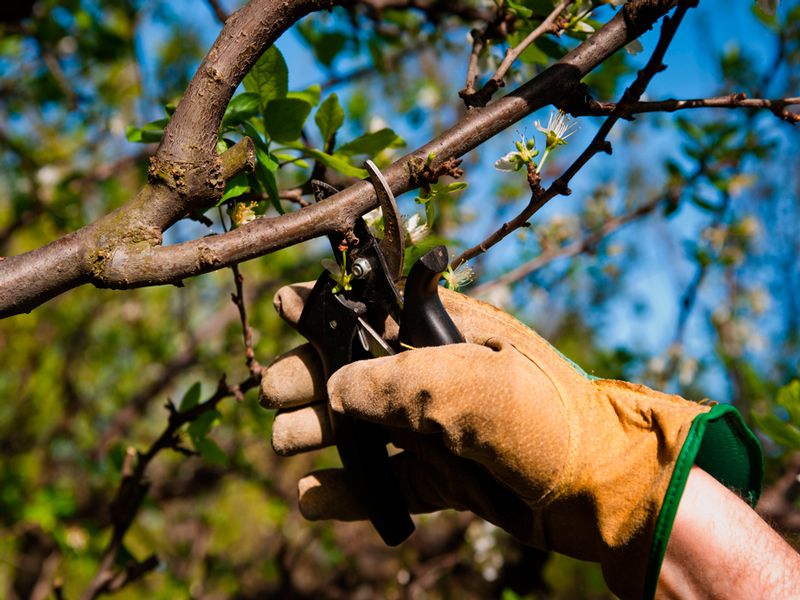
Spring pruning is considered crucial for plant formation. Since cherry trees are heat-loving, branches are pruned immediately after the buds swell. For effective spring pruning, follow these steps:
- Tools are being prepared: pruning shears, scissors.
- Branches that could cause the crown to become dense are removed. Those growing upward are pruned back to the base, leaving branches that extend parallel to the ground.
- The trunk is cleared of diseased and old branches - they draw all the nutrients and juices from the plant, without bringing any benefit.
- If shoots are less than 30 cm long, they are left alone; only branches that interfere with the growth of the remaining branches are removed. Next, the trunk needs to be trimmed; its height above the tree's frame should be about twenty centimeters.
The procedure is carried out before the beginning of the growing season, otherwise the plant will become ill and will take a long time to recover.
Much more time is devoted to pruning felt-type cherries. In the first year, the plant is shortened by half a meter, and in the second year, approximately 25% of the lateral branches are removed. This type of cherry has a dense crown and does not bear fruit, so scaffold branches should be left and shortened only by 10 centimeters, while the remaining shoots are pruned to the ground.
Features of summer pruning
During the growing season, any damage to the shoots takes a long time to heal, so cherry trees should only be pruned in the summer if they are diseased.
Occasional pruning of interfering shoots is permitted, but their removal should only be done if signs of disease are present. Affected branches should be immediately cut off and burned to prevent the disease from spreading to healthy ones.
Features of autumn pruning
Pruning cherry trees in the fall allows them to prepare for winter more quickly. Timing depends on the region's climate. In the south, pruning is done before November, and in the north (Siberia), until the end of September.
However, novice gardeners should be aware that fall pruning should not be performed on young trees, as it weakens them. As a result, the cherry tree will not survive the winter.
Tree pruning scheme in autumn:
- All branches that interfere with the development of other shoots are removed. Skeletal branches (primary branches, extending from the tree trunk) responsible for crown formation are retained.
- Weak shoots are left untouched, as it is recommended to remove them in the spring.
- An overly powerful vertical shoot is reduced to the size of those located on the side.
All cut areas are coated with a resinous substance to speed up healing. When pruning a plant in the fall, be sure to take the time when sap flow is slow and the cold weather hasn't arrived. If pruned shoots are exposed to frost and branches dry out, the tree may become diseased.
How to prune?
The specifics of pruning vary depending on the age and shape of the cherry tree.
Differences by age
The main principle for cultivating newly planted trees is to create a proper crown. Seedlings are virtually immune to disease, and pruning to remove susceptible branches is unnecessary.
When planting cherry trees, the branches are pruned immediately, leaving only the 5-6 strongest. It's preferable for the remaining branches to face in opposite directions—this promotes a spreading crown.
For two-year-old seedlings, remove branches about half a meter long. These can be shortened by a third, and then the shoots that lean toward the ground are pruned. For trees 80 centimeters tall, the branches are shortened to the buds. Using a tool with a sharp blade is recommended.
During fruiting, the cherry tree becomes depleted and ages more quickly, so the branches are cultivated. Through constant sanitation, the tree stops depleting itself.
When pruning old trees, the main task is to remove diseased and dead branches that prevent new shoots from forming. These steps are essential to prevent disease and the death of the cherry tree. If the trees have any branches that are bending or hanging downward, they should also be removed.
Differences in shape
When pruning a tree, branches located below 70 centimeters above the ground are removed. They are cut at an angle, eliminating intertwining branches. The crown is shaped into a vase. New shoots are shortened slightly to encourage new branches and lateral branches. The height of such a tree should be at least 3.5 meters.
If the plant is a shrub, it requires careful pruning. Branches located below the crown should be at least 40 degrees in relation to the trunk to prevent future fractures. Pruning branches that compete with the main trunk will help create a strong skeleton.
Cherry tree care is challenging. However, with proper spring and fall pruning, you can prevent the development of various diseases and, therefore, avoid the need for treatment.
Pruning can improve the health of a tree, clean the crown, increase yield, and prevent infestation by various pests.