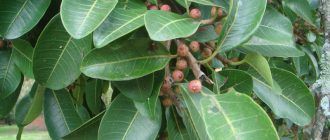
Oleander is a shrub belonging to the Apocynaceae family. It is native to subtropical countries such as Morocco, Portugal, and southern China.
Content
Description of oleander
Oleander is a large, branched, evergreen shrub, reaching a height of 4 m. Long, pointed leaves with a glossy surface are located on brown branches.
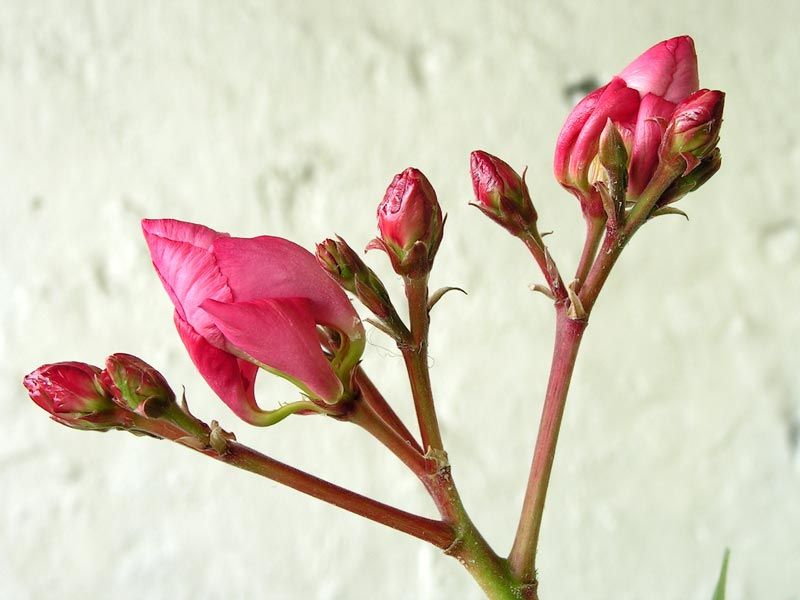
The plant produces large flowers of varying colors and shapes. They form inflorescences. The flowering period typically occurs between summer and fall.
Types and varieties of oleander
The main types of oleander are:
- Ordinary.
- Fragrant.
- Indian.
Each of them is further divided into varieties, the largest number of which are found in the common oleander.
| Variety | Description |
| Light pink varieties | |
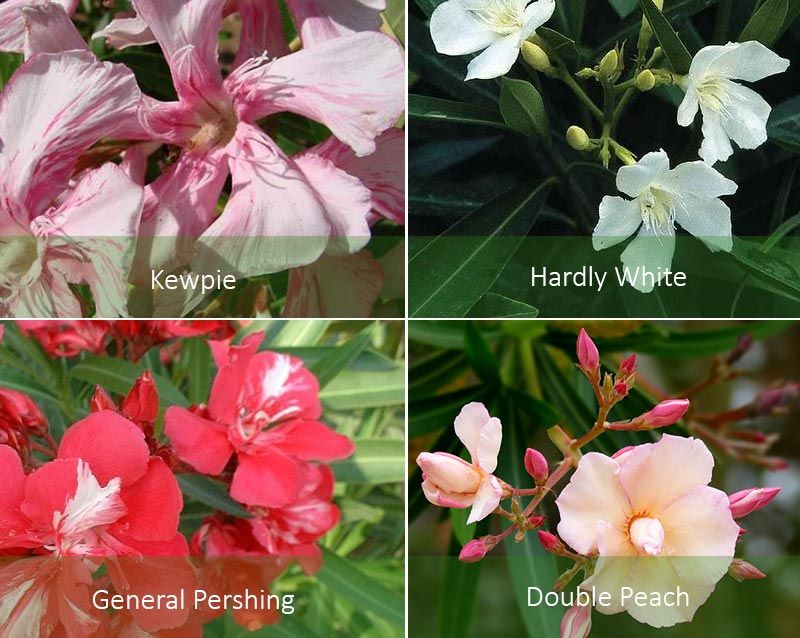
| Kewpie | The flower shape is simple. The color is cream with a pinkish tint. |
| Double Peach | It is distinguished by a large number of petals and a delicate coral hue. |
| Martha Hanna Henslee | The edge of the petal is embossed and has bright pink veins on a paler background. |
| Bright pink varieties | |
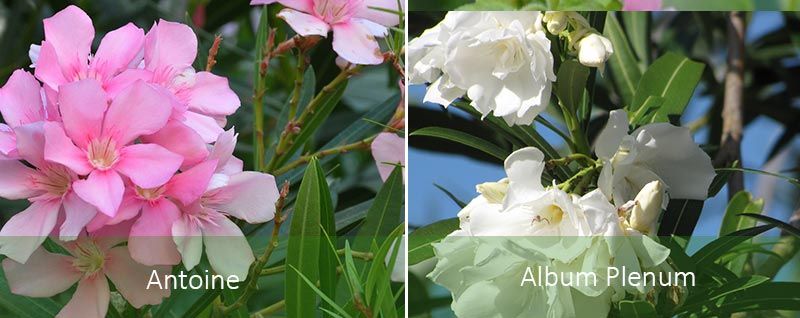
| Antoine | The flowers have a pointed tip and rich red stripes on a bright pink background. |
| General Pershing | Lush, pink with white stripes. |
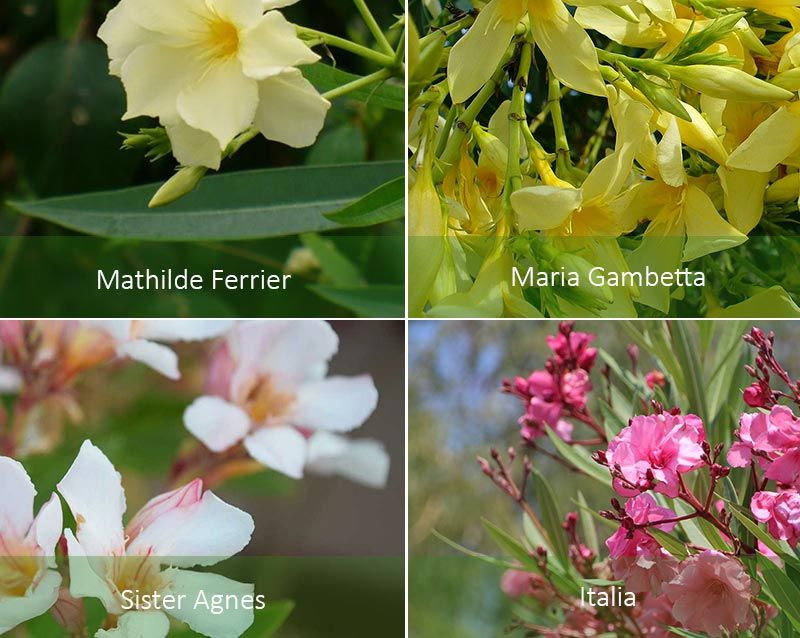
| Italy | The red-pink petals curl inward. |
| Whites | |
| Hardy White | They have a simple form. |
| Sister Agnes | The edge of the flower is wavy. |
| Album Plenum | They are distinguished by a white-yellow center and double inflorescence. |
| Orange-peach | |
| Sherrie Allen Turner | The shade is light orange, turning into a more saturated middle. |
| Angiolo Pucci | A soft orange with a richer center. |
| Miss Roeding | They are distinguished by their splendor and coral hue. |
| Reds | |
| Blue Blanc Red D | Variegated red and white flower. |
| Cherry Ripe | They have a white pistil and bright amaranth petals. |
| Rubis | They are distinguished by their terry and uniform coloring. |
| Yellow | |
| Maria Gambetta | The flower is lemon-colored. The hue is unevenly distributed, becoming darker toward the center. |
| Luteum Plenum | The flower is double, light yellow. |
| Mathilde Ferrier | The distinctive feature of this variety is the ribbed edge and pointed tip of the petals. The color is yellow-saffron. |
The intricacies of growing and caring for oleander at home
Caring for the flower at home is quite simple. Oleander requires:
- Sufficient amount of sunlight.
- Ventilation of the room, which will provide a constant flow of fresh air.
- Abundance of moisture.
- Experts advise growing the plant with care, due to the toxic sap in its leaves and stems.
Location and temperature
This species should be placed on a south-facing surface. Otherwise, it will shed its leaves if it lacks sunlight. The plant's comfortable summer temperature averages 25°C (77°F). In winter, it can withstand temperatures as low as -5°C (23°F).
To give the bush a “rest” during the winter, you should create comfortable conditions for it – put it on the balcony as soon as autumn ends.
Oleander has low frost resistance. This is due to the bush growing in southern latitudes. The minimum temperature for the plant is -5 to -10°C.
Watering
Water regularly—the shrub thrives on moisture. However, water only after the soil has dried out slightly. Be careful, as allowing the soil to dry out excessively can be detrimental to the root system.
The water should be warm and settled. Ideally, its temperature should be a couple of degrees higher than the room temperature where the plant is located.
During hot summer weather, in addition to watering directly into the soil, you can also leave water in the tray. This will prevent the leaf tips from drying out. When it's cloudy, drain the container.
Soil and fertilizer
Growing the plant requires soil with a neutral pH. Slightly alkaline soil is also acceptable.
It's worth keeping in mind that the shrub requires regular feeding, especially when it's actively growing. During this period, it's recommended to apply fertilizer twice a month. Organic fertilizers will stimulate foliage growth and inhibit flowering. However, mineral supplements are beneficial for oleander. Fertilizers should be applied in the evening.
Spraying
The plant is easy to spray. This procedure is generally not necessary in spring, summer, and fall. However, it should be done in winter, as excessively dry air causes leaf tips to dry out. Spray once every 7-10 days. Use water that's warmer than the room temperature.
Transplantation, pruning
A bush needs to be replanted in the following cases:
- After the planted cutting reaches the required parameters.
- When the dimensions of the plant no longer correspond to the size of the pot.
After transplanting, intensive watering is necessary.
The plant requires regular pruning. Immediately after flowering, it's best to reduce the length of each branch by half. The following season, the end of the new, rapidly growing shoot will produce a flower. A cutting from an oleander branch can be used as a cutting for planting.
Reproduction
To grow a new plant, you can plant seeds purchased from a specialty store. However, this process is fraught with certain difficulties, including poor germination, the need for pre-planting treatment, and the need for specific conditions for germination.
For this reason, cuttings are the most common method of propagation. To do this, use a sharp knife to remove a 15-cm-long branch with four buds. This is done during the off-season. Afterward, the cut should be sprinkled with charcoal. This will prevent rot and disease.
Next, the cutting is placed in a mixture made of equal parts humus, turf, and sand. It's important to create comfortable conditions for the plant—a constant temperature of 21°C and slight humidity. It's important to avoid retaining moisture in the soil to prevent rot. Once 4 or 5 leaves appear on the branch, the oleander should be transplanted to its permanent location.
It is important to remember that the flower is poisonous, so any contact with it should be protected with gloves.
Potential difficulties in caring for oleander, diseases, pests
Oleander is rarely attacked by pests and diseases. However, if they do occur, they are typically affected by mealybugs, spider mites, scale insects, oleander canker, and fungal diseases (sooty mold, gray mold, leaf spot). These diseases can be treated with both commercially available treatments and folk remedies.
To get rid of scale insects, use the insecticide Dicis and the non-systemic insecticide-acaricide Actellic, along with alcohol or kerosene. If using commercially available products, dilute 15-20 drops in 1 liter of water and spray the infested areas. Alternatively, soak a cotton swab in the solution and apply it to the areas where the scale insects have attached themselves.
The same procedure is done with kerosene or alcohol, provided that the disease is not in an advanced stage.
To be absolutely sure that the bush is infested with red spider mites, take a close look at the leaves. You may notice brown spots on the undersides. They can suck the sap out of the plant. Actellic will also work. The concentration is the same as in the previous case. However, if you don't want to deal with chemicals, you can try a folk remedy: simply wash the plant under water at 45°C. Oleander will tolerate this temperature, but the spider mite will not.
Oleander canker is incurable. It can only be prevented by proper plant care.
Spraying with a fungicide will help combat gray mold. Sooty mold should be removed from the leaf surface with a damp cloth. Leaf spot, however, requires cutting off (removing) the affected parts and adjusting the growing conditions to optimal conditions.
Top.tomathouse.com warns: Oleander – benefits or harm
Oleander contains ineriin and oleandrin, toxic substances that can cause severe intoxication. It's best to keep the plant in a special room in your home—a winter garden. Furthermore, the flowers have a faint scent that can cause insomnia and mild headaches.
Benefit:
- Perfectly purifies the air.
- It has bactericidal properties.
- Absorbs radiation.