Pachyphytum is a perennial succulent from the Crassulaceae family. The plant gets its name from the Greek words "pachy" meaning thick and "phytum" meaning leaf. It is native to South America and Mexico.
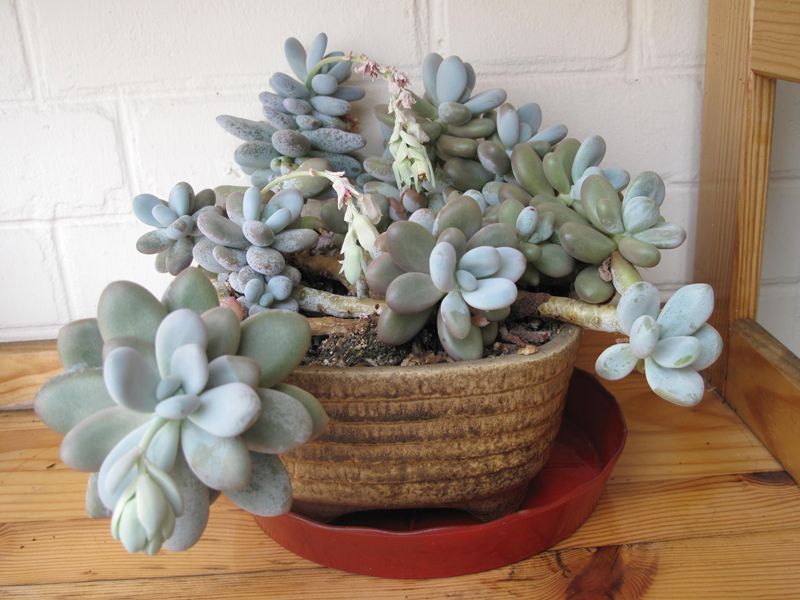
Description of Pachyphytum
The plant has a branched root system, but the roots are thin. The stem is creeping, with lateral branches. The foliage is sessile and short-petioled, rounded or cylindrical. The color is green-blue.
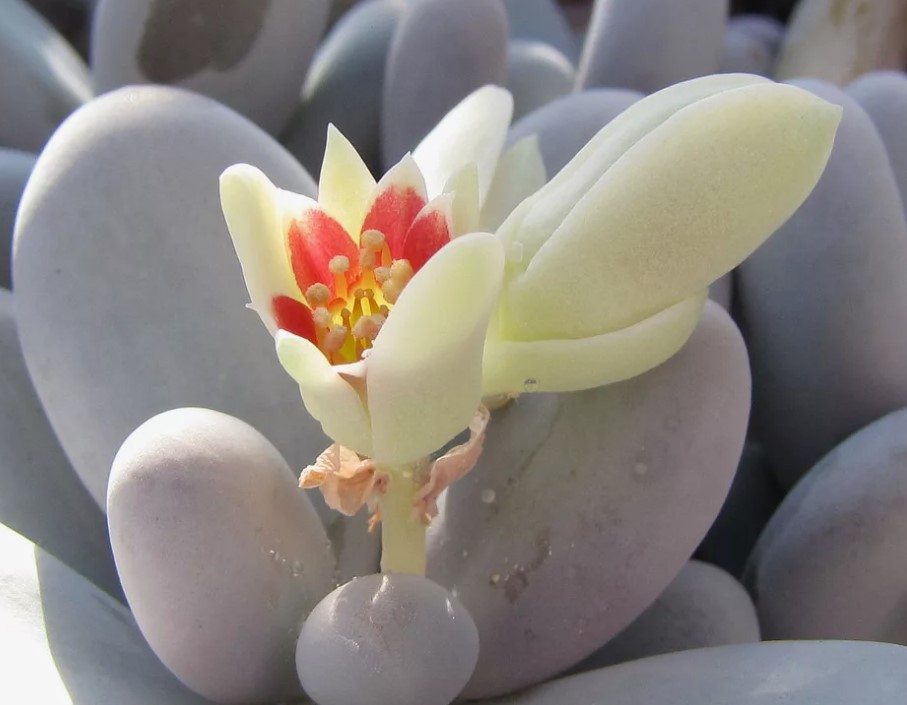
The peduncle is long and erect. The flowers resemble miniature bells, white, pink, or red. They have a subtle, pleasant scent.
Types of Pachyphytum
There are many different types and names of pachyphytums, but only the following are suitable for growing indoors:
| View | Description |
|
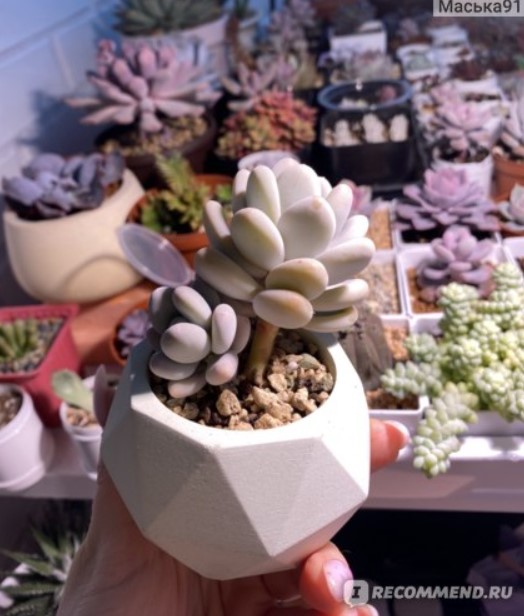
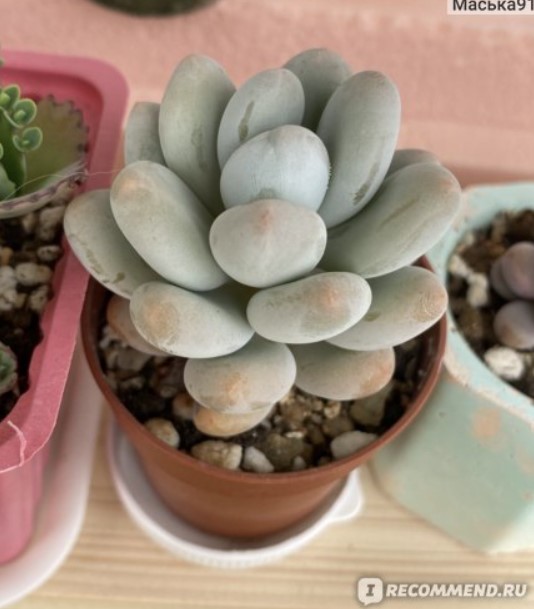
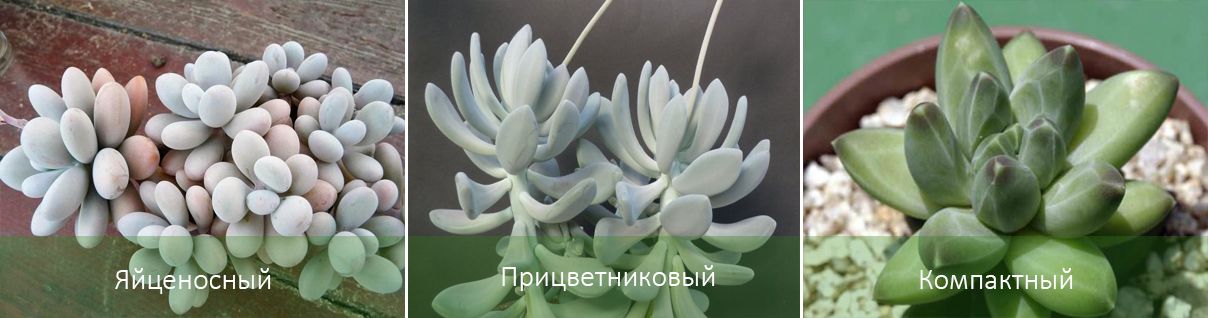
Oviparous (Pachyphytum Oviferum)
|
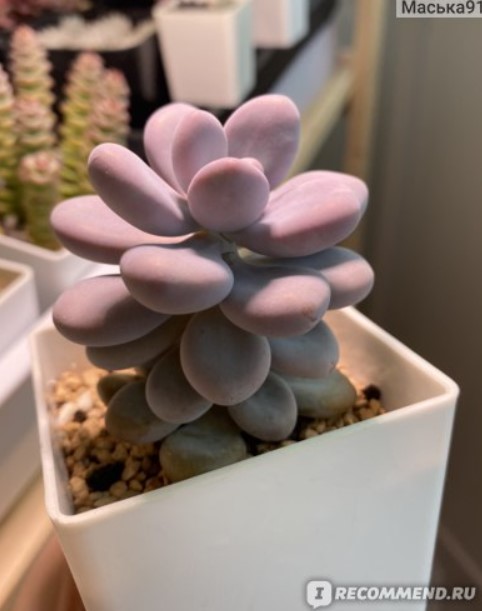
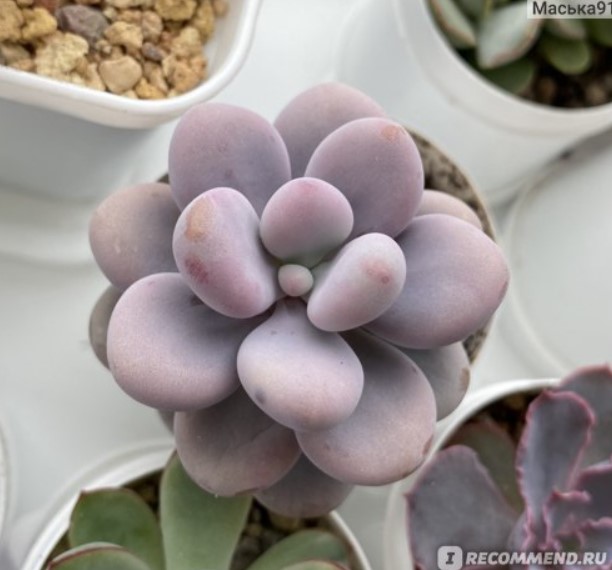
A shrubby plant up to 15 cm tall with a straight, dense stem. The foliage is blue-white with a slight lilac tint, up to 30 mm long, and has a waxy coating. The flowers are pale pink, sometimes speckled with raspberry.
Variety: Rubra - more pinkish leaves, with white-pink inflorescences.
|
| Bract (Pachyphytum bracteosum) 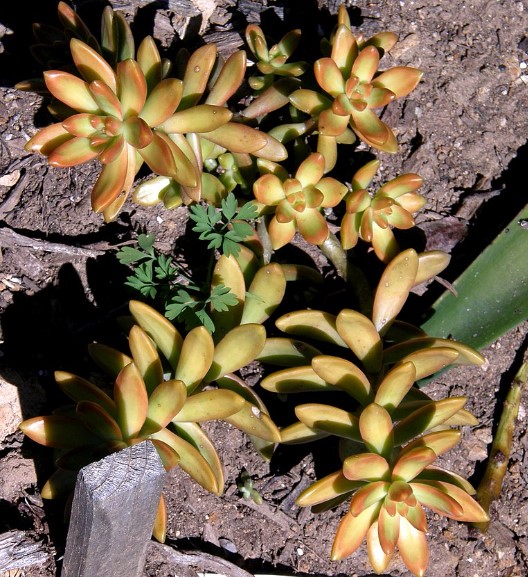 |
The stem is up to 35 cm tall. The foliage is dense and elongated, scarred, and has a visible light gray waxy coating. The flowers are deep pink and red. The shape is bell-shaped. |
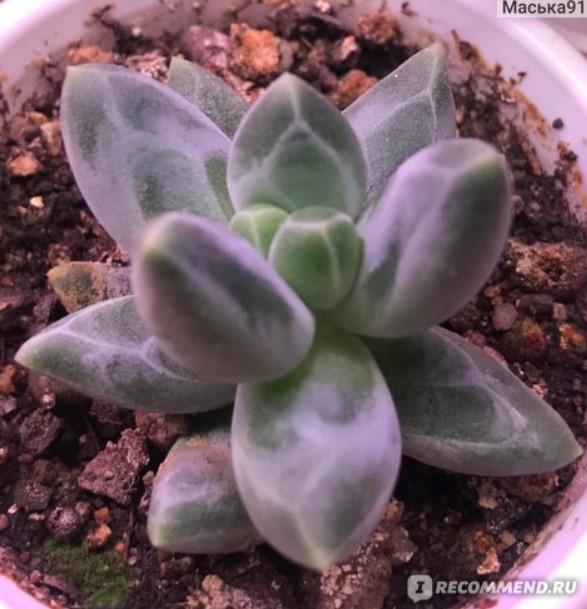
| Compact (compactum) (Pachyphytum compactum) 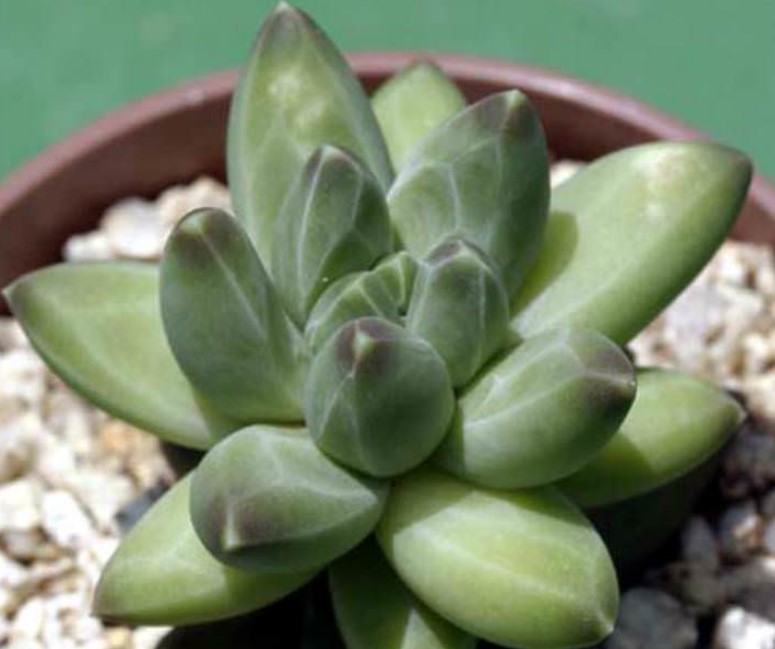 |
A low-growing succulent with a thick, fleshy stem. The foliage has a white, marbled patina. The flowers are small, pink with yellow highlights. The flower stalk reaches 40 cm in length. |
| Lilac
(Pachyphytum Lilacinus)
|
Height up to 20 cm. Shrub-like succulent with short stems. Pale green, oblong foliage. Medium-sized, deep pink flowers. |
| Gonzhou
(Pachyphytum ganzhou)
|
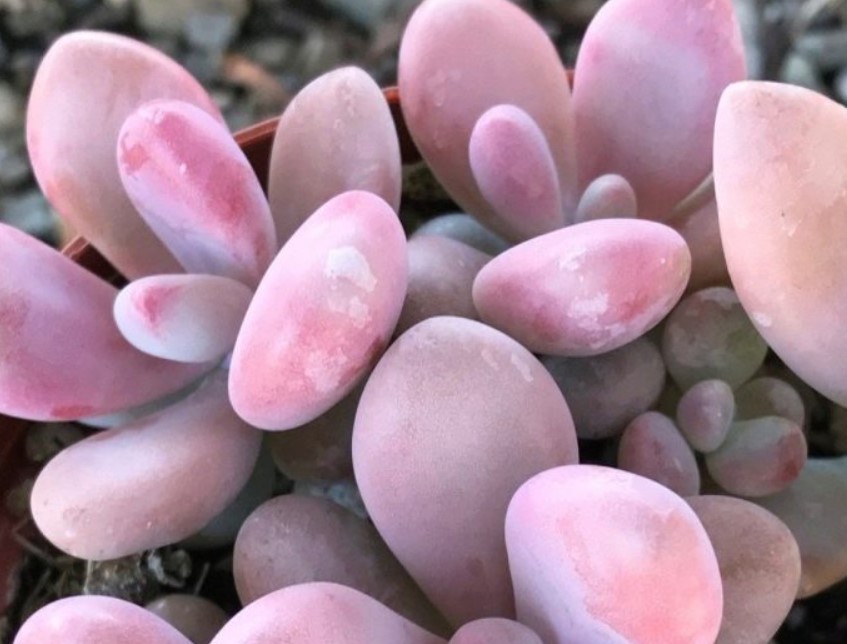
Leaves are pink. Rarely cultivated. |
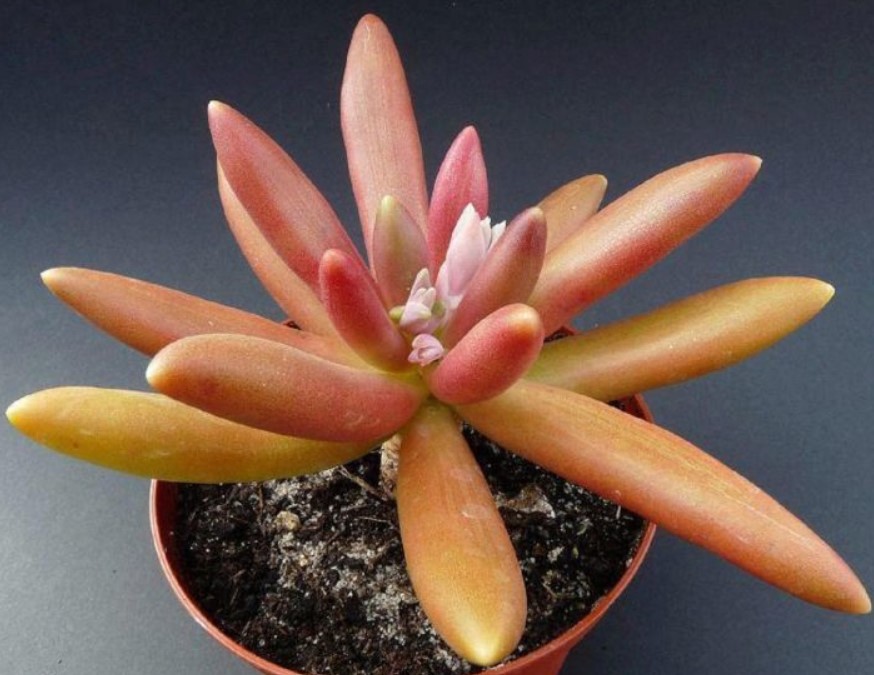
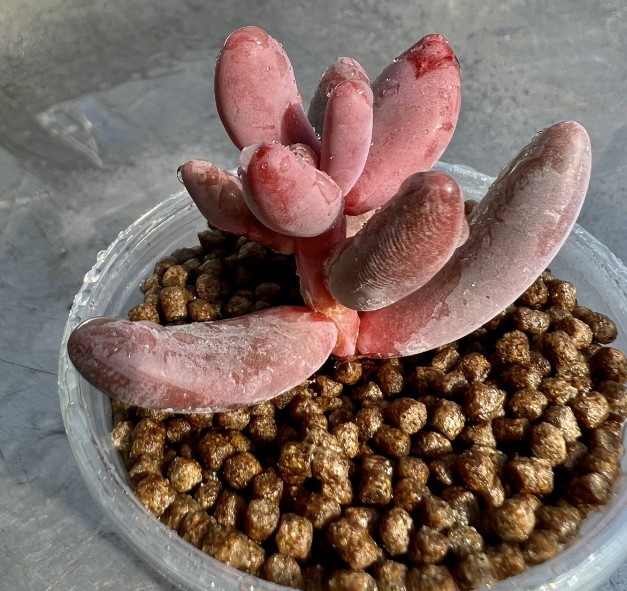
Methods for growing indoor pachyphytum, planting, and replanting
Succulents should be grown in small pots with large drainage holes. When planting for the first time, fill the bottom of the container with a drainage layer of pebbles and expanded clay. The soil should be neutral or slightly acidic. You can choose a soil specifically designed for cacti and succulents, or prepare your own substrate by mixing equal parts of turf, leaf mold, and river sand.
Replanting should be done in the spring every 1-2 years.
You can get a new houseplant by cuttings and planting seeds, but the second method is almost never used anymore.
Caring for pachyphytum at home
Pachyphytum care at home depends on the season:
| Parameter | Spring-summer | Autumn-Winter |
| Location, lighting | It loves light and requires bright light, so it is placed on southern windows. | |
| Temperature | +20…+26 °C. Ventilate frequently, can be taken outside. | +10…+16 °С. Is in a state of rest. |
| Humidity | It tolerates dry air well and does not require additional humidification. | |
| Watering | 2 times in 7 days. | Once a month. If the temperature is below 10°C, it is recommended to avoid watering. |
| Top dressing | Fertilizers with low nitrogen content are applied 3-4 times. | Not carried out. |
Diseases and pests
The plant is highly resistant to fungal diseases, but suffers from the effects of mealybugs. These insects suck the sap from the flower, causing it to become covered in a white web. The foliage dries up and falls off, the roots rot, and the sticky excretions of this pest are considered a breeding ground for sooty mold.
If signs of this pest appear, it is recommended to:
- Soak a cotton swab in the soapy solution and wipe the leaves, getting rid of larvae and adult insects.
- Spray the flower with one of the following infusions: garlic, tobacco, or calendula (available at pharmacies). Repeat three times, 7 days apart.
If the plant is heavily infested with pests, use insecticides. Suitable products include Actellic, Vertimek, and Admiral.
When using these products, remember that they are toxic, so they should not be sprayed indoors or without a respirator. Use the products strictly according to the instructions; failure to follow them could cost the plant its life.
Reviews of pachyphytum from gardeners
My sweet, beloved succulent survived the drought and severe frost. 💚
Good day and good mood to all!
So, today my review will be about this lovely and delightful plant—a Pachyphytum, a succulent that's been growing in my home for several years now. I bought this plant a long time ago at a regular store, in a small pot. To be honest, I wasn't really expecting it to survive (since I bought it in winter and it arrived home in relatively good condition, but I wasn't sure).
a genus of succulent plants of the Crassulaceae family.
Pachyphytum
After all, everyone knows it's best not to buy or choose plants before winter, for obvious reasons. But what's done is done. Back then, I didn't know its name or its characteristics. Only that it was a succulent, just like some of my other options. I just really liked the pachyphytum visually.Price at time of purchase: about 80 rubles per plant (including a seedling pot; the plant itself was very small at the time of purchase—just one branch).
Place of purchase: large supermarket, plant/flower care department.
PachyphytumPackaging: nothing extra, just a planting pot and the plant itself.
Since I already had succulents at home, including the famous money plant (or "crassula"), the question of care was immediately resolved, as the pachyphytum is just like many other succulents—it requires the same conditions. It can also be planted with other succulents (to create a "hill"), etc.Covered with a waxy coating of a bluish color.
Low (up to 50 cm), evergreen, bare perennial shrubs with thick, fleshy, sparsely branched stems with traces of fallen leaves.
I started by growing the pachyphytum in a small pot—all according to the rules for growing succulents, which can be found online and in gardening forums. It's also important to remember that succulents don't like excessive watering (they store moisture in their leaves) and should never be overwatered, but neither should they be left without water. The best watering method is dry air and infrequent soil watering.
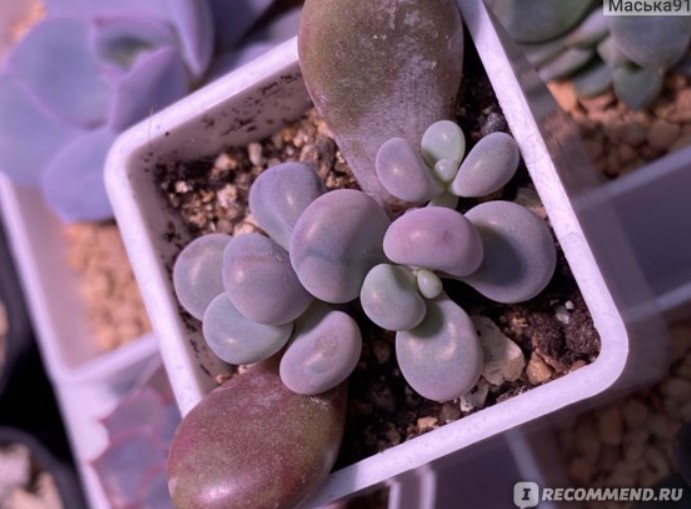
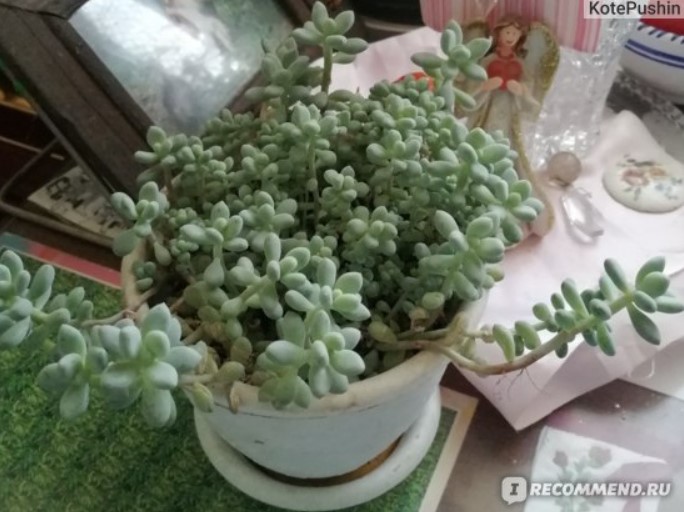
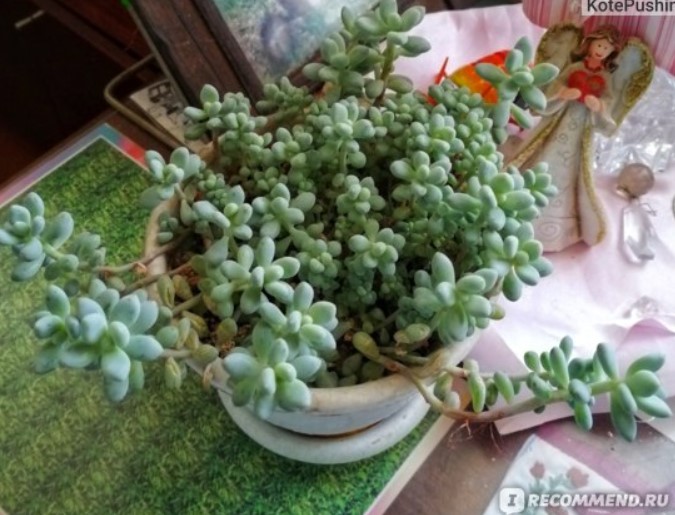
Pachyphytum in a pot
And most importantly, succulents really don't like the cold. More specifically, extreme cold. Some of my plants (unfortunately) didn't survive the winter and dry climate, especially the succulents, even though they weren't located very close to the windows.
But while it handled the drought relatively well and survived perfectly, the frost played a cruel joke on it. Of course, if its native Mexico, it's clearly not adapted to our climate, especially in winter, when the temperature outside is already -27-33°C.In winter, pachyphytum enters a dormant period and should be moved to a cooler location, where the temperature is around 16 degrees Celsius. However, ensure that the room temperature does not drop below 10 degrees Celsius to prevent the plant from freezing.
I once had to go away for a long time, and my succulents were not properly planted. The worst part was when it was cold, they were moved to a windowsill and that was it. Many died. But, strangely enough, only this pachyphytum survived. I had to prune it back severely, and almost nothing remained—just a twig (just like it was at the very beginning, not the full-grown beauty it was later). The twig didn't show much hope for survival either. I didn't bother and simply stuck it in a glass of water to let the roots grow (thinking: if it survives, fine; if it doesn't, I'm done with the succulent).
To my delight, this branch produced excellent roots (I didn't use any special root growth promoters) within two weeks, and then I replanted the succulent—this time in a regular pot, but one that was initially larger than the previous one. I simply left the plant alone—that is, I misted it periodically (and watered it sparingly, only when the soil was clearly dry). And the Pachyphytum reciprocated. Smile
This succulent also needs good drainage (water shouldn't stagnate and the soil shouldn't be wet—this will cause the plant to rot and die). I periodically add sand and small stones to the soil.It is recommended to water the plant with warm water in small amounts, just enough to moisten the soil. During the winter months, the pachyphytum should be watered less frequently, as the plant is dormant during this time.
As a result, I ended up with this lovely, spreading plant (I didn't prune it or shape it, I just waited for it to gain strength and grow into a pretty bush, when it got stronger, etc.). When it's cold, I move it away from the window (but don't deprive it of light—it needs plenty of light, as it promotes good growth). And when it's too cold, the same applies. It grows just as well in winter as in summer, but in frosty weather, I move it away from drafts and other sources when it's very cold, and then put it back out again when the cold subsides.
The best option for placing pachyphytum would be western and partially southern windows, protected from the midday sun in summer, or eastern windows in extreme cases.
Propagation was also easy—you can start from a leaf or a twig—the main thing is to get good roots, and then you just need to let the plant get stronger and everything will be fine. Smile
The flowers have five petals and are bell-shaped and tilted downward. They can be white, pale yellow, or pinkish-red. The flowers are surrounded by fleshy sepals, which have a waxy coating on their surface, like the plant's leaves. After flowering, small pods form, which contain the ripening seeds.
Hide quote
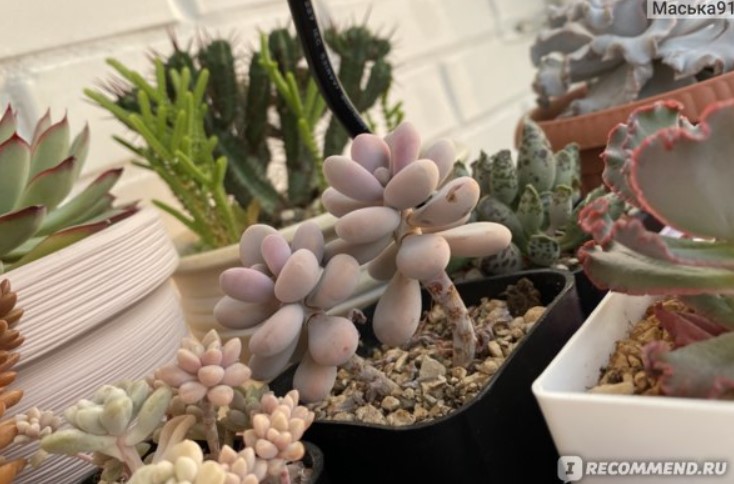
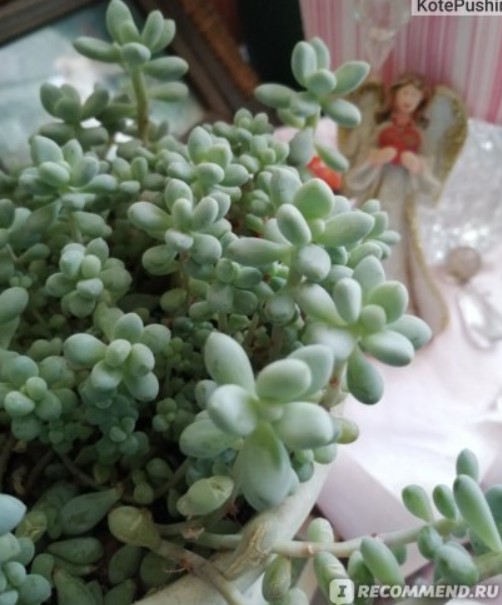
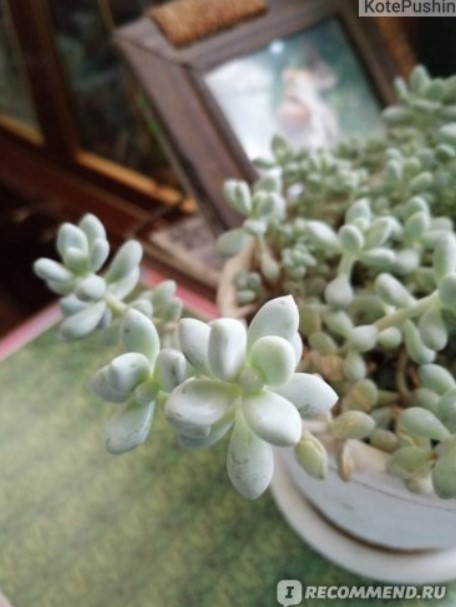
The branches and bushes themselves are a pleasant light green with a slight waxy coating that gives the plant a slightly blue tint. Or rather, it visually gives the plant that blue tint. The leaves resemble pebbles, fleshy and soft, and slightly oval in shape. There are several varieties of pachyphytum, so some plants may have wider and larger leaves, while others have smaller branches and leaves. It all depends on the specific variety, but they are all very cute and classy. SmilePros:
A pleasant and beautiful plant in its own way.
Complements other succulents perfectly.
Fairly easy to care for.
Growing quickly.
Suitable for home greenhouses and florariums.
It goes well in a hill with cacti.
Quite compact.
No need for heavy watering.
Withstands harsh conditions.
It has a pleasant delicate color and leaves.
Not too picky.
Will fit perfectly into any interior.
High adaptability.
Suitable for creating plant "hills".
More hardy than some other succulents.Cons:
It is not recommended to water with a shower - this can break fragile leaves or flood the soil.
They do not like heat (warmth or acceptable temperature, but not extreme heat) and extreme cold.
It hasn't bloomed yet (but they rarely bloom indoors).Pachyphytum in a pot (at home)
Conclusion: I absolutely adore this succulent. It fits into any interior, delights the eye with its delicate, soft greenery, is relatively easy to care for, and is one of the most hardy succulents. It's perfect for terrariums, rock gardens, cactus gardens, and other succulents. Delicate and sweet. I love it. I recommend it. SmileHappy shopping and positive vibes to everyone!
Advantages
Beautiful
Care is simple
KotePushin
recommends
My favorite plump ones🥰 I'll show and tell you about a small part of my succulent collection - Pachyphytum Oviferum, Moonstone Pink, Baby Finger and others🌵🩷
Greetings, dear reader! 🌵Two and a half years ago, the first succulents appeared in my house, and since then, my passion for these unusual plants has grown from an amateur hobby into a real professional endeavor.
My collection includes various succulents: echeveria, crassula, sedum, cacti, living stones, etc., however, pachyphytums occupy a special place on my shelves and in my heart.
Pachyphytums also belong to the Crassulaceae family, and are distinguished by plump, succulent leaves, often with a distinct bloom. The name "pachyphytum" is Greek for "thick-leaved."
My collection of pachyphytums includes the following varieties: oviferum/oviparous - this is the most common type, I recommend it for beginners, another unpretentious variety is pachyphytum compactum, which has interesting facets on the leaf.
P. oviferum
P. compactum
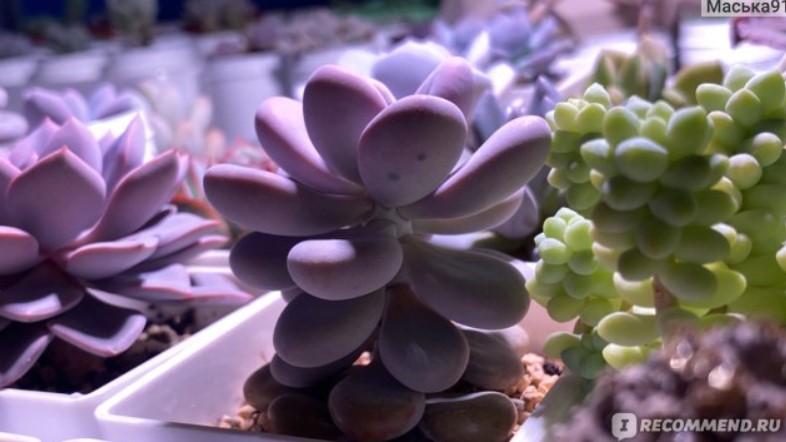
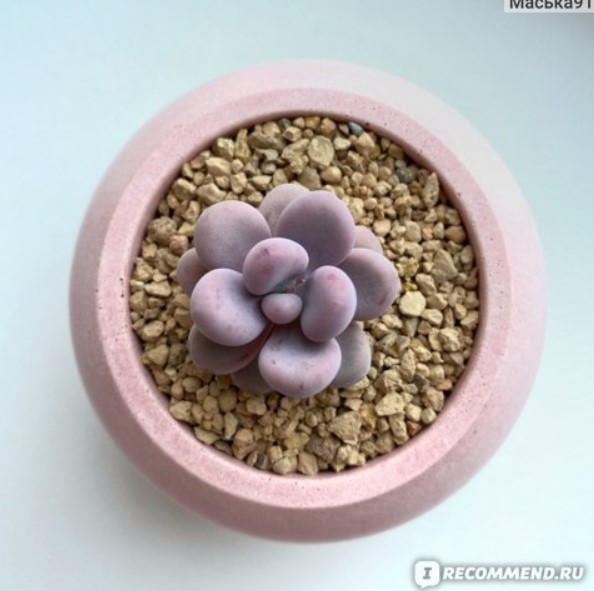
Pachyphytum 'Moonstone Pink'. A gem of my collection, I've been hunting for it for a long time. It's one of the most treasured succulents in my home. It's distinguished by its delicate pink color; in low light, it can fade, but retains its pink hue.
Pachyphytute Amethystium. Similar to Moonstone, but the leaf hues are slightly different: the pink can veer toward purple, and in low light, it loses its color and takes on a glaucous hue.
Amethystium
Pachyphytum rubra, another member of the rose family, is always pink, only changing in intensity, becoming brighter under extreme conditions. The plant itself and its leaves are smaller than those of its relatives, and it grows extremely slowly.
Pachyphytum Rubra
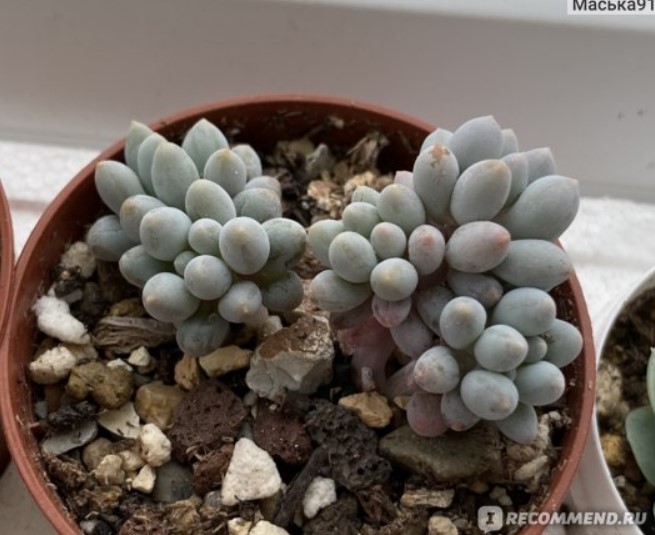
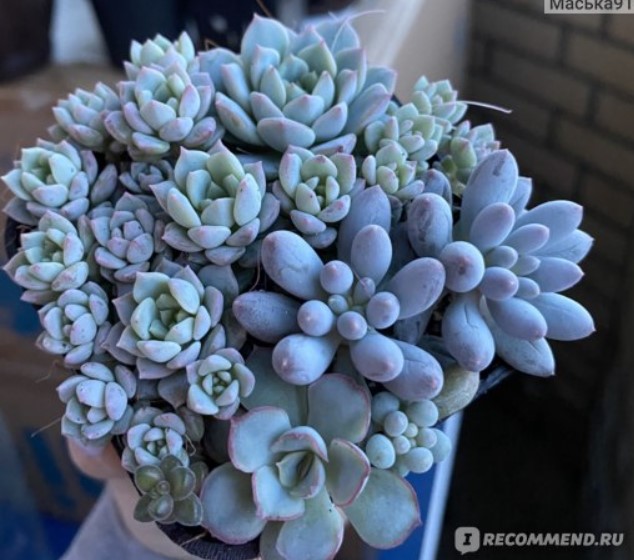
Pachyphytute Baby Finger. The leaves are plump and elongated. They can have various shades, especially in Korean varieties, but I can't achieve color with this particular variety.
P. Baby Finger
Care is no different from that of other succulents. Infrequent watering, special loose soil, and maximum light are the three fundamental requirements for the successful maintenance of any succulent.
Propagation. They reproduce well from leaves. The photo shows offspring grown from a mother leaf.
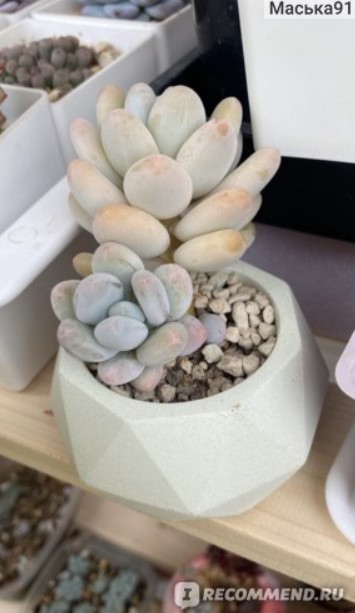
Oviferums are quite good at producing offspring from the root beneath the mother plant. In the photo, the larger one is the mother plant, the offspring below is the offspring, and another new leaf is visible—the second offspring. Ultimately, the resulting bush will consist of three offspring.
And of course, propagation is by cutting off the head: we plant the head in the ground, it will quickly take root, and the remaining stump will also produce babies.
Moon Stone Pink in a concrete planter
On the one hand, succulents are considered unpretentious plants; on the other hand, when you begin to delve deeper and become interested in the rarer representatives of this group, you realize that, nevertheless, our conditions are very far from their native lands.
Problems that beginners often encounter:
the plant is overwatered, as a result it stretches out or, even worse, rots,
the soil is selected incorrectly,
do not provide the succulent with enough light,
They incorrectly select plants by combining them in one pot or "garden", for example, they plant haworthias and echeverias together.
Unformed "kindergarten". P. Baby Finger on the right - 2 headsGenerally speaking, these are wonderful, beautiful and unusual plants that attract the attention of both beginners and experienced gardeners.
Definitely recommend!
Maska91
recommends