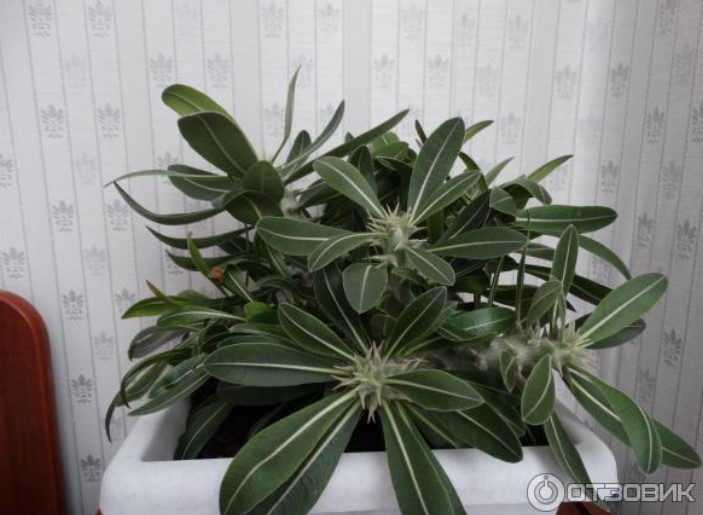
Pachypodium is a succulent plant in the Apocynaceae family. It is native to Madagascar and the arid regions of South America.
Features of Pachypodium
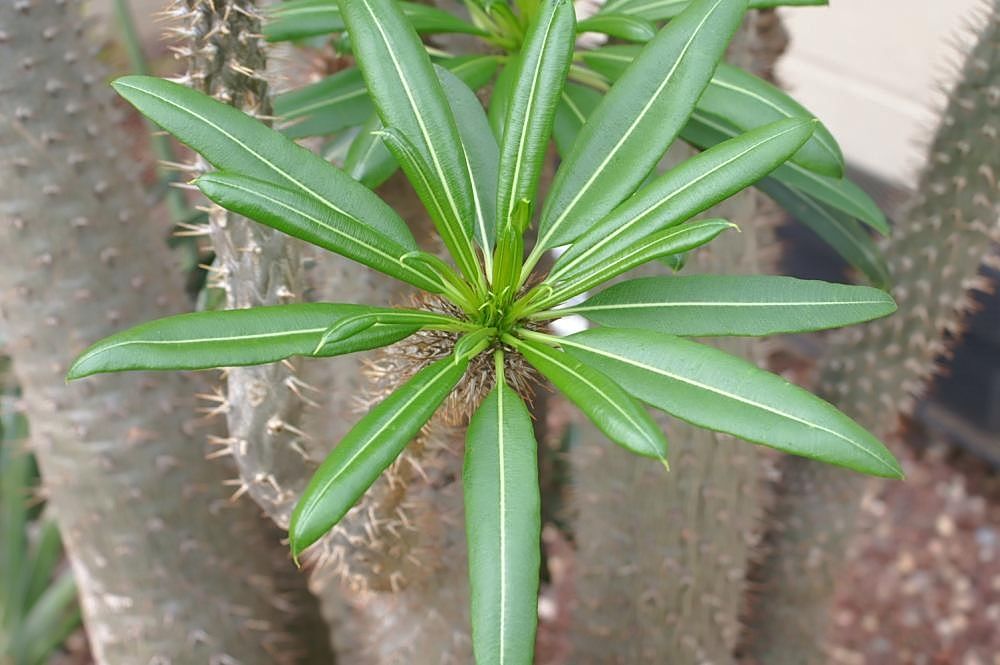
A shrubby plant with thick trunks that store moisture in case of drought. Its shape varies from bottle-shaped to cactus-like.
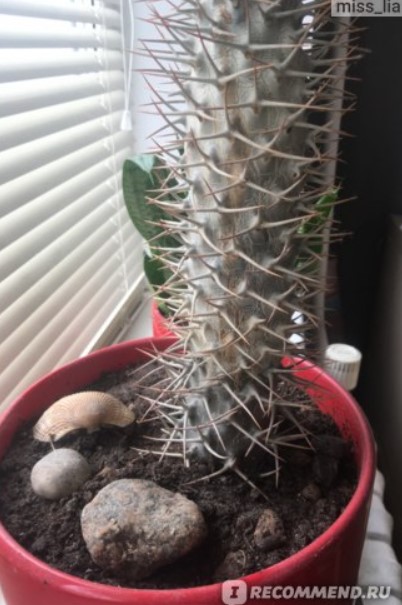
A distinctive feature is the presence of spines, grouped in pairs or threes and arranged in rings around the trunk. They form parallel to the leaves and grow rapidly. The spines are unable to regenerate, so friction gradually wears them away.
This plant, like many other species in the genus Adenium, secretes a clear juice.
Popular varieties of pachypodium for the home
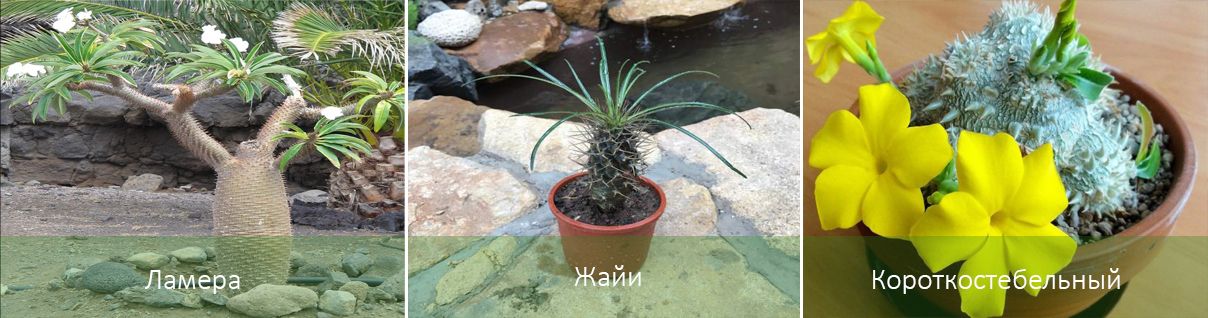
The following types of pachypodium can be grown in an apartment:
| View | Description
Foliage |
Flowers |
| Lamera (Mexican palm) (Pachypodium lamerei typica)
|
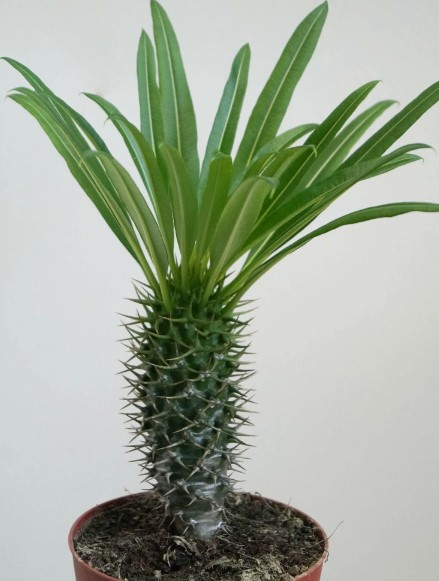
An erect, sparsely branched, spiny stem grows up to 50 cm indoors. The spines are borne on spirally arranged tubercles. Dark green, located at the top. |
Diameter up to 11 cm, cream, light pink with a light yellow center. |
Lamera (variety – branched) Pachypodium lamerei ramosum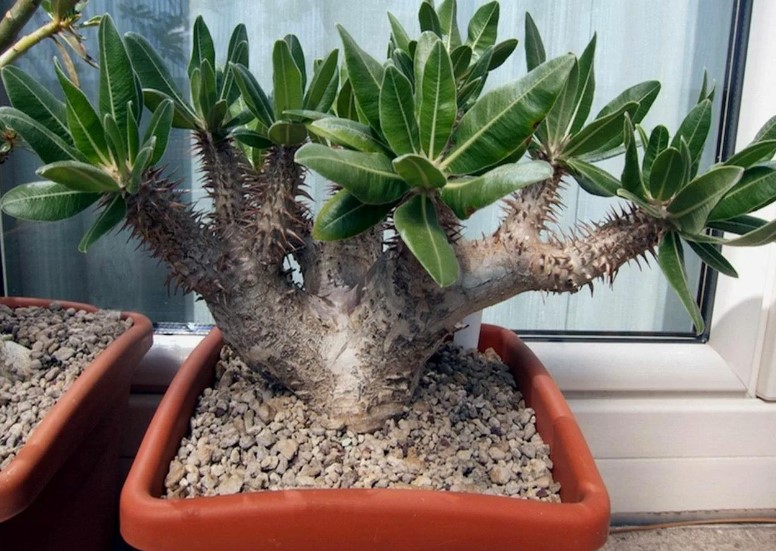 |
Bottle-shaped trunk with a small number of thorns, branching.
Elongated, not drooping, light. |
Approximately 10 cm in diameter, they form umbrella-shaped inflorescences. Color: white. |
| Geayi (Pachypodium geayi)
|
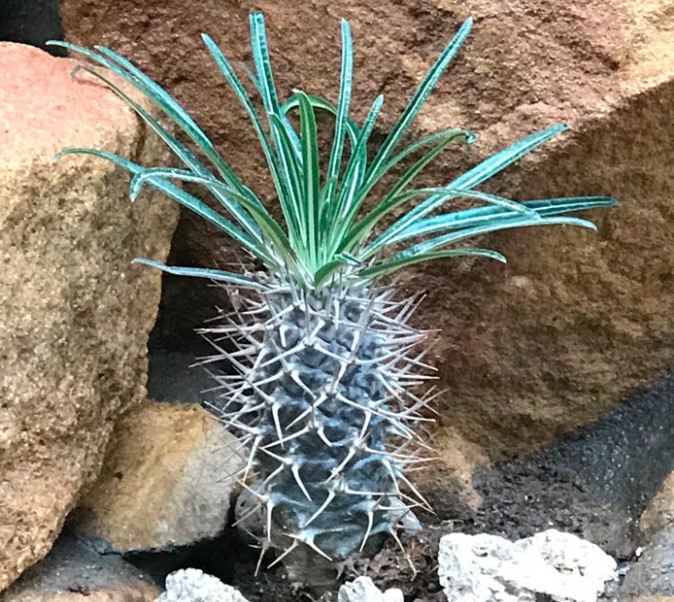
The thorny, thickened trunk reaches 60 cm in height.
Narrow and pubescent, dark green in color. |
White, throat - lemon. |
Short-stemmed (Pachypodium brevicaule)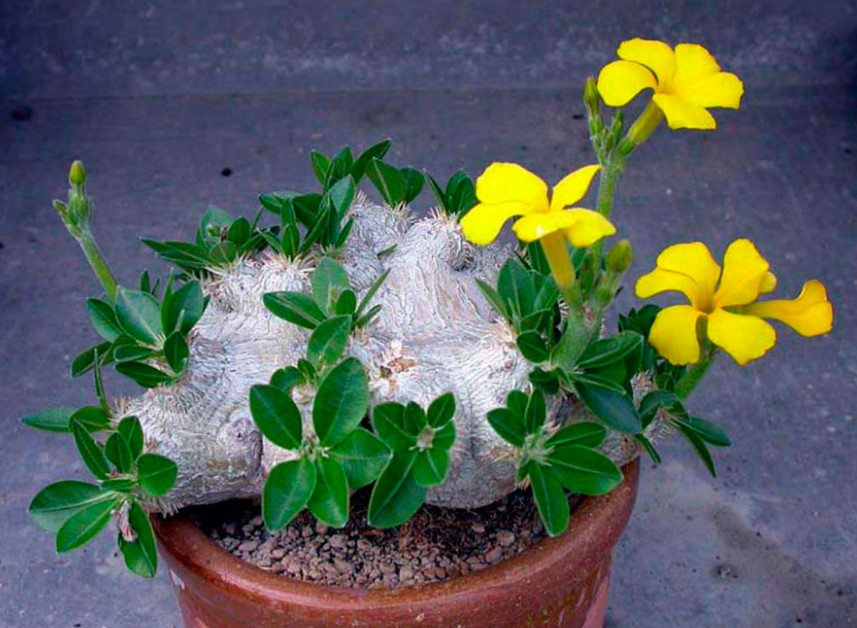 |
After shedding its leaves, it resembles a stone. The stem is smooth, up to 60 cm in diameter.
Small. |
Yellow, large in size. |
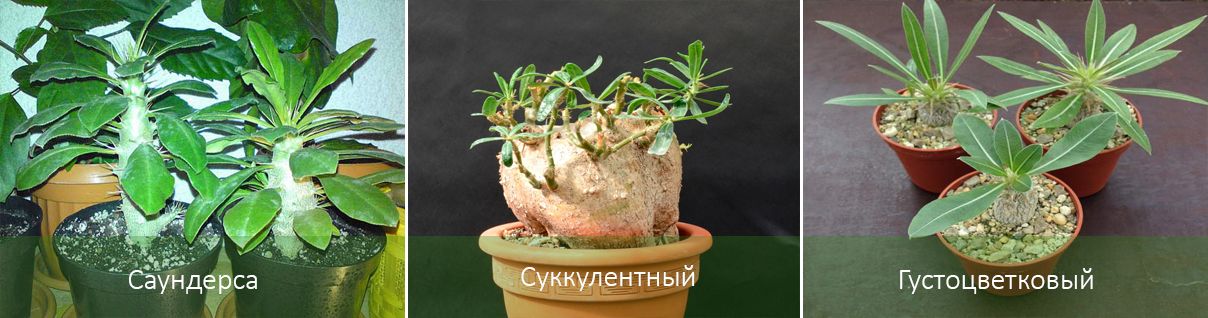
Saunders (Pachypodium saundersii)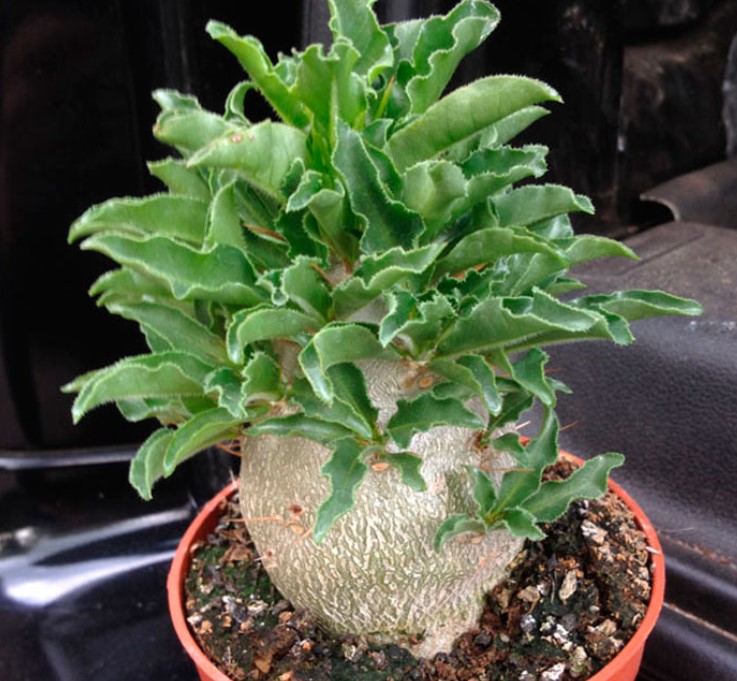 |
Gray-green, spherical trunk, grows up to 1.5 meters, with a small number of thorns.
Wide, has a tapering base. |
They resemble Pachypodium lamerii, but with a pink edge. |
Succulent (Pachypodium succulentum)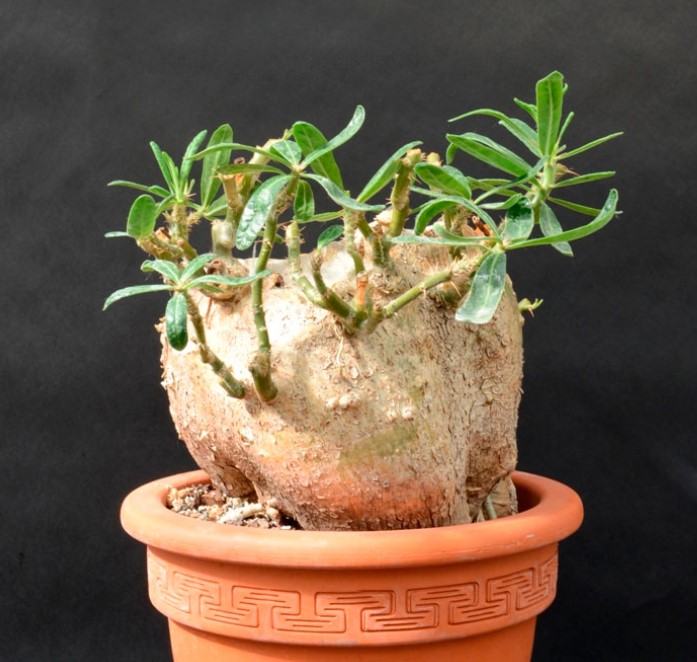 |
A large trunk buried in the ground resembles a cobblestone in appearance.
Small, pubescent, with several spines. |
Pink buds with a red center, shaped like bells. |
Pachypodium densiflorum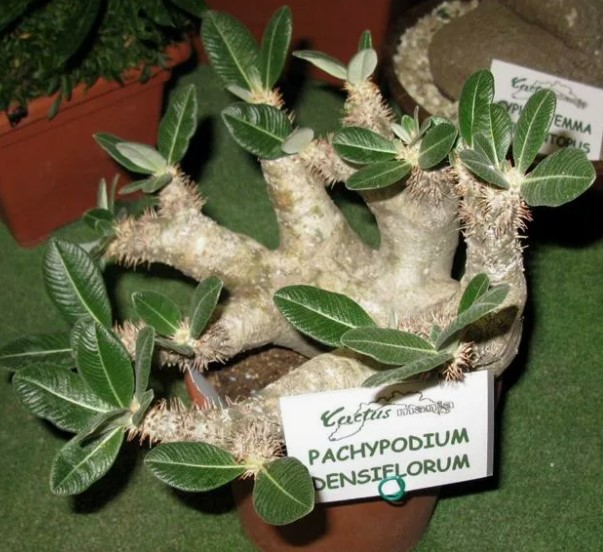 |
Reaches a height of 45 cm, stem thickness is about 30 cm.
Small, directed upwards. |
Bright yellow inflorescences. |
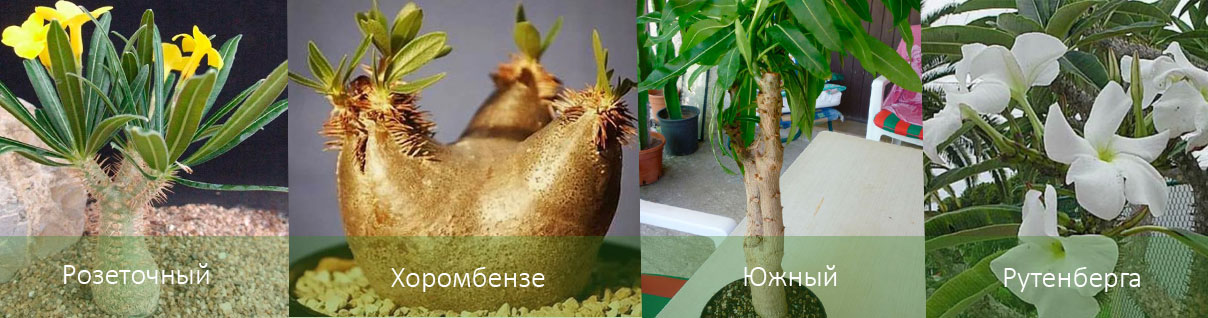
Horombenze (Pachypodium horombense)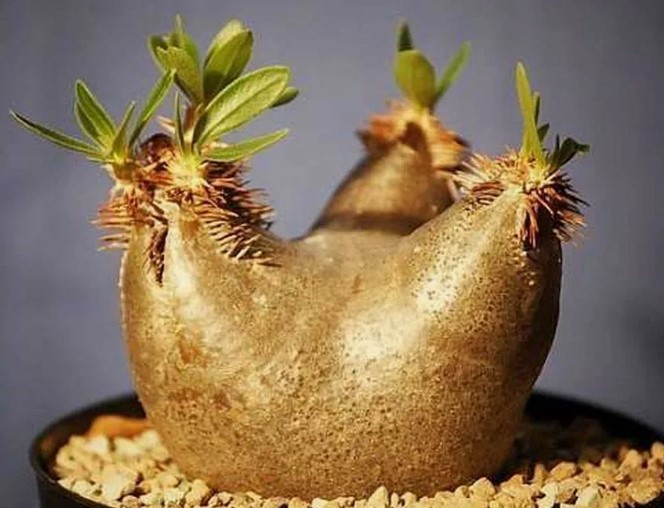 |
A low-growing plant with a thick, smooth trunk.
Thin. |
Large. Yellow. Grow in clusters. |
Southern (Pachypodium meridionale)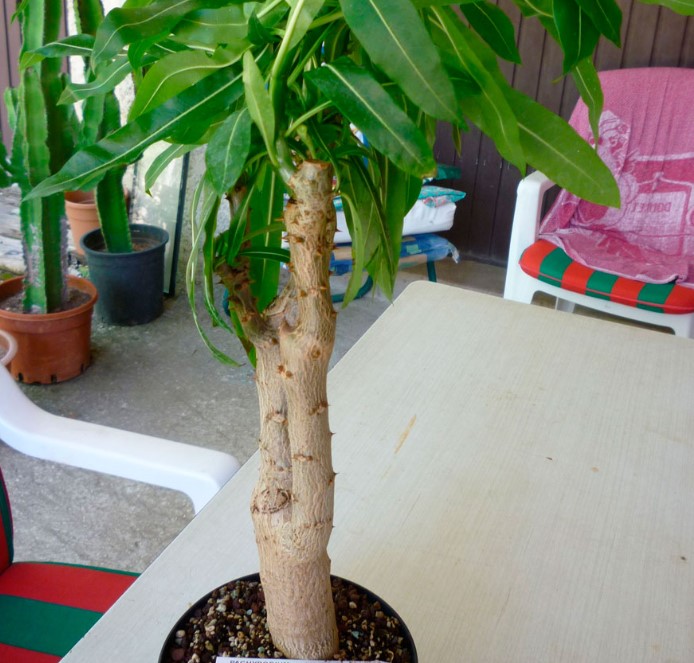 |
It reaches 1 m in height. The trunk is silvery-brown and smooth.
Large, elongated. |
Large, red in color, with a rich aroma. |
Rosette (Pachypodium rosulatum)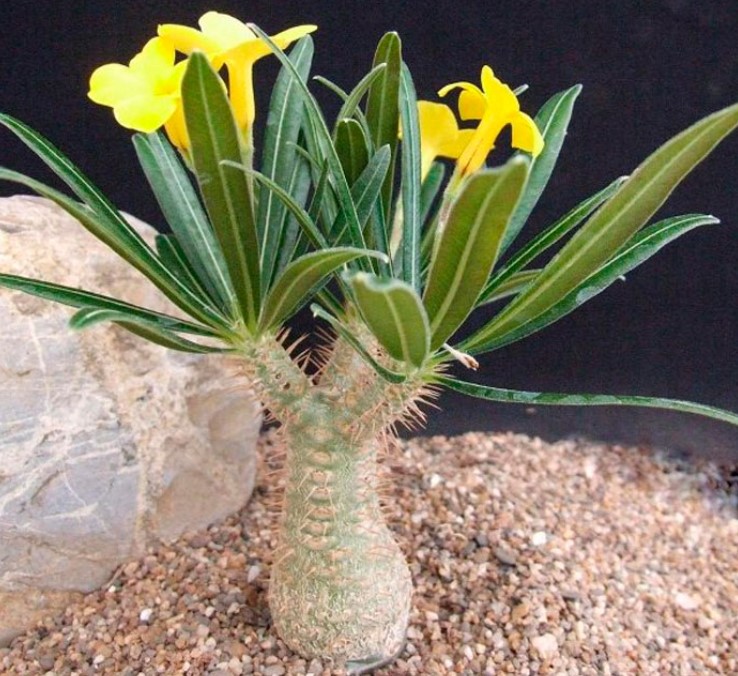 |
Short but thick stem.
Small. |
Light lemon. |
Rutenberg (Pachypodium rutenbergianum)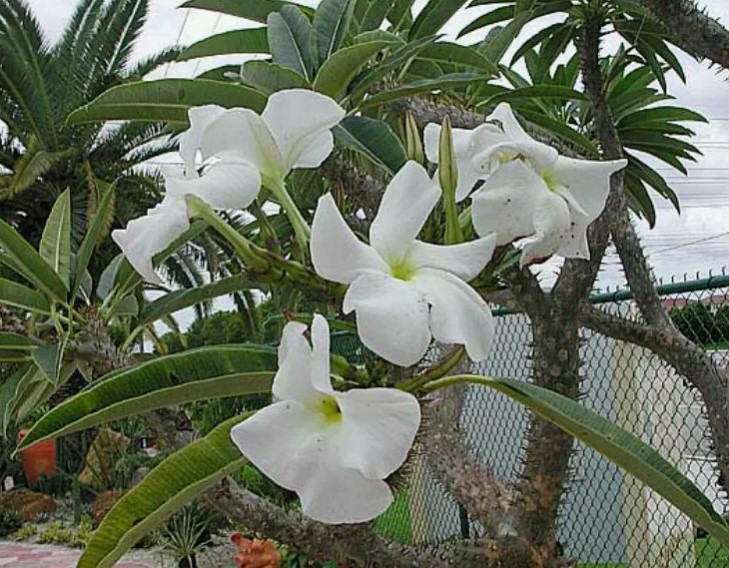 |
The trunk diameter is up to 60 cm, with thorny branches.
Shiny, dark green. |
White, large. |
 Keeping pachypodium indoors
When caring for pachypodium at home, you should focus on the time of year:
| Parameter | Spring-summer | Autumn-Winter |
| Location/lighting | Prefers direct sunlight and does not require shade. Place on a south, southeast, or southwest-facing windowsill. Can be moved to a garden or balcony. | Requires additional lighting. Place next to a heating device. |
| Temperature | +18…+30 °С. | +16 °C and above. |
| Watering | Once every 1-3 days. Use settled water at room temperature. | Twice a month, as the top layer of soil dries out. |
| Air humidity | It stores water well, so it can tolerate even 45-55%. | 40-50%. |
| Fertilizers | Once every 14 days, apply fertilizer for cacti. | They don't contribute. |
Transplantation, pruning
Due to the slow growth of pachypodium, repotting is performed every 2-4 years. The optimal time is spring, immediately after wintering.
A pot slightly larger than the previous one is selected and then filled one-third with a drainage layer of expanded clay, pebbles, or brick chips. Choose a light, neutral soil. If you're making your own potting soil, mix equal parts turf, leaf mold, and coarse sand. Before use, warm the potting mix in a frying pan or oven and treat it with a 1% solution of potassium permanganate.
To protect your hands, wear two pairs of gloves and cover the plant's trunk with a thick cloth. The rhizome is not freed from the old soil, so the plant is transferred to the new container along with the soil ball.
With proper care, pachypodium can grow almost to the ceiling, at which point it will need to be pruned. To slow growth, trim the top of the plant, which can be rooted if desired.
Basically, pruning pachypodium involves several steps:
- The stem is cut with a sharp blade at a height of 15-20 cm.
- The cuts are treated with charcoal. Sulfur is often sprinkled on top.
- The plant is moved to a room with good lighting and dry air, and watering is discontinued. Lateral shoots appear in about a month.
- They form the top.
Propagation of Pachypodium
The palm can be propagated by seed and cuttings.
The first growing option is quite complex, but if it is chosen, the seedlings are buried 5 mm deep in a suitable substrate and covered with polyethylene or glass. The seedlings are then moved to a well-lit room with a temperature of 20°C. After the first seedlings have formed, the cover is removed, but not immediately, allowing the palm to acclimate to the new conditions. Once the seedlings have emerged, they are transplanted into different containers and then cared for in the same way as mature plants.
When propagating by cuttings, rooting can be difficult, so follow the rules strictly. First, cut off the top of a mature palm at a height of 15 cm, then plant the cutting in a soil mixture specially formulated for mature pachypodiums. Place the plant in a well-lit area.
Diseases, pests, and mistakes in caring for pachypodium
When growing pachypodium indoors, it can be susceptible to attacks from diseases and insects, and its condition can also deteriorate with improper care:
| Manifestation on leaves and other parts of the palm tree | Cause | Elimination |
| Drying and yellowing of the tips. | Moisture deficiency. | Adjust the flower's watering regime. |
| Loss of tone, rotting of the trunk and rhizome. | Over-watering. Low temperature. | Reduce the frequency of watering and move the plant to a room with higher temperatures. |
| Blackening and wrinkles, including on shoots. | Drafts, temperature fluctuations. Using cold water for irrigation. | Protect the plant from cold air movement, regulate the temperature, and use only warm, settled water for watering. |
| Mass drying and falling off. | Moving the pot. | After replanting the flower, the container is not touched for some time. |
| Shrinking and thinning of shoots. | Insufficient lighting. | The palm tree is moved to a room with better lighting. |
| Brown-purple spotting, rhizome and trunk rot. | Late blight. | Affected areas are removed, and the cuts are disinfected with activated charcoal. The plant is watered with a solution of fungicides such as Skor and Previkur for 2-3 months. |
| Gray-brown spots on the stem and shoots. | Anthracnose. | All damaged areas are removed, and the cuts are treated with crushed chalk. The palm is given a warm shower. Every 3-4 days for 2-3 months, the pachypodium is sprayed with solutions of Ridomil and Oxychom. |
| Blurry yellowish spotting, thin white webbing all over the plant. | Spider mite. | The palm tree and soil are treated with ethyl alcohol and then placed in a shower after 25-30 minutes. Acaricides such as Actofit or Neoron are used. |
| Gray and brown bumps. | Scale insect. | Kerosene or vinegar is dripped onto the pest shells. After 2-3 hours, the insects are collected by hand. The plant is washed in the shower and then sprayed with Actellic or Metaphos. |
| Silvery beige scars. | Thrips. | The palm tree is treated with a soap-alcohol solution and placed in a shower. It is then sprayed with solutions of Mospilan and Aktara. |
Useful properties of pachypodium
Florists note that pachypodium has a number of useful properties:
- protects the home from negative energy;
- has an analgesic effect in inflammatory processes.
Pachypodium Reviews
✾ My exotic pet Pachypodium (about its pot, its harmfulness, and its neighbors)
✾ HELLO EVERYONE! ✾I went to the store to buy a pot for a houseplant and saw this beauty. I later came back and bought it because I couldn't forget it...
Pachypodium is a slow-growing succulent plant.
It grows in arid regions of Madagascar, Africa, and Australia. Translated from Greek, "pachys" means thick, and "podos" means leg.
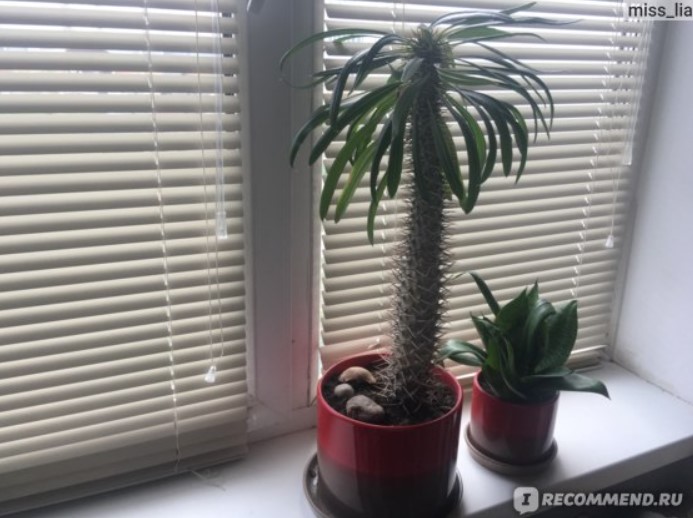
And so I had a question: where should I transplant the pachypodium so that it looks good?
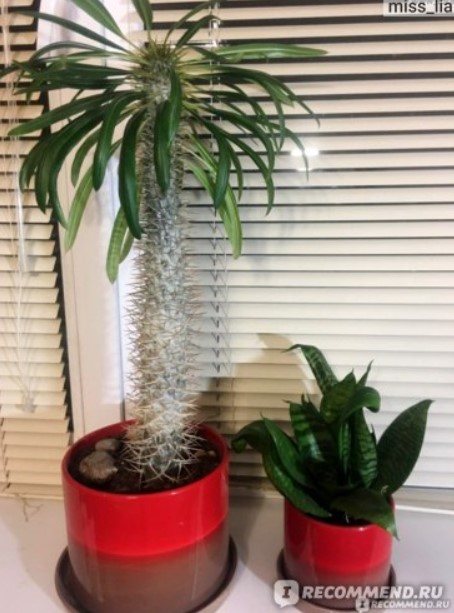
I couldn't find any specific ideas online, so I had to figure it out myself. I thought a wide but shallow pot was needed. I chose a pair of pots and planted a Sansevieria honey plant next to them.
I transplanted it wearing thick, dense fabric gloves to avoid getting pricked.
And then, the winter before last, almost all of my plant’s leaves fell off.
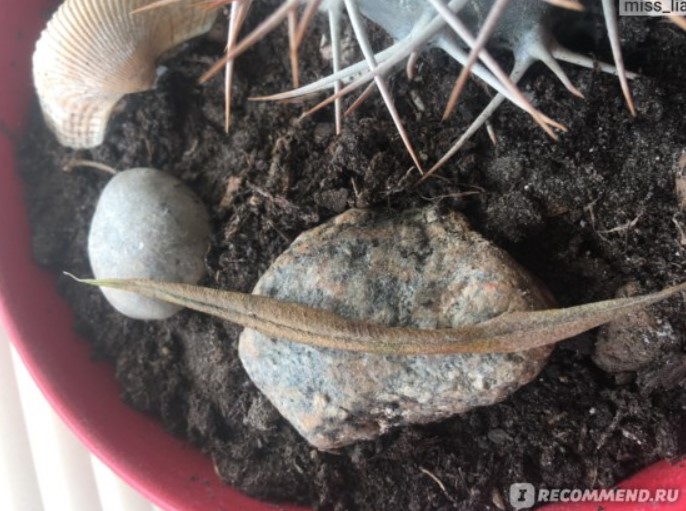
This is what dry leaves look like
It turns out this is normal for pachypodium. You should stop watering for 5-6 weeks, then resume when new leaves begin to emerge. The leaves constantly die off at the bottom, but this allows the crown to form at the top. Incorrect watering and insufficient sunlight can also cause leaf loss.
Pachypodiums are rare in cultivation and grow slowly when grown in small pots. They require good light year-round. In summer, they should be placed on a balcony or in the garden. In winter, pachypodiums require temperatures above 18°C. The soil should be slightly moist, otherwise the plant will drop its leaves. Overwatering in winter can cause black streaks to appear on the leaves, and the leaves may fall off. In spring and fall, the plant should be fed with liquid fertilizer. Pachypodiums are difficult to propagate by cuttings. They are propagated exclusively by seed. Repot the plant twice a year using "Palm" or "Cactus" substrate.
Mine always leans to the side, so I periodically turn it towards the light.
I discovered my worst fear about pachypodium after I bought it…It turns out its sap is toxic and poisonous. It causes blindness when it gets into the eyes, and when ingested, it causes tetanus and cardiac arrest, and has a nerve-paralytic effect. That's probably why it has such thick and long spines.
Having warned my son about all the dangers of this plant, I wondered if it was harmful to breathe the air in the room where the pachypodium was located?
After all, it was standing in my nursery! And then one day my child came to me with tears in his eyes and said: "Mom, goodbye, I'm dying. I got a pachypodium injection."... It's getting worse by the hour!
After Googling, I discovered that pachypodium sap is released only when the plant is damaged, has no effect on skin, and is only dangerous if it comes into contact with wounds or mucous membranes. If you wash your hands thoroughly after handling the plant, it won't cause any harm. Also, you shouldn't eat the flowers or leaves of this plant. Incidentally, many popular houseplants are poisonous, including dieffenbachia, cyclamen, pomegranate, milkweed, croton, clivia, ficus, schifflera, monstera, and many others.
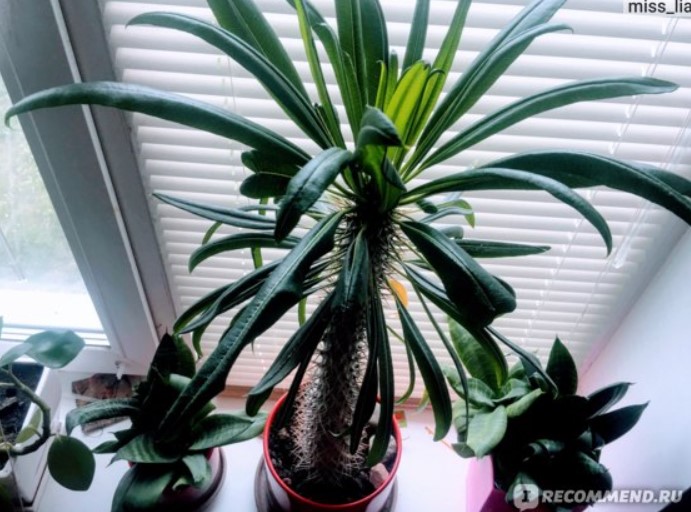
So, I've been the owner of a pachypodium since about 2013. This spring, new foliage started growing on the top of my plant, possibly due to overwatering. I was watering it more than usual.
This is how bizarrely shaped it was. The upper leaves were fresh and juicy, while the lower ones were more limp and gradually falling off.
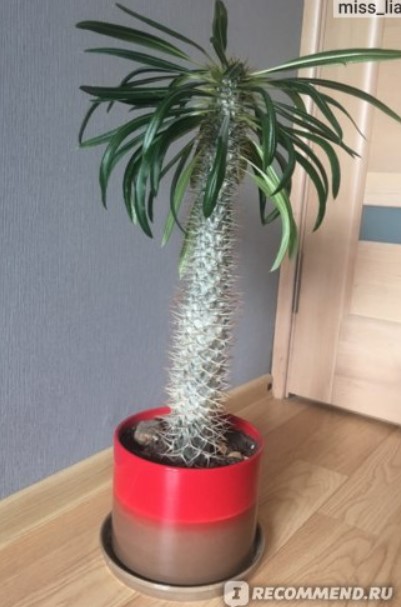
Here's a photo 10 months after writing the review:
✾ Conclusion:Pachypodium will undoubtedly bring that beloved exoticism to both your home and office. It will surely surprise your friends, relatives, and neighbors. However, be very careful if you have small children.
So decide for yourself whether to have it or not, but I recommend it to all lovers of exotic things!
Thank you for your attention!
Advantages
Beautiful
Unusual
Easy to care for
Perfect for both home and office.
Tolerates direct sunlight well
It looks impressive
Flaws
Very poisonous
It's hard to transplant
miss_lia
recommends
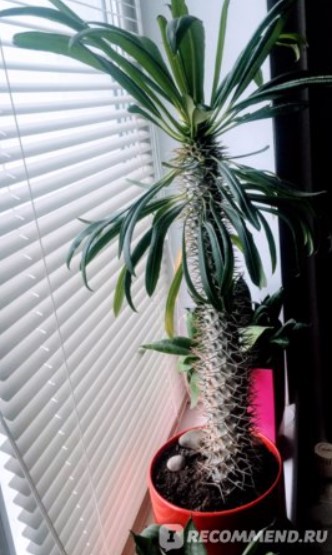
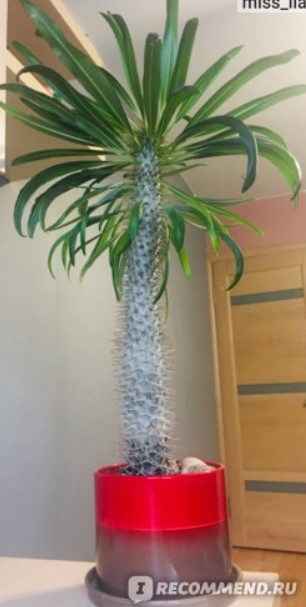
Review: Indoor flower "Pachypodium" - unusual plants on our windowsills - Pachypodium jayii and Pachypodium horombense
Advantages: an original plant that requires minimal care
Disadvantages: very prickly
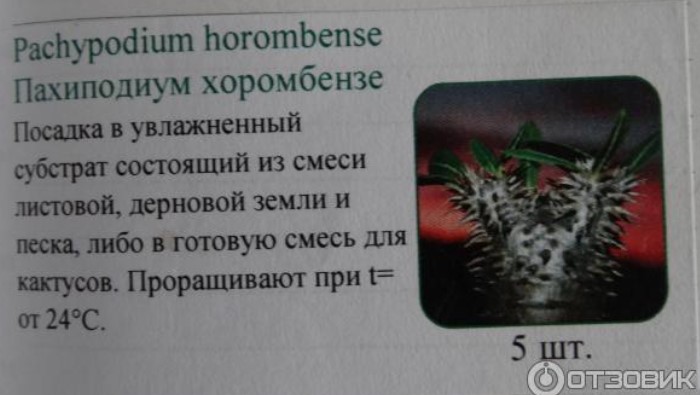
I have two types of pachypodium, grown from seeds. I bought the seeds online; here's what the packaging included.
Unfortunately, I didn't take a photo of the seeds themselves((
In the spring, the Pachypodium Khorombense decided to bloom, but ended up shedding its flowers.
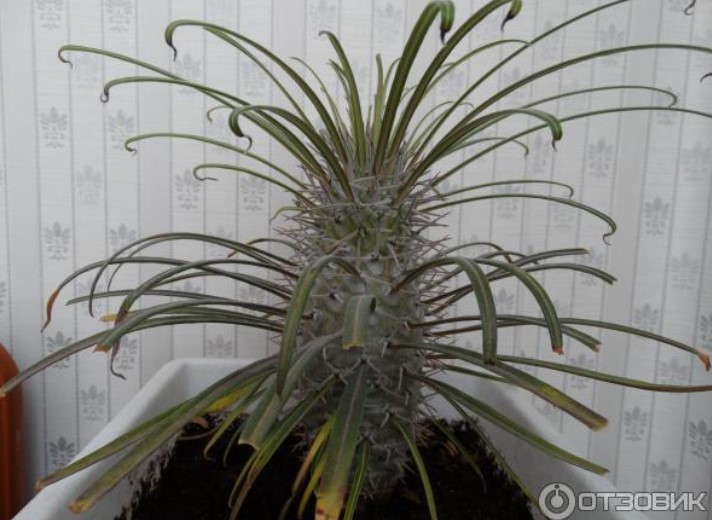
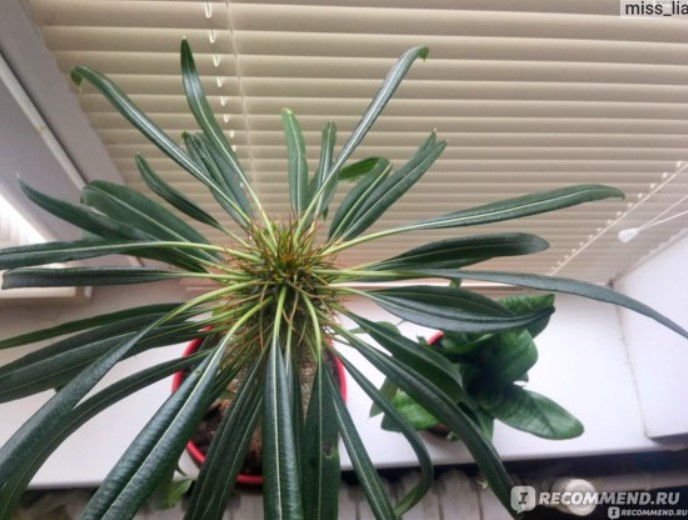
This is a Pachypodium jayi, also in spring. It's lost some leaves after being repotted, but you can see at the top that it's starting to actively grow.
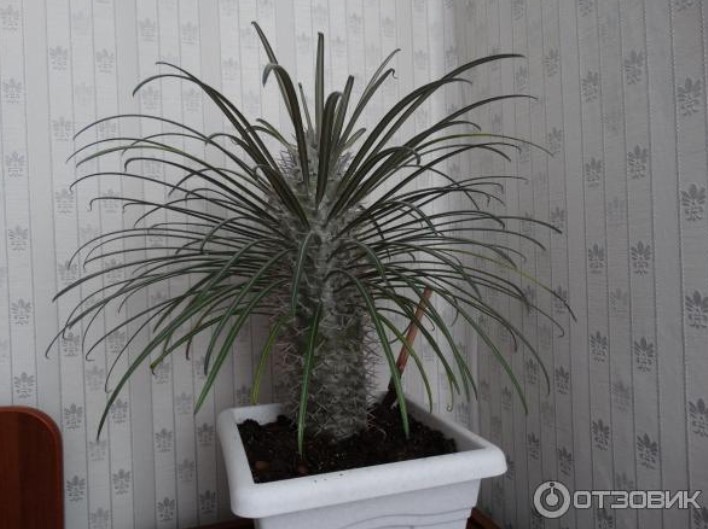
This is what my Pachypoiums look like now. My Pachypodium jayii is currently about 35 centimeters tall (although they're said to be slow-growing).
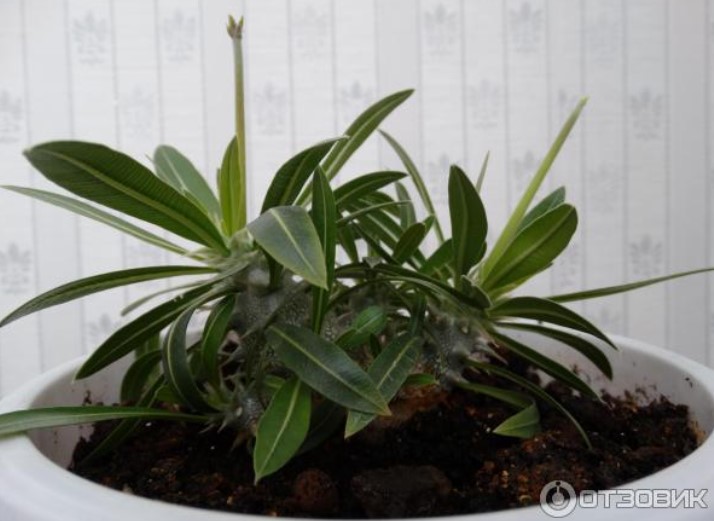
And the Pachypodium Khorombense actively branches and has formed a bush like this.
Pachypodiums don't require any special care. Water as needed with lukewarm water; keep the soil consistently moist in summer, reducing watering during the dormant period. If the plant is overwatered, the trunk won't be as fleshy and will stretch out unsightly. If it's not watered enough, it will begin to drop leaves. They prefer good light—mine are on a south-facing windowsill in direct sunlight, with no shade. Fertilizing is necessary periodically.
Usage time: 1 year
Year of manufacture/purchase 2013
The overall impression is of unusual plants on our windowsills - Pachypodium jayii and Pachypodium horombense
My rating
5
I recommend it to friends YES