Pachystachys has been known since the 19th century as a tropical plant that can be grown both in summer cottages in areas with mild and warm winters, and indoors. Its popularity stems from its bracts, which resemble a candle, an antique candelabra, or a golden lollipop. Translated from Greek as "fat ear," the plant is native to the tropics of South America, Australia, and the subtropics of India.
Description
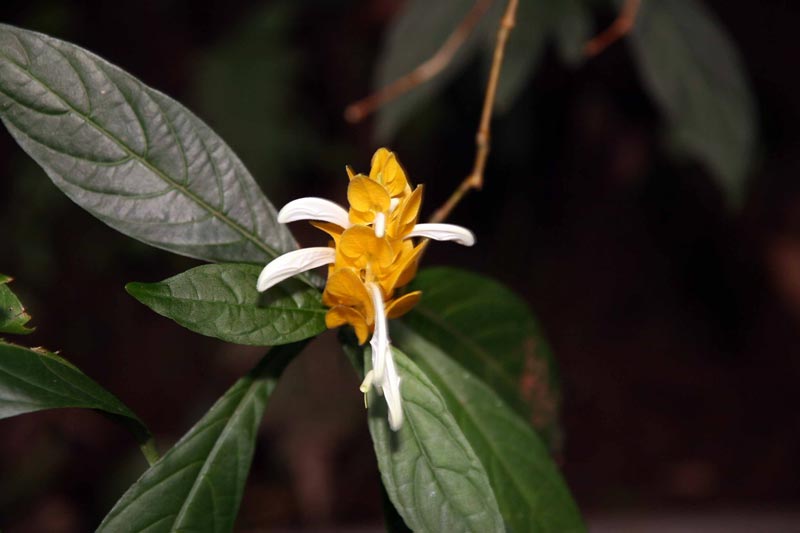
A perennial plant reaching 1.5 m in height, forming a spherical bush of thin, woody stems. The leaves are oval, tapering at the ends, 10-12 cm long, veined, and dark green.
In late March to early April (and almost until October), yellow or orange bracts emerge from the ends of shoots that cling tightly to the stem. These are followed by soft, white, orange, or pink flowers, about 10 cm long, with elongated petals of two or four, depending on the species. After one to two weeks, the flowers fade, but the spike itself remains. During flowering, a bush may produce 15 or 20 flowers.
Pachystachys lutea and other species
There are 12 known varieties of Pachystachys, but only two or three are found in cultivation; the rest can be seen in tropical or subtropical forests.
| Variety | Peculiarities | Leaves | Flower / Bracts |
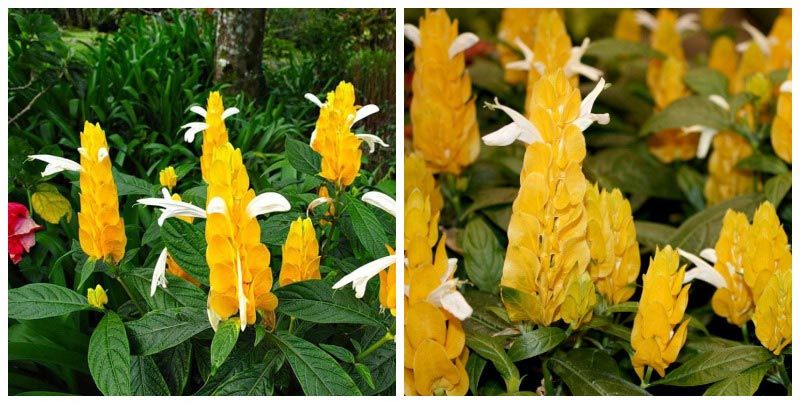
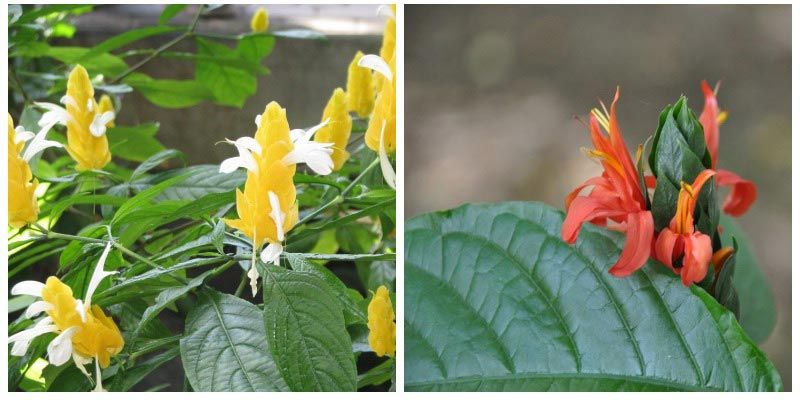
| Yellow Pachystachyslutea | The branched shrub reaches a height of 90 to 120 cm. The stems are green, woody closer to the root. | The leaves are round, 15-20 cm, tapering at the ends, more than 5 cm wide, bright green, with obvious veins. | From March to September, yellow ears of corn appear, then white or cream flowers, consisting of an elongated double petal and stamens, begin to peek out from the scales. |
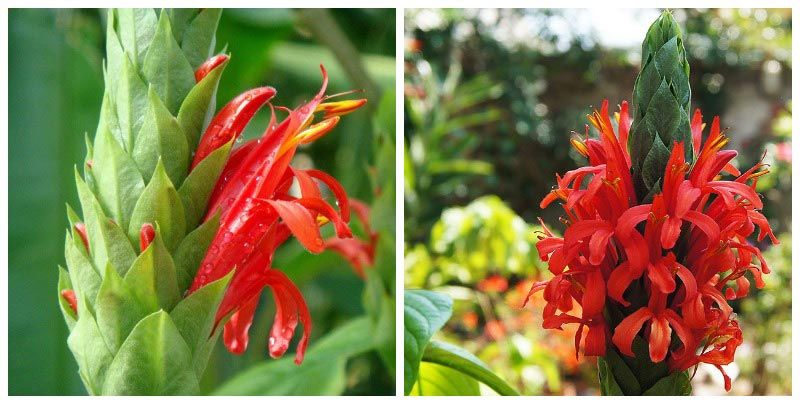
| Red Pachystachys (Pachystachyscoccinea) | A spreading bush, about 2 m in height. | With elongated, long, dark green leaves (up to 40 cm), sometimes with burgundy streaks. | In mid-spring, sturdy spikes of scales emerge, followed by red, elongated petals with four yellow stamens in the center. Three petals curl downward, and one stands up like a sail in the wind. Perhaps it was for this flower that the red pachystachys was named "cardinal's guard," but legend has it that it was because of its color, which resembled the feather on the guards' hat. |
| Spikelet pachystachys | Requires increased care, is rare, and forms a bush up to 1 m high. | It has long, dark green, curved leaves reaching up to 25 cm. | In spring, a candle of green scales appears, then releases several red flowers with yellow, tall stamens. |
Caring for Pachystachys at home
This plant is not very demanding, but since it came to us from the tropics, it requires some care.
It is advisable not to place the pot on the sunny side in summer to avoid burning the leaves; pachystachys prefers a windowsill on the east or west side.
In summer, the room temperature should not be higher than +21…+25 °C, and in winter, the temperature should not be raised to +14 °C.
In summer, you can place the potted plant outside, but not in direct sunlight. Mist it three times a week and water it generously. The soil in the pot should be constantly 60% moist; you can place jars of water next to the plant. Pachystachys dislikes drafts; if the room is well-ventilated, it should be moved to a different location.
In winter, water no more than twice a week, after letting the tap water settle. This is when the pachystachys begins its dormant period (from the end of October), but the main thing is not to overdry the soil, which should be barely moist.
Fertilize twice a month (Good Strength, Flower Happiness, Agricola), in March before flowering and in the fall. Do not drip fertilizer onto the stems and leaves, as this may cause burns.
Once a year or two, depending on how the bush grows, it should be repotted into a larger pot. Expanded clay should be added to the bottom of the new pot. You can use a ready-made potting soil for ornamental plants or make your own by mixing humus, peat, and sand with clay-turf soil. The repotted plant should be thoroughly watered.
Pachystachys requires pinching (trimming) the tops where the flowers are forming, so the small bush will bloom more profusely. The very first pruning of a newly planted young bush is done at a distance of 10-15 cm from the ground.
The plant also needs to be rejuvenated. Over time, the lower leaves fall off and stop growing, and the bush begins to lose its original appearance. It's best to trim off all the old stems; new buds will appear in their place, or you can plant cuttings.
Reproduction of Pachystachys
Propagation is carried out by cuttings:
- Non-lignified cuttings are cut in the spring from the upper part of the plant, leaving 1-2 leaves.
- Place in water, you can add aloe juice to stimulate growth or Kornevin.
- Pachystachys thrives in warm conditions, so the temperature should be between 22 and 25°C. Once the cutting has rooted in water, it can be potted.
The second method of reproduction:
- Plant several cuttings in a pot, then the bush will be fluffier (pot up to 15 cm).
- Pre-treat the roots with Kornevin and deepen them 1.5 cm into the soil.
- Be sure to cover the pot with a jar, bag or plastic bottle.
- Remove the jar once a day to allow the plant to ventilate. After a month, you can finally remove the bag or bottle.
- When the first leaves appear, they should be pinched for better growth.
- Next spring, you can transplant the seedlings into larger pots.
Improper care
| Symptoms | Reasons | Methods of elimination |
| The leaves have become lifeless, dry and curl up. | There is not enough moisture or the room is too dry. | Water and mist more frequently. This plant originates from tropical forests and requires constant water. |
| The leaves have fallen | The room where the plant is located is too cold or the soil in the pot is dry. | Water the plant more frequently, add water to the tray, and move it to a warmer location. Pachystachys doesn't like cold or drafts; it prefers humidity and warmth. |
| The plant is growing upwards | There is not enough daylight. | Change the location of the pot, you can also trim the plant again and plant cuttings. |
| The plant's trunk at the bottom is completely bare. | It's time to rejuvenate the plant. | Plant the cuttings and prune. |
| The cuttings do not root | It is necessary to trim the leaves on the cuttings. | Cover the pot with a bag or jar. |
| The root is rotting, the leaves are falling off | Trim off rotting roots, replant in new soil, adding ash. | Pachystachys does not like cold and drafts; the soil in the pot should not freeze. |
Diseases
With proper care, the plant rarely gets sick.
| Symptoms | Reasons | Methods of elimination |
| Aphid. A sticky white coating appears on the leaves of the plant, as well as on the stems, then the leaves may have a black coating, and the stems seem to be fluffy, covered with aphids. |
Leaves and stems should be washed daily with warm water. If aphids aren't immediately detected, it's best to treat the leaves and stems once a week with Fitoverm or Intavir. A regular soap solution can also be used. | Aphids don't like wet leaves and stems; it's recommended to spray the plant. To prevent them from spreading to other indoor plants, it's advisable to keep the new ones away from others for the first few days. |
| Scale insect. The leaves become sticky and wet. |
Oval, hard, brown spots are visible on the candles and on the inside of the leaf. | The pot should be moved to a warmer room and treated with a soapy solution, and also watered generously. |
| Powdery mildew. The plant begins to shed its leaves. |
White, downy areas are clearly visible on both sides of the leaves, which then darken and thicken. If this is a recent occurrence, spray the plant with Topaz once a day for three weeks in a row, or make a garlic tincture (infuse 30 g of crushed garlic in a liter of water in a dark place for 24 hours). | Powdery mildew only settles on weak flowers; prevention is to feed and water the plant. |
| Spider mite. A barely noticeable web appears on the plant; if you look closely, you can see small mites. |
It is necessary to carry out a one-time treatment with Ftover or Taurus. | The spider mite does not like water, you need to constantly spray the plant, place the pot on a tray with water, you can put expanded clay. |
With proper care, pachystachys will always delight with its blooms, perfectly fitting into any interior, whether it's a home, a veranda, or a balcony. It's no wonder it's popular among gardeners not only for its flowers but also for its vibrant, spike-shaped bracts.