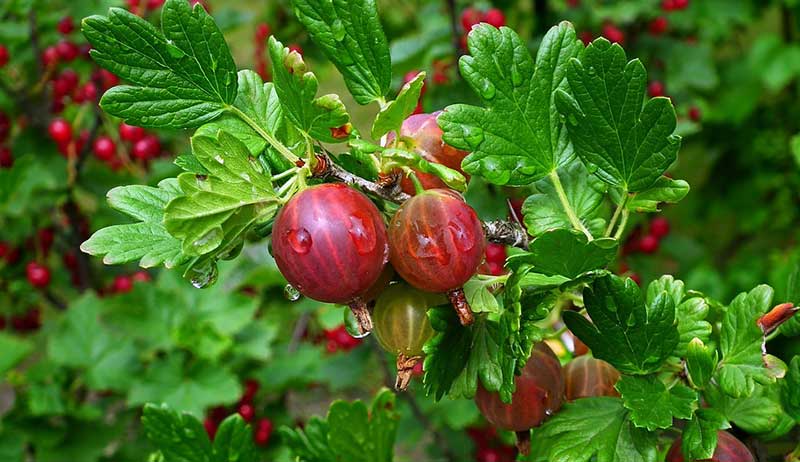
Gooseberry is a small shrub reaching one meter in height. It can be found wild in forests and cultivated in gardens. Its characteristic features include numerous thin, sharp spines on its branches. The leaves are rounded or heart-shaped, up to 6 cm long, and covered with a fine fuzz. It blooms in May, with greenish or reddish flowers.
The fruits are oval or round berries up to 12-15 mm long, sometimes reaching 30 mm. They are covered with bristles or bare, with veins visible on the translucent skin. When ripe, the color is initially green, then yellow, and then with a reddish tint. Ripening time is July-August.
The plant is repotted in spring or fall, most often during the last season, September-October. This is because the leaves are falling, growth is slowing, and sap flow has ceased. The roots have strengthened over the summer, and the stems have matured. The plant has already begun preparing for winter, and being in a dormant phase, it will more easily tolerate the move to a new location. The best time to repot is cloudy weather.
Gooseberries can be replanted in the spring, but it's not recommended. This is because they are the first to emerge in the garden. If buds appear, the sap has begun to flow, and the root system has revived. Replanting at this time can damage the roots, reducing survival. Spring weather is changeable, and temperatures are unstable, so it's easy to miss the emergence phase.
Summer replanting is carried out only if it is necessary to urgently clear the area where gooseberries are growing.
Why is a transplant necessary?
Gooseberry transplantation may be required in the following cases:
- The plant grows in one place for a long time, the harvest is weak or absent altogether.
- Changes to the site, other plantings, flower beds, and construction are planned at this location.
- There was a need to replant the plant.
- The bush was shaded by other trees.
- Gooseberries grow in the shade, there is a lot of dampness around them, and they often get sick.
- The soil around the plant is depleted.
Transplantation times vary by region
The crop is grown throughout Russia, in the southern regions of Ukraine, and in Crimea. The transplanting season depends on the location:
- Northern regions of the Urals and Siberia: if the weather is good – early September, if it is bad – August.
- Crimea, southern Ukraine – from mid-October to mid-November.
- Moscow region – from mid-September to October.
- Non-Black Earth Region – October.
Tools
Before starting work, you need to prepare tools and protective equipment:
- shovel, pitchfork;
- pruning shears or scissors with long handles;
- axe (for removing thick roots);
- bucket;
- thick gloves.
Selecting a location and preparing it
Choosing a planting site is crucial, as it determines the growth and yield of gooseberries. This sunny plant thrives best in sunny areas, protected from wind and drafts. It can be planted along a wall or fence.
Although the plant thrives on moisture, it should be watered so that water does not stagnate in the depressions around the trunk. Otherwise, there is a high risk of fungal diseases due to overwatering.
It grows well in light loamy soil. If the soil is loose, add clay; if it's heavy, add sand. The plant produces a rich harvest in black soil. If the soil is acidic, add lime and dolomite flour. Before replanting, dig the area thoroughly and remove weeds.
Gooseberries should not be planted in areas previously occupied by currants and raspberries. The soil there is depleted, infertile, and infested with fungal diseases.
Step-by-step instructions for transplantation
The transplant site is prepared in advance. A hole is dug a week or more before transplanting the shrub. This is necessary to prevent the seedling from becoming too deep in the soil over time. The width should be equal to the spread of the roots, and the depth should be up to 50 cm.
Step-by-step instructions for transplantation:
- Before digging up the bush, old branches are cut off, young and long ones are shortened by one third.
- Long-handled pruning shears are used for pruning trees. If a bush has many branches, it is thinned out, leaving the strongest and most mature ones.
- The soil is dug up to a diameter of approximately 40 cm, this is necessary to make it easier to remove the bush.
- They dig up the bush with a shovel.
- The thick roots are cut off with an axe, the small ones are left untouched.
- The entire lump of earth is lifted with a pitchfork and carefully transferred to the film without damaging the root system.
- The first layer of the pit is drainage, it can be gravel or broken brick.
- Add fertile soil mixed with humus and compost; all of this should be of a homogeneous mass to reduce damage to the roots.
- Water is poured into the hole, 3-4 buckets, wait until it is absorbed, the seedling is placed in the middle of the hole, and carefully covered with soil.
- The root collar is lowered slightly, approximately 6-8 cm below the soil surface. It is compacted and watered again, then topped up with soil, compacted until the hole is filled with soil.
- Cover the top with mulch, the layer should be 5-10 cm above ground level. It will settle and level out over the winter.
Proper care before the onset of frost will help the plant establish itself in its new location. Water it once a week, removing the mulch beforehand and then replacing it. Sawdust is also used; it will protect the root system from freezing during the winter and will also serve as fertilizer later. If the bush survives the winter, it will yield a good harvest next season.
Safety precautions
Gooseberries are a thorny plant, so it's important to follow not only the proper transplanting technique but also safety precautions to avoid injury. Wear thick work gloves when working with them.
Possible errors and their consequences
Sometimes gardeners, considering gooseberries to be an unpretentious plant, do not strictly adhere to the rules for replanting, whether it is done in the fall or spring:
- An adult bush does not take root well without a lump of earth; its roots must be dug up with a sufficient amount of soil.
- Rooting agents increase plant survival. Special preparations have been developed for use during planting or transplanting. The most common is Kornevin, used as a biostimulant to accelerate the establishment of weakened root systems.
- After transplanting gooseberries to a new location, they are frequently watered with cold water. However, some complain that the bush was planted on time, provided with proper care and timely watering, but the plant still dies. The plant's ideal temperature is between 18 and 25 degrees Celsius. Water should be settled or tap water; well water is strictly prohibited.
If you transplant gooseberries correctly, observing the transplanting timeframe and subsequent care, the plant will take root well and soon produce a rich harvest of berries.