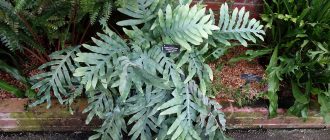
The elegant Platycerium (Staghorn Fern) is a popular representative of the ancient fern family.
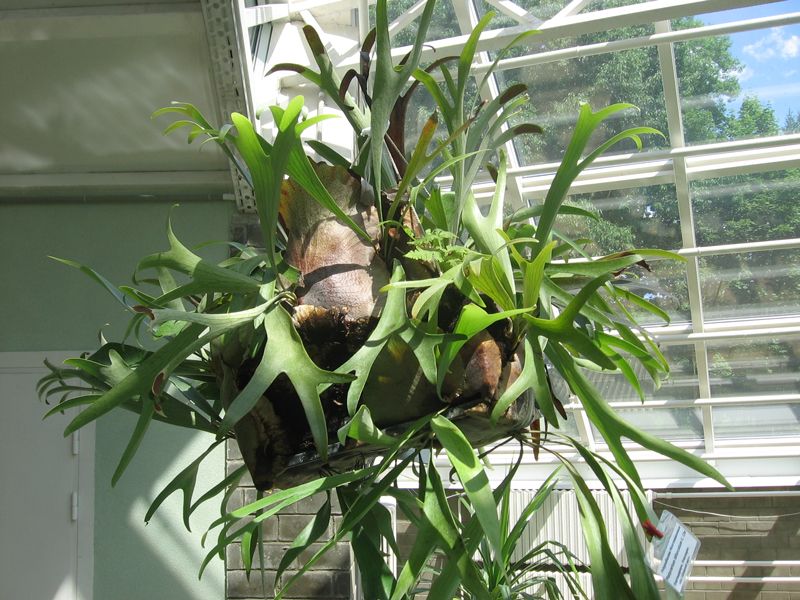
Its natural habitat is the tropics, growing on free-standing trees, clinging to the trunk and thick branches.
Content
Description of Platycerium
The staghorn fern belongs to the Ephipitae, order Myriapoda, domain Eukaryota. It gets its name from its unusual appearance.
Features of leaves
- spore-bearing (fertile) - participate in reproduction, similar to deer antlers;
- Vegetative (sterile) - the oval ones are used as a storage medium for nutrients.
Types of Platycerium
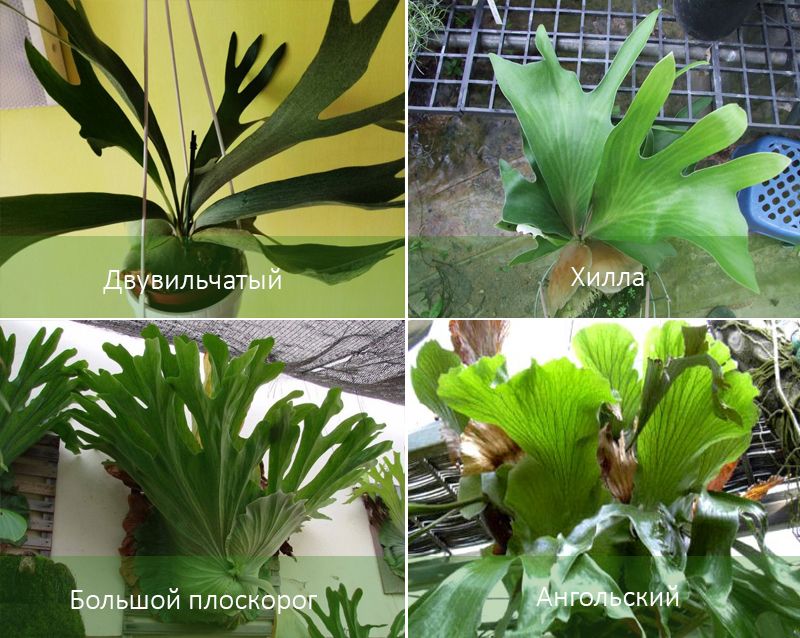
It is divided into 17-18 varieties. The following are known in floriculture:
| View | Description |
| Two-forked (bifurcatum) | The fronds are triangular, glaucous in color, deeply dissected along the edges, and blunted at the tips. Sterile, rounded, with curled edges. |
| Hilla | Similar to the bifurcated one, but the leaves are smaller, shallowly divided, and straight. |
| Greater flathorn | The spore-bearing parts reach 2 m in length and hang down like straps. The sterile parts are extensive and slitted. |
| Angolan | Fertile leaves are wedge-shaped, undissected, pale orange. Sterile leaves are entire, curved backwards. |
Features of caring for Platycerium
The flower is quite demanding. Caring for it at home requires following certain rules.
Location, lighting
The plant thrives on a west or east exposure, in bright but filtered light. The longer the shoots, the less shade it tolerates. Prolonged exposure to shade leads to stunting and darkening of the color.
Temperature
In summer, a temperature of 20 to 25°C is sufficient; extreme heat reduces humidity. In winter, temperatures can drop to 14 to 17°C. Some varieties tolerate lower temperatures.
Humidity
This tropical plant thrives on humidity (80% is ideal). Spray from above as often as possible, using a fine mist.
If there's an aquarium or humidifier in the room, hang it nearby. Avoid placing it close to heating appliances or in strong drafts.
Watering
The hotter the weather, the more intensively you should water. It's recommended to periodically place the pot in a bowl of warm water. Afterward, allow the soil to dry out to prevent root rot.
Transplantation, soil, pots for growing
For planting, you'll need slightly acidic soil (pH 5.5-6); ready-made orchid soil will do. You can also make your own mixture using the following ingredients:
- leaf humus 20%;
- coarse sand 20%;
- natural high-moor peat 40%;
- pine bark mulch 10%;
- dry moss 10%.
Charcoal powder is also added, 2% of the filler volume.
Feed with small (0.5 of the recommended) doses of preparations for decorative flora.
Repot after two years. Staghorn antlers have underdeveloped roots, so a shallow pot is needed. A permeable layer is placed underneath. Dying parts are not removed—they remain part of the plant's nutritional structure.
When propagating using a block, the roots are placed in a wrap of damp sphagnum moss, secured with fishing line or thin wire. If possible, add nutrients under the wide flat branches.
A hanging cocovite planter or wooden planks in a carved frame are used as support. This arrangement looks like an artist's creation and adds an exotic touch to the home's interior.
Reproduction of Platycerium
The reproductive period begins after 7 years. Mature spores are scattered over a shallow layer of sphagnum moss. Before beginning, the moss should be sterilized with boiling water and allowed to cool.
Cover the seed container with a glass lid until germination occurs. A warm, shaded location with consistent moisture is required for germination.
When replanting, careful division into containers is allowed.
The shoots (babies) are planted on pebbles with damp moss. They are kept under plastic wrap for four days to strengthen, and then cultivated in the standard manner.
Problems with growing Platycerium
- lack of moisture (lethargy and drying out);
- parasitic insects (aphids, mites, scale insects);
- brown spots (burns) due to direct contact with the sun's rays.
Beneficial properties
Despite its capriciousness, the flathorn perfectly filters harmful impurities, improving the microclimate of the room.