Among the primroses, the amaryllis snowdrop is considered the most beautiful. White buds appear on long stems in March. They are frost-resistant and hold up well in bouquets. Due to over-collection, they are on the verge of extinction in the wild.
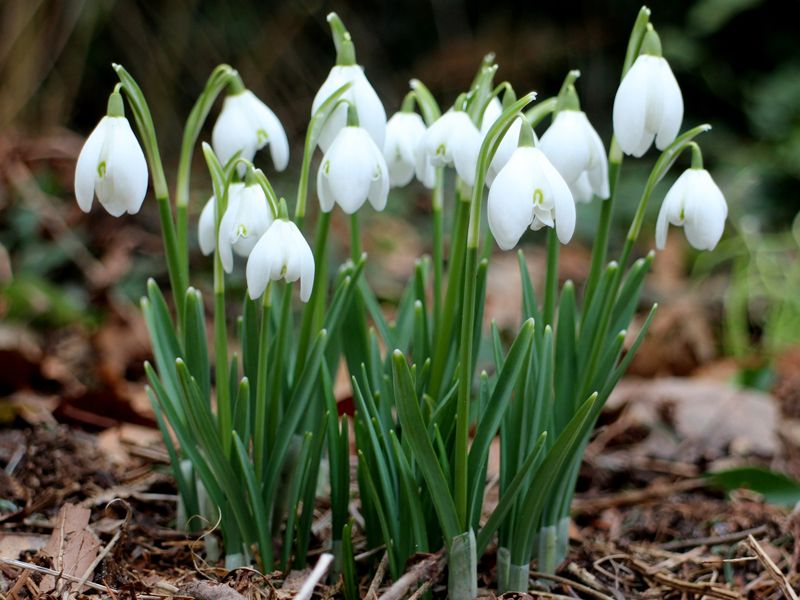
Many species are grown to decorate gardens and parks. In Holland, snowdrop bulbs are prized as highly as tulip bulbs. In England, a primrose festival has been established and is celebrated on April 19th.
Content
General description of snowdrop
Galanthus (snowdrop), or milk flower, is a bulbous plant in the Amaryllis family. There are over 20 species, most of which bloom in early spring. They grow in clumps and adapt well to gardens in many climates across Russia. The flower stalks are low-growing, while the buds are large, with three long outer petals and numerous short inner petals, exuding a delicate fragrance. Flowering occurs in early winter or early spring. By midsummer, a three-chambered rind forms, filled with oval, dark gray or black seeds. Snowdrop leaves are linear and pointed, growing until midsummer, then withering. The bulb is conical or ovoid, formed from scales, and grows up to 3 cm wide. Each year, bulbous offshoots (or corms) form in the axils of the outer layer.
The flower propagates by seeds and division. It is frost-resistant, adapts well to various climates, and is easy to grow in different regions.
Myths and legends about the snowdrop
According to biblical tradition, Eve was responsible for the appearance of snowdrops. They were expelled from Paradise with Adam in winter. Eve lamented this, surveying the snowy expanse. A few snowflakes, to encourage travelers and herald the approaching spring, transformed into white flowers. In European culture, snowdrops are considered a symbol of rebirth. The French and Germans call the galanthus "snow bell." The name is no coincidence; the delicate bud resembles it in shape. The English call the snowdrop "snow drop." The flowers inspire writers, poets, and artists.
Many cultures around the world have tales and legends associated with snowdrops. European tales often speak of their origin: from pearl beads or dragon's teeth. In Russia, everyone knows Samuil Marshak's fairy tale "12 Months."
The stepmother sent her stepdaughter into the forest to pick snowdrops. The brothers took pity on her and let the flowers bloom.
Snowdrop is listed in the Red Book
The natural habitat of snowdrops is constantly shrinking due to mass harvesting of the flowers. They appear around March 8th, last a long time, and are easy to transport. The sale of snowdrops is now officially prohibited. Picking them is illegal. Many species of primroses, including snowdrops, are listed in the Red Book of Endangered Species. In the last century, areas where these flowers grow in Russia were designated as nature reserves or sanctuaries to allow the flowers to reproduce naturally.
Types of Galanthus
There are about 20 known species of snowdrops. Half of them are used for decorative purposes.
Alpine
This plant is endemic to the Western Transcaucasus. It grows 6-9 cm tall and bears snow-white flowers. Its broad leaves are distinguished by a glaucous tint. It is most often grown in garden plots.
Snow-white
Common in the wild, it blooms in late February or early March and is frost-resistant. The bulb grows up to 2 cm in diameter, with a 12 cm flower stalk and slightly shorter leaves. The bud is large, conical, up to 3 cm long, and lasts up to a month. More than 500 varieties have been developed for different regions based on the wild, snow-white snowdrop. Popular in Russia include Lady Elphinstone and Arnott.
Bortkevich
It grows in the Caucasus near beech thickets. It is named after the botanist who described the plant in detail. The leaves are narrow, dense, and a rich green with a bluish tint. They grow up to 6 cm by the time they flower, then reach a 30 cm flower stalk.
The buds are standard, cone-shaped, with a green spot in the center. The petals are up to 4 cm long.
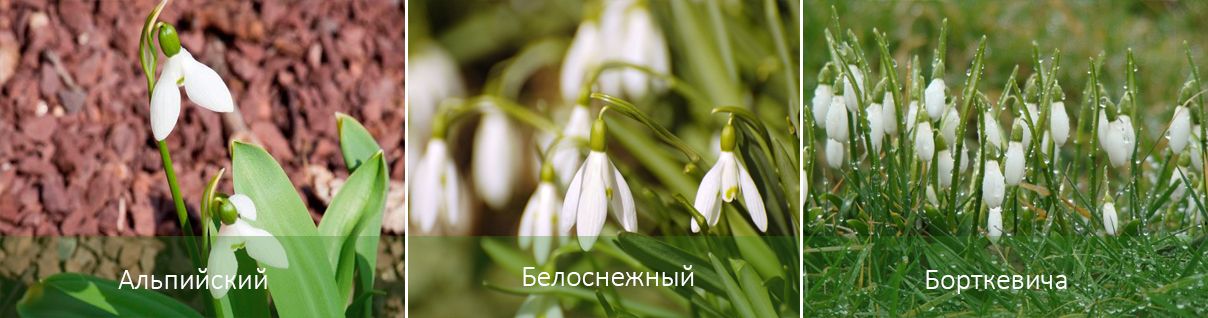
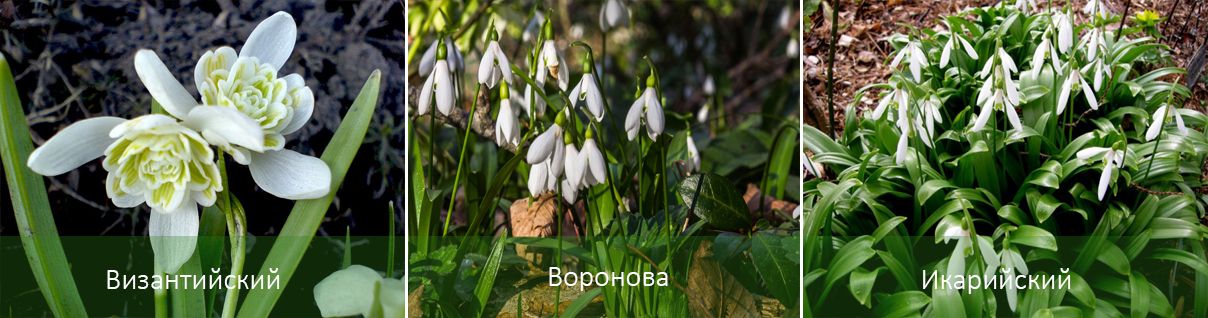
Byzantine
It belongs to the snowdrop family, although its flowers appear in autumn, not spring. It has a pleated appearance: three long white petals and many green, jagged petals with a white border. It grows wild on the shores of the Bosphorus, is cultivated in Western Europe, and is not widely distributed in Russia.
Voronova
In the wild, it is common in the foothills of the Caucasus along the entire Black Sea coast. It is cultivated in Europe and grows well in central Russia. The snowdrop is named after a renowned biologist dedicated to the conservation of rare plant species. The flower stalk grows up to 15 cm tall, with petals ranging from 2 to 4 cm in length. The bud is a standard cone-shaped flower that lasts up to 20 days. The leaves are narrow, up to 2.5 cm wide, folded, and slightly arched.
Icarian
Found in the wild only in Greece, it is successfully cultivated in other regions and is undemanding of soil conditions. It is distinguished by its dull-colored leaves and a green spot on the inner petals. The stalk is up to 20 cm long, and the bulb is small, up to 2 cm in diameter. The bud is up to 4 cm long, conical, with arching upper petals. It blooms in April, and the bud lasts up to 25 days.
Caucasian
A low-growing species found in the forests of Central Transcaucasia and Iran. The leaves are straight, narrow, and glossy. They grow up to 25 cm during the growing season and reach 15 cm during flowering. The flower stalk is short, reaching 20 cm. The bud is bell-shaped, up to 1.5 cm in diameter. The petals are white, narrow, up to 2.5 cm long. The inner petals have a green spot. It blooms in late March, lasts up to 15 days, and holds well in bouquets. It freezes out in harsh winters. In garden plots, it requires shelter.
Cilician
It grows in Asian countries at the foothills of mountains, and is found near Batumi. It is distinguished by its wedge-shaped bulb, up to 2 cm thick. The leaves are matte, straight, narrow, up to 1.5 cm wide.
The flower stalk grows up to 20 cm long. The elongated outer petals with an oval tip reach 3 cm, while the inner petals reach 1 cm, and are partially green at the base. It blooms in mid-March, and the buds last up to a week.
Folded
Found in Crimea, Moldova, and Ukraine. The bulb is ovoid, with pinkish scales, up to 3 cm in diameter.
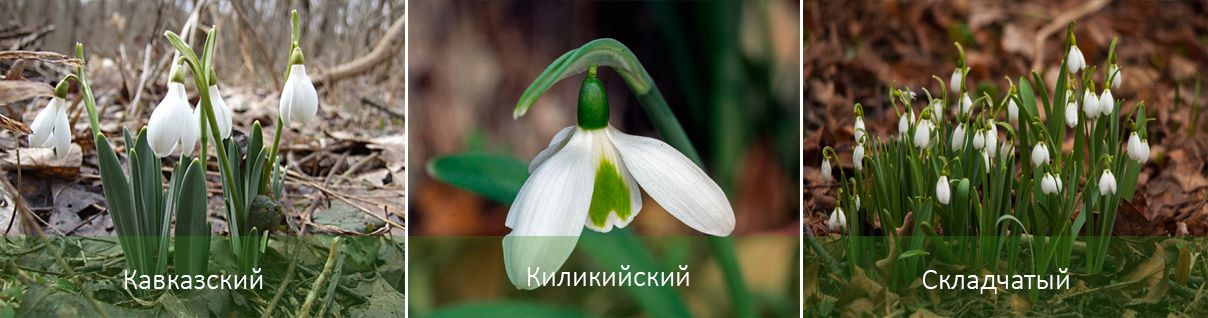
The glaucous leaves change color as they grow, from light to dark green, becoming glossy and arching toward the ground. The flower stalk grows up to 25 cm tall. The bud is large, conical, up to 4 cm in diameter. It appears in March and blooms for up to three weeks.
Broadleaf
Found in the Caucasus, it adapts well to temperate climates. The bulb grows large, up to 5 cm in diameter.
The leaves are straight, dense, and a rich green. The stalk grows up to 20 cm, the bell-shaped bud appears in April, and lasts for three weeks. The elliptical petals are up to 4.5 cm long, with the inner petals lacking a green spot.
Elveza
Common in Eastern Europe, this plant is named after the botanist who described it. It is distinguished by its bluish tint on the leaves (which develop a bloom) and the spherical shape of the bud. The petals are 5 cm long. The flower stalk is 25 cm high, and the leaves are 3 cm wide. It blooms from mid-February to mid-March and holds up well in bouquets.
Features of growing and propagating snowdrops
Primroses are rarely planted in separate beds. They are more often used to add color to landscape compositions in alpine gardens, flowerbeds, rock gardens, and rockeries. Snowdrops thrive alongside:
- with other bulbous flower crops: tulips, daffodils;
- perennial plants that bloom in autumn and develop during the dormant phase when the foliage dies off.
Snowdrops are resistant to recurrent frosts and temperature fluctuations, maintaining their decorative appearance even in the snow. Their leaves and flower stalks merely bend, then straighten up and continue blooming.
Galanthus bulbs are poisonous and require care when handling them. Protect your hands with gloves. Choose a well-lit location for planting, one that receives shade during the hottest part of the day. Delicate primroses do not like direct sunlight. Light, nutritious soil is preferable. Bulbs do not thrive in poor clay soils. Areas with a high water table should be pre-drained to prevent waterlogging.
When planting, the bulb is buried to a depth equal to three times its diameter. Daughter shoots are grown separately, at a shallower depth. As they grow, they do not deepen on their own and must be replanted. The bulb produces up to three bulblets annually, and over time, tussocks form on the plantings. Dividing the bulblets is recommended every six years. Broken areas are treated with crushed charcoal for disinfection. Daughter shoots are planted immediately, preventing them from drying out.
Propagation by seeds: sow in the spring, plant 2 centimeters deep, and water generously. The shoot will emerge in 20–25 days, but it will take 3–4 years for buds to appear.
When planting, the soil used to cover the bulbs is amended with distilled manure (no more than ¼ of the soil volume) and a complete fertilizer for bulbous plants is added. Follow the dosage instructions. Do not use fresh manure as top dressing, as excess nitrogen promotes fungal infections.
Snowdrops are prone to viral infections. If the leaves become brown and pale, the bulbs should be dug up and discarded to prevent spreading to neighboring plants. Fungal infections occur after a warm winter or with overfertilization. Natural fungicides are used for treatment. Chlorosis (the pale color of the leaves) is caused by a lack of micronutrients; in this case, a complex fertilizer such as superphosphate is used.
The following are considered dangerous pests:
- narcissus fly, whose larvae eat away the bulbs;
- onion nematode, the plant begins to wither;
- The moth lays eggs on the leaves.
Insects are wary of inspection treatments. Preventative spraying is carried out when the first winged insects appear. Rodents eat the bulbs, and the shoots eat the leaves. Wood ash is an effective repellent.
Top.tomathouse.com informs: several rules for growing snowdrops
Primrose lovers who grow snowdrops in their gardens maintain the plant throughout its life cycle. Here's what to keep in mind to ensure good blooms:
- Avoid planting in areas that dry out quickly, as this will reduce the number of flowers. In low-lying areas where meltwater accumulates, the bulbs will rot.
- After germination, the plant needs to be watered if there is little melt water or there has been no rain for a long time.
- It's best to divide mounds or separate the bulblets in the summer, when the snowdrops are dormant. After autumn replanting, the bulbs don't reach their full strength and don't form buds. Don't disturb the plants in the spring either.
- Only the yellowed leaves are trimmed when the growing season is over. The greenery provides nutrition for the new bulbs.
- During winters with little snow, snowdrops are covered with peat or light compost to prevent the soil from freezing. Heavy coverings are not used for snowdrops.
- During the flowering period, phosphate-based fertilizers should be used. Using other fertilizers is undesirable. Excess nitrogen causes excessive leaf formation and the plant begins to rot.
If favorable conditions are created, the flower will develop normally, producing abundant flower stalks every year.
Snowdrops don't require constant care. When planting in the right location, the plant will thrive and reproduce on its own. More buds will appear each spring.
You can achieve a staggered flowering season by planting several varieties of snowdrops, such as Elvesa, Snow White, and Plicate. They will delight you with delicate buds from early spring until the snow melts.