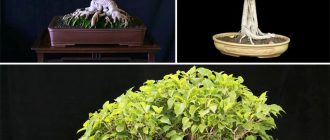
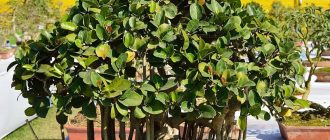
Polyscias is a tropical perennial native to Madagascar and the Pacific islands. It belongs to the small genus Araliaceae, comprising only a few dozen species. Translated from Latin, polyscias means "many shades," which refers both to the plant itself, with its lush, branched crown, and to its habitat—the understory shaded by tall trees. Polyscias occurs naturally in both shrubby and tree-like forms. Its foliage, which can have the most bizarre shapes and come in a variety of colors, lends this tropical dandy its decorative appearance.
Description
The long, branching roots of the polyscias plant intertwine to form a mesh-like structure, enveloping the soil on all sides. Young shoots and stems have greenish bark, which later takes on a brownish tint. An interesting feature of this plant's branches is their flexibility: they can even be tied into knots. The trunk of a young plant is densely covered with branches, but with time it becomes bare, leaving only the upper branches, forming the crown.
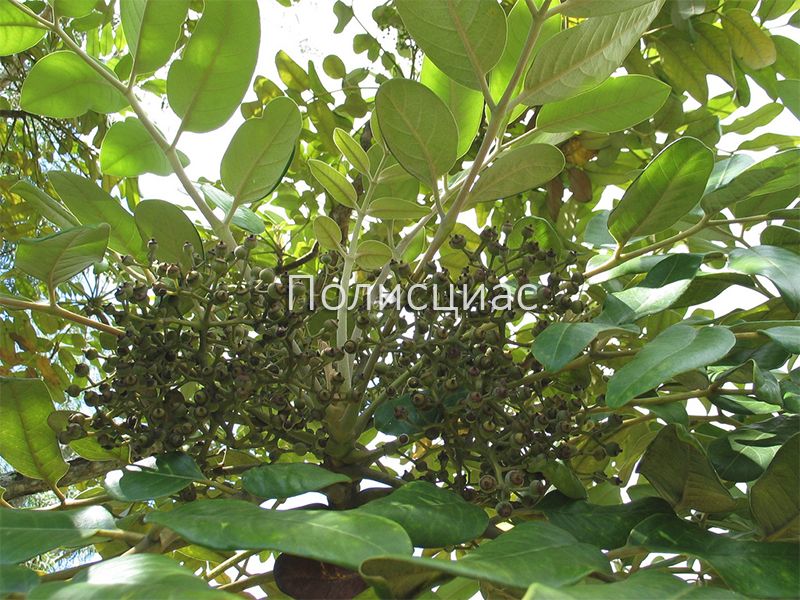
The leaf petioles are short and typically light green, but some varieties of Polyscias have leaves edged with stripes or spotted with white and beige. Leaf shapes can vary: pinnate, oblong, or round.
Polyscias flowers are small, white, gathered in umbrella-shaped clusters, and have virtually no scent. They can only be seen in the wild—polyscias never blooms indoors. The flowering period is followed by fruiting, but these fruits are short-lived and are not used in artificial cultivation.
Popular varieties for home cultivation
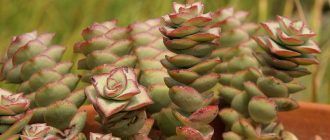
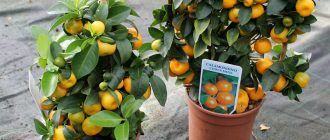
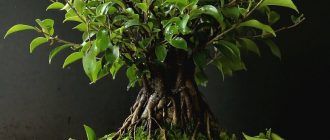
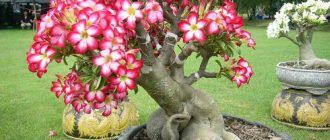
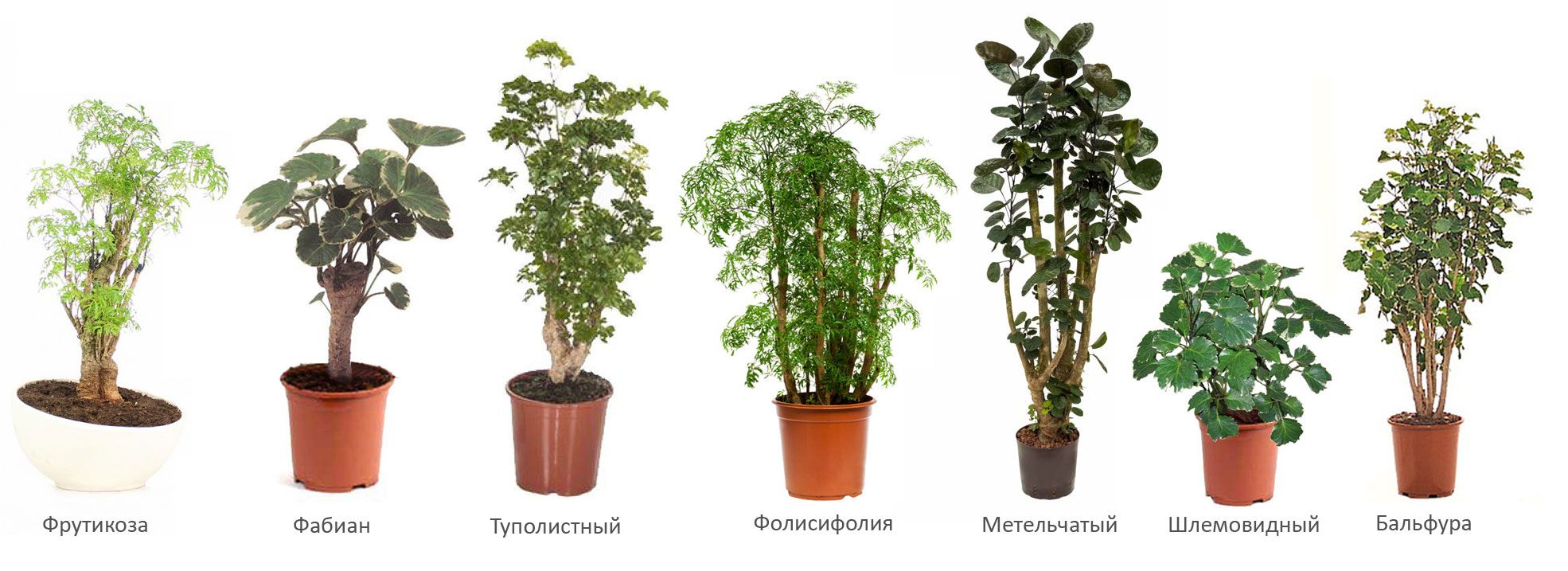
Among the many varieties of polyscias, there are some that are most popular for cultivation and home growing. They are shown in the photo below and vary in both appearance and price (which varies from one thousand to twenty thousand rubles in different stores):
- Fruticosa (shrubby) – grows to a height of two meters, with curly, elongated leaves about twenty centimeters long, with serrated edges. The foliage of this plant is edible and can also be used medicinally. There is a cultivar called "Robla," whose foliage resembles geranium;
- Fabian – the leaves are round, dark green with a purple tint. The thick trunk of this plant is covered with tough, wood-like bark. One popular cultivar of this species is Vertakt;
- Obtuse-leaved - a low bush covered with three- to five-lobed leaves, the surface of which is glossy, and the edge resembles a blade;
- Fern-leaved (also known as Folisifolia) – reaches two and a half meters in height. The appearance of its long, patterned leaves resembles a fern. The foliage grows in dense clumps, making the shoots resemble bouquets;
- Paniculata is a small shrub with small, oblong or pointed leaves with serrated edges. The "variegated" subspecies has light yellow spots on the surface of the leaves;
- Helmet-shaped – thin shoots extend upward from the main thick trunk of this plant, with virtually no branching. The leaves are trilobed, with a serrated edge, and are either solid or patterned. Some varieties of this species of Polyscias have spiny or lobed foliage. The "marginata" variety has leaves edged with a light border;
- Balfoura is a shrub whose shoots are covered with grayish-green bark. The leaves are large, rounded, trilobate, with an uneven light stripe along the edge. The "Pennosca" variety has more decorative foliage, with a marbled surface covered with whitish spots and a white border around the veins;
- Guilfoylia is probably the tallest of all the species mentioned. It reaches three meters in height, branches well, and has large, jagged-edged leaves edged with a yellowish or white stripe. Varieties known as "Victoria," "Bush," and "Branch" are grown specifically for indoor cultivation.
Care instructions: location, lighting, temperature, humidity, watering – seasonal chart
Polyscias is a demanding plant, caring for which at home does not present any particular difficulties, but it has its own nuances, presented in the table below.
|
Winter/autumn |
Spring/summer |
|
| Location | Avoid direct sunlight (or perhaps partial shade). The room should be well-ventilated and aired regularly. Do not place near a window, heater, or radiator, and avoid drafts. | |
| Lighting | Artificial lighting may be required in short daylight conditions. | The right lighting is bright but diffused, and for varieties with variegated leaves, brighter than for others. Variegated polyscias does not require shade. |
| Temperature | +17-20 degrees | +20-25 degrees |
| Humidity | High. Regularly mist the plant with room-temperature, settled, or filtered water. Rinse the leaves periodically with warm water. A basin, jar, or bucket nearby is ideal. A humidifier in the room is also helpful. You can place the plant pot in a container filled with wet sand or expanded clay. | |
| Watering | Three days after the top soil layer has dried out. | Water generously, and do so when the top layer of soil is dry. Loosen the soil between waterings. |
If you care for the plant according to these recommendations, it will delight you with its healthy and elegant appearance for a long time.
Selecting a container, soil, replanting, pruning
Polyscias requires a large pot with holes in the bottom. The larger the pot, the faster the plant grows.
A small bush cannot be planted immediately in a huge container - its roots will begin to suffocate, and the soil will become sour.
The container size is appropriate for the plant's height and age; repotting is then performed. Drainage, such as expanded clay, should be placed at the bottom.
You can buy soil at the store, or make your own by mixing two parts garden soil with one part peat and one part river sand. The mixture should be disinfected by rinsing it with water with a crystal of potassium permanganate added, or by thoroughly evaporating it.
Repotting is done as the plants grow: young plants are repotted once a year in the spring, adult plants - once every three years, also in the spring.
If the bush has reached a size where repotting is impossible, instead, renew the soil by removing the top layer and replacing it with fresh, fertile soil. To avoid damaging the root system and destroying the root ball, carefully loosen the soil around the roots, remove them, and transfer them to a new container.
There are two types of pruning for polyscias:
- Medicinal, designed to remove dried and weak branches.
- Decorative pruning is used to give the plant a more aesthetically pleasing appearance. This includes pinching the tips of shoots to maintain the desired crown shape, as well as pruning an overly long bush with exposed stems. This is a rather unsightly procedure, and the result is unpleasant to look at, but such pruning is beneficial for the plant, as it promotes the formation of a dense and lush crown. Polyscias can also be pruned to a standard, which limits its growth—this method is used for growing bonsai.
Top dressing
The best option is to use ready-made complex fertilizers sold in stores, both mineral (in powder or tablet form) and liquid.
During the warm season (the period of active growth and vegetation), the Policias is fed once every fourteen days, and once a month in the fall. In winter, the plant is left without additional feeding.
Reproduction
There are two ways to propagate polyscias:
- Division – during spring repotting, the plant is divided into two or more parts. During this procedure, young shoots are cut off and then replanted into smaller containers.
- Cuttings are taken from cuttings with two or more internodes (buds). The lower cut should be made at a 45-degree angle. The cuttings are planted in pots filled with a sand-peat mixture, heated from below, and covered with plastic film on top, or in a greenhouse-like structure. Within a month, the first young shoots will appear on the cuttings. Gradually, the covering material is removed—first for a few minutes a day, then completely.
The choice of the simplest method is up to the plant owner.
Top.tomathouse.com warns: Diseases and pests
The most susceptible to diseases are weak plants that are not maintained properly.
The most important conditions for the health of polyscias are optimal lighting, humidity, watering and temperature, the standards for which are given above.
Insufficient humidity or overwatering can cause leaves to fall off. Cold, drafts, icy water, and low room temperatures can lead to gray mold. Dry air can cause the foliage to turn brown, which can eventually lead to plant death. There's only one treatment: adjust the conditions and bring them back to normal.
Among the insects that cause harm to polyscias, the most common are:
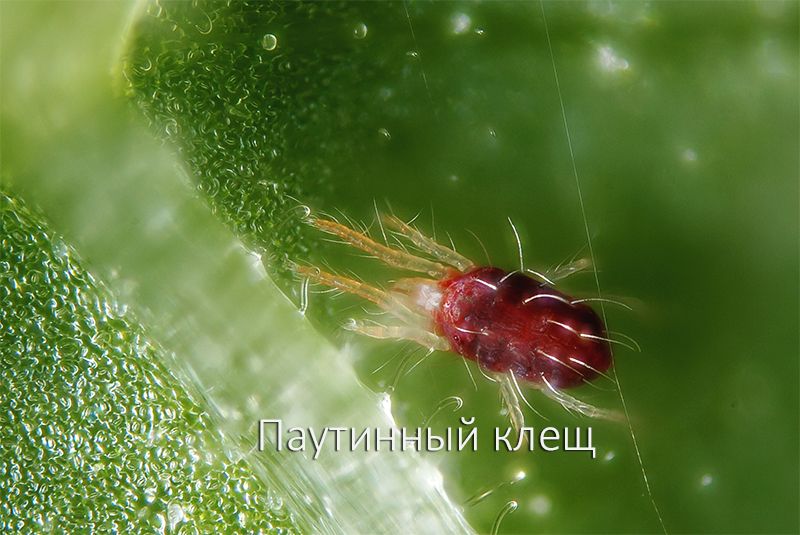
- Spider mites can be controlled using folk remedies, such as boiling onion peels and applying the decoction to the plant, or using tobacco. If this doesn't work, resort to chemicals;
- Aphids - these pests are collected by hand, and the leaves affected by them are cut off, then insecticide treatment is carried out;
- Scale insects are insects that can be identified by the reddish growths on the foliage. To remove them, you can wash the plant with soapy water and scrub it with a soft brush. Insecticides available in stores are also effective against scale insects.
Benefit or harm?
One of the most unpleasant properties of polyscias is its toxicity. Its sap can cause chemical burns, and contact with skin, mucous membranes, or eyes is unacceptable. Wear work gloves when pruning and caring for the plant, and wash your hands thoroughly with soap after each procedure.
At the same time, the plant looks beautiful and unusual, and can decorate any home. A few plants can transform a room into a tropical haven. This perennial shrub is a suitable candidate for bonsai cultivation—a dwarf tree, growing which is an interesting and exciting hobby.