Garlic is one of the most ancient medicinal plants and spices. It's also relatively easy to grow. It can be planted in the fall or spring, but the best time is considered to be autumn, before frost sets in.
Content
Benefits of Fall Planting
Garlic is divided into winter and spring varieties. The difference lies in planting time. Winter garlic is planted in the fall, while spring garlic is planted in the spring. However, winter garlic has several advantages:
- In the spring, there are many urgent tasks to do in the garden and vegetable patch, unlike in the fall, when all the harvest has been collected.
- Winter crops are not afraid of frost or harsh winters. But the tender shoots of spring crops die when temperatures drop.
- Spring garlic may dry out by spring due to storage.
- Winter crops, as a rule, are not subject to attacks by diseases and pests, unlike spring crops.
- Autumn planting does not require careful care, as the soil is quite moist.
- A bountiful harvest of winter garlic is obtained already in the first summer months, unlike that planted in the spring.
Requirements for planting garlic in winter
Garlic is considered a moderately demanding plant. However, it's still necessary to follow some guidelines when planting it.
Deadlines
It is planted two weeks before the onset of frost. The recommended soil temperature is 10° C, or lower.
| Region | Depth (cm) | Deadlines |
| Average (Moscow region) | 5 | end of September – beginning of October |
| Southern | 3 | beginning of November |
| Northern (Urals, Siberia) | 5 | September |
If you plant garlic deeper than 10 cm, you can extend the planting period in cold climates to mid-August to October. This will allow the vegetable to root better and survive the winter.
Lunar calendar 2023
The best days for planting garlic in winter in 2023 are the following:
- September — 3 (from 18:00)-5 (until 23:05), 8 (from 07:59)-10 (until 19:35), 16-18 (until 07:58).
- October — 1-12, 16-22 (until 09:06).
- November — 3 (from 18:00)-5 (until 23:05), 8 (from 07:59)-10 (until 19:35), 16-18 (until 07:58) for the Southern regions.
Unfavorable days:
- September - 14, 15, 28, 29, 30.
- October - 14, 15, 28, 29.
- November - 12, 13, 14, 26, 27, 28 for the Southern regions.
Selection of seed material
Select firm, healthy onions. Separate them into cloves. The cloves should be large and fleshy.
Tip: Do not use garlic grown for food.
Before planting, soak the plant in a weak solution of potassium permanganate or copper sulfate for 24 hours. Other solutions can also be used.
When using species that do not bolt, it is necessary to take only the outer cloves.
Location, soil
The garlic planting site should be warm and receive at least six hours of sunlight per day. The bed should be oriented north to south.
Garlic thrives in well-drained, humus-rich, and slightly sandy soil. Avoid adding fresh manure, as it can burn the bulbs and make them more susceptible to disease.
Garlic's best predecessors in garden beds include tomatoes, cucumbers, zucchini, pumpkin, and legumes. Potatoes, root vegetables, and onions are undesirable.
Preparing the garden bed
It is better to prepare the landing site a month before the expected planting:
- Fertilize the soil. Per square meter: 10 kg of rotted leaves, 250 g of chalk, 500 g of ash, 2 tablespoons of potassium sulfate, and one tablespoon of superphosphate.
- Distribute and dig the bed. Its width should be no more than a meter, and its height 30 cm.
- If there is no rain, water to ensure greater soil settlement.
- To prevent diseases, treat the soil with a 1% copper sulfate solution. Then cover with plastic wrap.
- The day before planting, distribute urea (a tablespoon per square meter) and water.
When planted directly into dug soil, garlic sinks deeper as the soil settles, growth time increases, and yield decreases.
Plant peas, oats, and white mustard near the prepared bed (40 cm). When the garlic sprouts appear, plant them between them. This will help retain snow on the plants and provide moisture in the spring.
Planting technology
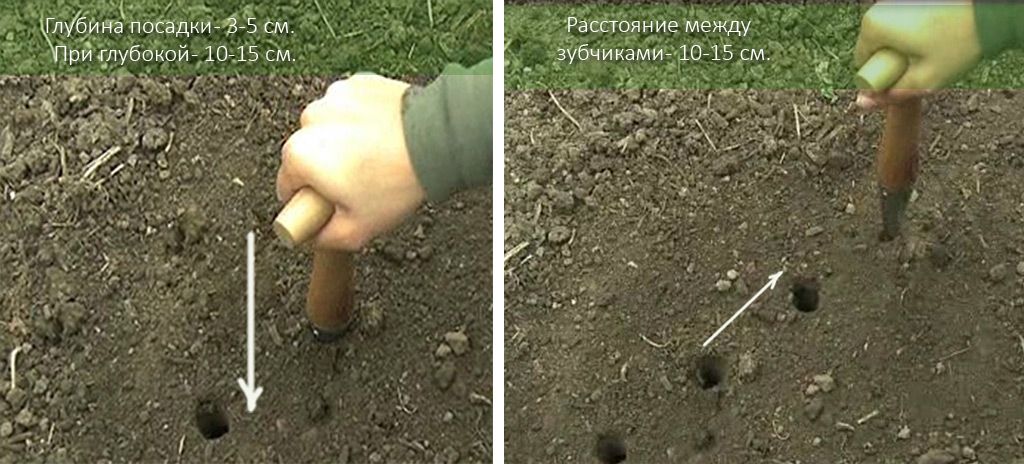
- If the soil is dry, water the bed before planting. Plant the cloves 10-15 cm apart, 20-25 cm apart, and 3-5 cm deep. Deep planting, 10-15 cm, is also possible.
- Fill with soil, level and compact the soil with a rake.
- Mulch the bed (with peat, leaves, sawdust, spruce branches) approximately 5 cm. In the spring, do not forget to remove the mulch from the sprouts.
Top.tomathouse.com recommends: an alternative planting method
Along with the standard method, there's another—the lazy one. It's good in the following situations:
- the need to save space and time;
- single plantings to protect strawberries, shrubs, trees and other crops.
Step-by-step instructions
- Choose varieties with no more than five cloves per bulb. The selection must be thorough, ensuring the bulbs are firm and free of rot and disease.
- The top scales are removed, the bottom is cut off from the roots, the stem is left at a height of about 5 cm.
- The prepared material is soaked for a quarter of an hour in a weak saline solution (half a tablespoon of salt per liter of water).
- The planting depth is at least 10 cm, with a distance of about 30 cm between the heads.
- More abundant feeding is required than with standard planting. Fertilizer is added directly to the holes. A teaspoon of compost mixed with garden diatomaceous earth is used.
- The head is placed on the bottom and pressed down lightly. If the soil is infertile, compost is placed on top.
Garlic is a plant that protects against pests and diseases.
It's recommended to plant this crop near planned plantings of tomatoes, cucumbers, lettuce, carrots, beets, and potatoes. It also works well near strawberries. However, avoid planting it near legumes and cabbage.