Gooseberry is a perennial berry bush, one of the most undemanding. It is distinguished by its exceptional productivity, resilience, and rich vitamin content.
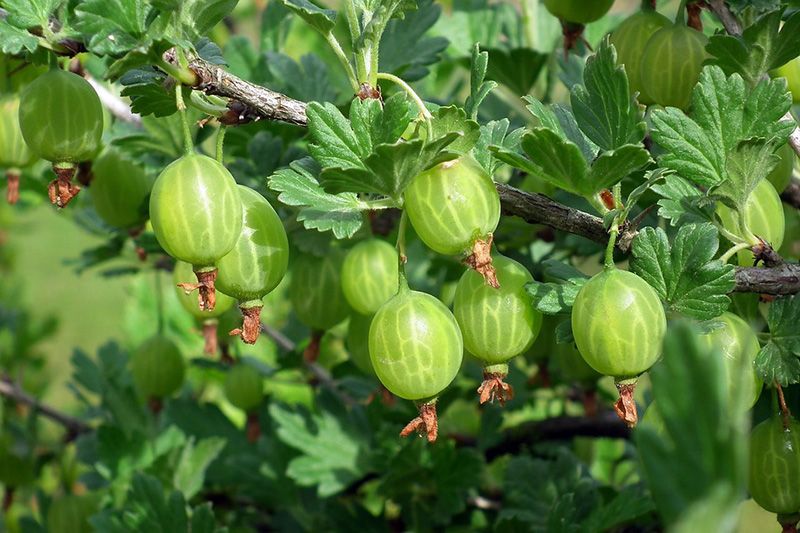
The need for landing
Gooseberries contain vitamins C, B, and A, as well as up to 20% sugar. In the Moscow region, where small gardens are easy to grow, having at least one gooseberry bush is essential for family health. Gradually incorporating gooseberries into your diet reduces the risk of hypertension and many other cardiovascular diseases.
Planting dates
At the seedling market, you can usually find gooseberries with bare roots. To ensure their establishment, they are planted before the buds swell or after the bush has finished flowering. The best times of year are spring and fall. When choosing the optimal season, consider the region where you are planting.
Autumn
In southern Russia, it's not a good idea to plant gooseberries in the spring, as the heat prevents the seedlings from establishing themselves and the plant dies. However, in the fall, with moderate temperatures for two to three weeks, the plant's root system has time to adapt and recover.
The optimal planting time is from September 15 to October 15. The first harvest can be collected the following summer. Don't delay planting. The plant won't have time to adapt to the new location and won't survive the onset of cold weather.
Spring
In northern regions, planting occurs in the spring. Thanks to the mild climate, the gooseberry root system easily adapts to the new soil within a few months, thus preparing for the long winter.
When planting at this time of year, it's important to begin the process as early as possible, before the plant's sap begins to flow. Otherwise, the seedling may die.
For spring, it's best to choose seedlings with a closed root system. The plant is protected by a ball of soil, which retains moisture and promotes favorable adaptation to new conditions.
Summer
For this, you need to purchase special seedlings. These are bushes packed in a sturdy container. This way, the plant doesn't experience much stress and takes root much faster. Summer heat won't have much of an effect on it.
In the central part of the country, planting can be done in either season thanks to the favorable climate. However, gardeners still prefer to plant in the fall or late August.
Selecting a seedling
Two-year-old seedlings are ideal for planting. They have developed stems and leaves, and the roots and shoots are 20-30 cm long. When planting, only 3-4 buds should remain, and the stems and any excess are trimmed. This process helps the bush survive with underdeveloped roots.
If you're planting a bare-root seedling, it's important that the shoots have already hardened this year. Don't delay replanting; it should be done within three days.
Seedlings with closed root systems tolerate transplanting best. The soil should not crumble or dry out. If they outgrow the protective covering, it's worth combing them out with your hands.
Any type of seedling needs to be watered generously, regardless of the time of year.
Selecting a location and soil
To ensure that the plant takes root without difficulty, several criteria must be taken into account:
- The area should be free of high-rise buildings and tall fences. These are detrimental to gooseberries, blocking them from the sunlight needed for a good harvest.
- The location of trees and large bushes nearby interferes with the proper development of gooseberries, as they lack nutrients.
- The place where the bush grows should be ventilated, but strong winds can destroy the plant.
- The groundwater level should be more than one and a half meters above the soil surface. The closer it is, the faster the roots will rot, which will lead to the death of the plant. If necessary, create a small raised bed.
- Soil rich in organic matter has a positive effect on gooseberry growth. If it lacks sufficient micronutrients, it should be fertilized before planting.
- Compost, manure, and plant humus are the most common and effective soil amendments. Additionally, superphosphate, potassium chloride, or urea can be used, but in individual doses. It all depends on the quality of the soil and its chemical structure.
Planting diagram
There are several gooseberry planting schemes. The choice depends on the variety and the area where the plant is being planted:
- Loosening involves thinning twice. Plants are spaced 75 cm apart, leaving 1 meter between rows. When the crowns of the bushes begin to touch (this will happen in a few years), they need to be thinned out by replanting some of them. This procedure should be repeated as needed.
- With subsequent thinning – at a distance of 1.5 meters and between rows of 2 meters.
- Between trees – a 4-meter row spacing is ideal, allowing the bush to grow well. When the plant reaches the desired size, touching the tree crowns, it is dug up, keeping a distance of 30 cm from the trunk, for replanting.
Step-by-step planting of gooseberries
It is important to take all points into account to avoid the death of the plant:
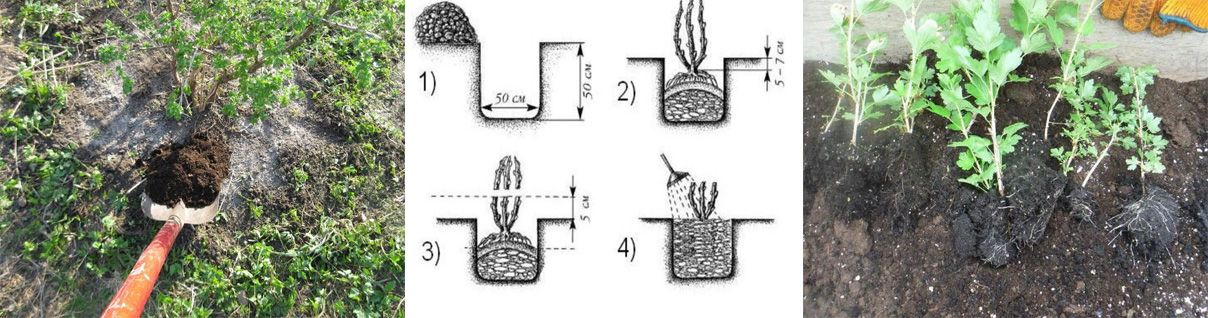
- The depth of each hole should depend on the size of the seedling's root system. Typically, it's between 40 and 55 cm in diameter. The hole should be prepared in advance.
- When creating holes for a plant, it is worth setting aside layers of soil in different places, as they have different compositions of microelements.
- Fertilizer is prepared in advance - humus or compost:
- 200-300 g of superphosphate;
- 300 g of ground wood ash;
- 60 g of any fertilizer with a high potassium content;
- 50 g of limestone.
- The fertilizer is poured into the hole. Its volume should not exceed 10 liters.
- Then, fill in the top layer of excavated soil to avoid direct contact with the concentrated fertilizer. The soil should fill the hole to a depth of 10 cm.
- The seedling is placed on top and should be upright. The roots should be straightened out, positioned vertically without damaging them.
- The roots of the gooseberry are covered with the bottom layer of soil.
- Water and soil are combined when planting. The optimal volume of liquid for each plant is 10 liters (1 bucket).
- To avoid the formation of voids, the soil around the seedling is compacted by hand.
- The root collar should be 5 cm deep in the soil, and only then can you stop burying the seedling and water it for the last time.