Gardeners claim that peonies can grow outdoors for over twenty years, provided they are planted and cared for properly. These bushes adorn any plot with their lush buds.
Peonies will only thrive if planted correctly. Therefore, it's important to know the timing, location, and other details.
Peony planting dates by region in 2024
Planting outdoors in autumn is the most preferable. By September, the root system has developed, and the plant has time to recover from the growing season and gain strength.
In autumn, planting should be done one to six weeks before the onset of frost. This ensures the bush will establish itself before winter.
In spring, bare-root seedlings have a very difficult time planting and transplanting, and they take a long time to recover. To improve this situation, it is recommended to plant as early as possible, after the snow has melted and temperatures are not expected to drop below -5 degrees Celsius.
Planting times in spring and autumn depend on the region and its weather conditions:
- In Siberia, planting takes place in August and the first two weeks of September. In the northern part, it should be completed six to eight weeks earlier than in the south. In spring, it should begin six weeks later than in the south, approximately May to early June.
- In the Urals, planting occurs from the second ten days of August to mid-September. In spring: late May to early June.
- Peonies are planted five to seven days later in the central and northwestern regions (the same applies to the Moscow region). In spring: May.
- In southern regions, peonies should be planted from September to mid-October. In spring, the best time to plant peonies is mid- to late March.
Always monitor weather conditions. Cover planted plants.
This doesn't apply to plants with closed root systems (grown in boxes or pots). These peonies can be planted from early spring to fall (even during the hot summer months of June and July).
Peony planting dates according to the 2024 lunar calendar
The dates of spring and autumn when peonies can and should not be planted are listed in the table.
| Month | Favorable and the most favorable days | Unfavorable, prohibited days |
| March | 1-6, 13-15 (until 06:15), 26 (from 10:00 a.m.) - 31 | 7-8, 9 (from 12:00 p.m.),10,11 (until 12:00),24 (from 10:00 a.m.), 25, 26 (until 10:00 a.m.) |
| April | 1 (from 07:04) - 3 (until 12:07), 5 (from 14:12)-7 (until 14:24), 25, 28 (from 12:37 p.m.) -30 (until 6:20 p.m.) | 3 (from 12:07 pm) -5 (until 14:12 pm), 7 (from 9:20 p.m.),8, 9 (until 21:20), 23, 24, 30 (from 18:20) |
| May | 2 (from 21:52)-4 (until 23:40), 25 (from 18:36) - 27, 30 (from 03:32)-31 | 1-2 (until 21:52), 7 (from 06:22), 8, 9 (until 06:22), 22 (from 16:52), 23, 24 (until 16:22), 28-30 (until 03:32) |
| August | 1-3 (until 14:08), 8 (from 12:31)-11, 15 (from 20:51)-17, 20 (from 21:25)-21, 24-26 (until 06:04) | 3 (from 14:13), 4, 5 (until 14:13), 18, 19, 20 (until 21:25) |
| September | 4 (from 19:11)-7 (until 08:18), 12 (from 05:36)-14 (until 10:52), 16 (from 12:39), 20 (from 12:02 pm) - 22 (until 1:23 pm) | 2 (from 04:55), 3, 4 (until 04:55), 14 (from 10:52 a.m.)-16 (until 12:39 p.m.), 17 (from 05:34), 18, 19 (until 05:34) |
| October | 9 (from 12:38 pm)-11 (until 19:31 pm), 18 (from 14:26 pm)-19, 29 (from 07:29) - 31 (until 20:29). | 1 (from 21:49), 2, 3 (until 21:49), 11 (from 19:31 pm)-13 (until 22:55 pm), 16 (from 14:26), 17, 18 (until 14:26) |
Peony seeds: selection and preparation
The planting material chosen should be small. A typical division has a rhizome length of about twenty centimeters and three to five replacement buds. For example, the Holland variety is five to eight centimeters long and has one to three replacement buds. Peonies with these parameters take root much better than larger specimens.
Planting large, undivided bushes is not recommended. They produce buds in the first year, but the old rhizomes quickly die. This inhibits the formation of new shoots, causing the peony to become weak, bloom poorly, and may even die.
Old, poorly formed plants are dug up and cleared of soil. Fresh sections containing replacement buds and young roots are cut off with a sharp knife. These can be used as planting material.
Small specimens are pre-planted in a nursery bed. Planting is done according to a specific pattern (15-20 centimeters in a row, 50-60 centimeters between them). The seedlings require careful care. Well-growing specimens can be transplanted to their permanent location after a year, while the rest can be planted as they develop.

How to choose a location and soil for planting peonies, what is suitable
Peonies love warmth and light. They tolerate light shade for up to three hours a day. It should also protect the plant from direct midday sun. They are sensitive to north winds and drafts. The location should be chosen for several years, not just one.
Within three to five years, the root system will grow to 70-80 centimeters. Therefore, a site with deep groundwater should be chosen. It's also important to avoid flooding from melted snow. Excessive moisture will cause the rhizome to rot and the plant to die.
The soil for planting should be moderately to slightly acidic. Peonies thrive in loose, nutrient-rich soil that allows for air circulation.
When planting in sandy soil, it is amended with humus, peat, ash, dolomite flour, and garden soil. If peonies are planted in dense clay soil, it is mixed with sand or peat (this creates an airy, loose substrate). Sand is also added to nutritious, yet quickly compacting, black soil.
Preparing the soil for planting peonies
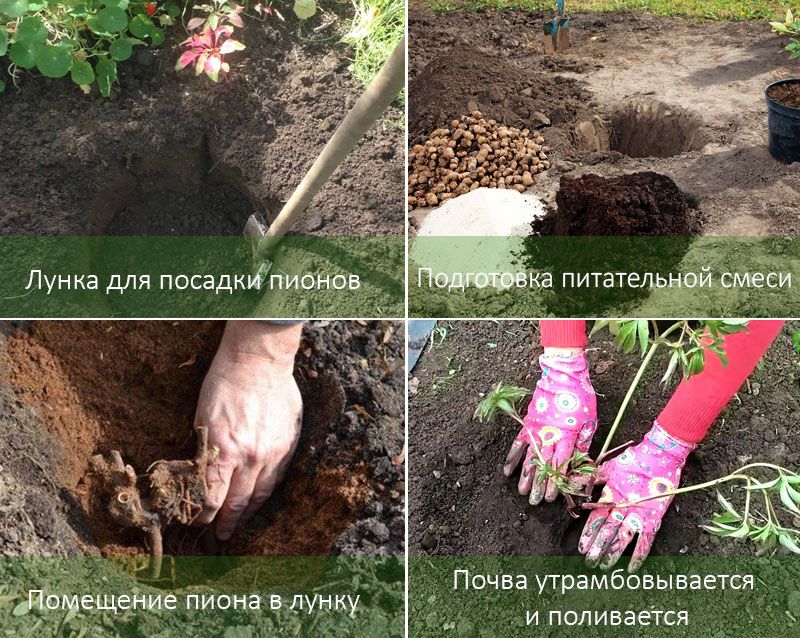
This stage is crucial for proper growth, development, flowering, and longevity of the plant. Holes are dug four to six weeks before planting. This allows the soil to settle to the desired level. The holes are spaced 80-100 centimeters apart (if they are dug too close together, the plants will grow poorly). The holes are 60-70 centimeters deep and 55-70 centimeters in circumference.
A mixture of:
- compost soil;
- peat;
- manure;
- potassium sulfate 150 grams;
- bone meal 350 grams;
- superphosphate 170-200 grams;
- 140-170 grams of crushed slaked lime (when the soil is clayey).
The mixture is mixed with the top layer of soil and compacted slightly. The nutrient mixture should fill the hole halfway.
Rules for planting peonies
When landing, the following rules must be observed:
- Tree varieties are planted at a depth of 80 centimeters, while herbaceous varieties are planted at a depth of 60 centimeters. The hole diameters are 60 and 50 centimeters, respectively.
- The bottom of the hole is lined with a drainage layer to avoid moisture stagnation.
- The hole is filled with nutrient substrate.
- After placing the straightened roots in the soil, cover them with an additional 15-20 centimeters of soil to prevent the buds from remaining on the surface of the substrate. Otherwise, the growing point (the most delicate part of the peony) will remain unprotected from external factors: scorching sun, cold wind, frost, and so on. However, planting the plant too deeply is also not recommended. Although it will produce lush foliage, it will bloom poorly or fail to form buds at all.
- The soil is compacted and watered (8-10 liters of water per plant).
- When planting in summer or fall, peonies are mulched with peat (a 10-centimeter layer). You can make your own nutrient-rich substrate for filling the hole before planting or purchase it from specialty gardening stores. If all planting requirements are met, peonies will grace the garden with their lush buds for many years, without requiring frequent repotting or replanting.
Mistakes when planting peonies and their prevention
Gardeners often buy peony shoots in late winter or early spring. However, novice gardeners make a serious mistake that can ruin the plants: storing them in unsuitable conditions before planting.
Peonies are perennials that require a "cold start" (this also applies to hybrids). This means that the seedlings will begin to develop rhizomes only at low soil temperatures (0 to 10 degrees Celsius). If kept on a heated windowsill or near a radiator, they will produce numerous buds. This may initially seem like a good sign. However, such shoots quickly die. This happens because at high temperatures, all the nutrients from the soil are drawn into the above-ground parts (the foliage). The roots quickly exhaust their remaining reserves and die.
To protect the flowers, wrap them in plastic wrap and store them in the vegetable compartment of a refrigerator or in a cool cellar at a low, above-zero temperature. You can also bury the cuttings in a snowdrift on the north side of the building. It's recommended to keep them under the snow until it melts. Don't worry about the shoots; this natural storage method won't harm the plants.
Once the soil has warmed slightly, the peonies are planted in the nursery bed. They are then mulched with peat. By autumn, the shoots will be well established and will tolerate transplantation to their permanent location well.
Hobby gardeners make mistakes that cause peonies to fail to produce buds at all or to fail to open them. The most common ones are:
- the growth point is placed too deep in the soil (deeper than 5 centimeters) or, on the contrary, is located high above the ground (higher than 2-3 centimeters);
- the bushes are planted in a place that is too shaded or damp;
- the cuttings are very small in size;
- the seedlings are too large, there are not enough nutrients in the soil for flowering;
- the plant is too old, it needs to be replanted with division;
- the soil has high acidity, it must be reduced by adding lime or wood ash;
- a large amount of nitrogen fertilizers was applied;
- the buds froze in the spring (the plant needs to be mulched for the winter);
- the leaves were cut off early last year;
- the plant was affected by rot because preventive measures were not taken;
- Last season the flower was poorly watered and fertilized.
To encourage a perennial plant to bloom, factors that hinder this process must be eliminated. Repotting to a more suitable location, carried out according to all rules and regulations, is usually necessary. If the bushes are not blooming due to disease, they should be treated with special commercial fungicides. Bayleton 0.1%, Topsin M 2%, Fundazol 0.2%, and Azofos are effective against gray or bacterial rot.