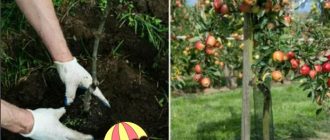
One of the most beloved and sought-after crops in our gardens is the plum. Native to Asia, it quickly spread across Europe, eventually reaching Russia. For this easy-to-grow shrub to thrive and produce a bountiful harvest, it requires not only good care but also proper planting. In temperate climates, spring planting (April) is preferable. However, fall planting, if done properly before mid-October, is also possible.
Content
Advantages and disadvantages of autumn planting of plums
Planting plums in autumn has its advantages:
- If the plant does not survive the winter, it can simply be replaced with another one in the spring.
- Return frosts will not affect the planting time – the tree is already in the ground.
- Awakening buds require moisture and nutrition, and soil compacted by this time will provide everything necessary.
- The specimen will begin to bear fruit a season earlier than if planted in spring.
- A seedling dug up in the fall is not sensitive to damage to the root system, since it was removed from the soil after the end of the growing season.
- There is no need to store the tree in a trench for spring planting.
- Double dose of nutrition (during autumn replanting and spring care).
There are some disadvantages:
- The plant requires careful insulation for wintering.
- Plum planting should be carried out after the end of the growing season, but not less than 3-4 weeks before the onset of frost.
- The impossibility of continuous monitoring of the seedling's condition.
- Winter, with its fluctuating temperatures, is very difficult for young trees to establish themselves. Many specimens die during the winter.
Timing for planting plums in open ground in autumn
Planting plum trees at the right time is especially important in the fall, so the seedlings can establish themselves before frost sets in. It's best to do this 30-45 days in advance.
By region
In different climatic conditions, the onset of frost occurs at different times, so the timing varies for different regions.
| Region | Planting dates |
| Middle zone | end of September - beginning of October |
| Moscow, Moscow region | first half of October |
| Siberia, the Urals, and the Leningrad region | September |
| South | end of October |
According to the lunar calendar of 2023
The gardener decides for himself whether to take into account the recommendations of the Lunar calendar.
| Month | Favorable numbers | Unfavorable and forbidden numbers |
| September | 3 (from 18:00)-5 (until 23:05), 16-24, 27 | 14,15, 28 (from 12:58 p.m.), 29, 30 (up to 12:58 p.m.) |
| October | 1-3 (until 08:02), 8-12, 16-19, 20-22 (until 09:06) | 14,15,28,29 |
Planting plums in open ground in autumn step by step
To ensure the seedling takes root and survives the winter successfully, follow these rules when preparing for planting:
- The planting hole should be dug in advance, several weeks before planting.
- The size of the hole is 70x70x70, if there are several seedlings or a whole row, the distance between them should not be less than 3 m.
- A drainage layer of 10-20 cm of broken brick, gravel with sand, and small stones is placed at the bottom of the pit to drain spring waters.
- The next layer is organic matter. This can be mature compost or humus.
- A 3-5 cm layer of regular soil follows to prevent the seedling's tender, fragile roots from being burned. The temperature of the organic layer will be much higher than that of regular soil, and adequate autumn nutrition will trigger the onset of vegetation (swelling and bud break) in winter. This must be avoided. The organic matter is being laid down for the seedling to use in subsequent seasons, as the tree will grow in this location for many years.
- Mix the remaining planting soil with half organic matter and wood ash (0.5-1 l). This soil will be used to fill the hole when the plant is placed.
Choosing a Plum Tree + 5 Best Varieties
Some tips:
- When choosing a seedling, focus only on zoned varieties.
- Self-fertility is crucial to consider: many plum varieties require pollination, otherwise fruit will not set. Self-fertile varieties produce better fruit when pollinating plums are nearby.
- For a small garden area, it is better to purchase low-growing plum varieties (up to 2 m).
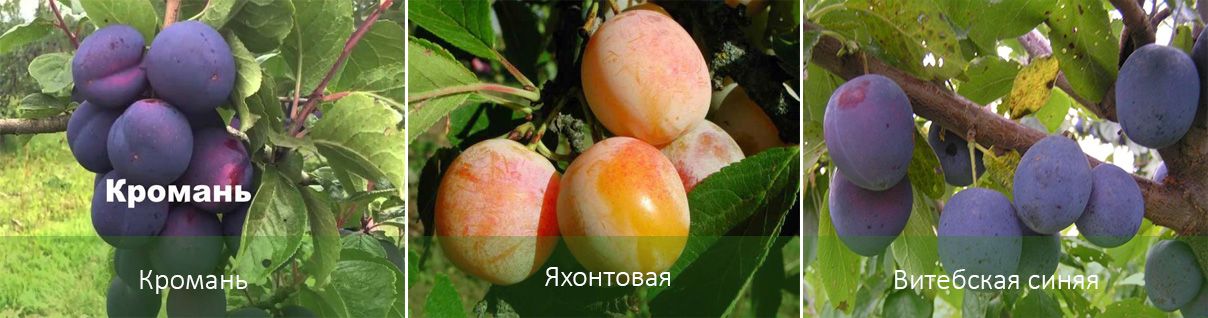
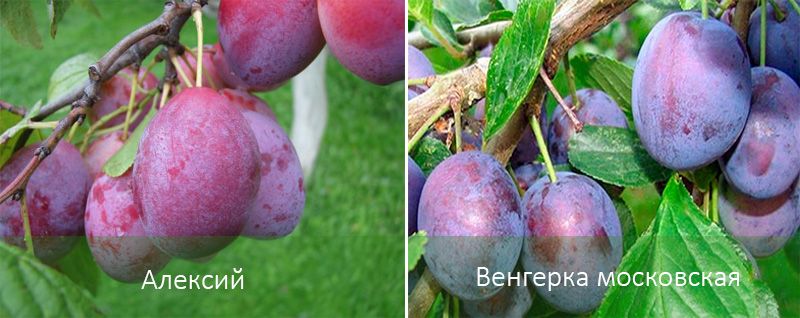
A table of the best varieties for the Moscow and central regions will help.
| Name | Ripening period | Self-fertility | Color, weight (in grams) and taste qualities on a point scale (1-5) |
| Kroman | Early | Full | Dark blue; 35; 4.7. |
| Yakhontovaya | Early | Partial | Yellow; 30; 5. |
| Vitebsk blue | Mid-season | Full | Blue; 32; 4. |
| Alexey | Late | Full | Dark purple; 20; 4.5. |
| Moscow Hungarian | Late | Full | Dark red; 20; 3.7. |
For the partially self-fertile Yakhontovaya variety, the best pollinators would be Skorospelka Krasnaya or Pamyat Timiryazeva.
Planting and caring for plum trees in Siberia are the same as throughout Russia. It's important to choose a regionalized variety that can thrive and bear fruit in the harsh Siberian winters. Another important consideration is cultivating the plant as a low-stemmed bush.
Choosing a location for planting plums
In the first years, the main function of the plum tree is to increase vegetative mass, that is, to grow in width and height.
Plum trees will reach full fruiting later. However, proper development and harvesting begins when the planting site is selected.
This crop is wary of drafts and freezes in the cold of lowlands where damp air stagnates. It strongly dislikes shade. It can tolerate partial shade, but will produce its best harvests in a well-lit location.
Experienced gardeners plant plums under the protection of fences and houses, but taking into account the daily light.
Soil for plum
Plum prefers fertile, loose soil with a neutral pH. Whether the soil is loamy or sandy, the main requirement is that the tree receives a regular supply of sufficient nutrients.
- Clay soil is not suitable for plum trees. Despite its rich composition, it retains moisture, which is not tolerable for plum trees. Also, during drought, the tree's roots cannot find water in clay soil and will die without regular watering.
- Plums will not grow well in acidic soil, so owners of such plots add an acidifier to the planting hole. Slaked lime, dolomite flour, and even regular wood ash can be used for this purpose.
The crop is completely unsuited to waterlogged conditions. Stagnant moisture is fatal. - Swampy areas and soils with high groundwater levels are absolutely unsuitable. If the owner of a low-lying plot decides to plant a tree, it will only grow on a raised bed with at least 1.5 meters of water.
Step-by-step instructions for planting plums in open ground in the fall
Detailed step-by-step instructions on how to properly plant a plum tree in the fall:
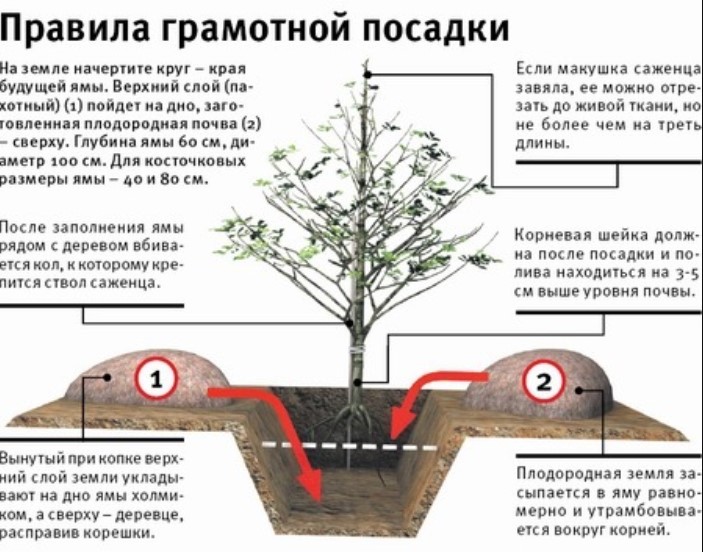
- A wooden stake is driven into the center of a hole prepared a month or two beforehand; it will serve as a support for the plant during the first years of its life.
- A mound is formed from the soil removed in advance, on which the seedling will be placed.
- The roots are carefully inspected: damaged or unhealthy roots are removed, any that are too long are trimmed, and any dried roots are soaked in water. Do not shake off the soil the tree was in when you purchased it.
- The plant is placed in the center of the planting hole, directly on the mound. The roots are spread out along the edges and carefully covered with soil. The stake is placed 5-7 cm to the north. The soil should not cover the root collar; it should remain 3-5 cm above.
- The tree roots are then covered with soil, carefully compacted to prevent underground voids from forming in the hole.
- Tying a seedling to a stake is only possible with a thick cord or a piece of fabric, but not with wire.
- The last stage is abundant watering (up to 2 buckets per plant), after which - loosening the soil and mulching the soil around the trunk.
This crop is easy to grow; even a beginner can handle it. The key is proper planting and subsequent care. This includes fertilizing, weeding the tree's surrounding area, shaping and thinning the crown, spraying for diseases and pests, removing root suckers, and whitewashing the trunk to prevent frost cracks.
Gardeners' reviews of plum planting in autumn
Plant the plum in a permanent spot, and don't bury it. Last year I planted a bunch of apple trees, a cherry tree, and two plum trees, and only the plums survived out of the whole "crowd" of seedlings. Their tops froze, and they started growing from the roots! I added some "Autumn" fertilizer and a little humus to the hole, and watered it well before winter, which probably helped. Although I sprinkled everything on the apple trees too, the plum trees turned out to be more frost-resistant, so give it a try! (And tell me, if you bury them, will they overwinter better??? I'm just curious, I'm also a novice gardener.
)
A plum tree planted in the fall, although this is the best time to transplant, may not have taken root for several reasons. For example, the fall was quite dry, and you didn't provide adequate watering—plums love moisture. Or the winter was very cold, the ground froze deeply, and the roots died. Perhaps you chose an unsuitable planting location—heavy or rocky soil, a shady spot, etc. Consider whether you added strong fertilizer to the hole—this could burn the tree's roots. It would be a good idea to add humus and wood ash to the hole when planting. Perhaps you accidentally or unknowingly covered the root collar with soil. This is absolutely not recommended; instead, it should be left about seven centimeters above the soil line. There are many possible causes.
Although, considering that new shoots have appeared from below, it means the roots are alive. So, wait a bit; don't rush to uproot your sapling. Let these young shoots grow, then you can shape them into the bush you want, and simply saw off the dried trunk and branches or trim them with pruning shears.
Firstly, there are no plum bushes; plums are fruit trees. They can have multiple trunks if allowed to develop shoots, but they are definitely not bushes, as plums reach a height of 4-5 meters.
Secondly, if we're talking about central Russia, autumn is not a good time to plant plums. In this region, plum and other stone fruit seedlings are planted in the spring whenever possible. They take root better this way. If you do buy a stone fruit seedling in the fall, it's best to bury it in a trench at a 30-degree angle, protecting it from mice, and plant it in the spring. It's likely the seedling has frozen.
Thirdly, regarding the shoots that have successfully survived the winter, they can only be used to shape a plum tree if your plum tree is native to its own roots, not grafted. This is fairly easy to determine—the graft on such a young sapling is almost at ground level, easily visible if present. However, it's easier and more reliable to buy a new sapling and plant it in the spring. They're not that expensive.
You may need to pay attention to the soil pH; it should be permeable, slightly acidic, and fertile. When preparing the hole (1 m in diameter and 45 cm deep) for planting the plum, it is recommended to add 15 kg of rotted manure, 400 g of superphosphate, and 100 g of potassium salt. The hole should be dug three weeks in advance. The best option is to prepare the soil in the fall and plant in the spring. Important: the root collar, after the soil has settled, should not be deeper than 3 cm from the surface.
Plum in Siberia
Most of our gardeners grow Ussuri plum varieties and cultivars, which boast high frost resistance and high yields. However, a good harvest isn't always possible. Low or absent yields can be caused by the plum's planting location, poor cultivation practices, disease, or unfavorable climatic conditions.
Many gardens are located on land with a very acidic soil solution. Stone fruit crops, including plums, require a near-neutral soil solution (pH 6.5-7) to thrive. To deoxidize the soil at the planting site, slaked lime should be applied at a rate of 0.5-0.9 kg per square meter over an area of 8-10 square meters under deep digging. Up to 1 kg of slaked lime is added when digging the planting holes. Periodically, every 4-5 years, slaked lime (0.3-0.5 kg per square meter) is applied under the planted trees along the perimeter of the crown projection.
The plum tree's planting site in the garden should be dry, free of standing water in the spring, and well-warmed. If groundwater is present or dense clay or rock layers are high, plum trees should be planted on hills. Sandy soils, being the poorest, should be enriched with organic matter. Clay is added to the planting holes to fill 1/4 to 1/3 of the hole's volume. The hole diameter should be 1.5 times larger than that of loam soil. Drainage is not provided.
It's important to keep in mind that sandy soils are deficient in copper, zinc, and boron. Therefore, when growing plums, preference should be given to treating them with copper-based preparations for disease control (before leaf bloom) at the doses indicated on the packaging. Zinc fertilizers are applied by spraying with a 6% zinc sulfate solution during the plant's dormant phase. Plums should be treated with boron, at a concentration of 0.01%, before flowering, regardless of soil type, to strengthen the fruit buds. Typically, when the first flowers appear, treatment is carried out with boric acid dissolved in water, applied directly to the buds.
Stone fruits need lime, spread around the diameter to promote fruit set. I might get some blooms this year. I've heard from anyone who has plum trees that they don't bloom until the fifth or sixth year, at the earliest.
Plum trees do not have gender divisions; they are not actenidia or sea buckthorn.
I've been growing plums very well for the last 15 years. My first plums are over 15 years old, I've lost count. I planted them while I was in school.
I can't recommend any varieties. I like a lot of them, and they can be used for a variety of purposes. Personally, I'm a sucker for varieties with hard-to-remove pits; I like that they don't fall out when you break them.Plums should be planted in pairs, not male and female, but simply two varieties that ripen at the same time. Plums produce both male and female flowers on the same tree, but for good pollination, pollen from a tree of a different variety is needed. lusien2005, you were just lucky; most likely, your neighbors have a plum of a different variety, and your trees are cross-pollinating.
For plums to bear fruit well, they need to be planted correctly from the start. Go to your dacha in midwinter and choose a spot for the plums. Plums should be planted in a spot that is mostly or completely free of snow, so the ground freezes. This will prevent damping off. Only select varieties that are suitable for our region; remember, their roots freeze and they need to be able to withstand our frosts. Plants should be spaced at least 2 meters apart. I planted my first ones this way, and after three years, they had closed up. So, I recommend planting them 2.5-3 meters apart. This way, the entire crown is exposed to light, and fruiting doesn't migrate to the edges for a long time.
Actually, a varietal plum tree begins bearing fruit in the third year! Incidentally, stone fruits are resistant to cross-pollination and can be propagated from seeds very well, but they then bloom in the seventh to tenth year (some varieties even in the fifteenth). Honestly, the seller should warn you how the seedling was obtained.
The plum tree is very resistant to spring sun and winter drying; frost cracks are almost never seen on it, but the bark itself begins to peel over time – this is not a problem.
All stone fruits suffer from coccomycosis, and plums are no exception. So if the tree is strong and you've taken good care of it for 15-25 years, you might not even notice it's sick. BUT, it still gets sick. Cherry trees are no exception. Cherry plums fare slightly better, but they'll also develop the disease in the 5th-7th year. Incidentally, plums and cherries are most often infected in nurseries during grafting or propagation. If the soil conditions are poor, the tree can wither and die much earlier. There's nothing you can do about it; you just have to accept it. This disease can't be cured. Just care for your trees and love them, and they'll thank you.